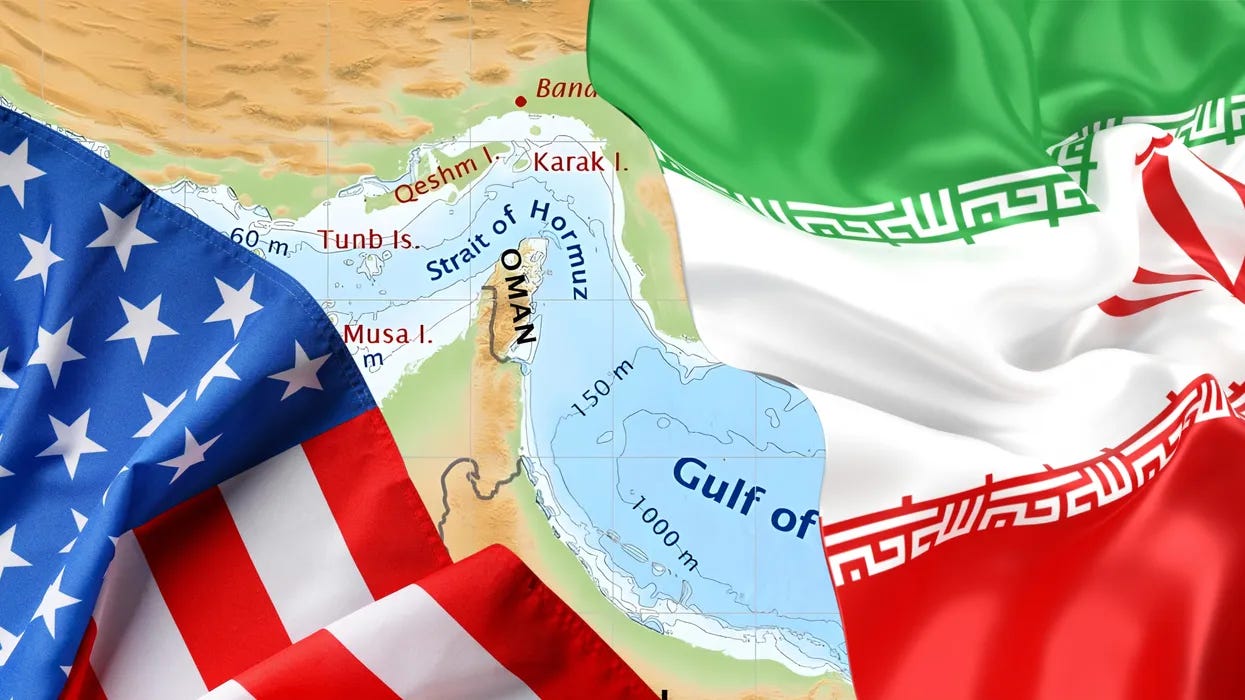
The strait has bought Tehran time, but America can rebuild its arsenal in safety and return with the regional allies Iran cannot afford to unite.
The Strait of Hormuz is narrow enough for a tanker captain to see the Iranian coast on one side and Oman on the other. Roughly a quarter of the world’s seaborne oil trade passes through that strip of water, along with liquefied natural gas, refined fuel and fertiliser. A disruption reaches the price of diesel in Karachi, food imports in Egypt, factory margins in China and household bills in Europe before it reaches the American political class that decided the war could be managed. UNCTAD has described the strait as a critical artery of global trade. It is also a place where the bill for an American war can be handed to people who had no part in starting it.
For an Iranian household, the strait appears in a wage that loses value between paydays, a pharmacist unable to promise when a medicine will arrive, a factory that cannot cost the part it needs and a family forced to guess which price will change before morning. The war reaches them long before another missile does.
Iran has made that geography matter again. The United States can strike Iranian military sites, impose sanctions, mobilise allies and speak of freedom of navigation, but it cannot order insurers back into a war zone or force traders to treat the next cargo as certain. Tankers wait, insurers retreat, freight rates rise, governments release reserves, and the cost travels outward. Tehran has bought time, not safety.
Its better strategy begins beyond Hormuz. The strait should secure a settlement, reopen commercial routes on enforceable terms, finance the repair of an exposed economy and divide the regional coalition Washington will need for another war. A prolonged closure would do the opposite. Every delayed tanker and higher insurance premium gives the United States an argument for new maritime arrangements, deeper Gulf basing and a permanent coalition built around the proposition that Iran must be contained by force.
That choice has divided Iranian political and security circles. One camp sees an American military short of interceptors and long-range missiles and concludes that Tehran should extend the confrontation until Washington accepts terms it once considered impossible. The other sees a country under blockade, an increasingly anxious China and Gulf governments that can be frightened into tighter cooperation with America. Both camps can count the American missiles, and yet only one is counting the protected factories, financial capacity, allied bases and distant territory from which America can prepare the next bombardment.
Reuters reported this month that the war had consumed virtually all of the U.S. Army’s global stockpile of key long-range precision missiles, roughly 65 percent of Patriot interceptors, significant THAAD inventories and close to half of the Tomahawk arsenal. Those are not peripheral expenditures. They are weapons Washington would need in more than one theatre, and their depletion has produced a real constraint on the Pentagon.
Iranian hardliners have not invented that constraint. Every Patriot fired at an Iranian missile is unavailable elsewhere. Every Tomahawk sent from a destroyer in the Gulf becomes an argument in Congress, an order on an assembly line in Arizona and a planning problem for Indo-Pacific Command. American doctrine rests on the faith that air power, naval power, intelligence dominance and financial sanctions can impose costs faster than an adversary can organise a response, and yet Iran has made every American strike carry a consequence far beyond the target list.
The costs of a weapons shortage fall differently on the United States and Iran. The United States still has carrier groups, strategic bombers, regional bases, satellite systems, reserve inventories, allied air forces and an economy that can expand weapons production through emergency appropriations. It can borrow in its own currency, direct public money into private weapons plants and distribute the cost across a continental economy. The factories making the next interceptors and cruise missiles sit beyond Iran’s reach. America rearms while its ports, refineries, power stations and major cities remain protected, and yet Iran must rearm while the same foundations of national life remain open to attack.
The asymmetry is made of geography and capital. American munitions stocks fall in a war fought far from American territory; Iranian munitions stocks fall in a war whose targets sit inside Iran: missile bases, air defences, electricity networks, transport corridors, oil infrastructure and the civilian economy that pays for all of them. The American foreign policy apparatus can pause when its magazines run low, fund another production run and return from carriers, bombers and allied bases, while Iran has to repair the country between strikes.
Washington’s political system often fails to prevent war. It is more competent at funding one after a shock has supplied a clean public rationale. A prolonged Hormuz crisis offers precisely that rationale: permanent expansion of American military production, new Gulf basing arrangements, wider maritime surveillance, coalition operations and infrastructure designed to reduce the strait’s power over global energy flows. Israel supplies the immediate military case, Gulf partners supply geography and logistics, Europe supplies the language of maritime security, and American industry supplies the weapons once Congress converts disruption into emergency appropriations. Iran could win this round while America builds the next one.
America can destroy Iran through repeated campaigns rather than a single decisive strike. It can degrade air defences, strike energy and transport infrastructure, tighten maritime enforcement, pause when magazines run low and return after its factories replenish them. Iran must rebuild missiles, ports, power stations, refineries, communications networks and ordinary life under sanctions while its territory remains inside the target area, and yet the United States can prepare each new bombardment from protected land. The interval between strikes belongs to American factories and appropriations; in Iran it belongs to the people who have to keep the country alive. Time repairs American power while consuming Iranian power.
Iran’s ability to endure cannot be measured by missile production alone. Its strategic reserves are also foreign currency, oil storage, spare parts, shipping access, functioning ports, electricity supply, food imports, medicine, industrial equipment, wage stability and the willingness of its population to live under emergency conditions without deciding that the state has confused endurance with policy.
Those reserves are harder to replace than a missile. The United States can spread an energy shock across a large economy, strategic reserves, allies and consumers. European states can subsidise bills, draw down inventories and absorb slower growth. China can shift cargoes, buy from other suppliers and use its financial strength to smooth disruption. Iran faces the same shock from inside an economy restricted by sanctions, currency pressure, limited access to global finance and years of securitised economic management.
A blockade enters through ordinary life. It reaches the trucker waiting for a replacement part, the factory manager unable to price an imported component, the pharmacist whose supply chain has narrowed and the family whose savings lose value before the next payday. These are the weight-bearing facts of the military account because they determine how long a country can sustain one, and yet no state can manufacture purchasing power through language.
Public reporting cannot fully map the arguments inside the Supreme National Security Council, the presidency, parliament, the clerical establishment and Iran’s security institutions. Their disagreements pass through institutions built to hide disagreement. The Institute for the Study of War reported friction among hardline factions during negotiations over whether a settlement should permanently end hostilities and ease the blockade. Competing definitions of national survival divide Tehran.
The first camp believes America has exposed its weakness and should be pressed until it accepts Iran’s regional standing, sanctions relief and a durable recognition that it cannot dictate Iran’s security. The second sees the present moment as the last period in which Tehran can exchange bargaining power for a commercial future capable of sustaining the country through the next crisis. The hardliners ask what more America can fire today. Iran’s survival depends on what America can manufacture tomorrow and what Iran will still be able to repair when it arrives.
China is central to that calculation because it is already Iran’s most important economic relationship. Reuters, citing Kpler data, reported that China bought more than 80 percent of Iran’s shipped oil during 2025. Iranian barrels give Chinese refiners discounted supply; Chinese buyers, traders, shipping networks and payment channels give Tehran a lifeline around sanctions. The relationship provides economic oxygen while giving Beijing substantial power over the terms.
Tehran cannot treat Chinese opposition to American power as a Chinese commitment to Iran’s maximal war aims. Beijing wants Iran sovereign enough to resist American coercion and to deny Washington complete control over Eurasian energy flows. It also needs stable access to Gulf oil and gas. Chinese factories, export orders, provincial governments and domestic fuel prices have no interest in paying a permanent tax for a regional war.
A fact sheet published by the U.S.-China Economic and Security Review Commission put China’s 2025 two-way trade with Saudi Arabia and the United Arab Emirates at about $108 billion each, against $41.2 billion with Iran. Beijing has political reasons to keep Tehran from falling under American control and larger commercial reasons to keep the Gulf functioning.
A closed Hormuz raises China’s energy costs even when China continues buying Iranian crude. It disrupts shipping schedules, insurance, finance, petrochemical supply chains and the wider Gulf economy from which China imports far more than oil. During the earlier escalation, the partial reopening of the strait and the lifting of the U.S. naval blockade eased Iranian commercial pressure. Al Jazeera reported from Tehran that non-oil trade with China had fallen sharply during the closure.
China cannot serve as Iran’s economic rear area while Iran’s strategy damages the trade routes China needs to operate. Tehran should use the present moment to force a different relationship. A long-term agreement should guarantee minimum purchase volumes, set price floors that reduce the penalty attached to sanctions and create payment mechanisms Iranian firms can use beyond crude transactions. Energy contracts should be tied to investment in refining, petrochemicals, electricity transmission, solar manufacturing, rail freight, ports, industrial equipment and logistics.
The China-Iran strategic partnership already offers a framework for work across energy, infrastructure and technology. Its announced ambitions have long exceeded its implementation. Tehran should stop treating grand investment figures as an achievement and demand projects with dates, financing, contractors, equipment deliveries and employment targets. Customers, infrastructure and productive capacity that no single buyer can dictate are Iran’s exit from economic coercion and part of its defence: refineries that return to operation, electricity networks without a single point of failure, rail routes beyond vulnerable ports and payment channels that continue after Washington decides to strike again.
Russia can help, though Tehran should see Moscow without sentiment. The two countries share an interest in resisting American sanctions architecture, expanding non-Western financial channels and weakening Washington’s claim to control the regional security order. Russia can offer military-technical cooperation, intelligence links, trade across the Caspian, transport tied to the International North-South Transport Corridor and experience acquired under sanctions, but it cannot shield Iran from a later American campaign.
Russia also sells oil into the Asian market Iran needs. Its producers compete for Chinese refining capacity and for the discounted demand that sanctions create. Moscow has its own war economy, its own capital shortages and its own unequal dependence on Beijing. Tehran should study that condition closely. A country can evade Western pressure and still become dependent on partners whose interests are larger than its own.
The relationship with Russia should remain transactional: transport, banking, industrial maintenance, defence production and Eurasian market access. Iran needs a wider commercial map, with China for scale, Russia for Eurasian access, Turkey for industrial exchange, Central Asia for overland trade, India where Chabahar and regional diplomacy permit, Iraq for electricity and commerce, and Gulf states willing to restore investment and transit links after the war. Each additional route reduces the force of the next blockade, and each creates a constituency with an interest in keeping the region from becoming a launch platform against Iran.
The Gulf states matter most because their territory, ports, airspace, surveillance facilities and financial systems can either complete America’s regional architecture or deny it cohesion. Tehran needs an arrangement under which their rulers judge commerce with Iran safer than another American war launched through their neighbourhood. Hormuz can frighten them into short-term restraint, and yet permanent fear pushes them towards the American protection Iran is trying to defeat. A negotiated reopening would split interests that continued closure will unite.
Hormuz should remain a bargaining instrument without becoming Tehran’s strategy. The strait can secure tangible concessions: a halt to attacks on Iranian territory and civilian infrastructure; enforceable limits on maritime operations; restoration of commercial access; banking channels protected from arbitrary closure; sanctions relief tied to specific sectors; reconstruction finance; and long-term energy agreements that keep Iran from returning to the market as a distressed seller. Tehran should take those gains, reopen the waterway and move the contest onto ground where American bombardment is less decisive: trade routes, industrial depth, regional diplomacy, distributed infrastructure and relationships Washington cannot easily command.
Permanent closure invites the world to solve the Iran problem through bypass routes, alternative supply contracts, military escorts, Red Sea pipeline expansion, strategic reserves and a diplomatic coalition built around global economic security. The International Energy Agency estimates that Saudi Arabia and the United Arab Emirates have 3.5 to 5.5 million barrels per day of bypass capacity through routes that avoid Hormuz. That capacity cannot replace the strait’s normal flows, but it can reduce Iran’s bargaining power while new infrastructure is built.
Every day of disruption gives Iran bargaining power, and yet every year of disruption creates the commercial and military systems that will weaken it. The United States has a munitions problem today. Iran has a coalition problem that becomes fatal once American production recovers, Israel has another operational window and Gulf governments decide that their own security requires Iran’s permanent military reduction.
Tehran should make Washington pay for reopening Hormuz, Beijing invest in Iranian capacity rather than purchase Iranian distress, Moscow provide concrete economic value rather than rhetoric about multipolarity and Gulf capitals choose commerce over participation in the next American campaign. It can then use the settlement to harden civilian infrastructure, diversify trade, restore purchasing power and rebuild a deterrent that rests on the country’s endurance rather than the strait’s closure. The people asked to absorb this war cannot rebuild a country on promises about resistance while America reloads around them.


