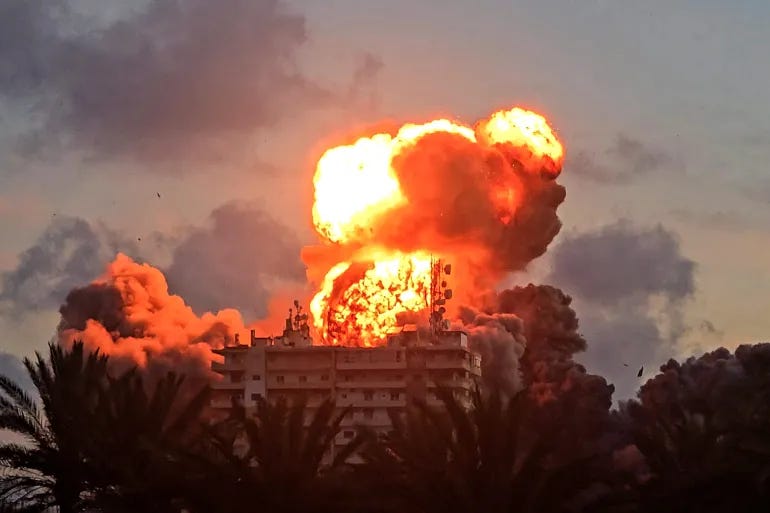
The week began with a strike on a building in Rimal, Gaza City. It ended with the Israeli military crossing the Litani River in Lebanon for the first time since 2006, the seizure of a medieval crusader fortress, and a total death toll in Lebanon since March 2 that the Lebanese Health Ministry placed at more than 3,412 people with 10,269 wounded. In Gaza, where the war has now run for over 31 months, the cumulative toll passed 75,800 confirmed dead by early May. In the week of May 25–June 1, the killing did not pause. Neither did the official language that describes it as something else.
Gaza: Rimal, Maghazi, the Death of Mohammed Odeh
On Monday, May 26, an Israeli airstrike hit a residential building in the Rimal neighbourhood of Gaza City, killing three people and wounding twenty. The Israeli Prime Minister’s office announced that the strike had targeted Mohammed Odeh, the commander of Hamas’s Qassam Brigades military wing, who had replaced Izz al-Din al-Haddad as Hamas’s military leader in Gaza after al-Haddad was killed in an Israeli strike on May 15. On Tuesday, May 27, Hamas confirmed in a statement that Mohammed Odeh had been killed in the Monday strike, along with his wife and two of his sons.
The sequence has a structure worth naming. On May 15, Israel killed al-Haddad, the Qassam Brigades commander, along with seven other people, in a strike on an apartment in the Rimal area of Gaza City. Fifty others were wounded. Less than two weeks later, Israel killed al-Haddad’s successor in another residential building in the same neighbourhood, along with his wife and two children. On May 27, the day after the Rimal building strike, additional Israeli strikes across Gaza City killed at least seven more people and wounded eighteen. Mourners carrying the bodies of Mohammed Odeh, his wife, and his sons through the streets of Gaza City were photographed by Reuters. The photographs show men carrying shrouded bodies through rubble. They are not photographs of combatants. They are photographs of a family being buried.
On Tuesday May 26, Israeli strikes in the Maghazi displacement camp in central Gaza killed at least five Palestinians, according to reports from Gaza civil defence. The day’s strikes in the camp formed part of a sustained campaign across central Gaza. Since the beginning of the war, the Maghazi, Bureij, and Nuseirat refugee camps in central Gaza have been struck repeatedly, with camps designated as areas of civilian refuge consistently treated by Israeli forces as operational zones. On May 6, an UNRWA health centre in Maghazi Camp had been struck by Israeli fire, according to UNRWA’s own situation report, which noted that the building was targeted by bullets from Israeli forces operating in the east of the camp.
The humanitarian framework around Gaza has not changed in substance since Israel reimposed its total blockade in March 2025. The UN noted on May 24 — one day before this reporting week began — that only 906 aid truckloads had reached Gaza since Israel’s Rafah operation began. OCHA’s reporting for comparable periods has consistently shown that between 40 and 60 percent of planned humanitarian aid convoys to northern Gaza are denied, impeded, or forced to abort by Israeli authorities. The UN’s estimate of the minimum number of trucks needed daily to meet basic needs is 500. Most days, a fraction of that number enters.
Starvation is not a background condition in Gaza at this point in the war. It is a documented policy consequence. OHCHR reported in April 2026 that at least 111 Palestinians were killed in Israeli attacks that month alone, including at least 18 children and 7 women, across continuing airstrikes, artillery and naval shelling, drone attacks, and gunfire. The Human Rights Watch World Report 2026, published in February, stated directly that Israel’s denial of water to the Palestinian population of Gaza amounts to the crime against humanity of extermination and the genocidal act of inflicting conditions of life calculated to bring about the destruction of the group in whole or part. The report notes that for more than eleven weeks between early March and mid-May 2025, Israeli authorities imposed a total blockade on Gaza — no food, medicine, or other aid — in order, they said, to pressure Hamas to release hostages.
The cumulative confirmed death toll in Gaza as of early May 2026 stood at more than 75,811, of whom over 73,770 were Palestinian. The count includes 270 journalists and media workers killed, 120 academics, and over 560 humanitarian workers. Israel’s own figures account for 2,039 Israeli deaths. These numbers are from the Gaza Health Ministry and the Israeli Ministry of Foreign Affairs respectively. They do not include the uncounted dead still under rubble across a territory where 265 sports facilities have been destroyed or damaged, where the Palestinian Football Association has lost at least 565 of its members, where UNRWA’s warehouses hold truckloads of aid stuck in Egypt and Jordan that the Israeli government has refused to allow in.
Lebanon: Tyre Ordered Evacuated, Beirut Struck, a Family Killed on the Adloun Highway
The week in Lebanon began on the night of Monday May 25 into Tuesday May 26 with what Al Jazeera’s correspondent Obaida Hitto, reporting from Tyre, described as “massive Israeli strikes” pounding eastern Lebanon. The strikes hit Machgharah in the western Bekaa, and another strike farther north targeted the strategic Qaraoun Dam. Strikes further south around Nabatieh followed a fresh Israeli evacuation order covering the city. The Lebanese Ministry of Public Health confirmed at least 31 people killed and 40 injured across the country on Tuesday alone.
On Tuesday night into Wednesday May 27, the IDF announced it had conducted strikes on more than 100 Hezbollah targets across southern Lebanon and the Beqaa Valley in a single operational wave. The targets, per the IDF statement, included weapons storage facilities, command centers, observation posts, and a weapons manufacturing and storage facility in the Mashghara area. The IDF said it had “eliminated a number of Hezbollah operatives.” Lebanese state media reported civilian casualties across multiple sites that night. The IDF’s Arabic-language spokesman, Avichay Adraee, issued warnings to buildings in Tyre and surrounding neighbourhoods on Wednesday, declaring that all territory south of Lebanon’s Zahrani River — roughly 40 kilometres north of the Israeli border — constituted a combat zone and that residents must move north. The Zahrani River is not a peripheral southern frontier. It runs through the southern portion of Lebanon’s most populated coastal region, encompassing Tyre, one of Lebanon’s oldest cities and a UNESCO World Heritage site. The order required the forced displacement of tens of thousands of people from their homes and, in many cases, from the apartments of displaced people who had already fled from further south.
On Wednesday May 27 morning, Netanyahu publicly confirmed that a large Israeli ground force was pushing deep into southern Lebanon to seize areas and “fortify” what he described as a “security zone.”
On Thursday May 28, Israeli strikes killed at least 19 people across Lebanon. In Tyre, Israeli aircraft hit a building and a cafe overnight, setting off fires. Emergency crews worked through rubble searching for bodies. On the Adloun Highway — the key coastal road connecting Sidon and Tyre — an Israeli drone struck a car carrying a family attempting to flee at dawn. The Lebanese Health Ministry confirmed that six members of the same family were killed in that strike: among the dead were two children and both of their parents. The account came from Lebanon’s state-run National News Agency. No official IDF statement addressed that particular strike.
In Sidon, further north along the coast and a city that had not been a primary strike zone until this week, an Israeli drone struck an apartment building where displaced families from the south had taken shelter. The strike killed five people and wounded twenty-one others, including five children. It was the strike on Sidon that marks the geographic shift of this week most precisely: the Israeli offensive moved north, into cities that had been receiving the displaced, rather than only striking the areas from which displacement was being ordered.
On Thursday afternoon, Israel’s air force struck the Choueifat suburb of Beirut, the Lebanese capital — the first strike on Beirut in three weeks. The target was not publicly identified. Videos from the neighbourhood, which sits close to Beirut’s international airport, showed white smoke rising from a residential area. A woman and two children were killed in this strike, per the Lebanese Health Ministry. The IDF statement said it had “precisely struck” the city of Beirut, without identifying the building or the stated target.
By May 28, the Lebanese Health Ministry’s total death toll since March 2 had passed 3,100. By May 31, after the further escalation of the final days of the week, that figure stood at more than 3,412 killed and 10,269 wounded. More than one million people have been displaced across Lebanon since March 2. That is roughly one in five of Lebanon’s entire population driven from their homes in less than three months.
The Litani River and Beaufort Castle
On Friday May 29, Israeli troops crossed the Litani River for the first time since 2006. The Litani is not merely a geographic line. It is the northern limit that UN Security Council Resolution 1701, passed in 2006, set for the Israeli military’s permissible operation in Lebanon, and it has functioned since the 2024 ceasefire as a stated boundary for Israeli ground operations. The crossing was confirmed by IDF statements and reported by Al Jazeera and multiple international wire services. Netanyahu stated publicly that the crossing was part of the effort to establish a “security zone.”
On May 31, Israeli forces seized Beaufort Castle, the 12th-century crusader fortress that sits on a ridge commanding wide views over both southern Lebanon and northern Israel. The Israeli Defence Minister Israel Katz confirmed the seizure was made “at the direction” of Netanyahu, and added: “The campaign is not yet over. The IDF is strong, and we are all determined to crush Hezbollah’s power and complete the mission: ensuring security for the residents of the North.”
The IDF Arabic-language spokesman then issued evacuation orders for all residents of southern Lebanon, specifically those south of the Zahrani River, and issued warnings for thirteen additional villages. The orders covered Lebanese army positions as well as civilian communities. The Lebanese army said one of its soldiers was killed in an Israeli strike in the Nabatieh area during the week — the latest in what the Lebanese military described as a sustained pattern of attacks on its personnel. The UN confirmed that 103 Lebanese medical workers have been killed and 230 injured in more than 130 Israeli strikes since March 2.
Lebanon’s Prime Minister Nawaf Salam, whose government was formed in early 2025 under international pressure as an alternative to Hezbollah’s political dominance, accused Israel of pursuing a “scorched-earth policy.” Germany’s Foreign Minister Johann Wadephul said Israel’s advance was “cause for serious concern.” France, Italy, and the United Kingdom issued joint statements calling for de-escalation and the protection of civilians. The IDF described every site it struck as Hezbollah infrastructure. Tyre’s café, the apartment building in Sidon, the car on the Adloun Highway carrying a family trying to flee, the suburb of Beirut near the airport: each of these received the same operational language from the same spokesman.
There is a documented gap between that language and the documented bodies. It has existed for the full 31 months of this war. It is not a gap that press releases close.
Gaza Flotilla: Violence and Sexual Abuse in Israeli Detention
Separate from the ground operations, a significant accountability story broke during the week. Democracy Now and other outlets reported on testimony from activists from the Global Sumud Flotilla who had been detained by Israeli forces after their vessel was seized. Their testimony described violence and sexual abuse during Israeli detention. Spanish police had attacked flotilla activists at Bilbao Airport in the week prior. On May 29, Paris launched a formal inquiry into the treatment of French activists detained by Israel following the flotilla’s interception.
The flotilla had been attempting to break the naval blockade of Gaza, which remains in effect and through which Israel controls the entry of all goods, fuel, and aid into the territory by sea. The activists were carrying humanitarian supplies. The legal status of the naval blockade has been challenged by multiple UN bodies and independent legal scholars as incompatible with international humanitarian law given the scale of the humanitarian catastrophe it contributes to. Israel maintains the blockade is a lawful security measure.
The West Bank: Settler Violence and Institutional Erasure
While the air and ground war dominated coverage of Palestinian suffering this week, UNRWA’s most recent situation report covering activity through mid-May 2026 documented a continuing campaign in the occupied West Bank that receives far less international attention. The first four months of 2026 saw the most violent start to a year in terms of Israeli settler attacks since UNRWA and OCHA began systematic monitoring of settler violence in 2013. Settlers have attacked Palestinian communities in Jalud, Tayasir, Hebron, al-Hadidiya, and Masafer Yatta, among others. Palestinian structures have been demolished, livestock killed, and agricultural land seized and torched.
Since the beginning of 2026, more than 900 Palestinians have been forced from their homes in the West Bank due to a combination of settler violence, access restrictions, and demolitions. The pace of settlement expansion and the documented involvement of members of the Israeli military in enabling settler violence have been recorded by multiple UN bodies, Human Rights Watch, and Amnesty International.
Israel has, since January 2026, refused to renew the operating licences of 37 international humanitarian organisations working in the occupied Palestinian territory. The Palestinian human rights organisation Al Haq and the Euro-Mediterranean Human Rights Monitor have described this licensing regime as contravening international law and as constituting a deliberate strategy to sever the last remaining humanitarian supply lines to a population under siege. The practical consequence is the approaching collapse of what remains functional of the health and relief systems in both Gaza and the West Bank.
The Structural Condition at Week’s End
At the close of this week, the total confirmed death toll in the Gaza war from October 7, 2023 through early May 2026 stands at more than 75,800, of whom over 73,770 are Palestinian. The death toll in Lebanon since Israel opened this new front on March 2, 2026, has crossed 3,412, with 10,269 wounded. More than one million Lebanese have been displaced. Israeli forces are now north of the Litani River, occupying a 12th-century castle, and issuing evacuation orders for an entire region of a sovereign country with a functioning government and an army that has lost at least one more soldier this week to Israeli fire. The Gaza Health Ministry cannot fully count its dead in the north because Israeli military operations have made independent access to that area impossible. UNRWA has truckloads of food and medicine in warehouses in Egypt and Jordan that the Israeli government has refused to allow in.
Over the course of the week of May 25–June 1, the following are documented: a family of six, including two children and their parents, killed by an Israeli drone strike on a car on the Adloun Highway while trying to flee; a woman and two children killed in a strike on a Beirut suburb; five people including five children wounded when a drone hit a Sidon apartment building hosting displaced families; Mohammed Odeh killed in his home with his wife and two sons; at least 31 people killed in Lebanon on Tuesday alone; the IDF crossing the Litani River; Beaufort Castle taken; Tyre designated a combat zone. The total number of people killed across both theaters in this single week, based on compiled Lebanese Health Ministry and Gaza Health Ministry figures, runs into the dozens for Gaza and no fewer than 50–70 in Lebanon.
The phrase “ceasefire” appeared in official communications from the United States, Israel, Lebanon, and Iran throughout this week. The question of what that word means when used in the context of the events described above is not a rhetorical question. It is a legal and moral one that the international institutions charged with answering it have declined to answer with binding consequences.
What is happening in Gaza and Lebanon does not require interpretive language to describe. It requires accurate enumeration and the political will to act on the record.


