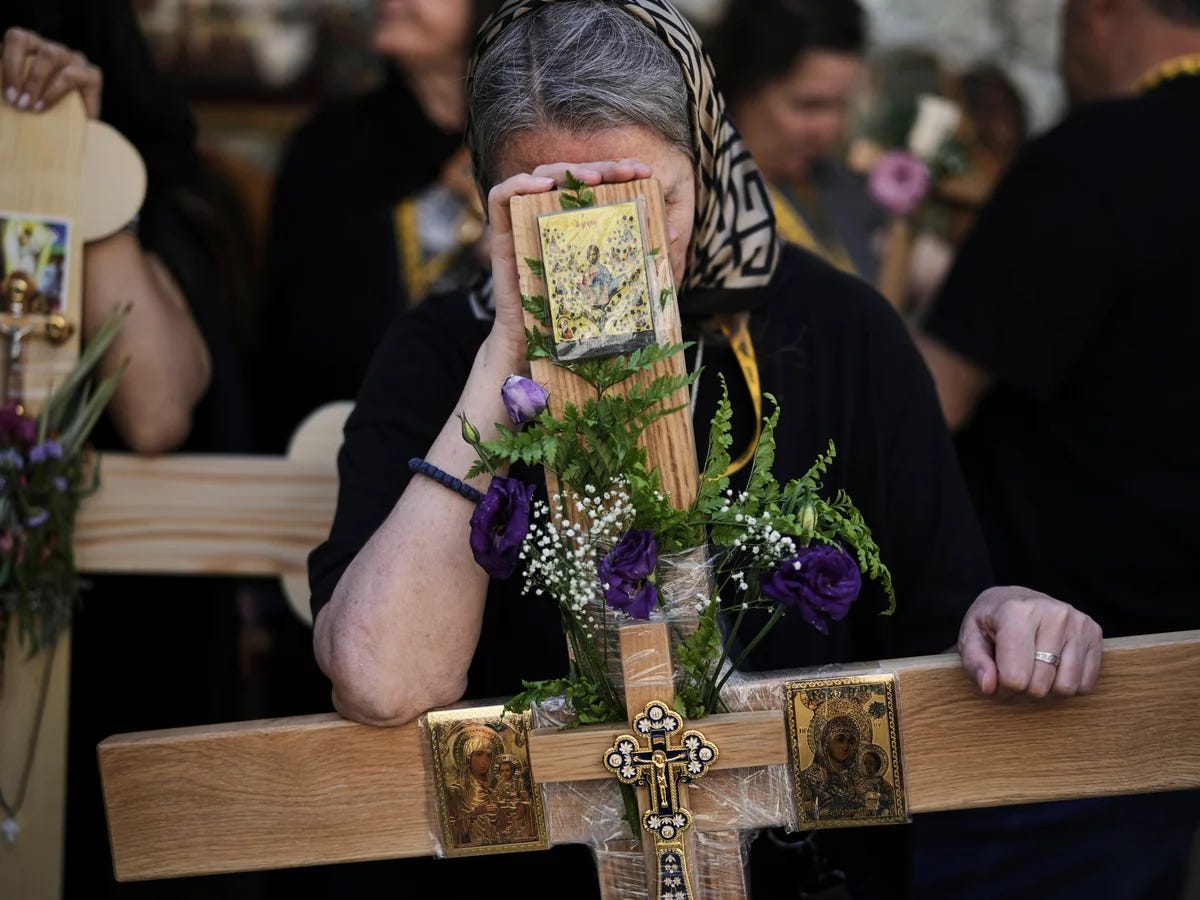
Israel’s War on Palestinian Christianity
How Tel Aviv Is Erasing Christianity’s Oldest Community
Mother Agapia Stephanopoulos remembers the morning in August 2001 when the road disappeared. She was driving toward Bethany, the occupied West Bank village where she ran an Orthodox girls’ school, when the way was blocked by Israeli military concrete cubes. No notice. No explanation. Just the wall of occupation dropping across a road that had connected her school, her three hundred students, and her convent to the world they lived in. “All of a sudden, there’s big cement cubes on the street,” she said, “and we can’t use that road anymore to get where we are.” The cubes were the opening act. The separation wall came next, built on Palestinian land, cutting Bethany off from Jerusalem, cutting her convent off from the Mount of Olives it sits beneath, and cutting apart, in the process, a Christian home for boys that stood in the wall’s path. “The Israelis just took over and cut up that home,” she has said, “to make part of the wall.”
She has lived in the Holy Land since 1996. Born Anastasia Stephanopoulos in New Jersey, sister of the television anchor George Stephanopoulos, she moved to the convent of St. Mary Magdalene in Jerusalem and two years later was assigned to administer the girls’ school in Bethany, al-Azariya in Arabic, the village of Lazarus. On the school grounds is a stone from the sixth century, at the site where the Gospel of John places the meeting between Jesus and Martha before the raising of her brother. Lazarus’s tomb is down the road. The road once continued freely into Jerusalem, nine kilometers away. It does not anymore.
The school held roughly three hundred students, nearly all of them Palestinian Muslim girls. Scripture and languages were taught beneath icons and crosses on every wall. “No one ever objected,” she has said. “In that time, we all still believed peace was possible.” She recalls the period after Oslo as something that resembled normalcy: movement was easier, the wall did not exist, the checkpoint infrastructure had not yet calcified into permanent occupation furniture. Then, one morning in August 2001, the concrete cubes appeared, and the world she had been living in disclosed what it actually was.
“We are closed off in Bethany from going to our convent in Jerusalem because of the wall built on Palestinian land.” She has said this in interviews, in church forums, in appeals to evangelical leaders she describes as having no interest in how Israel treats Christians. The Church of the Holy Sepulchre, the holiest site in Christianity, is roughly nine kilometers from Bethlehem. A Christian Palestinian living in Bethlehem requires an Israeli military permit to reach it. Those permits are rarely granted and are suspended entirely during periods of Israeli military escalation, which in the occupied West Bank have become the permanent condition rather than the exception. Mother Agapia has warned, repeatedly, that if the trajectory does not change, the churches of the Holy Land will become museums, emptied of the congregations that make them something other than tourist infrastructure. What she means is that the buildings will remain after the people are gone, preserved for pilgrimages organized by the same Christian Zionist political infrastructure that provided the cover for the occupation that drove the people out.
Palestinian Christianity was not a remnant community before Israel was established. It was a civilization. Between 1860 and 1914, Christians comprised roughly eleven percent of a Palestinian population of 350,000 people. By the eve of the First World War, of 616,000 Palestinians, approximately 69,000 were Christian. They held deep roots in Jerusalem, Nazareth, Bethlehem, Ramallah, Jaffa, Haifa, Lydda, and Ramle. They ran schools, newspapers, hospitals, and civic institutions across every denomination of Eastern and Western Christianity. They were, in the most literal sense, the oldest Christian community on earth, living in the land of Christianity’s birth with an unbroken presence stretching back to the first century.
The Nakba ended that world with the deliberate thoroughness of a military campaign.
In 1948, Zionist militias and the newly formed Israeli army expelled more than 750,000 Palestinians from their homes. Among the more than 500 villages depopulated were those with majority or large Christian populations. The village of Iqrit in northern Galilee was entirely Christian. Its residents were expelled in November 1948 by Israeli military officers who promised them the evacuation was temporary, fifteen days at most. They never returned. The case went to the Israeli Supreme Court, which ruled in their favor. The government ignored the ruling. In 1951, the army demolished Iqrit. The stone church still stands on the hill above where the village was, used by the descendants of the expelled for occasional funerals, the only visit home their family has been permitted in seventy-seven years. Kafr Bir’im, another Christian village in Galilee, was expelled and demolished under the same logic and the same broken promises.
These were not peripheral cases. Historian Benny Morris, working from declassified Israeli military archives, documented that Haganah operational orders issued in April and May 1948 explicitly directed units to uproot villagers, expel them, and destroy the villages themselves. The expulsions targeted Palestinian presence, Muslim and Christian alike, wherever that presence stood between the Zionist project and the demographic majority it required. The Nakba did not discriminate between faiths. It discriminated between Jewish and Palestinian.
Before 1948, Jerusalem held approximately 27,000 Christians. After the expulsions, that number collapsed. In Gaza, a small but rooted Christian community of around 5,000 existed before Hamas took administrative control in 2007. By October 2023, on the eve of the current Israeli assault, that number had already fallen to approximately 1,000, not because of Hamas governance but because of decades of Israeli blockade, economic siege, and the accumulating weight of occupation that had made Gaza an open-air prison long before the current war. What remains of Gaza’s Christian community now, after twenty months of bombardment, cannot be counted with confidence. The people doing the counting cannot move through the rubble.
In 1922, Christians were eleven percent of the population of geographic Palestine. Today the figure is below one percent. Israel’s preferred explanation attributes this collapse to Hamas, to the Palestinian Authority, to Islamic conservatism. That explanation begins its demographic accounting after three-quarters of Palestinian Christians had already been expelled in 1948. It is the methodological equivalent of measuring the casualties of a fire from the moment the survivors begin to rebuild.
The Dar al-Kalima University study in Beit Jala interviewed more than a thousand Palestinians, half Christian and half Muslim, on what drove the pessimism and emigration of Palestinian Christians. The study found the Israeli occupation, its movement restrictions, land confiscations, permit denials, arbitrary arrests, and the structural hopelessness of living under military administration with no political horizon, was the primary driver. Only a small percentage of respondents cited concerns about Muslim religious conservatism. This is a Palestinian university in the occupied West Bank, interviewing its own community, and the community answered clearly.
Bethlehem is the sharpest case study because its prominence makes evasion difficult. In 1950, Christians comprised eighty-six percent of Bethlehem’s population. By 2007 that figure had fallen below twenty-two percent and it has continued declining since. What arrived in Bethlehem during this period was not a failure of Palestinian governance. What arrived was the Israeli settlement of Har Homa, built from 1997 on land seized from Palestinian villages on the city’s southern edge, severing access routes between Bethlehem and Jerusalem. What arrived was the separation wall, whose construction through Bethlehem’s agricultural hinterland cut the city from its surrounding villages, from its farmland, from the Jerusalem market that had sustained its economy for centuries. What arrived was the checkpoint system that makes the nine-kilometer journey to Jerusalem, where Palestinian Christians need to reach the Church of the Holy Sepulchre to worship at the holiest site of their faith, subject to Israeli military permit decisions that are arbitrarily enforced and routinely denied.
In Jerusalem, the compression operates through legal instruments rather than concrete walls, though the walls are there too. Since 1967, Israel has revoked the permanent residency rights of more than 14,000 Palestinians under a law that allows cancellation if a Palestinian spends more than three years outside Israel or acquires residency rights elsewhere. A Palestinian Christian family whose children study abroad, whose head of household works in another city, can return to find their right to live in their own home administratively erased. Settler organizations operating within the legal system have used shell companies, fraudulent transactions, and, in documented cases, forged documents to acquire properties in the Christian and Armenian Quarters of the Old City. These transactions are frequently challenged in Israeli courts and frequently upheld. The Greek Orthodox Patriarchate of Jerusalem has fought repeated legal battles to retain control of church-owned properties targeted by the same settler organizations that drive West Bank land seizures.
The separation wall also carved through East Jerusalem’s Christian communities in ways whose consequences are still accumulating. The Cremisan Valley, which links Bethlehem’s Christian suburbs of Beit Jala and Beit Sahour to their agricultural land, was the site of a years-long legal battle in which Christian families and two Salesian religious institutions fought the wall’s routing through their land. Israel ultimately built it anyway, severing families from vineyards and olive groves that had been in continuous cultivation for generations. The ruling that permitted construction cited military necessity. Military necessity is the Israeli legal system’s version of regret: it closes the case without resolving the injury.
In July 2018, the Israeli parliament passed Basic Law: Israel as the Nation-State of the Jewish People. The right to national self-determination in Israel, the law states, “is unique to the Jewish people.” Arabic is demoted from official language status to a language of “special status,” a formulation that has no defined legal content. The state commits to viewing Jewish settlement as a national value and pledges institutional support for its promotion. The law contains no mention of equality. It contains no acknowledgment of non-Jewish citizens. It does not describe Israel as a democracy.
This was formalization, not innovation. Palestinian Christians, Arab citizens of Israel, and Druze had been living under an informal two-tier legal and social order since 1948. The Nation-State Law wrote that order into the basic constitutional architecture of the state in terms that cannot be repealed by ordinary legislation. Greek Orthodox Patriarch Theophilos III, with studied understatement, said the law reminded him of laws of a similar nature that the post-war international order had agreed to prohibit.
The Rossing Center for Education and Dialogue, a Jerusalem institution whose mission is fostering Jewish-Christian relations and whose credibility depends on being taken seriously by both communities, surveyed 300 Palestinian and Arab Christians in Israel and East Jerusalem in December 2024. Nearly sixty-five percent of respondents said the Nation-State Law confirmed them as second-class citizens. Thirty-six percent were considering emigration. In Haifa, the figure was forty-eight percent. The driving factors: security at forty-four percent, the socio-political situation at thirty-three percent. These are not Christians in the occupied territories, afraid of Hamas, as the Israeli government consistently implies. These are Christian citizens of the state of Israel, or legal residents of occupied East Jerusalem, describing their own government’s basic law as the reason they are considering leaving the country. The Nation-State Law did not cause violence directly. It supplied the philosophical permission structure within which violence operates without accountability, because the law has already answered the question of whose presence the state considers legitimate.
In October 2023, following a surge of documented incidents in which Israelis spat on Christian clergy and pilgrims in the Old City of Jerusalem, Itamar Ben Gvir gave an interview to Army Radio. He was then Israel’s national security minister, with direct statutory authority over policing throughout Israel and the occupied Palestinian territories, including the Old City. He said that spitting on Christians was not a criminal matter. He described it as “an old Jewish tradition.” He later added that the incidents were deserving of condemnation, while urging critics to stop “slandering Israel.”
The official responsible for policing anti-Christian violence announced that the violence was traditional and not worth prosecution. He was not removed. He faced no formal rebuke from the Netanyahu government. The Rossing Center’s 2025 annual report documented a forty percent increase in attacks on Christians compared with 2024: 155 incidents of physical assault, spitting, hitting, pepper-spraying; 52 attacks on church properties including arson, graffiti, damaged statues; 28 incidents of verbal harassment; 14 cases of defaced public signs bearing Christian content. The Rossing Center notes that these figures reflect documented cases only, and that underreporting is significant because many victims have prior experience of Israeli police attributing complaints to the mental illness of the perpetrator or dismissing them without investigation.
During the same period, Ben Gvir expanded firearms licensing eligibility in Jerusalem. More than 300,000 Jewish residents of the city became eligible to carry a gun, according to the Times of Israel. The Rossing Center’s 2026 report assigned direct responsibility for what it called “the recent surge in overt animosity towards Christianity” to Netanyahu’s government, describing a “continued and expanding pattern of intimidation and aggression” against Christians. The report found that Palestinian Christians were being targeted both as Christians and as a national minority, two distinct categories of persecution that the same population was absorbing simultaneously.
Finance Minister Bezalel Smotrich, Ben Gvir’s partner in the far-right coalition and the official who as Israeli defense minister controls West Bank civil administration and therefore settlement expansion policy, reportedly attended the inauguration of a new settlement outpost on the eastern lands of Beit Sahour in early 2026. Beit Sahour is the Palestinian Christian city believed by tradition to mark the location of the shepherds’ fields in the Gospel of Luke’s nativity narrative. A cabinet minister personally inaugurating an illegal settlement on the land of a Christian biblical town is not an abstraction. It is a policy announcement.
The Gospel of John, chapter eleven, verse fifty-four: Jesus withdrew to a city called Ephraim and remained there with his disciples. Ephraim is Taybeh, on a hill northeast of Ramallah in the occupied West Bank, home to around 1,400 people, maintaining three active churches, widely regarded as the last entirely Christian village in the occupied West Bank. Its continuous Christian presence stretches back further than most nations on earth have existed.
Since 2025, Taybeh has been encircled by six Israeli settler outposts, three on the west and three on the east. The eastern zone, covering more than half the village’s territory, is where the majority of the agricultural land lies. The three parish priests, Fathers Bashar Fawadleh of the Latin church, Daoud Khoury of the Greek Orthodox, and their Melkite counterpart, wrote jointly to international bodies describing the eastern zone as “an open target for the illegal settlers, who are quietly expanding under the protection of the army and serving as a springboard for further attacks on the land and people.”
In July 2025, armed settlers set fire to the surroundings of the fifth-century Byzantine ruins of St. George Church, wrote threatening graffiti on walls, and destroyed olive groves. On July 28, they attacked the village overnight, torching two vehicles, throwing stones at homes. On March 19, 2026, approximately thirty settlers entered a quarry and concrete plant on the village’s western edge owned by Roland Bassir and his brother, their only livelihood for twenty years. The settlers had posted a video online announcing their intention to take the site. They entered on the declared schedule, raised an Israeli flag over the structures, and conducted what Vatican News described as Talmudic rituals on Bassir’s property. The Israeli military, whose forces are deployed throughout the West Bank and hold full operational authority over the territory, did not remove them. Bassir had not been able to access his own property as of late March 2026.
Father Fawadleh issued an appeal to Christians worldwide. “We feel that we are losing everything,” he said. The priests called for an international investigation into the arson, the property destruction, the damage to holy sites, and for pressure on the Israeli authorities to remove the outposts. Diplomats visited Taybeh in July 2025 after the church fires, expressed solidarity, and left. The settler outposts remained. The quarry remained occupied. This is not a failure of diplomacy in the conventional sense. Diplomacy failed because the state being asked to remove settlers from Palestinian land is the same state whose minister called the occupation of that land a national value written into its basic law.
The phrase the priests used, “under the protection of the army,” describes the functional architecture of every Israeli settlement and outpost in the West Bank. Settlers advance. The military secures the perimeter against Palestinian counter-access. The Civil Administration, the Israeli bureaucratic body that governs the occupied West Bank and is currently under Smotrich’s authority, either retroactively legalizes outposts or delays their removal through legal proceedings that stretch for years while the facts on the ground solidify. When courts eventually order removal, the infrastructure is established, the land use has been changed, and removal is declared impractical. This process has been applied across the West Bank for decades. What is happening to Taybeh is not exceptional. It is the standard template applied to the last Christian village that could not absorb itself into a larger urban population and become invisible.
The Holy Family Catholic Church in Gaza City was struck by Israeli fire on July 17, 2025. Three people were killed: Saad Issa Kostandi Salameh, Foumia Issa Latif Ayyad, and Najwa Abu Daoud, who survived the initial blast and died from her wounds hours later. Father Gabriel Romanelli, who had ministered in Gaza for nearly thirty years and who had spoken almost nightly with Pope Francis until the pontiff died in April 2025, was wounded in the leg. The church had been sheltering hundreds of displaced civilians, Christians and Muslims, including children with disabilities, since October 2023.
It was not the first time. In December 2023, an Israeli military sniper shot and killed Nahida Khalil Anton and her daughter Samar Kamal Anton as they walked across the church compound toward the bathroom. They were sheltering at a church. They were shot within its walls. In July 2024, the surrounding grounds were shelled, causing damage and injuries. The July 2025 strike was the fourth or fifth incident at the same compound, depending on how the 2024 shelling is counted. After each incident, Israel expressed regret, said it was investigating, and produced no accountability. After the July 2025 strike, the Israeli foreign ministry spokesperson said Israel deeply regretted the damage and any civilian casualties and that the circumstances remained under investigation. France condemned the attack, citing the church’s protection under the 1913 Constantinople agreement. Pope Leo XIV called for an immediate ceasefire. No investigation has produced a finding. No individual in the Israeli military has faced consequence for any of the incidents at the Holy Family compound.
This impunity is the mechanism that makes everything else possible. The settlement outpost on Bassir’s quarry persists because no one in the Israeli legal or military system has any obligation to remove it. The arson at St. George Church in Taybeh in July 2025 resulted in no arrests. The Israeli police’s documented practice of attributing complaints from Christian victims to perpetrator mental illness or dismissing them without investigation is not a dysfunction of the system. It is the system performing its designed function, which is to absorb Palestinian grievance without generating accountability, to allow the compression to continue below the threshold of international consequence.
In 1948, approximately 70,000 Palestinian Christians lived in what became the state of Israel and the occupied territories. They were eleven percent of the population. Seventy-seven years of occupation, expulsion, wall construction, permit denial, settlement expansion, arson, street violence defended as tradition by government ministers, and the systematic legal codification of their second-class status have reduced them to less than one percent. The community that existed when Rome crucified Jesus on a hill outside Jerusalem, that persisted through Roman persecution, Byzantine consolidation, the Crusades, Ottoman administration, and British mandate, has been compressed toward extinction by a state whose founding displaced the majority of its members and whose present government has constitutionalized the hierarchy that ensures the compression continues.
Mother Agapia has spent thirty years in Bethany watching this unfold from a school built on ground where Christ’s footprints are still, by ancient tradition, preserved in stone. She watched the concrete cubes appear on the road. She watched the wall cut through the boys’ home and the farmland and the route to her convent. She ran her school for three hundred Palestinian girls from families trying to live normal lives, under crosses and icons no one objected to, and she has been saying since 2002, in letters slipped through monastery gates and church forums and American lecture halls and podcasts with tens of millions of views, the same thing: the oldest Christian community in the world is being removed from the land of its birth, and the international Christian political infrastructure that could raise the cost of that removal has chosen, for reasons of its own, to look away.


