It Took Me A While To Find Him In Tel Aviv
Thomas Massie Lost the Most Expensive Primary in American History. His Opponent Wasn't in Kentucky to Win It.
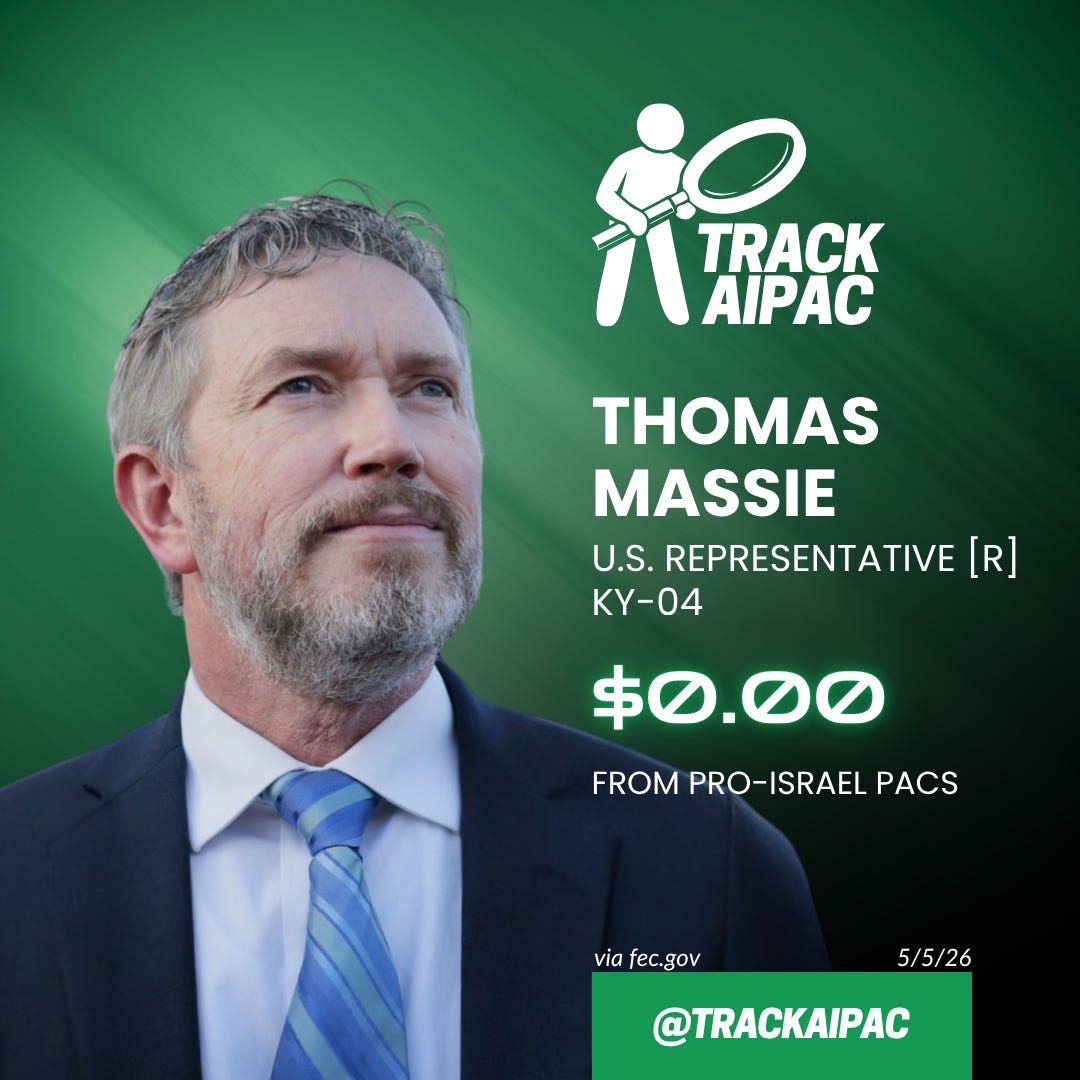
He walked out grinning. The ballroom at the Marriott Cincinnati Airport in Hebron, Kentucky was packed and loud, and Thomas Massie, who had just lost the most expensive House primary in the history of the United States, took the microphone and said: “I would’ve come out sooner, but I had to call my opponent and concede. And it took a while to find Ed Gallrein in Tel Aviv.”
The room erupted.
Gallrein, the man AIPAC, the Republican Jewish Coalition, Paul Singer, Miriam Adelson, and Donald Trump had spent $34 million to install in Massie’s seat, was in Tel Aviv on the night he won a congressional election in Kentucky. His constituency, apparently, begins at Ben Gurion Airport. Senator Ted Cruz went on social media afterward and said he wished Massie hadn’t made the joke. AIPAC called it antisemitism. The Republican Jewish Coalition, whose CEO had previously branded Massie’s reading of FEC filings aloud as “antisemitism and bottom-of-the-barrel nativism,” issued a congratulatory statement that read: “Massie has been one of the most consistently hostile voices in Congress toward the U.S.-Israel relationship. Our community was proud to support Gallrein and help ensure Massie’s defeat.”
An organization that spent $9.4 million to remove a sitting American congressman, whose candidate was in a foreign country on election night, congratulated itself for the outcome and described it as a victory for the community. Ted Cruz wished the man they removed hadn’t noticed.
Massie noticed. He has been noticing for months, loudly and on the record, and what happened in Kentucky’s Fourth Congressional District on May 19, 2026, is the most complete documentation available in modern American political life of what happens to a legislator who notices out loud.
THE MAN THEY SPENT TWELVE YEARS TRYING TO MANAGE
Thomas Massie is an MIT-trained engineer and cattle farmer from Lewis County, Kentucky. He built his own house. He has represented his district since 2012, winning by margins that, in any normal year, make a primary challenge a ritual rather than a threat. He told CBS News on the eve of the primary that in a typical year, he wins with 80 percent of the vote. He said the pro-Israel spending disrupted his race more than Trump did.
The record he was defending is worth laying out in full because the organizations that chose to bury it in advertising rather than debate it understood something: the record is not debatable. He voted against every foreign aid package to Israel, citing civilian casualties in Gaza and the position that a country with a GDP exceeding $500 billion does not require American taxpayer subsidy for its military. He voted against Trump’s One Big Beautiful Bill over its trillion-dollar addition to the national debt. He reintroduced the War Powers Act in 2026 as the United States moved toward military action against Iran, demanding that Congress authorize the operation before the executive branch launched it. He forced the release of the Jeffrey Epstein files through a bipartisan discharge petition with Ro Khanna of California, a mechanism the speaker’s office, the White House, and Republican leadership all tried to kill. Trump eventually signed it. He passed the PRIME Act, dismantling federal meat inspection rules that had protected large processing monopolies at the expense of the small farms his district is actually built from. He voted against the surveillance state. He voted against executive war powers expansions. He voted against deficit spending when Democrats ran it and when Republicans ran it, which in the current Congress is treated as a form of mental illness.
He did all of it while keeping his constituent endorsements, winning his primaries, and refusing to be managed by the party leadership, the president, or the donor class that funds both. The lobby that spent $9.4 million to unseat him called him “the most anti-Israel Republican in the House.” In Washington in 2026, this is what passes for an argument.
THE MAN THEY BUILT IN A LABORATORY
Ed Gallrein is a retired Navy SEAL from Boone County. Four Bronze Stars. Thirty years of service. His military record is genuine and deserves genuine respect. It also does not explain a single thing about why he was running for Congress.
Gallrein ran for a Kentucky state Senate seat in 2025. He lost. He had never won any election before MAGA Kentucky, the United Democracy Project, and the Republican Jewish Coalition Victory Fund decided he was the instrument they needed. His own campaign raised $3.16 million. The outside organizations that selected him as their vessel spent $19 million. That is roughly six external dollars for every dollar his own operation generated, a ratio that describes a procurement rather than a candidacy.
He also refused, for the entire length of the campaign, to appear in public without his presidential bodyguard. Kentucky Public Radio contacted him for interviews repeatedly. He ignored every request. Massie held candidate forums and showed up alone because Gallrein would not attend. When voters confronted him about the refusal to debate, he had an answer: “I’m debating him every day. I’m talking right to the American people, just like the president does, with no middleman.” He was comparing himself, a man who had lost his only prior campaign and had never held federal office, to the sitting president of the United States, and offering the comparison as an explanation for why he would not answer questions from the 760,000 people asking him to represent them.
Massie described it to Slate with characteristic economy: “He won’t show up to a debate, he’s not doing large rallies. He’s trying to avoid any hard questions.” He said the anti-Massie energy did not exist organically in the district. There was no crowd in Boone County demanding to replace a twelve-year congressman with a man who had just lost a state senate race. The energy was manufactured. Manufactured energy costs money, and Gallrein’s backers had plenty of it.
What his campaign produced instead of a record of public positions was a wall of paid advertising. Tiffany Cianci, a macroeconomics analyst who organized Creators for Kentucky, an independent media coalition reaching some forty million people, described watching one hour of local television in the campaign’s final weeks. Every commercial break ran four or five ads consecutively. Four or five out of five were attacks on Massie, funded by people who have never lived in the district, running so densely that a Northern Kentucky voter trying to understand their own primary had to pass through a manufactured informational siege before reaching anything resembling the actual race.
One ad, paid for by a super PAC called Hold The Line, was an AI-generated deepfake depicting Massie at a dinner table holding hands with Alexandria Ocasio-Cortez and Ilhan Omar, accusing him of being in a “throuple” with the two congresswomen and “cheating with The Squad on the America First movement.” This is what $34 million looks like at the content level: fabricated sexual imagery, produced by people who do not live in the district, distributed to voters who deserved a debate and got a deepfake instead. Gallrein declined to offer the debate. He was in Tel Aviv.
THE MATH BEHIND THE MARGIN
Gallrein won by approximately 1,300 votes, a margin of about ten percentage points, and where those votes came from matters.
A tracking poll by BIG DATA POLL, conducted May 12 to 14, found Massie leading among voters who planned to vote early by 57.6 percent to 42.4 percent. Gallrein led among in-person election day voters by 52.3 percent to 47.7 percent. Among people engaged enough with the race to cast an early ballot, Massie was winning by fifteen points. The margin that decided the outcome came from the in-person pool, the lower-information voters who follow Trump’s endorsement and had been reached by months of paid absentee ballot operations before they ever set foot in a polling place.
What $19 million in outside support buys in a House primary is not persuasion. Persuasion requires a debate, a record, an argument. It buys infrastructure: phone banks working voter files for months to identify the low-information Trump-aligned voters in every precinct and ensure they have received multiple outreach contacts before election day. It buys absentee ballot request programs that turn passive supporters into returned ballots. It buys the specific machinery that converts a presidential endorsement into actual votes from people who would not otherwise have participated in a congressional primary. Massie’s twelve years of constituent relationships could not be matched by a single campaign account. The professional turnout operation that $19 million funds is designed precisely to neutralize the kind of ground-level loyalty that incumbents build over a decade, by adding volume that drowns it.
None of this is fraud. It is the documented operation of money at a scale that makes the distinction between a purchased outcome and an earned one functionally indistinguishable from the outside. AIPAC did not hide the methodology after it worked against Jamaal Bowman in 2024. They issued a press release celebrating it. The methodology was the same in Kentucky. The only difference was the price.
THE LEDGER
Federal Election Commission filings document the architecture of this spending with some precision, though not complete precision: MAGA Kentucky’s full donor disclosure remained overdue at the time of publication.
What the filings confirm: AIPAC’s United Democracy Project spent $4.15 million in independent expenditures. The Republican Jewish Coalition Victory Fund spent $3.87 million. MAGA Kentucky, run by Chris LaCivita, Trump’s senior political advisor, spent $7.5 million. Of that, $1 million came directly from Paul Singer and $750,000 from Miriam Adelson’s Preserve America PAC. Singer simultaneously wired $2.5 million to the United Democracy Project, making him the single largest donor to AIPAC’s electoral super PAC in the relevant period and the largest outside individual investor in the effort to remove Thomas Massie from Congress.
Singer runs Elliott Management, a hedge fund that in 2012 impounded an Argentine naval training vessel in a Ghanaian port when Argentina defaulted on sovereign debt Singer had purchased at a discount. The sailors were stranded for eleven weeks. Singer eventually collected $2.4 billion in 2016 after fifteen years of litigation that cost Argentina far more in disrupted credit access than the original debt was worth. His approach is consistent across theaters: locate the leverage point, apply financial pressure, and hold until the counterparty concludes that compliance is cheaper than resistance. In Northern Kentucky, the leverage point was a congressional primary. The counterparty was a congressman who had introduced legislation requiring Singer’s preferred lobbying organization to register as a foreign agent.
Adelson inherited controlling interest in Las Vegas Sands from her late husband Sheldon, who spent his final years lobbying against a two-state solution to the Israeli-Palestinian conflict and against any American diplomatic pressure on the Israeli government. She has continued the donor portfolio without revision. Her $750,000 to MAGA Kentucky is one entry in a long record of contributions aimed at ensuring American military aid to Israel carries no conditions, regardless of how that aid is deployed.
When Massie named these organizations and their donors publicly on ABC News on May 17, Matt Brooks of the RJC called the naming “antisemitism and bottom-of-the-barrel nativism at a time when Jew hatred is on the rise.” The accusation arrived not in response to any statement about Jewish people, but in response to a congressman reading FEC filings on camera. Its function was not to answer Massie’s charge. Its function was to warn every other legislator watching what it costs to make the same charge. Massie had already calculated the cost and made it anyway. Two days later he told his crowd he had to find his opponent in Tel Aviv to concede the race. The crowd understood exactly what he meant.
THE LEGISLATION THEY PAID TO KILL
Four days before the primary, Massie introduced the AIPAC Act. The legislation requires AIPAC to register under the Foreign Agents Registration Act, the 1938 statute governing organizations that operate inside the United States on behalf of foreign principals. Saudi Arabia’s lobbyists register under FARA. Turkey, Qatar, the UAE, China, Russia. Every organization in Washington that advances a foreign government’s interests through American legislative channels is required to disclose its finances, its activities, and its contacts with foreign officials. AIPAC has declined for sixty-two years.
The history behind that declination begins in 1962. Robert Kennedy’s Justice Department, investigating AIPAC’s predecessor organization, the American Zionist Council, ordered it to register under FARA. Senator J. William Fulbright’s Senate Foreign Relations Committee had documented that the Israeli government was moving money through American Jewish organizations to generate domestic political pressure on American foreign policy. The AZC received substantial funds from the Jewish Agency, a quasi-governmental Israeli entity. Justice issued seven registration demands over fourteen months. The AZC refused all seven. The final ultimatum gave the organization seventy-two hours to comply. It was issued in late 1963. Kennedy was killed weeks later. Under Johnson, the enforcement effort was quietly dropped. The AZC dissolved; AIPAC incorporated separately, inherited its operations, and has spent sixty-two years since without ever registering as a foreign agent.
The last official who tried to make them comply did not finish the attempt. Massie tried again, in a week before his own removal, knowing exactly what the attempt would cost. The organizations his legislation targets spent $9.4 million responding to it. The AIPAC Act will die in committee. It was introduced anyway, on the record, and will stay on the record.
WHAT GALLREIN’S VICTORY SPEECH REVEALED
Five minutes. That is how long Ed Gallrein spoke at his victory party in Covington. He thanked Trump first. He said his focus would be “advancing the president’s and the party’s agenda to put America First and Kentucky always.” He said Massie had “burned every bridge” in Washington. He said “the radical Democrats loved him.” He did not mention the opioid crisis in the eastern part of the district. He did not mention the small farms being squeezed by commodity prices and processing monopolies. He did not describe a single policy position he holds on the issues that have actually shaped the lives of the 760,000 people he is now asking to be represented by. He pledged unconditional allegiance to the executive branch and called it a platform.
Trump, asked about the result, said: “He was a bad guy. He deserves to lose.” The White House communications director posted: “Do not ever doubt President Trump and his political power.” These are the statements of an administration that believes Congress exists to ratify its decisions rather than to check them. Massie spent twelve years operating on the opposite understanding. He forced recorded votes. He demanded war authorizations. He held up legislation until the leadership went on record. He treated the constitutional arrangement as functional rather than decorative. The operation that removed him treats it as decorative.
What Trump purchased is one more compliant vote in a chamber that already belongs to him. Bill Cassidy in Louisiana was removed the same week. Indiana state senators who defied Trump on redistricting were removed the same week. The operation runs identically each time: a recruited challenger, a presidential endorsement, and outside money that changes the arithmetic of the primary. Massie was the hardest target in the sequence. He survived 2020. He survived 2022. He had the deepest constituent record and the longest track record of outlasting Trump’s anger. They took him down with $34 million. Every House member watching the result understood what the invoice means for their own next primary.
THE CONCESSION SPEECH
Most politicians who lose by ten points in the most expensive congressional primary in American history give a brief speech and exit. Massie gave the longest concession speech in recent memory to a crowd that did not act like it had lost.
He opened on Tel Aviv. The room erupted. He told them they ran a race they could be proud of, that they didn’t owe anyone an apology for a single thing they did. He asked when bipartisanship became a dirty word. He described Trump’s gilded ballroom while gas sits at five dollars a gallon and diesel approaches six and called it a Roman Empire situation, and his crowd caught the analogy instantly. He listed names from the Epstein files while his supporters grew louder with each one. He said: “If the legislative branch always votes whichever way the wind is blowing, then we have mob rule. But if they follow the Constitution, we have a republic.” He told them he has seven months left in Congress and he intends to use them.
When the chants started, “2028!” he paused, absorbed the room, and said: “You’ve made a compelling argument. We’ll talk about it later.”
He was not performing graciousness in defeat. He was registering the room and filing the result. Ro Khanna, the progressive Democratic congressman from California who worked with Massie to force the Epstein files vote, posted a video afterward: “My good friend Thomas Massie lost tonight. He lost because he had the guts to take on the Epstein class.” A California Democrat and a Kentucky libertarian Republican built the kind of alliance that produces those words, publicly, on the night one of them loses a race funded by the people the other one named. That relationship, and what it represents about who actually crosses party lines on principle in the current Congress, is the story the outside spending operation was deployed to prevent from being told widely. Massie told it from the stage anyway, to a crowd that had already been watching.
“What started out as an election turned into a movement,” he said. “We stirred up something.”
SEVEN MONTHS
Massie serves until January. He has nothing left to protect and a floor to stand on. The AIPAC Act will not pass this Congress. He will speak on it from the House floor regardless, to an audience that grew considerably larger because the organizations named in the legislation spent a historic sum to make him famous. The Epstein files he forced into public record are being read. The War Powers legislation is in the record. Every vote he cast, every position he held, every dollar spent to remove him from one building: all of it is now part of the documented case he has been building for twelve years about what the legislature is designed to be.
The people who funded his removal wanted election night to end the story. They got instead a concession speech that will be replayed every time another legislator faces the same calculation, a national audience assembled in real time by people who sent small donations and watched the race because it mattered, and a man with seven months of congressional access, nothing to lose, and every reason to use both. They won Kentucky’s Fourth. The argument is now everywhere Massie goes, and Massie goes everywhere a microphone is pointed at him.
Gallrein will sit in the seat. He will raise his hand when he is told to. He will vote for the agenda he pledged to advance, and the donor class will mark the investment closed.
The crowd that chanted 2028 has not dispersed. The question Massie left open from that ballroom, in a room that answered it before he finished the sentence, is what happens when a movement built to save one seat turns its attention to the next one.


