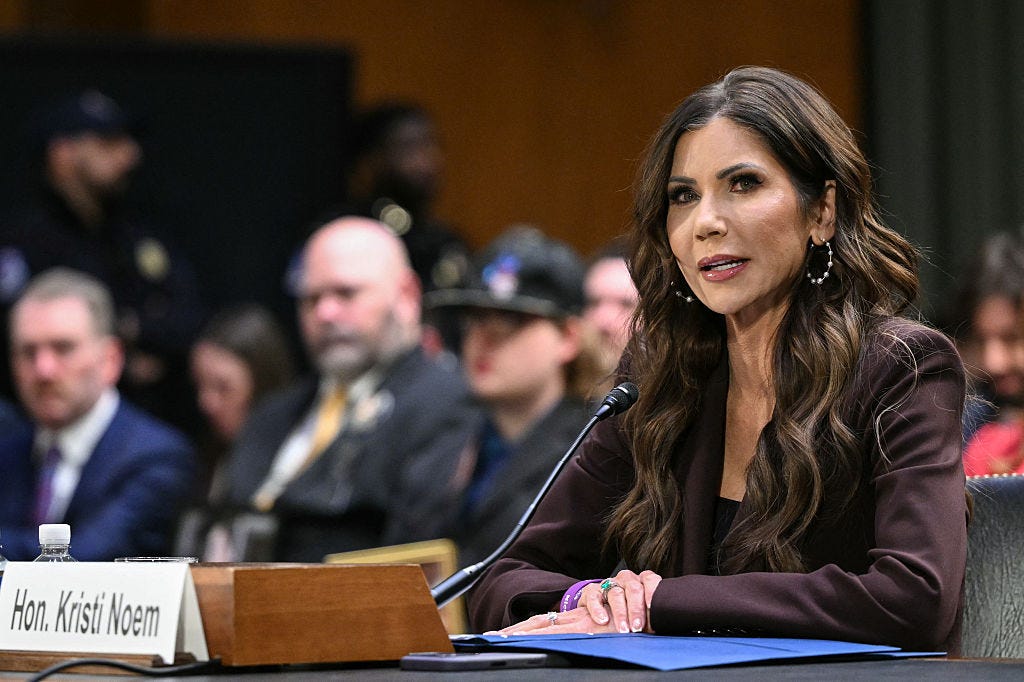
Kristi Noem: Fired, Not Accountable
She Was Never Fit for the Job. America Found Out the Hard Way.
Renee Good was a mother of three. Alex Pretti was a veterans’ nurse. On a January morning in Minneapolis, federal immigration agents shot both of them dead in the street.
Before any investigation had been opened, before any medical examiner had filed a report, before any body camera footage had been reviewed, Kristi Noem went in front of the cameras and called them domestic terrorists.
That single act told you everything you needed to know about the woman running the Department of Homeland Security. Not the $220 million she spent on television advertisements starring herself. Not the luxury Gulfstream jets with bedrooms and bars, purchased with funds meant for deportation operations. Not the Coast Guard commander fired mid-flight, according to congressional testimony, because a blanket had been left behind on a government aircraft. Not the rumors of a personal relationship with her top adviser, Corey Lewandowski, a man with a documented record of physical battery, sexual harassment, and removal from virtually every previous position he had held due to misconduct.
What told you everything was this: two American citizens were dead, their families were still in shock, and the Secretary of Homeland Security of the United States got in front of a microphone and lied about them to protect her agents.
On Thursday, March 5, Donald Trump fired her. She became the first Cabinet secretary removed in his second term. She had lasted thirteen months.
Noem had no immigration enforcement background when she was handed the largest law enforcement agency in the United States, a department of 250,000 employees responsible for everything from cybersecurity to disaster relief to the Coast Guard. She got the job, according to reporting by the Wall Street Journal, in significant part because of Lewandowski, who first lobbied for her as a vice-presidential candidate and then pushed for her appointment at DHS. Trump, who values television presence above most operational metrics, liked how she performed on it.
That is where the qualification began and ended.
Her record before DHS had already established a pattern of fiction presented as credential. In her 2024 memoir, “No Going Back,” Noem claimed to have met North Korean leader Kim Jong Un during her time in Congress. Congressional travel records did not support the claim. When reporters pressed her, her own spokesman described it as one of two small errors. The publisher removed the passage from reprints. Noem, asked directly whether the meeting had occurred, refused to give a straight answer, saying only that the anecdote should not have been in the book. No public record has ever placed her in a room with Kim Jong Un or in North Korea. Her memoir also described canceling a meeting with French President Emmanuel Macron because of comments he had made to the press. Macron’s office told The Dakota Scout that Noem had never received a direct invitation to meet the president and that no such scheduled event appeared on his calendar.
A woman who published fabrications about her foreign policy credentials became the nation’s chief domestic security official. That progression did not happen by accident. It happened because the credential being evaluated was not competence. It was loyalty and brand value.
From her first weeks at the department, Noem operated less as an administrator than as a brand in motion. She flew to El Salvador’s CECOT prison, posed for photographs in front of detained men standing at cell bars, and did it wearing a $50,000 gold Rolex Cosmograph Daytona. She held press conferences across the country to announce deportation numbers. She launched a self-deportation ad campaign that ran overwhelmingly in English, aimed at a population that largely speaks Spanish.
That campaign cost American taxpayers approximately $220 million in production and airtime, according to the ad-tracking firm AdImpact. ProPublica reported that a lucrative subcontract went to a firm whose principal was the husband of a former DHS spokesperson. During his Senate Judiciary Committee testimony this week, Republican Senator John Kennedy told Noem directly that his research showed the bids had not been properly opened and that she had selected one firm incorporated eleven days before she awarded it the contract.
Trump, asked about the campaign by Reuters on the day he fired her, said he had never known anything about it.
That denial, delivered on the day of her removal, functions as its own confession about how the administration now reads the liability column.
The ad campaign was not the only spending that drew scrutiny. Noem approved the purchase of two Gulfstream G700 luxury jets. Her department then moved to acquire a Boeing Business Jet 737 at approximately $70 million, an aircraft outfitted with a bedroom and a bar. Noem defended the acquisitions in congressional testimony, saying the planes would serve as long-range command and control aircraft and be used for deportation flights.
One administration official, speaking to Axios, described the total planned cost of the three aircraft as exceeding $270 million and called it the worst aircraft deal in the world.
The Boeing 737 was lent to First Lady Melania Trump, who used it on multiple flights between Washington and New York. When administration officials learned that Lewandowski and Noem had arranged this, their assessment, as reported by Axios, was that the two believed the gesture had made them untouchable.
It did not.
The killing of Renee Good and Alex Pretti was the weight that broke the foundation.
Federal agents deployed to Minneapolis in an immigration enforcement surge shot and killed both of them. Body camera footage and mobile phone video taken by bystanders directly contradicted Noem’s characterization of the two as armed agitators engaged in domestic terrorism. Good was a mother of three. Pretti was a nurse who cared for veterans.
At the Senate Judiciary hearing on Tuesday, Democratic Congressman Jamie Raskin told Noem that of three homicides committed in Minneapolis in 2026, her agents were responsible for two. He accused her department of barring Minnesota’s own investigators from the crime scenes. Republican Senator Chuck Grassley, the committee’s chairman and a figure not given to confrontation with his own party’s administration, called the killings unacceptable. Republican Senator Thom Tillis, who had voted to confirm her, called her tenure a disaster and threatened to block all of Trump’s nominations until she answered his questions.
Noem refused to retract her domestic terrorism characterization at either hearing. When pressed to explain her initial comments, she said she had been relaying information from agents on the scene. Video evidence existed. It contradicted those agents. She testified after that video had been reviewed. She said it anyway.
Inside the administration, officials described the Minneapolis operation as a failure that had been designed to address Somali visa fraud and ended with two Americans dead in the street.
Corey Lewandowski holds a record that would have ended any conventional appointment process. Congressional testimony this week catalogued it: physical battery charges, sexual harassment allegations, and removal from previous positions for misconduct. He was brought into DHS as a special government employee, a classification intended to limit the number of days a person can work within the department. He was a constant presence regardless.
Under his influence, according to current and former DHS officials speaking to CNN, staff were fired frequently. Employees who were not trusted were required to take polygraph examinations. Trump reportedly rejected a formal request to make Lewandowski Noem’s chief of staff specifically because of concerns about a personal relationship between the two. That did not end his operational role.
DHS’s acting director of ICE, acting FEMA administrator, acting director of the Cybersecurity and Infrastructure Security Agency, and acting TSA administrator are all serving without Senate confirmation. The department’s leadership structure had been hollowed out and replaced with provisional figures, all of whom served at the pleasure of two people who held the institution as a personal vehicle.
Representative Jamie Raskin, at the House Judiciary hearing on Wednesday, described to Noem an incident in which Lewandowski, aboard a government aircraft while it was ascending, walked into the cockpit and demanded to know where Noem’s blanket was. A 2003 Coast Guard Academy graduate and distinguished commander was fired over that question.
When Representative Sydney Kamlager-Dove asked Noem directly, under oath, whether she had ever had sexual relations with Lewandowski, Noem called the question tabloid garbage. She did not answer it with a no.
Her husband, Bryon Noem, was seated behind her during both days of testimony. He left the chamber on Wednesday before the Lewandowski questions were raised.
In June 2025, Noem issued a directive requiring her personal written approval for any DHS contract, grant, or funding obligation exceeding $100,000. She described it as a financial oversight measure.
A Senate report, produced by Senators Gary Peters and Andy Kim using data provided by whistleblowers, found that the directive had delayed or left pending at least 1,034 FEMA contracts, grants, or disaster assistance awards as of September 2025. Average delays ran three weeks, with some cases significantly longer. The report concluded that the directive violated the Post-Katrina Emergency Management Reform Act of 2006, which prohibits actions that significantly and substantially reduce FEMA’s mission, authorities, and responsibilities.
The practical effect on the ground was documented in detail. Hurricane Helene tore through western North Carolina in 2024, leaving an estimated $60 billion in damage. North Carolina counties spent beyond their annual budgets clearing debris and repairing infrastructure, waiting on federal reimbursement under the understanding that the money had been approved. The bottleneck created by Noem’s signature requirement held back what one state official described as $17 billion in recovery funds nationally. When a Republican congressman from California raised a specific $2.5 million hazard mitigation grant for a fire-prone rural district that had been sitting since June waiting for Noem’s signature, her response was to cite how much FEMA had distributed overall.
She also cycled through three acting FEMA administrators during her tenure. The first, Cameron Hamilton, was removed after he clashed with Lewandowski and told lawmakers he did not support the administration’s plan to dismantle FEMA. The 122-page FEMA Review Council report, produced to advise on the agency’s future, was cut to 23 pages by Noem. A Florida congressman presented what he said was the original draft in open hearing and said Noem had excised all the input from governors, emergency management directors, and FEMA experts.
In the final weeks before her removal, Noem and Lewandowski announced the suspension of TSA PreCheck during the ongoing partial government shutdown. The program, which allows background-checked travelers faster screening at airports, was to be suspended nationally starting at 6 a.m. on a Sunday. The White House intervened. The suspension was reversed within hours, creating confusion at airports across the country. A DHS spokesperson described the reversal as a shift to an airport-by-airport approach.
The DHS Inspector General, Joseph Cuffari, sent a formal letter to Congress accusing Noem’s department of having systematically obstructed his office as he sought data related to immigrant arrests, airport security programs, and counterintelligence operations. Even officials described as sympathetic to the administration began speaking publicly about their concerns with her leadership. One senator noted on the record that the situation had to be extraordinarily bad for an inspector general to bring it to Congress himself.
The Department of Homeland Security has been partially shut down since February 14, locked in a congressional funding standoff. At the time of Noem’s removal, 100,000 employees had been furloughed, including those responsible for cybersecurity operations, while the United States was conducting military operations against Iran.
FEMA lost approximately a third of its permanent workforce during her tenure, along with the majority of its experienced senior leadership. The contracts, grants, training programs, and emergency preparedness funding she froze left internal reviewers warning the agency could not manage a major catastrophe.
Multiple officials inside the department told CNN they were relieved by her removal. One called it long overdue and said she had never been qualified for the position. Another said she had paid the price for exploiting the role for personal gain.
Trump announced Noem’s removal on Truth Social on Thursday afternoon, praising her for numerous and spectacular results, particularly on the border, and saying she would move to a new role as Special Envoy for the Shield of the Americas, a Western Hemisphere security initiative to be announced at his Doral, Florida property that Saturday.
He named Oklahoma Senator Markwayne Mullin as her replacement, describing him as a MAGA Warrior and a former undefeated professional MMA fighter.
Noem, traveling outside Washington when the announcement came, posted a statement thanking the president and expressing enthusiasm for the new role.
The administration official who described her removal to CNN cited the cumulative weight of failures: the fallout in Minneapolis, the ad campaign, the infidelity allegations, staff mismanagement, and constant feuding with the heads of CBP and ICE. The adviser who spoke with Axios was more direct. She had burned through her goodwill, and it was everywhere and it was everything.
Kristi Noem spent years constructing herself as a political commodity. She turned the South Dakota governorship into a content operation, converting executive authority into proximity to Trump, then into a Cabinet post. She arrived at DHS and kept doing exactly that: the television ads, the El Salvador photoshoots, the Rolex, the press conferences in cities she had ordered raided.
A woman who published a memoir containing an invented meeting with Kim Jong Un became the cabinet secretary who oversaw the nation’s domestic security. A woman who could not run a disaster relief signature process without creating a $17 billion national bottleneck told Congress she was dispersing FEMA funds faster than ever in history.
Two Americans are dead in Minneapolis. Their killer agency’s chief called them terrorists and would not take it back under oath. The department she ran is shut down. The Inspector General says she obstructed federal oversight. The jets cost the public more than a quarter billion dollars. The ad campaign that featured her face cost another $220 million and was partially awarded to a firm incorporated eleven days before she chose it. 1,034 disaster aid awards sat waiting for her signature while communities that had been through hurricanes and wildfires waited for reimbursements their own governments had already approved.
She was fired for none of it. She was fired because Trump’s advisers told him she had become visible liability, because the congressional hearings had been humiliating, and because the internal chaos she and Lewandowski ran through the department had made it ungovernable.
The two Americans she called terrorists are still dead. No one in Washington is treating that as the reason for anything.
That is the documented accountability record of the United States government, in sequence, without any interpretation required.


