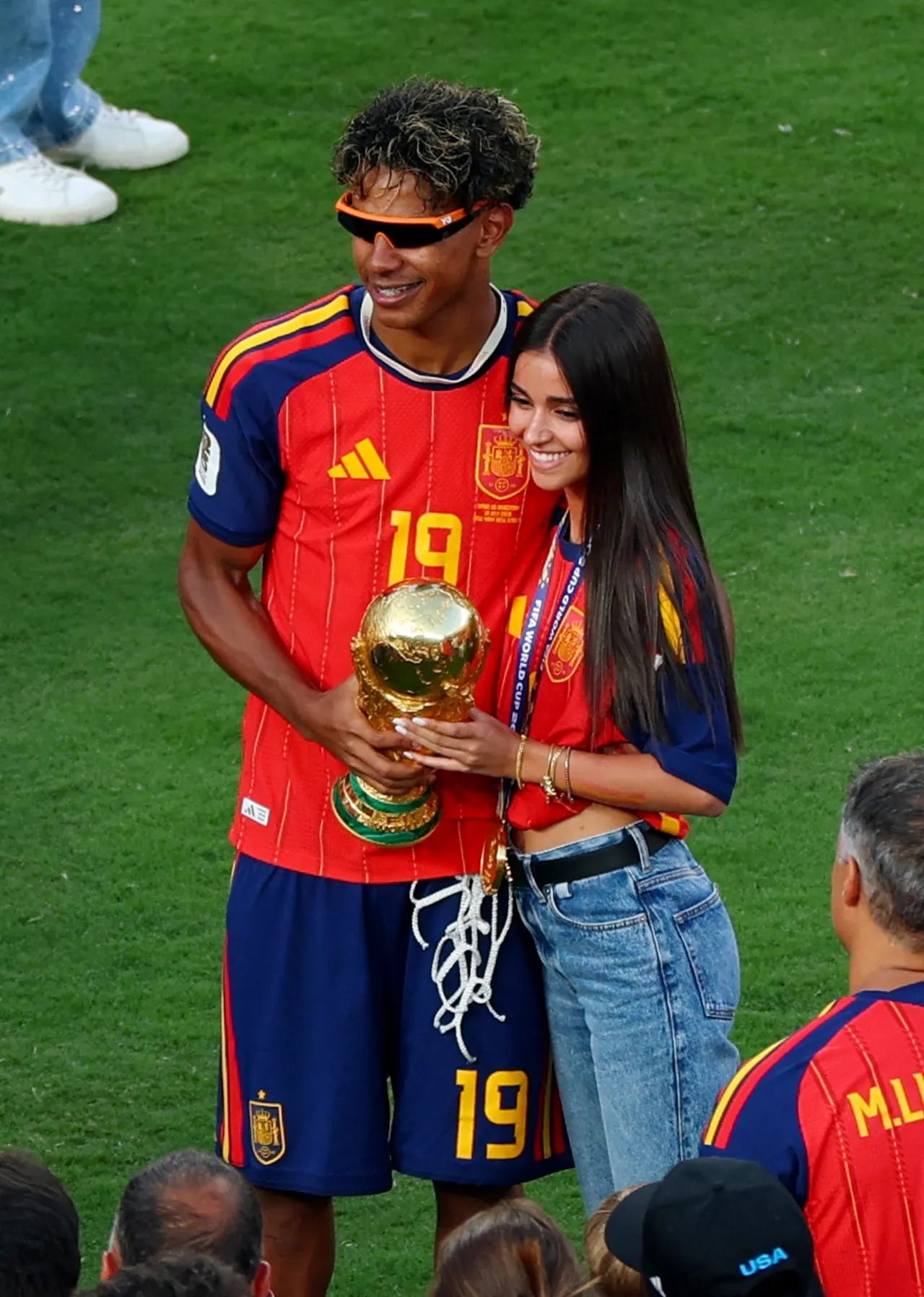
There is a childish way of watching tournament football, and it survives because the sport makes it easy. The eye runs toward the goal, the assist, the flourish clipped for social media, and from there it builds a judgment that is often too small for the game that actually happened. A winger with one goal and no assist becomes quiet. A forward who did not own every possession becomes constrained. A star who looks different for country than he does for club becomes, in this shallow reading, somehow diminished by the national shirt. Lamine Yamal’s World Cup for Spain sat directly in the path of that misunderstanding. On the surface, the numbers invited it. Through Spain’s run, he was not always the final touch. He was not always the scorer. He was not even always the most statistically decorated player in the move that finished in the net. But Spain’s own setup, and Spain’s own players, described something else entirely: a side trying to get the ball to Yamal in the right spaces, then clearing his lane so that his dribbling could force defenders into ugly choices and the rest of the structure could attack what those choices left behind. Marcos Llorente put it plainly before the knockout round against Austria, saying that Yamal often did not need much help, that extra support could even make things worse, and that the best option was frequently to give him the ball, stay back, and leave him isolated in a one-on-one. That is not a decorative detail. It is the mechanism.
Once that mechanism is named, the tournament looks different. The question stops being why Yamal did not resemble the permanent possession hub he can sometimes become at Barcelona and becomes something harder and more interesting: what did Spain need from him that was specific to international football, specific to tournament tempo, specific to the compressed brutality of matches where one unstable flank can decide everything before a team has time to correct itself. Spain’s answer was not sentimental. They did not ask him to be involved for the sake of involvement. They did not seem especially interested in maximizing the sheer volume of his touches if those touches arrived in zones where the defense remained comfortable. They wanted him where defenses hate to live, high and wide on the right, with room to face up a full-back, enough separation to tempt the second defender across, and enough trust from his teammates that they would not clutter the zone trying to participate in his duel. That is a narrower brief than the one he often carries at club level. It is also, in knockout football, a more vicious one.
At Barcelona, Yamal can be the beginning, middle and acceleration of the same attack. He can receive early, combine inside, drift into the half-space, carry through pressure and then still have the composure to play or finish the decisive ball. That broader burden belongs to club football because club football permits repetition. There is training time. There are layered automatisms. There are weeks and months in which a side can slowly bend its rhythm around one player’s instincts until his preferences become part of the team’s grammar. International football is not built that way. The players arrive in fragments from different systems, with different habits, under a coach who has far less time to produce cohesion and far less margin for experimentation once the tournament begins. What survives in that environment is clarity. Spain found clarity in Yamal’s most immediate gift. Get him the ball in the duel. Let the duel contaminate the whole shape.
That contamination, more than any single highlight, explains his importance. The tournament record had Yamal at 23 successful take-ons in 352 minutes at that stage, but the number only begins the argument. His ball progression and duel-winning kept shifting the focus of play toward him, drawing one defender, then another, until an entire flank was devoted to containing him. That pressure gave Spain’s central attackers, including Dani Olmo and Pedri, more room to work, while the left side could advance with greater force because the defensive emergency had already been declared elsewhere. Against Austria, all three Spanish goals came from the left after Yamal’s side of the pitch had absorbed the opponent’s attention. This is not coincidence dressed as interpretation. It is tactical redistribution. He did not always deliver the final act because his work had already made the final act easier for someone else.
This is the part lazy commentary misses because it is still addicted to the old accounting methods of football fame. It knows how to reward the player who finishes and how to praise the player who records the pass before the finish, but it remains awkward around the player whose touch rearranges the field two phases earlier and leaves everyone else with cleaner arithmetic. Yet elite football has always contained this less visible hierarchy of contribution. Some players complete the sentence. Others decide its structure. Yamal spent large parts of Spain’s World Cup doing the second job. The dribble was not there to entertain. The feint was not there to decorate the move. His role was to make the defense abandon its preferred distances. Once that happened, Spain’s midfield and opposite flank could enter a scene whose terms had already been rewritten.
There is a larger story here about Spain as well, and Yamal’s tournament role sits at its center. For years, the country’s football identity was trapped inside arguments about inheritance. Every major Spanish side had to be measured against the memory of sterile possession or the mythology of total control, as though the nation had signed a permanent aesthetic treaty with one era of midfield domination. Long before this World Cup, that had already started to change. The center still carries the short-passing intelligence associated with Spain’s best sides, but the break in tempo now comes from the wings, where Yamal waits on the right until the ball arrives and the whole careful order of the opposing block has to answer for him. Spain did not abandon their historical instincts. They sharpened them. Possession remained the means of control, but width and dribbling became the means of incision.
That shift matters because modern elite defenses are built to survive pure circulation. Every serious opponent can slide, compress, and wait. The ball can move beautifully across the width of the pitch and still produce almost nothing if the box remains structurally intact and no defender is forced into a personal crisis. That is what a player like Yamal changes. He turns collective order into individual risk. The full-back is no longer protected by the comfort of the block because he is now being asked to hold ground against a specialist who can beat him inside or outside. The nearest midfielder can no longer guard his zone with patience because he must start deciding whether to help. The center-back begins to cheat toward the duel and in doing so weakens the line he is trying to protect. This is how a dribbler governs a match without touching the final pass. He creates hesitation in people whose job depends on certainty.
Spain’s intelligence lay in recognizing that helping him too much could destroy the very advantage they were trying to exploit. Llorente’s remarks were unusually candid on that point. Sometimes, he said, helping Yamal would make things worse, because the overlapping run could drag another defender into the zone and crowd the space the winger needed. Those are the comments of a team that has thought seriously about the geometry of its star rather than simply praising him in the abstract. The plan was not “let the genius play.” The plan was more precise and far more modern: remove the unnecessary noise around the genius, preserve the isolation, and trust that the reaction he provokes will produce openings elsewhere. This kind of discipline is easy to admire when it succeeds and much harder to maintain in real time, because footballers are taught from childhood to support, combine and offer angles. Spain had to resist some of those reflexes to maximize the value of their most dangerous player.
Yamal carries another kind of discipline into this football, one that is too often flattened into background biography when it is not ignored altogether. He is Muslim, the son of a Moroccan father and an Equatorial Guinean mother, raised in Rocafonda, the working-class Mataró neighbourhood whose final postcode digits, 304, he forms with his hands after scoring. He has observed Ramadan while playing at the highest level, adjusting the private order of fasting and prayer to the brutal public timetable of elite football, where a late meal, recovery session and training schedule are planned down to the minute. The point is not to turn faith into an explanation for a feint or a finish. Football has enough of that lazy mysticism. It is to see the full person Spain have placed at the center of their spectacle: a young Muslim from a migrant neighbourhood, playing for a country whose national shirt has not always made room gracefully for the people who now carry it furthest.
That distinction matters because the modern football industry likes origins when they can be compressed into a marketable gesture, a postcode on a boot, a clean little ascent from the estate to the stadium. Yamal keeps making the 304 with his fingers, and yet the gesture refuses the industry’s tidy version of arrival. Rocafonda is not a mood board. It is where his family lived, where his Moroccan inheritance remained part of ordinary life, and where the language of Muslim belonging travelled through homes, shops, football cages and the obligations of kin. At Barcelona and with Spain, he is watched as a phenomenon; back in the social world that made him, he is also a son, a grandson and a boy whose faith has a calendar of its own. That does not make his football more exotic. It makes the usual demand that he become culturally weightless look exactly as small as it is.


There is room here, too, for his little brother, Keyne, who watched Spain’s win over Austria at Los Angeles Stadium with a child’s unguarded joy while his older brother carried the tactical burden on the field. The cameras found Keyne and the clips travelled quickly, because football now turns every family moment into content before the final whistle. But his place in the story is gentler than that. He is the small figure in the stands who reminds you that, beneath the discussion of spacing and tournament systems, Yamal is still playing before the people for whom a Spain shirt, a World Cup night and an older brother on the pitch are matters of family pride. Yamal’s changing role remains the subject here; Keyne stands at its edge, loved, cheering, and free to be a child.
There is also a compliment hidden in the way Spain used him. Adaptation at this level is often mistaken for compromise, as though the truly gifted player should only be praised when he is given complete expressive freedom. The opposite is often closer to the truth. Great footballers are not only those who can do many things. They are those who can do fewer things, on command, without losing force. Yamal’s World Cup asked him for self-editing. Not every possession needed the full Barcelona catalog. Not every sequence required him to drift into the center and conduct. Not every attack demanded that he become the move’s chief organizer. Spain needed him to hold his position at the correct moments, receive in the correct lane, challenge the correct defender, and trust that the tactical aftershock would carry the rest of the attack forward. That is not a smaller footballing intelligence. It is a more mature one.
The statistical surface of the tournament, by itself, can still mislead. Sporting News noted that through six appearances Yamal had one goal and no assists, while other reports emphasized that his production looked quiet in conventional terms. Yet those same broader accounts also point toward the contradiction in that reading: Spain kept advancing, Spain kept creating, and Yamal kept remaining central to how the attack deformed opposition shapes even when the goal record lagged behind the eye test. Fox’s tournament breakdown framed his offensive impact in exactly those terms, noting how his individual talent forced opponents to double-team him and opened space for others while he remained dangerous in the final third regardless of whether he personally recorded the return. The contradiction dissolves once the role is properly described. His numbers looked modest because the damage he produced was collective before it was personal.
That distinction, between visible productivity and structural productivity, is where the best tournament football is usually understood or misunderstood. In league play, the larger sample eventually flatters the star. Over months, the volumes accumulate. The goals catch up. The assists settle into an order that reflects influence. In a World Cup, the sample is violent and short. One match can freeze an illusion in place. A player can dominate the tactical reality of two rounds and still be described as quiet because someone else placed the last touch on the move. That is why editorial judgment matters here. The task is not to romanticize unseen labor for its own sake. It is to identify what the team is actually asking for and whether the player is delivering it. Spain asked Yamal to be a destabilizer first. He was.
It is tempting, with a player so young, to frame all of this as the early stage of a larger evolution, and there is evidence for that too. Luis de la Fuente has spoken of a more assertive Yamal in the attacking third, while Spain’s off-the-ball movement and use of over- and under-lapping full-backs have been arranged to unlock their wide forwards. The phrase matters less than the football. Spain are not waiting for Yamal to become central to their identity. They have already accepted that he is, and the tactical choices around him show that they understand the difference between making a star busy and making him destructive. One is vanity. The other wins tournaments.
So the right way to describe his World Cup is not to say that Spain reduced him from the Barcelona version into something less complete. Spain extracted the portion of his game most capable of breaking knockout matches and built around its consequences. They trusted his dribbling to pull the defense toward him, trusted their midfield to profit from the lanes that opened, trusted the opposite flank to arrive in space the defense could no longer balance, and trusted Yamal himself to accept a role whose greatness was often clearest one pass before the pass that everyone remembers. That is a harder form of stardom because it requires the player to dominate the architecture of the move without always owning its final credit. He did it anyway. Precision.


