Lebanon
While the World Drafts Another Statement of Concern, Israel Is Busy Stealing the Land Beneath It
I have been thinking about the road between Sidon and Tyre, the one that runs along the Lebanese coast past the Roman ruins and the fishing harbors and the smell of the sea in the early morning. I have driven it many times. It is a road that carries ordinary Lebanese life: vegetables going to market, families visiting relatives, fishermen returning before dawn on land their grandfathers fished before them and their grandfathers before that. It is on this road that an Israeli drone found a car at first light and destroyed it with everyone inside. Six members of the same family. They were not fighters. They were doing exactly what Israel’s displacement order had told them to do: leave their own land, temporarily, and survive. The order came. They obeyed. The drone killed them on the road of their compliance, and Lebanon’s health ministry recorded their deaths in the same morning bulletin it now produces every day, with the same formatting, the same categories, the same column for “killed” and the column for “wounded,” a document that has become, without anyone deciding it should, the daily ledger of a people being erased from land that is theirs.
Then there is the car in Jezzine, carrying Ali Shoeib and Fatima Ftouni and her brother, a cameraman, all of them Lebanese journalists covering this war for Lebanese people on Lebanese soil. The car was marked. Israeli forces knew what it was. The airstrike found it anyway, and three funerals were held in Chouifat while the international community was composing the week’s statement on the importance of protecting civilian journalists. I know the road to Jezzine. It climbs through pine forests into the mountains, past old summer houses and apple orchards that Lebanese families have tended for generations, and there is a stretch in late afternoon where the light comes through the trees in long golden columns, and Ali Shoeib is dead on that road, on his own country’s road, and the light still comes through.
On the eve of Eid al-Adha, the 26th of May, when Lebanese families in the south were gathered at home for the holiday on the land where they have always lived, Israel struck more than a hundred sites across southern Lebanon and the Bekaa Valley in a single overnight campaign. Thirty-one people died, including children who had never held a weapon and never would. I have covered Lebanese Eids in peacetime: the smell of lamb cooking before dawn, children in new clothes on the stairwells of apartment buildings their families have owned for fifty years, the particular noise a neighborhood makes when it knows it belongs to itself. Israel bombed that belonging. It does so because the project it is executing requires that belonging to be destroyed, because a people rooted in their land are harder to remove than a people made into refugees, and removal is what this project has always been about.
On May 31st, 2026, Israeli soldiers walked into Beaufort Castle in southern Lebanon and planted their flag. The fortress sits on a limestone ridge above the Litani River, on Lebanese land, in Lebanese mountains, overlooking Lebanese valleys where Lebanese people have farmed and built and buried their dead for centuries. Israel occupied this castle from 1982 until 2000, eighteen years of illegal military occupation of sovereign Lebanese territory that ended only because the Lebanese resistance made the cost of staying unbearable. The soldiers who returned to Beaufort in 2026 came back to land they were driven from, land that was never theirs, with a flag that represents a state built entirely on the dispossession of other people’s land, and Netanyahu called it a “decisive shift.”
He is right that it is decisive. It tells us everything about the nature of this project that Israel required no new legal basis, no UN mandate, no treaty, and no invitation to re-occupy Lebanese sovereign territory. It required only the military capacity to do so and the political certainty that no one would stop it. That certainty has been earned across decades of occupation, bombardment, and settlement construction on stolen land, each act absorbed by the international community with a statement of concern and no consequence. Israel now holds approximately 2,000 square kilometers of Lebanese land. On June 1st, it issued forced displacement orders for seven Lebanese villages: al-Fouqa, Arabim, Yaroun, Azzeh, Arkey, Jbaa, and their surrounds, ordering Lebanese people off Lebanese land to make room for an Israeli military advance that has no legal basis in any instrument of international law.
The operational pattern is not complicated and has never been complicated. Strike the population. Issue the displacement order. Move the army into the emptied space. Establish the perimeter. Call it a security zone. Issue new orders. Advance again. It is the same pattern Israel used in 1948 to empty 530 Palestinian villages and towns. It is the same pattern it used in 1967 to seize the West Bank and Gaza. It is the same pattern it used in 1982 when it drove into Beirut. The Lebanese and Palestinian people are not living in the path of this project. They are the obstacle this project was designed to remove, because the land under their feet is the land the project wants, and the project has been explicit about wanting it since before the state of Israel existed.
Netanyahu formalized the expansion of what his government calls the “security buffer zone” in Lebanon on March 29th. A security buffer zone on Lebanese land, administered by Israeli forces, from which Lebanese civilians are expelled and into which the Israeli military moves freely, is not a security measure. It is an occupation. It is Lebanese land under foreign military control, and the foreign military has no claim to it under any law, any history, or any logic other than the logic of a supremacist colonial project that has decided the land belongs to it because it has the weapons to take it.
Israel’s Finance Minister Bezalel Smotrich said in May 2026 that his government is “constructing the Land of Israel and dismantling the concept of a Palestinian state.” The Land of Israel, in the ideology Smotrich openly represents, extends from the Jordan River to the Mediterranean Sea and northward to the Litani River in Lebanon. It is a map drawn over the top of Lebanon and Palestine, over the homes and graves and farms and cities of millions of people who have lived on this land for generations, and it is being enacted right now with F-35s and artillery and displacement orders and settlements and the systematic destruction of everything that makes Palestinian and Lebanese life sustainable on Palestinian and Lebanese land.
As of June 1st, 2026, Lebanon’s health ministry has recorded 3,412 people killed and 10,269 wounded since March 2nd, all of them on Lebanese land, all of them killed by a military that had no right to be there. More than one million Lebanese people have been displaced from their homes. Nearly 1.24 million face food insecurity through mid-2026, a condition produced by Israel’s systematic destruction of the infrastructure of Lebanese life: the roads, the markets, the warehouses, the agricultural land that Lebanese farmers have worked for generations and that Israeli strikes have made inaccessible.
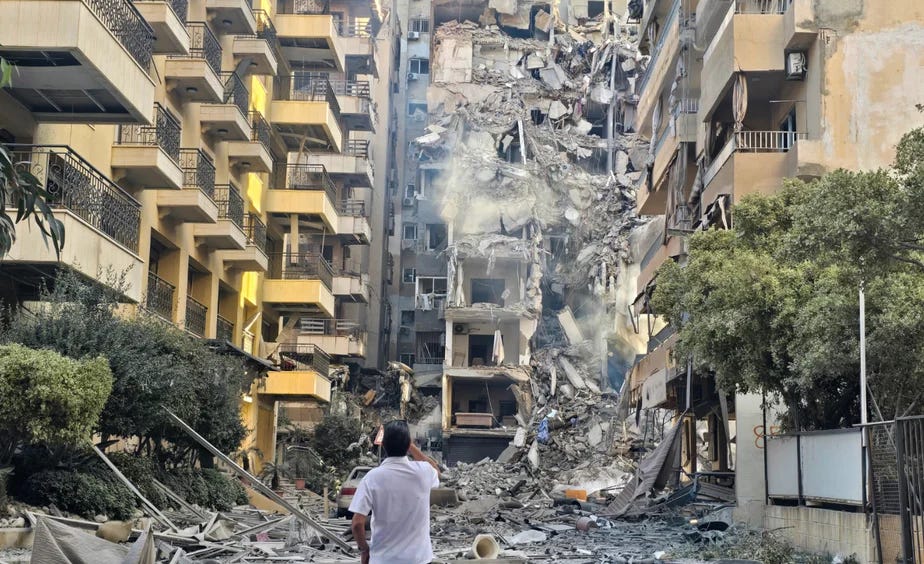
After strikes on Tyre on the night of May 27th killed 14 people including women, children, and a Lebanese soldier, Israeli warplanes returned to the same city within 48 hours. Hospital staff near Hiram Hospital were wounded in the second wave. Tyre is one of the oldest continuously inhabited cities on earth. Phoenician sailors built it. Lebanese people have lived in it for three thousand years. It belongs to Lebanon as completely and as historically as any city belongs to any people anywhere on earth, and Israel is bombing it, repeatedly, without legal basis, without accountability, and without the slightest indication that the governments capable of stopping it intend to do so.
More than 400 of the 3,412 deaths occurred after the ceasefire brokered by the United States took effect on April 17th. Over 400 Lebanese people killed inside the legal boundary of a ceasefire agreement that Israel signed and then treated as a temporary pause between operations. This is not a pattern of mistakes or miscalculations. It is a pattern of a state that has concluded, correctly on the available evidence, that it faces no enforcement, no accountability, and no cost for killing Lebanese people on Lebanese land.
The United States has vetoed Security Council ceasefire resolutions six times since October 2023. Six times, fourteen nations voted to demand a halt to the killing of Palestinian and Lebanese people on Palestinian and Lebanese land. Six times, one nation voted no and the killing continued. Each of those six votes was cast with full knowledge of the ICJ provisional measures, the UN commission genocide findings, the Lancet mortality research confirming 75,000 violent deaths in Gaza, and the daily Lebanese death toll accumulating in the ministry spreadsheet. The United States government read all of this and voted no, six times, because the relationship it is protecting is a relationship with a settler-colonial state whose military supremacy Washington has funded, armed, and diplomatically shielded for the better part of a century, and because Arab life, in the calculus of that relationship, has never been assigned a value that outweighs the strategic utility of the state that is ending it.
The US brokered a ceasefire on April 16th that Israel violated within the week. It extended the ceasefire in May with language giving Israel the right to act against “imminent threats,” a clause that has since been used to authorize the Beaufort operation, the Tyre strikes, the Bekaa bombardment, the displacement orders, and the ground advance across the Litani. On June 1st, Secretary of State Marco Rubio proposed yet another de-escalation roadmap. It is the fourth version of the same architecture that has failed three times already and added hundreds of Lebanese dead to the count with each failure. Washington is not trying to stop this war. Washington is managing the optics of a war it is materially enabling, and there is a difference between those two things that the Lebanese dead understand better than any diplomat.
Independent scientific research confirmed a violent death toll in Gaza exceeding 75,000 by early 2026. The Global Centre for the Responsibility to Protect formally concluded that Israeli forces are committing genocide against the Palestinian people, a legal and evidentiary finding based on documented evidence of intent to destroy Palestinians as a group, on Palestinian land, because they are Palestinian and the land is theirs. A UN-mandated commission reached the same conclusion. The International Court of Justice issued provisional measures ordering Israel to prevent genocidal acts. Israel continued without modification because the order carried no enforcement mechanism and the United States had already demonstrated through its vetoes that no enforcement mechanism would be permitted to exist.
Gaza City was designated a famine zone while American weapons were in transit to Israeli military bases. The Leahy Law prohibits the transfer of US military assistance to forces credibly accused of gross human rights violations. The credible accusations fill volumes of UN documentation and peer-reviewed research. The law has not been invoked. The weapons have not stopped. Israeli ministers have described Gaza publicly as a future real estate opportunity, as land to be resettled by Jewish Israelis after its Palestinian population has been, in the language of one minister, “relocated.” These are not the statements of soldiers exceeding their orders. They are the statements of the government directing this campaign, made in public, on the record, without consequence, because the ideology behind them is the same ideology that built the Israeli state on Palestinian land in 1948 and has been expanding across that land, and Lebanese land, ever since.
In the occupied West Bank, on Palestinian land under illegal Israeli military occupation since 1967, the dispossession requires no air campaign. It proceeds through settlers who are armed, legally protected, and financially subsidized by the Israeli state. In May 2026, settlers removed 3,000 Palestinian-planted trees in a single week. They attacked a Palestinian family near Hebron with bladed instruments. They burned a Palestinian house near Nablus. They exhumed a Palestinian grave because the burial site was too close to settlement land that was itself Palestinian land taken by force. The UN documented that settler violence in 2026 had already displaced more Palestinians than in the entire previous year, with 150 attacks recorded across 90 Palestinian communities by the end of March.
At least 44 Palestinians killed in the West Bank this year. Thirteen by settlers. Approximately 900 children among the displaced. These settlers are not rogue actors operating outside Israeli law. They are the leading edge of Israeli state policy, the people who move first onto Palestinian land, who establish the physical facts that the Israeli military then protects, that the Israeli legal system then formalizes, and that the Israeli government then annexes. Smotrich said his government is dismantling the concept of a Palestinian state. What he means is that Palestinian people will be left with no land, no state, no legal standing, and no future on the land where they and their ancestors have lived, because the ideology his government represents holds that land to belong, by divine and historical right, to the Jewish people alone, and that Palestinian presence on it is a problem to be administered into extinction.
France said nothing justifies the escalation in Lebanon. Macron controls the fourth-largest arms-exporting economy on earth and a permanent Security Council seat. His statement cost him nothing. Britain’s Foreign Secretary said the offensive diminishes diplomatic opportunities. She governs a country whose arms export licenses to Israel have survived multiple domestic legal challenges and continue to supply a military committing documented genocide and illegal occupation on three fronts simultaneously. Qatar called the ground campaign a breach of international law. Egypt called for Israeli withdrawal. All of them are right. None of them have done anything that has cost Israel a single soldier or a single dollar or a single meter of Lebanese or Palestinian land.
The tools of actual accountability are not secret. Arms embargoes. Trade agreement suspension. ICC referrals. Conditioning military aid on Leahy Law compliance. Recognition of Palestinian statehood with full legal consequence. Enforcement of the ICJ provisional measures. These instruments exist. They have been used against other states for lesser documented crimes. They are not being used against Israel because the governments capable of deploying them have made a choice: that the strategic architecture of the American-led international order, in which Israeli military supremacy is a structural feature rather than an aberration, is worth more to them than the lives of the Lebanese and Palestinian people being spent to maintain it.
The Lebanese people are on their land. They have always been on their land. The Palestinian people are on their land, what remains of it, and fighting for the rest. The graves in the south of Lebanon hold Lebanese people who were born there and died there and never left because it was theirs and they knew it was theirs. The olive trees in the West Bank that settlers cut down last week were planted by Palestinian hands in Palestinian soil and produced Palestinian oil for Palestinian families across generations that predate the state of Israel, its ideology, its settlements, and its F-35s by centuries.
A colonial project does not become legitimate because it has nuclear weapons and a Security Council patron. It does not become legitimate because it has held the land long enough that some people have started treating its presence as a fact of nature rather than a fact of force. The force is visible right now, today, in the ruins of Tyre and the smoking ridge above the Litani and the morning bulletins of Lebanon’s health ministry. The land under the ruins is Lebanese. It will remain Lebanese when the ruins are cleared and the soldiers are gone, however long that takes and whatever it costs to make it so. That is not an aspiration. It is history, and history, on this particular stretch of the Mediterranean, has a long memory and a longer patience than any occupation has yet managed to outlast.
Pity the nation that lives between the army of its occupier and the conscience of its friends. Pity it now, before the word conscience loses whatever meaning it still has left.


