


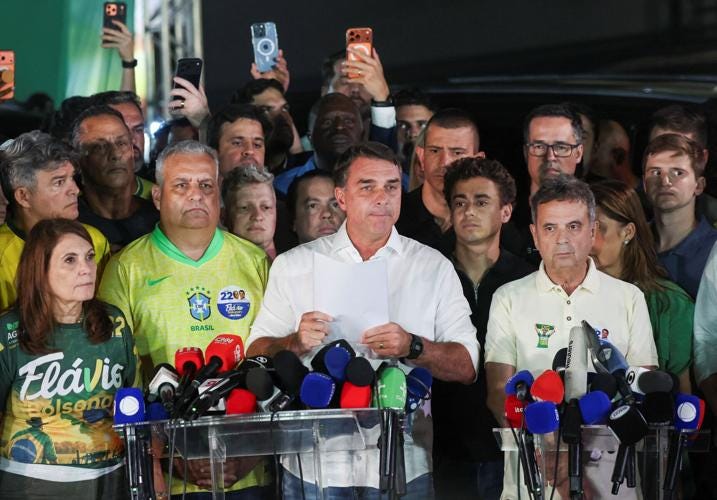
On the night of the first round, with the count finished and the result plain, Luiz Inácio Lula da Silva told his supporters that he had been convinced he would win outright. He called the outcome a lesson of democracy and described the coming runoff as the “prova dos nove,” the casting out of nines that Brazilian schoolchildren use to check their arithmetic. The confession was candid for a man who had spent most of the year at the top of the polls. In January, Quaest had projected a seven-point victory for him in a head-to-head contest with Flávio Bolsonaro. Through the summer, every major simulation had shown Lula leading the first round. Then the electorate delivered 56.1 million votes to Flávio and 53.9 million to the president, a gap of about 2.2 million. It was the first time the senator had finished ahead of anyone in a national contest, and he finished ahead of the most durable politician in the country’s democratic history. The rest of the field gave Lula little comfort. The remaining 7.8% of valid votes went mostly to candidates of the right: the psychiatrist and author Augusto Cury, the activist Renan Santos, the Goiás governor Ronaldo Caiado and the Minas governor Romeu Zema. Roughly a fifth of the electorate, about thirty-three million people, did not vote at all. Lula needed to win the abstainers and hold his coalition while Flávio needed only to collect what the right had already given him. Lula went into the runoff behind.
Three weeks later Lula checked his arithmetic and found it sound. He finished with about 64.3 million votes to Flávio’s 59.8 million, 51.79% of the valid total, and became the first Brazilian president to win a fourth term. The Washington Post described the result as a halt to Latin America’s rightward drift. That framing has substance. Allies of Donald Trump had recently won elections in Argentina, Colombia, Honduras and Peru, and Flávio had campaigned openly as the region’s next addition to that list. Lula’s supporters celebrated in the streets of Brasília with the particular joy of people who had spent three weeks preparing for defeat. The victory also completed a personal story that Brazilian politics has not seen before. Lula, a former metalworker born in a backlands district of Pernambuco, was imprisoned in 2018 after Sergio Moro convicted him on corruption charges. He spent more than a year and a half in a cell in Curitiba before the Supreme Court annulled the convictions. In 2022 he returned to beat Jair Bolsonaro by fewer than two percentage points, and he has now defeated the father’s eldest son by more than three. Few politicians anywhere have been jailed, cleared and elected twice more, and fewer still have done it against the same family.
The runoff map tempers the triumph almost immediately. Lula carried all nine states of the Northeast along with Amazonas, Amapá, Pará and Minas Gerais. Flávio carried the South, the Center-West, São Paulo, Rio de Janeiro, Espírito Santo, Acre, Rondônia, Roraima, Tocantins and the Federal District, thirteen states and the capital against Lula’s thirteen. Minas Gerais was the only state to change hands between the rounds. Lula took it with 50.43%, so a fourth term rests in large part on less than a point in a single state. Elsewhere the president gained ground without gaining states. In Rio, the Bolsonaro family’s home turf, his share rose from 39.41% in the first round to 46.90% in the second, and he still lost. In São Paulo, he won the capital in the first round while Flávio took the state as a whole by nearly fourteen points, 51.93% to 38.20%. Bahia gave Lula 71.16% in the runoff. Roraima gave Flávio 72.4%, his best result anywhere. Both camps can read the figures as proof that Brazil is two countries. The more useful reading is that the two countries now have different governments. One elected the president, and the other elected nearly everyone with whom he will have to work.
Flávio’s states were won by wide margins and will be governed by his allies. He took São Paulo and Rio with about 53% each, Espírito Santo with 56%, Paraná with 62.58% and Santa Catarina with 69.42%. Those states hold most of Brazil’s industry, most of its export agriculture and a commanding share of its tax base. São Paulo is home to more than a fifth of the country’s population, and its governor, Tarcísio de Freitas, was reelected in the first round with 62.65%. He beat Fernando Haddad, Lula’s former finance minister, by more than six million votes. Tarcísio was Jair Bolsonaro’s infrastructure minister and had been widely seen as the right’s strongest presidential prospect. He declined to run, said he owed his loyalty to the voters who had elected him in São Paulo, and promised to deliver the state for whoever carried the movement’s banner. His coalition included the PL alongside the MDB, the PSD, União Brasil and the Progressistas, parties that Lula’s government has relied on in Congress. Tarcísio’s decision to stay home may prove one of the shrewder choices of the cycle. He did not tie himself to Flávio’s defeat, keeps the largest state treasury in the country, and enters the next four years as the right’s most obvious candidate for 2030.
The PL elected more governors outright than any other party, taking Paraná, Rio Grande do Sul, Rondônia, Roraima and Santa Catarina in the first round. In Paraná the new governor is Sergio Moro, the judge whose conviction put Lula in prison, an appointment history seems to have arranged for its own amusement. In Minas Gerais, Cleitinho Azevedo, a Bolsonaro ally who campaigned against the political class with a large online following, will govern the state that gave Lula his margin. Minas voters split their tickets with remarkable precision. They chose Lula over Flávio and then chose a Bolsonarista to run their state. Rio produced the strangest result of the season. Datafolha’s final poll had Eduardo Paes, the former mayor and Lula’s candidate, eight points ahead of the PL’s Douglas Ruas, and the AtlasIntel series showed a similar lead. Ruas finished first anyway, with 49.27% to Paes’s 42.76%. The electoral court then annulled the votes of Anthony Garotinho, a disqualified candidate, and the recount lifted Ruas to 50.88%, enough to make him governor without a runoff. Paes appealed to the Supreme Court, where Justice Cristiano Zanin declined to suspend the ruling, and Paes withdrew with a line about respecting judicial decisions. Zanin is the same justice Flávio would later accuse of tilting the presidential vote, and his ruling handed the family’s party the governorship of its home state. Of the twenty governors chosen in the first round, twelve came from parties of the right or center-right.
Congress moved further in Flávio’s direction than the states did, and the Senate moved furthest. The PL elected nineteen senators this month and will hold 28 of the chamber’s 81 seats, up from 16, the largest bench in the house. It won both available seats in the Federal District, Mato Grosso do Sul and Rondônia. Michelle Bolsonaro, the former first lady, took one of the Federal District’s seats alongside Bia Kicis, and Carlos Bolsonaro, the son who ran his father’s digital operation, won a seat as well. Paraná sent Deltan Dallagnol, the prosecutor who led the Lava Jato task force that built the case against Lula, along with Filipe Barros. The PT did well in its own territory, taking both seats in Bahia, but the more consequential change happened in the middle. The PSD, the most flexible of the centrist parties, fell from fourteen senators to five. For two decades, Brazilian presidents of every stripe have governed by renting the center, trading ministries and budget money for votes from parties that would support any government that paid. Those brokers have shrunk while the two poles grew. A smaller center charges more for each vote and has less to lose by siding with the opposition.
In the Chamber of Deputies, the PL grew from 98 seats to 121, and its candidates set records that would have seemed absurd a decade ago. Nikolas Ferreira of Minas Gerais and Lucas Pavanato of São Paulo each passed three million votes, the largest totals any federal deputy has received. Each roughly doubled the record Eduardo Bolsonaro set in 2018, when he drew a little more than a million and a half. In Ceará, a state Lula carried easily, the PL’s André Fernandes broke the state record with more than 670,000 votes, so the party is winning individual contests even inside the president’s heartland. The left had standouts of its own, most visibly Erika Hilton of PSOL in São Paulo, and the PT increased its representation. The overall direction was nonetheless unmistakable. By one estimate, parties of the center and right will control roughly 57% of the Chamber and 62% of the Senate. Analysts at the law firm Covington called the right’s showing its largest electoral victory since the return to democracy in 1985. Neuriberg Dias, who heads the legislative monitor DIAP, told Reuters that governing would be a major challenge for Lula. The record supports him, since lawmakers have overturned dozens of Lula’s vetoes since he returned to office in 2023. The new Congress will also be younger in its habits, with 183 first-time deputies, about 35% of the chamber, arriving in Brasília with mandates built online.
The headline numbers flatter the right in one respect, and the exception matters for anyone tempted to describe the new Congress as a fortress. Poder360 counts 276 right-wing deputies, against 275 elected in 2022, and nobody yet knows how tightly they will vote together. The right’s share of the lower house barely moved while more of it gathered under the PL banner. That concentration makes the bloc easier to command and easier to split with a single quarrel, especially one about who leads it. The arithmetic of removal also deserves care. Impeaching a president requires two-thirds of the Chamber, 342 deputies, before the Senate can try the case, a threshold far above anything the right holds on its own. Brazil has removed a president before, though, and Dilma Rousseff’s fall in 2016 did not depend on an opposition majority. It depended on the center deciding that the government had become a worse investment than its rivals. Lula knows that history better than anyone, since Rousseff was his chosen successor. A Congress need not be hostile on paper to become dangerous in practice. It only needs to watch a president weaken and then calculate.
The bloc’s stated goals begin with the Supreme Court. PL leaders have said their priorities are the impeachment of justices and a sweeping amnesty for those convicted over the January 8, 2023 attacks on the Congress, the presidential palace and the court. That amnesty could also undo Jair Bolsonaro’s twenty-seven-year sentence for plotting to overturn the 2022 election. Removing a justice requires 54 senators, nearly double the PL’s bench. Covington’s analysts read the new Senate as holding barely enough members willing to try, and several of the winning candidates campaigned explicitly on stronger congressional checks on the court. Readers of this publication will recognize the target. The same court and the same justice, Alexandre de Moraes, drew American sanctions in 2025 after Eduardo Bolsonaro lobbied the State Department for them. A campaign that once ran through Washington’s sanctions office now has a domestic venue with constitutional standing. The family failed to remove the court’s authority from outside the country, and it now has senators who can attempt the same thing from inside the building.
On Sunday night Flávio refused the result, saying it could not be recognized in the circumstances and promising to seek its annulment. His complaint centered on Zanin’s last-minute decision to extend voting by two hours, and on Zanin’s past as Lula’s lawyer. His brother Eduardo released a video in English calling the election fraudulent and asking foreign governments to withhold recognition. The appeal sat oddly beside the record of a voting system in which no significant fraud has been detected since electronic ballots arrived in the 1990s. Within a day, the PL had stepped away from both brothers. Kassio Nunes Marques, whom Jair Bolsonaro appointed to the Supreme Court and who now presides over the electoral court, confirmed the count and expressed full confidence in the system. The party then formally accepted the result and declined to support annulment, while promising to raise complaints about government spending through institutional channels. Valdemar Costa Neto, the party’s president, has spent decades in Brasília, and his calculation was easy to follow. The PL had won the largest benches in both houses and six governorships, and a fight over the presidential count would have spent that capital on a lost cause.
Flávio followed his party. He dropped the annulment demand, though a lawsuit aimed at disqualifying the Lula-Alckmin ticket is being prepared, and he summed up the campaign by saying, “I wasn’t the one who lost; the system won.” He promised to organize the opposition from Congress. His own position is more precarious than his rhetoric suggests. He is the subject of at least two Supreme Court investigations, which he says are baseless, and a family adviser told the Washington Post that he is frightened of prison. He also attributed part of his retreat to an earlier suggestion from Eduardo that he should leave Brazil if he lost, advice that says a good deal about how the family understands its relationship with the country’s courts. His father is in prison and his brother lives abroad. A movement that lost its presidential bid has kept its institutions, and its leading family is now the most exposed part of it.
If those investigations narrow Flávio’s future, the family has a successor ready. Michelle Bolsonaro is already described as the natural heir to the leadership of Brazil’s right, and she will build that claim from a Senate seat. She brings the evangelical following that made her husband formidable and no criminal conviction of her own. Her name also keeps the brand on the ballot without the son who lost. The foreign relationships that shaped this campaign have not disappeared either. Flávio had pledged to bring Brazil into Donald Trump’s “Shield of the Americas,” a security and political initiative. The American officials and policy instruments documented before the vote did not require a Bolsonaro in the presidency to operate, and the new Congress gives them friendlier interlocutors than they had before. Benjamin Netanyahu’s invitation to Flávio also remains outstanding for whichever member of the family next comes within reach of power. None of this guarantees a Bolsonaro restoration in 2030. It does mean that the movement’s next candidate, whether Michelle, Tarcísio or someone yet unknown, will start from a stronger institutional position than Flávio did.
Lula has governed alongside a Bolsonarist Congress before, and he learned its terms quickly. When the last one was seated in 2023, the PL held 99 deputies, then the largest party bench since 1998. Lula told his ministers that his government depended on Congress rather than ruling it, a sentence that served as a governing philosophy for the next four years. He traded ministries for coalition votes, absorbed defeats on vetoes, and kept his program alive by accepting less than he wanted. That dependence is deeper now, and Lula turns eighty-one this week with the same instruments he used last time, ministries and budget money traded with the centrist parties whose votes settle most contests in Brasília. Those parties are smaller and more expensive, and they have watched the right outperform the polls twice in a single month. The president’s advantage lies elsewhere, in the Northeast, which gave him majorities no Bolsonaro has dented, in a party machine that still functions, and in a record of surviving every attempt to end his career. He has survived a prison cell, a corruption conviction and an election that the losing side tried to overturn by storming the capital. He has never governed with the right this strong, the center this weak, and his own margin resting on a single state.
The first test comes early next year, when the new Senate chooses its president, the official who controls the chamber’s agenda and decides which impeachment requests against Supreme Court justices ever reach a vote. Davi Alcolumbre holds the post and wants to keep it. The PL, as the largest bench, has the numbers to bid for it, and Bolsonaro had named an expanded Senate base as a priority before he went to prison. With 28 senators and no majority, the party needs the same centrist votes Lula needs, and the contest will show which side the shrunken middle now believes is the better partner. Lula’s supporters were right to celebrate on Sunday night, since the president beat a family, a foreign campaign and his own polls. Next year, a few dozen senators will meet in Brasília to decide whether that victory gives him a government or only a palace, and Lula will have to win most of them while his opponents need only a few.