Made in America, Trained in Israel
The documented origins of the paramilitary machine that Washington just claimed to destroy
In the spring of 1989, a former lieutenant colonel in the Israeli Army arrived at a ranch in Puerto Boyacá, a municipality controlled by death squads in Colombia’s Middle Magdalena Valley. His name was Yair Klein. He had permits from the Israeli government in his pocket. He had authorization, signed by Defense Minister Yitzhak Rabin in 1986, for his private mercenary company Spearhead Ltd to conduct military exports. He had clients.
Among them: Pablo Escobar Gaviria. Gonzalo Rodríguez Gacha, known as El Mexicano, one of the Medellín Cartel’s most violent operators. And the Castaño brothers, who would go on to found the AUC, the United Self-Defense Forces of Colombia, the most lethal paramilitary organization in that country’s modern history.
Klein trained them all.
He taught them explosives. He taught them assassination methodology. He taught them the tactical doctrine of irregular warfare that the Israeli military had refined across Lebanon, the occupied territories, and the wars of the 1970s and 1980s. A training video he used at Puerto Boyacá was later recovered by Colombian intelligence. It showed the instruction in clinical detail.
In August 1989, Liberal Party presidential candidate Luis Carlos Galán was murdered by Jaime Eduardo Rueda Rocha. Rueda Rocha had trained with Klein. The weapon used was an IMI Galil rifle traced directly to a Klein weapons shipment. The 1989 Senate Committee on Foreign Relations placed that rifle inside a consignment of 500 Israeli-manufactured machine guns that had traveled from Miami to the Medellín Cartel.
A 1991 US Defense Intelligence Agency report placed Klein among what it called “the more important Colombian narco-terrorists contracted by the Colombian narcotic cartels for security, transportation, distribution, collection and enforcement.” The DIA described him as having sent advisors to train cartel paramilitary forces and “selected assassin team leaders on how to unleash waves of terrorism in Colombia.”
The same 1991 US Senate report that documented Klein’s activities noted that Israeli Embassy personnel in Bogotá had known Klein was operating in Colombia and took no action until after his activities surfaced in the press.
Klein later claimed the CIA had contracted him to train Colombians on the Caribbean island of Antigua for a planned coup against Manuel Noriega in Panama. The operation was canceled one week before execution. The US military invaded Panama in December 1989. Klein says he was then told the weapons already assembled for the operation could be used as he wished. They were sold to the Medellín Cartel. He claims the CIA subsequently tried to discredit him to cover its own involvement.
The Israeli government convicted Klein of illegally exporting military equipment without the required licenses. His fine was paid. The training had already been completed.
What the Castaños Built, and Where It Went
The Castaño brothers took what Klein taught them and industrialized it.
The AUC, founded by Carlos Castaño Gil and his brothers in the 1990s, became the template for how a politically tolerated paramilitary force could operate at scale: franchise structure, regional commanders with operational autonomy, external military expertise imported for specific functions, and a public posture of fighting leftist guerrillas while running narcotics and enforcing territory for landed interests.
Washington knew this. The State Department listed the AUC as a foreign terrorist organization in 2001. US military training of Colombian forces continued throughout and after the AUC’s peak operational years. The Mérida Initiative and Plan Colombia together channeled more than $10 billion in US military and security assistance to the region over two decades. The stated objective was counterinsurgency and counter-narcotics. What the training produced was a generation of combat-seasoned Latin American soldiers available for hire once the official wars ended or their contracts expired.
By 2008, analysts estimated 12,000 mercenaries were operating across Latin America. By 2018, that number had reached an estimated 2.4 million, according to Paloma Mendoza Cortés, professor of national security at ITAM in Mexico City. The majority were of Colombian origin. They brought AUC-lineage tactical doctrine, IED construction expertise, and the kind of institutional military knowledge that cannot be improvised in a cartel training camp.
CJNG bought it.
Jalisco state authorities identified the presence of Colombian mercenaries in CJNG ranks as early as 2013. The governor’s office passed that information to the federal Attorney General. In a 2018 press conference following a spectacular assassination attempt against Mexico City’s police chief, Jalisco Governor Aristóteles Sandoval confirmed publicly that CJNG had been “recruiting Colombians with military and guerrilla warfare training and experience” for years. Mexican Army intelligence documents, later leaked by the cyberactivist group Guacamaya, tracked Colombian mercenary movements in Michoacán from late 2021 onward.
The Guacamaya documents did not describe a new phenomenon. They described an established system that the government had been watching for nearly a decade and had not stopped.
The American Layer
The Colombian mercenary pipeline was not the only external military knowledge flowing into CJNG.
Los Zetas, the cartel that preceded CJNG as Mexico’s most militarized criminal organization, were built entirely from deserters of GAFE, the Mexican Army’s Special Forces Airborne Group. The GAFE had been trained directly by US Special Forces under counterinsurgency programs funded through Plan Mérida. When thirty of those soldiers defected to the Gulf Cartel in the late 1990s and early 2000s, they took every element of that training with them. The US government had invested in them. The Gulf Cartel inherited the investment.
In May 2019, a former CJNG fighter identified only as Francisco gave an interview to Mexico’s Telemundo network. He had spent three months in a CJNG training camp in Talpa de Allende, Jalisco. He described the trainers. “There was a group of elite Marines,” he said. “There were Navy from the United States. There were Delta Forces. There was everything there.” The US Defense Department, when contacted, said it had no information about the activities of former servicemen. An anonymous police source confirmed to Telemundo separately that both retired and active-duty Mexican servicemen were involved with CJNG. The two statements together are their own kind of answer.
In March 2025, investigative journalist Seth Hettena published a detailed account sourced to Pierre Rausini, a former cartel insider. According to Rausini, a former Delta Force soldier, two ex-Navy SEALs, and a veteran of the 75th Ranger Regiment had been helping train CJNG’s paramilitary wing for years. These former US special operators, Rausini told Hettena, oversaw several hundred ex-soldiers drawn primarily from Mexico and Central America. “The paramilitary wing of Jalisco is their pride and joy,” Rausini said.
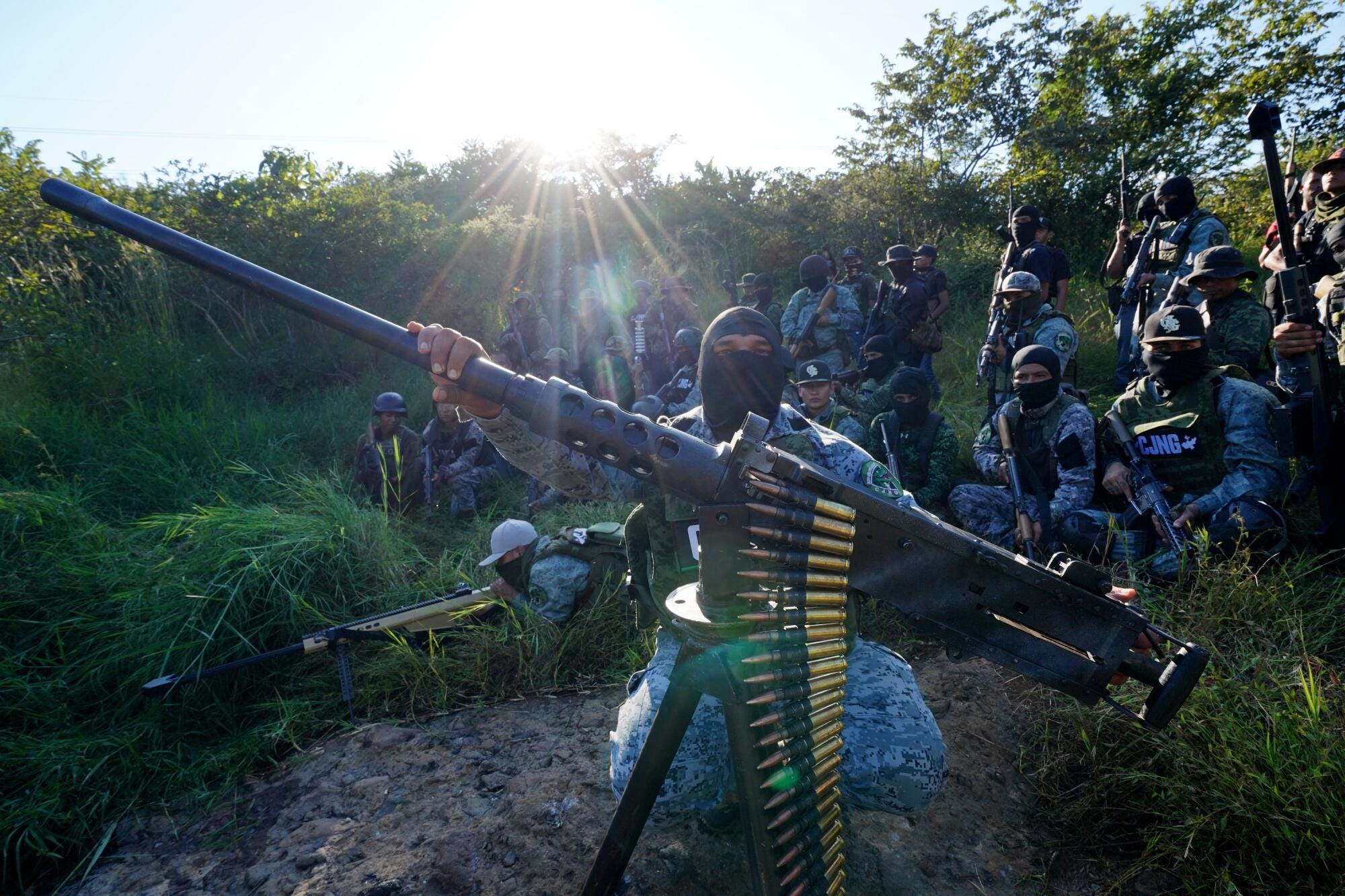
The paramilitary wing he was describing was the Fuerzas Especiales Mencho.
The Structure That El Mencho Built
The Fuerzas Especiales Mencho was not a security detail. It was a military formation.
Founded in 2019 under the command of Juan Carlos Valencia González, El Mencho’s stepson, it drew on everything CJNG had accumulated over a decade of purchasing military expertise. Colombian veterans with AUC-lineage training. Guatemalan special forces alumni. Former soldiers from Honduras and El Salvador. Mercenaries with documented experience in Afghanistan and Iraq. And according to a Telemundo investigation, former US special operations personnel operating under civilian cover.
Within the FEM, the most operationally significant formation that has emerged is Operativa Yogurt, commanded by Abraham Jesús Ambriz Cano, a 29-year-old from Apatzingán, Michoacán who goes by El Yogurt.
In May 2025, the Mexican Navy deployed a full land-and-air assault on El Yogurt’s base in Huitzontla, Chinicuila, Michoacán. The operation was one of the most significant federal deployments against CJNG’s paramilitary wing in years. Twelve of El Yogurt’s fighters were killed. Nine were arrested, among them three Colombian nationals with military backgrounds. Seized at the site: high-caliber weapons, improvised explosives, armored vehicles, tactical uniforms, and berets bearing the words “Fuerzas Especiales Mencho. Operativa Yogurt.”
El Yogurt was not among the arrested.
He escaped protected by Colombian mercenaries. Inside CJNG, surviving a Navy operation of that scale does not go unnoticed. It becomes biography.
The Weapons Pipeline
The training pipeline ran parallel to an equally documented weapons pipeline.
Operation Fast and Furious, run by the ATF’s Phoenix field office between 2009 and 2011, allowed 1,961 firearms to cross into Mexico. The stated goal was to trace weapons to high-value cartel targets. The ATF lost track of the majority of them. By 2012, Fast and Furious weapons had been recovered at crime scenes across Mexico, including at the site of mass killings in Ciudad Juárez. At least 150 Mexican civilians were killed or wounded at scenes where Fast and Furious weapons were later recovered, according to then-former Mexican Attorney General Humberto Benítez Treviño.
The weapons went consistently in one direction: toward the Sinaloa Cartel and its affiliate networks, which included the Milenio Cartel, the organization from which CJNG directly emerged.
Beyond Fast and Furious, the scale of US weapons entering Mexico has never stopped. The Mexican Army announced in 2023 that it had seized a dozen rocket launchers, 56 grenade launchers, and 221 fully automatic machine guns since 2018. ATF agents told reporters that same year that the agency was tracking an ongoing flood of .50 caliber rifles and belt-fed machine guns moving south across the border with minimal interdiction. Mexico filed two separate lawsuits against US arms manufacturers and distributors, alleging that between 200,000 and 500,000 firearms were being smuggled from the United States into Mexico annually.
CJNG’s propaganda videos, which the cartel has produced with the consistency of a media operation since at least 2011, show armored vehicles, rocket-propelled grenade launchers, .50 caliber rifles, and drone units deploying FPV explosives. The weapons in those videos were not manufactured in Mexico.
The Aircraft
On the morning of February 22, 2026, Mexican Army Special Forces conducted a pre-dawn raid on a compound in Tapalpa, Jalisco, a town two hours southwest of Guadalajara that had long been identified as CJNG territory.
El Mencho was there.
He was wounded in the firefight. Four of his fighters were killed at the scene. Three Mexican military personnel were wounded. El Mencho was loaded onto a SEDENA aircraft for transfer to Mexico City.
He was alive when he boarded.
He was dead when it landed.
The Defense Ministry issued a statement. Claudia Sheinbaum praised security forces on X. US Deputy Secretary of State Christopher Landau called it “a great development for Mexico, the US, Latin America, and the world.”
What the official record does not contain: cause of death. Time of death. The chain of custody between Tapalpa and Mexico City. The name of any independent witness present on that aircraft.
The Ministry confirmed that three individuals, including El Mencho, died during air transfer. It confirmed that three military personnel were wounded. It did not open the forensic record to independent examination, because no independent examiner was on that aircraft to produce one.
The Defense Ministry stated the operation had been conducted with “complementary information” from US authorities. That phrase has appeared in every bilateral counter-narcotics communiqué for twenty years. It has never been defined with precision, and it was not defined here.
Seven days before El Mencho died, US Navy SEAL instructors arrived in Mexico as part of what Bureau.news described as a classified program targeting top-level cartel figures. The Joint Interagency Task Force-Counter Cartel, activated January 15, 2026, out of Tucson, Arizona, under the command of Air Force Brigadier General Maurizio Calabrese, whose career was built running intelligence targeting operations at Al Udeid and USNORTHCOM, had been operational for 38 days when El Mencho was killed.
Flight tracking data reviewed in the hours surrounding the operation showed an aircraft using the callsign DRAGN01 with the transponder code 000001, a code Flightradar24 confirmed is not assigned to any aircraft and which AirNav Radar lists under “VARIOUS, Several Different Aircraft,” consistent with documented US military practice of spoofed transponder codes used by special operations aircraft operating in sensitive environments. The aircraft appeared on ground in Mexico during the operation window. A second unassigned aircraft was tracked routing to Hawaii in the hours following the operation, consistent with post-mission reporting to SOCPAC, the Special Operations Command Pacific, headquartered at Camp H.M. Smith, Pearl Harbor.
Both governments have used identical language: a Mexican operation, US complementary intelligence. Neither has addressed the spoofed aircraft, the SEAL instructor timeline, or the forensic vacuum on that flight from Tapalpa to Mexico City.
The Pattern
The pattern across 40 years is not one of rogue actors and operational failures.
Yair Klein arrived in Colombia with Israeli government authorization and weapons permits. The 1991 Senate report confirmed US and Israeli embassy personnel knew what he was doing. The DIA documented it. The CIA, by Klein’s own account, was his original contracting authority. The weapons intended for a CIA Panama operation ended up with the Medellín Cartel because, as Klein describes it, he was told they could.
The AUC soldiers Klein trained became the template for Latin American paramilitary doctrine. That doctrine traveled to Mexico through the mercenary labor market that US-funded counterinsurgency programs in Colombia, Guatemala, and El Salvador spent two decades producing.
The Mexican Special Forces that became Los Zetas were trained by US instructors. When they defected to the cartels, they brought that training with them, intact.
Operation Fast and Furious walked nearly 2,000 weapons into cartel supply chains and lost them.
Former US special operators are named in a 2025 investigative account as active trainers inside CJNG’s paramilitary wing.
None of this requires a conspiracy to explain. It requires only that you accept what the record shows: that the infrastructure of paramilitary violence in Mexico was built with materials the United States and Israel produced, distributed, and in many cases directly provided, and that the organizations that were supposed to destroy that infrastructure have repeatedly created the conditions for its expansion.
El Mencho built the Fuerzas Especiales Mencho on a foundation assembled over four decades by governments whose stated position is that the cartels are the problem.
He is dead now. On a government aircraft, somewhere between Tapalpa and Mexico City, in circumstances no independent authority has examined.
The foundation he built is still there.
This investigation draws on the 1989 Senate Committee on Foreign Relations report, the 1991 US Defense Intelligence Agency narco-terrorism report, Colombian court records and Interpol documentation on Yair Klein, ATF Inspector General findings on Operation Fast and Furious, the 2019 Telemundo investigation by Sin Embargo, Seth Hettena’s March 2025 investigation for The Iceman, Mexican Army intelligence documents from the Guacamaya leaks, Guacamaya-published SEDENA files on Colombian mercenary movements, ITAM national security research, the Mexican Defense Ministry operational statement of February 22, 2026, ADS-B Exchange and Flightradar24 flight data, JIATF-CC public documentation, and Bureau.news reporting on US Navy SEAL instructor deployment.


