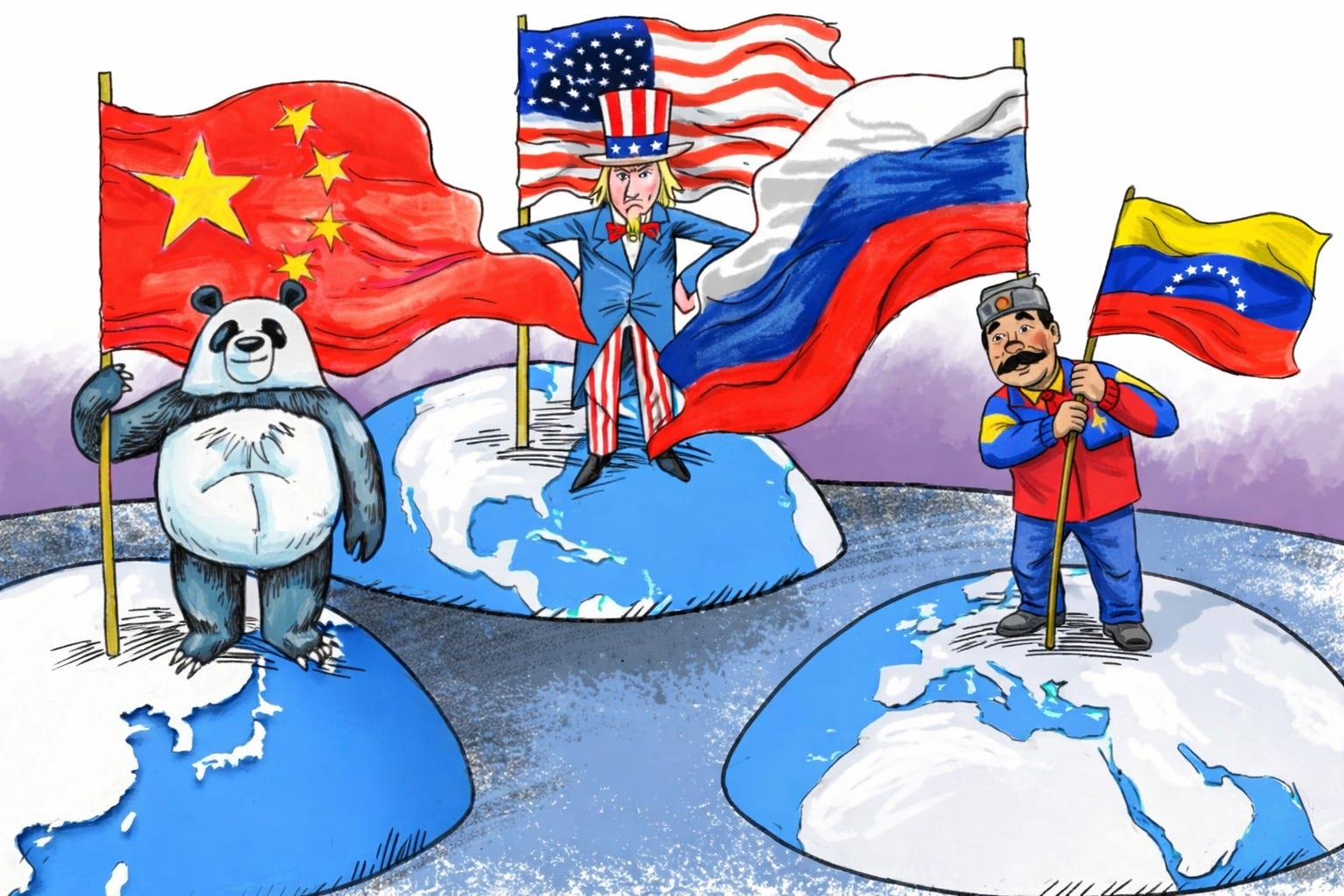
Maduro’s Fall, Russia’s Opening
How Venezuela’s shock upheaval tightens oil markets, nudges China toward Russian barrels, and leaves Moscow trading lost influence for higher‑priced exports.
The abuction of Nicolás Maduro by American forces is already reshaping the political map of the Americas. It also opens up a set of risks and opportunities in global energy markets that, on balance, may modestly favor Russia rather than sideline it.
For years, Venezuela has been more than a distant client for Moscow; it has been a showcase and a hedge. Caracas gave Russia a foothold in the Western Hemisphere, a partner willing to echo its rhetoric on US power, and an energy relationship that functioned as sanctions insurance. Russian firms invested capital and technology in Venezuelan fields while Western majors retreated, tying loans directly to future oil shipments and anchoring Russia in the Maduro era.
Regime change destabilizes that arrangement. A leadership that owes its survival to US military and diplomatic backing will be under pressure to revisit contracts and debts signed under sanctions and authoritarian rule. To gain legitimacy at home and reenter Western markets, a post‑Maduro government is likely to reopen oil deals, question how past loans are treated, and invite US and European majors back on more transparent terms. Russia will not be frozen out by default, but it will be one bidder among many rather than a privileged partner.
The simple story says none of this matters because oil is fungible: Venezuelan barrels lost to China will be replaced by Russian barrels. Reality is more nuanced. Venezuelan crude represents only a slice of China’s total imports, and Beijing has deliberately diversified suppliers across the Middle East, Russia, West Africa, and Iran. Disruption in Venezuelan flows is a problem for specific refiners, not a structural shock that forces China into an exclusive embrace with Moscow.
Yet even a limited disruption can work to Russia’s advantage. In a market already shaped by sanctions on Russian energy and periodic supply scares, the loss or delay of Venezuelan exports tightens balances at the margin and supports prices. Russia remains a large, flexible supplier into Asia, and higher global prices can improve its overall revenue position even if volumes are capped and discounts persist. For Moscow, that combination—constrained but better‑priced exports into a nervous market—is preferable to a world where Venezuelan barrels flood back quickly and heavy crude is abundant.
China’s behavior reinforces this dynamic. Beijing buys Russian oil on hard commercial terms, driven by discounts rather than political solidarity, but it has not walked away from Russian supply. Instead, Chinese refiners have used sanctions pressure to negotiate lower prices while keeping Russia as a core component of their import mix. If Venezuelan shipments become less reliable, China has every incentive to lean a bit more on Russian crude, especially if Moscow remains willing to price aggressively. That does not make Russia a clear winner, but it does mean that the “replacement” story contains a kernel of truth in the short to medium term.
Venezuela’s role in the shadow oil system is another important piece. Under sanctions, a network of traders, ghost tankers, and shell companies blended and re‑routed cargoes from Venezuela, Russia, and Iran, blurring origin and destination. Russian actors benefited from this plumbing, which helped move barrels outside formal channels and soften the impact of Western restrictions. A new government in Caracas that seeks sanctions relief and normal ties with Washington will have strong reasons to clamp down on this gray zone, both to unlock financing and to clean up the national oil company’s image. That reduces Russia’s room to maneuver in the black‑market ecosystem, but it also channels more volumes back onto visible routes, where price effects from any disruption can be larger and more immediate.
The clearest loss for Moscow is political. Venezuela has been one of the most vocal Southern backers of Russian positions at the United Nations and in broader debates over a multipolar order. If a post‑intervention government aligns more closely with Washington, it will be read across the Global South as a setback for Russia’s influence and a warning to leaders who have tried to hedge between rival blocs. That kind of symbolic defeat matters, especially as Russia leans more heavily on narratives of resistance to US power.
Still, the overall balance sheet is not one‑sided. Russia loses a degree of insider leverage in Caracas and a friendly voice in multilateral forums, but it gains from a tighter heavy‑crude market, a nervous price environment, and a Chinese demand structure that continues to rely on Russian barrels as a key input. The more slowly Venezuela returns to stable, large‑scale exports under a US‑aligned government, the more time Moscow has to monetize its position as a sanctioned but indispensable supplier.


