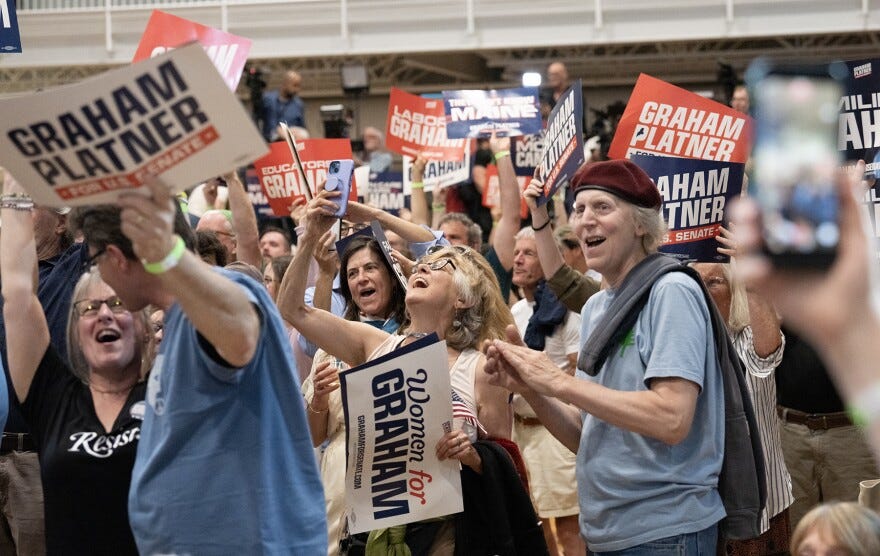
On June 9, 2026, Maine Democrats handed Graham Platner 72% of the vote in a primary that the political and media establishment had spent the better part of a year trying to ensure he never won. By the morning of June 10, the New York Post was running a headline that called it gloating. The Wall Street Journal ran an opinion piece titled “The Real Problem With Graham Platner.” The Republican Jewish Coalition called Senate Democrats “ashamed” for tolerating him. A sitting House Democrat said his tattoo should be disqualifying. And a RealClearPolitics aggregate published the same week showed him leading Susan Collins, the four-term incumbent Republican who has survived every Democratic challenger thrown at her since 1996, by 7.4 points.
Let’s sit with that gap for a second, because the gap is the story. Everything the machine had, it used. And the people of Maine looked at all of it and said, not yet, not this time, we’re voting for the oyster farmer.
What they threw at him
Start with the inventory. Platner has a Totenkopf, a skull-and-crossbones tattoo associated with Nazi SS units, on his chest. He got it in 2007, drunk, in Croatia, as a young Marine who says he didn’t know what it meant until it was pointed out to him decades later, at which point he had it covered up in October 2025, before it became a national story. He has old Reddit posts, eight to thirteen years old, written under a pseudonym during a period he describes candidly as one where he came back from war “angry, crude, and struggling mentally,” posts that asked tone-deaf questions about race, called rural white Americans racist, and made comments about sexual assault that he has since apologized for without qualification. He has ex-girlfriends who have come forward with allegations of toxic behavior and explicit messages sent during a marriage. He called himself a communist online. He has, in other words, handed his opponents a decade of raw material, and they used every page of it.
And then there’s the thing that actually explains why the Republican Jewish Coalition, the Wall Street Journal editorial page, and a chunk of his own party’s donor class lit up in the same 72 hours: Platner posted that one-third of Susan Collins’ fundraising this quarter came directly from AIPAC, and said out loud what a lot of people in Maine have been thinking quietly for years, that Collins is bought and paid for by a foreign government’s lobbying apparatus. For that sentence, he was called antisemitic by people who did not dispute the underlying number. They disputed his right to say it.
This is the part worth sitting with longest. A military veteran, a man who actually wore the uniform and went to war for this country, looked at his own senator’s campaign finance disclosures, did the arithmetic, and said the thing that the disclosures themselves already said. And the response from a meaningful slice of the establishment was not “here’s why that number is misleading.” It was a coordinated effort to make the saying of it the scandal, while the tattoo, the Reddit posts, and the personal allegations got run in parallel, a wall of noise designed to bury one inconvenient sentence about AIPAC under an avalanche of everything else.
Maine Democrats voted anyway. Three out of every four of them.
The establishment script, and why it didn’t work
Janet Mills, the sitting Democratic governor, ran against Platner first, on character. She dropped out in April 2026. Then came the tattoo story, then the Reddit posts, then the sexting allegations, each one timed with the precision of a release schedule rather than the chaos of organic discovery. By the time the primary actually happened, the strategy had become so transparent that even the National Republican Senatorial Committee, the body whose entire job is to defeat Platner in November, had to publicly concede he was ahead. When your opponent’s own attack machine admits you’re winning days before the vote, the attack machine has stopped being a threat and started being an advertisement for what it’s afraid of.
Platner’s response to all of this was not a polished crisis-management rollout. He went on Pod Save America and talked about the Reddit posts in his own voice, plainly, without a communications team’s fingerprints on every sentence. He covered the tattoo and explained, without performing contrition theater, what it was and wasn’t. And then he said the sentence that the entire piece hinges on: “This is the political establishment doing its best to make sure that people like me, who have lived lives that are sometimes flawed, they’re going to try to send the message that if you ever attempt to get into power, we will crush you.”
That is not spin. That is a description of what actually happened to him, in real time, on a timeline anyone can reconstruct from the press archive of the last twelve months. And Maine voters, who have spent those same twelve months watching grocery prices, heating oil, and prescription costs do things that no amount of Washington messaging has fixed, recognized the description as accurate, because it matches their own experience of being told their problems are someone else’s fault, their representatives are unreachable, and their concerns are beneath the people who claim to speak for them.
Why “the common man” isn’t a slogan here
Every candidate in America claims to speak for the common man. It is the most debased phrase in the language, deployed by hedge fund managers running for Senate, by dynastic political families three generations deep in the same House seat, by people whose actual lived experience of an electric bill is reading about it in a briefing memo. The phrase has been said so many times by people for whom it isn’t true that an entire generation of voters has learned to hear it as noise, the political equivalent of a car alarm nobody looks up for anymore.
What’s different about Platner is not that he says the phrase. It’s that the things being used against him are themselves evidence that the phrase is true. A man who has spent his adult life as an oyster farmer, a bartender, and a combat veteran is going to have a Reddit history that looks like an actual person’s Reddit history, messy and unfiltered and written at 2am after a bad day, not the laundered, focus-grouped digital footprint of someone who has been preparing for office since law school. A man who got a bad tattoo drunk at 23 because that’s what 23-year-old Marines sometimes do is going to have a bad tattoo. The opposition research that was supposed to be disqualifying is, read a different way, a biography. It is the actual texture of an actual life lived among actual people, the kind of life that does not survive contact with a Senate confirmation-style background check because it was never lived with a Senate seat in mind.
Compare that to the candidate the money was protecting. Susan Collins has been in the Senate since 1997. Her fundraising, by Platner’s own arithmetic, runs a third AIPAC in a single quarter. She is, by every structural measure, the establishment, not as an insult but as a literal description of where her money comes from and how long she has occupied the seat. The contest in Maine right now is not between two flawed people. It is between a man whose flaws are the ordinary flaws of an ordinary American life laid bare under a microscope built to destroy him, and an institution whose primary qualification is that it has never had to survive that microscope, because it has spent thirty years being the one that builds it.
The AIPAC sentence, again, because it’s the one that matters
Strip away the tattoo, the Reddit posts, the personal allegations, all of it real, all of it litigated, all of it survived. What’s left is the sentence that actually triggered the most concentrated institutional response: a Senate candidate said his opponent’s campaign finance disclosures show a foreign lobbying operation funding a third of her quarter, and named the lobby. That sentence is checkable. Nobody who attacked Platner over it produced a number that contradicted it. They produced outrage at the saying.
This is the mechanism FTGN has documented across multiple races this cycle: AIPAC and its affiliated structures do not generally win arguments about their influence by winning the argument. They win by making the argument itself the disqualifying act, so that the candidate who points at the documented number spends the next two weeks explaining why pointing at a documented number isn’t bigotry, while the number itself never gets discussed. It worked on other candidates, in other states, in other years. It did not work in Maine, in June 2026, against a man who had already been told by every institution that mattered that he was finished, and who therefore had nothing left to lose by simply being right.
What the 72% actually says
Seventy-two percent is not a margin. It’s a verdict on the strategy used against him. Maine Democrats were shown, in sequence, a Nazi-adjacent tattoo, a decade of ugly internet posts, and allegations of personal misconduct, the full opposition-research arsenal, deployed with the kind of timing that suggests it was held in reserve and released deliberately. They looked at all of it, weighed it against a man who farms oysters, served in the Marines, and said out loud what they already suspected about where their senator’s money comes from, and they chose him by a margin that no amount of post-primary spin can make look like anything other than what it is: a rejection, not just of Susan Collins, but of the entire apparatus that spent a year trying to make sure Susan Collins never had to answer for the AIPAC number in the first place.
Whether Platner wins in November against an incumbent who has never lost is a separate question, and an honest one. He has handed Collins’s campaign a year’s worth of attack ads already cut and ready to air, and the general electorate is not the same electorate that just gave him 72% in a Democratic primary. But that is November’s question. June’s question was simpler: can a man with an unvarnished, occasionally ugly, entirely real biography, who says the true thing about a powerful lobby out loud, survive the machine built to make sure people like him never get the microphone. Maine answered that question on June 9th, and the answer was not close.


