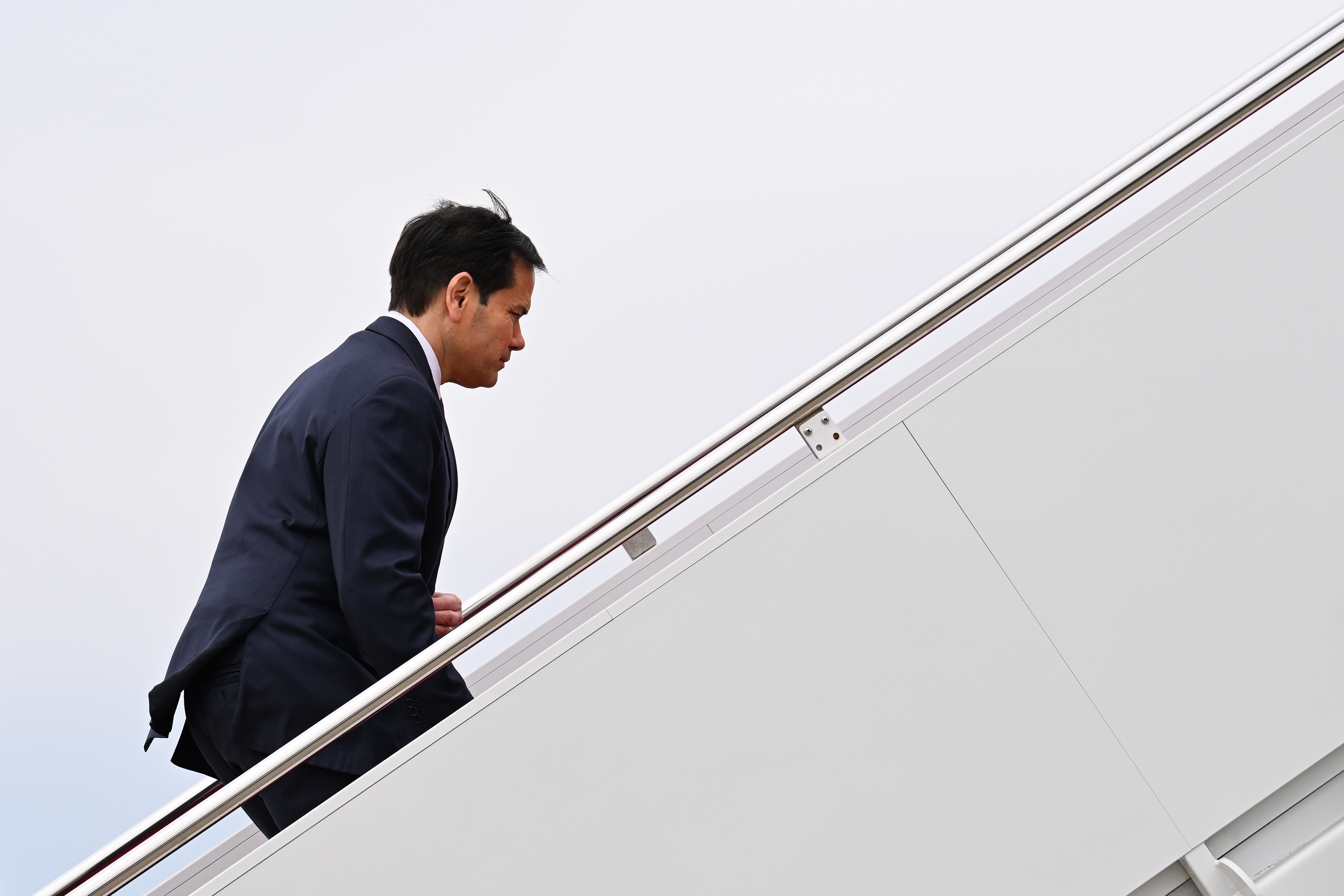
On the morning of March 30, Donald Trump posted to Truth Social that the United States was engaged in talks with “A NEW, AND MORE REASONABLE, REGIME” in Iran. The announcement was characteristically capitalised, unhedged, and factually unsourced. Less than an hour later, Secretary of State Marco Rubio appeared on ABC’s Good Morning America and described something considerably more uncertain. “We have to see if these people end up being the ones in charge, seeing if they are the ones that have the power to deliver,” Rubio said. He characterised the administration’s posture as testing an unverified interlocutor. “We’re gonna test it.”
Rubio was methodically walking back a claim his boss had just broadcast to millions of followers, doing it carefully enough to preserve plausible loyalty while making clear, to anyone paying attention, that no new Iranian regime had been identified and no talks of the kind Trump had described were confirmed. Rubio remained in his post. No correction was issued from the White House. The press cycle moved on.
What stayed behind was a structural question that the episode made legible: who, exactly, is running the Iran file? And how did the United States arrive at a moment where its Secretary of State publicly contradicts its president on the central factual premise of an active war, in a morning television appearance, and the answer to both questions remains genuinely unclear?
The Secretary of Everything
The official version is that Marco Rubio is indispensable. He holds, simultaneously, the positions of Secretary of State and National Security Adviser, a combination of authority without historical precedent except for a single prior case. Henry Kissinger occupied both roles in the Nixon and Ford administrations, and the comparison has been cited approvingly by Rubio’s allies as evidence of his reach. Trump, the argument goes, trusts Rubio with everything.
The data tells a different story. During his first fifteen months in office, Rubio has spent seventy-one days travelling abroad, fewer than any other Secretary of State in this century over the equivalent period. Compared to his recent predecessors, from John Kerry through Rex Tillerson, Mike Pompeo, and Antony Blinken, Rubio is, by the measure of overseas engagement, the most stationary chief diplomat in a generation. For a Secretary of State, travel is not incidental. It is the job. The meetings that do not happen in Washington happen in foreign capitals, and the foreign capitals have noticed.
Daniel Drezner, professor of international politics at the Fletcher School at Tufts University, collapsed the Kissinger comparison into a single sentence: “Everything was his portfolio,” Drezner said of Kissinger. “Rubio: it seems like nothing is his portfolio outside of Latin America.” The line is more precise than it sounds. Kissinger’s dual appointment concentrated authority to the point of monopoly. Foreign governments knew exactly who held American foreign policy in their hands, and they called that person. The arrangement was widely criticised for its opacity and its exclusion of the State Department’s institutional expertise, but no one doubted its coherence as a power structure. Rubio’s arrangement, nominally identical on paper, produces something closer to the inverse: two titles and, on the war that will define the Trump second term, jurisdiction over none of it.
The Iran negotiations, as of late April 2026, are being managed by Vice President JD Vance, special envoy Steve Witkoff, and Jared Kushner, Trump’s son-in-law. Vance led the first US delegation to Islamabad in early April, spent twenty-one hours in negotiations with Iranian counterparts, and returned without a breakthrough. Witkoff and Kushner have now been dispatched for a second round. Iran’s Foreign Ministry has denied that any direct meeting is scheduled with American officials. The White House insists talks are happening. This is the fourth consecutive week in which both sides have issued contradictory accounts of whether negotiations are occurring, who is speaking to whom, and what would constitute progress. In none of these accounts, official or disputed, does the Secretary of State appear; on the evening Vance was in Islamabad exhausting twenty-one hours of talks, Rubio was at a UFC event in Miami with the president.
Fourteen Years of Groundwork
To understand why Rubio is not in Islamabad, you have to go back to 2011, the year he arrived in the United States Senate as one of the chamber’s most prominent first-term hawks on Iran. The record he built over the following fourteen years is not ambiguous, and Iran’s negotiators have read it.
He opposed the 2015 Joint Comprehensive Plan of Action from its announcement, co-sponsoring bipartisan legislation that would have expanded sanctions on Iran’s ballistic missile programme, formally designated the Islamic Revolutionary Guard Corps as a terrorist organisation under US law, and imposed mandatory penalties on anyone involved in conventional arms transfers to or from Tehran. He called the deal “terrible” and argued it “pays the money they are using to fund those things.” He pressed European partners publicly and in writing to abandon efforts to preserve the agreement after Trump’s 2018 withdrawal.
After the withdrawal, his demands escalated. He called for the Central Bank of Iran to be severed from the SWIFT financial messaging network. He pushed to eliminate all oil sanction waivers, including those extended to China, which he described as a “financial reprieve” the regime did not deserve. In a 2023 letter signed alongside several Senate colleagues and addressed to secretaries Blinken and Yellen, he documented Iran’s ghost armada, then at 338 vessels, and demanded sanctions against Chinese individuals and entities purchasing Iranian-origin oil. The letter described Iran as having received roughly forty-seven billion dollars in Chinese oil purchases since Biden took office. And at some point in the preceding years, Rubio met with Reza Pahlavi, the son of the Shah deposed by the 1979 revolution. The meeting was not widely reported and has not been formally entered into the record of official diplomatic engagements. But in the architecture of Iranian political psychology, the Shah’s dynasty is not a historical chapter. It is the constitutive grievance of the Islamic Republic. The revolution justified itself in opposition to the Pahlavi order, and the clerical establishment has maintained that justification across nearly five decades of governance. A sitting United States Senator meeting with the heir to the deposed Shah is not an abstraction to Iranian negotiators. It is a data point that lands in a specific place in the ledger of American intentions toward their state.
Rubio also, in September 2025, praised the E3’s triggering of the UN sanctions snapback as “an act of decisive global leadership.” The snapback restored sanctions lifted under the nuclear deal, eliminated one of the last formal multilateral buffers between Washington and Tehran, and arrived five months before Operation Epic Fury launched on February 28, 2026. Rubio, as Secretary of State, celebrated the mechanism that removed the buffer.
None of this adds up to a man Iran’s government would choose to negotiate with. No official “no Rubio” condition has been publicly announced by Tehran. But the pattern of his exclusion from talks that have involved Vance, Witkoff, and Kushner across multiple rounds is not accidental, and several analysts have noted that Iran’s incentive to keep him out is structurally obvious. As one framing in the American press put it: if you are Tehran, you would rather bargain with a real estate developer than with the man who co-authored the ideological architecture of your destruction and met with the Shah’s son.
The Architecture of Improvised Diplomacy
Steve Witkoff is a property developer from New York who has been friends with Trump for decades. Jared Kushner is Trump’s son-in-law. Together, they have been assigned the United States’ three most consequential active diplomatic files: the war in Ukraine, the Gaza ceasefire, and now the Iran war negotiations. They helped broker a ceasefire in Gaza in Trump’s first weeks in office. They have met with Vladimir Putin. They are now shuttling to Islamabad to sit across from Iran’s Foreign Minister Abbas Araghchi, or to wait in Pakistan while Araghchi meets with Pakistani mediators and denies any planned meeting with Americans.
The use of personal envoys in sensitive diplomatic work is not unique to this administration. Barack Obama deployed a series of high-profile special envoys for Iran, Northern Ireland, and the Middle East. Joe Biden maintained the practice. What is structurally different in Trump’s second term is the scope: the same two men, both without formal diplomatic backgrounds or institutional knowledge of the countries they are negotiating with, are the principal American interlocutors for conflicts on three separate continents, while the State Department and its career officials function largely as an administrative layer beneath them.
Ryan Crocker, who served as US ambassador to six countries including Iraq, Afghanistan, Pakistan, and Syria, told the Financial Times that Rubio’s diminished public role reflects something more systemic than personnel management. It suggests, Crocker said, “the end of the post-World War Two world order dominated by the US. Not because we’re being pushed out but just because we don’t want to do it anymore.” What Crocker did not say, but the structure implies, is that improvised diplomacy conducted by personal loyalists without institutional grounding tends to produce exactly the kind of outcome currently visible in Islamabad: simultaneous contradictory statements from both sides about whether talks are happening at all, a war that has extended past its promised timeline, and no agreement.
Rubio himself told Al Jazeera in late March that the war’s objectives would be achieved “in a matter of weeks, not months.” He was describing the destruction of Iran’s navy, air force, missile production facilities, and missile launchers. It is now late April. The ceasefire has been extended. The timeline has not been formally revised, only quietly abandoned. Iran is not at the table in any confirmed sense. And the administration is dispatching a real estate developer and a presidential son-in-law to a Pakistani intermediary to see what, if anything, can be salvaged before the pressure calculus shifts again.
The 2028 Variable
The political arithmetic surrounding Rubio’s absence from Iran talks is not subtle. The Conservative Political Action Conference straw poll, released in late March, showed Vance at fifty-three percent support for the 2028 Republican presidential nomination. Rubio finished second at thirty-five percent. A year earlier, Rubio had registered three percent in the same survey. The jump of thirty-two points over twelve months is the kind of movement that political operatives notice and strategists try to understand.
The most coherent explanation is that Rubio has successfully maintained loyalty to Trump without absorbing the political cost of the war’s ambiguities. Vance has been visible, physically present in Islamabad, and publicly cautious about the administration’s shifting objectives. He is, as one Republican in Dallas told CNN at CPAC, “tied to this war.” Rubio has been audibly supportive and operationally distant. He delivers the administration’s public case with precision. At a televised Cabinet meeting in March, he gave a full-throated defence of Trump’s strikes: “He’s not going to leave a danger like this in place.” But he has not been the one sitting in the room when the danger refuses to resolve.
Stephen Walt, professor of international relations at Harvard, offered a clean read of the incentive structure: “Rubio may already sense that Iran is a complete loser, and the less he is associated with it, the better.” A former senior Republican aide, speaking to the Financial Times about the possible failure of negotiations, was blunter. If talks collapse, he said, that failure attaches to Vance. “Net plus Rubio.”
Matt Schlapp, who runs CPAC, described the war’s political stakes with the neutrality of someone who has been watching Republican presidential ambitions for two decades. “If it is seen as successful at getting the job done, I think people will be politically rewarded for doing the right thing,” he said. “If it goes on and on and on, I think the politics are tough.” By late April, it has been going on for fifty-six days and counting. The administration has been in Pakistan twice without a ceasefire. Trump has said he is “in no rush” to make a deal, that the war has had less of an effect on stocks and oil prices than he expected, and that he does not yet know the details of what Iran might offer. JD Vance is on standby. Rubio is not mentioned.
Jeremy Shapiro, research director of the European Council on Foreign Relations, described Rubio’s operational mode as finding ways to promote progress on issues important to him “but fashioning them in ways that are appealing to the president.” That description, loyalty as repackaging rather than alignment, is the most accurate account of how Rubio has survived, and risen, in a second Trump term that has run headlong against virtually everything he built his Senate reputation on. He supported Ukraine aid when Russia invaded in 2022, then sat silent on a gold couch as Trump and Vance berated Volodymyr Zelenskyy in the Oval Office. He spent a decade calling for maximum pressure on Iran and is now Secretary of State while maximum pressure becomes a live bombing campaign he is not managing.
What changes with each accommodation is the substance, not the loyalty, and the war is the clearest case so far.
What the Record Does Not Answer
The March 30 contradiction on Good Morning America did not produce a correction, a reprimand, or a clarification from the White House. Trump did not publicly acknowledge it. Rubio was not removed, reassigned, or asked to elaborate. The administration continued issuing statements about the war’s objectives, the timeline, and the status of negotiations, many of which contradicted each other across a span of hours, and Rubio continued to appear on television to explain them.
This is the texture of the administration’s foreign policy management on Iran: a war launched on February 28 with objectives that have shifted from regime change to nuclear disarmament to “a matter of weeks”; negotiations conducted by a real estate developer and a presidential son-in-law who are flying to Pakistan while Iran’s Foreign Ministry denies they have an appointment; a Secretary of State who publicly contradicted the president’s announcement of a new Iranian regime and remained in his post because the announcement was not true and everyone above him either did not notice or preferred not to address it.
What the record cannot establish is whether Rubio’s exclusion from the Iran negotiations is his own preference, a condition that Tehran has imposed, or a function of Trump’s instinct to assign the work he cares most about to the people closest to him personally. All three explanations fit the available evidence without contradiction. The formal answer, offered by White House spokesperson Olivia Wales, is that Rubio “is a trusted voice in every national security discussion.” The operational answer is that he has not been to Islamabad.
The question that stays open is whether, when this war ends, Rubio’s careful distance will have been enough to keep him clean, or whether fourteen years of public advocacy for the conditions that made the war possible will eventually attach itself to the outcome regardless.
Fourteen years constructing the ideological case for a confrontation with Iran, and when the confrontation came, they gave him the briefing room.


