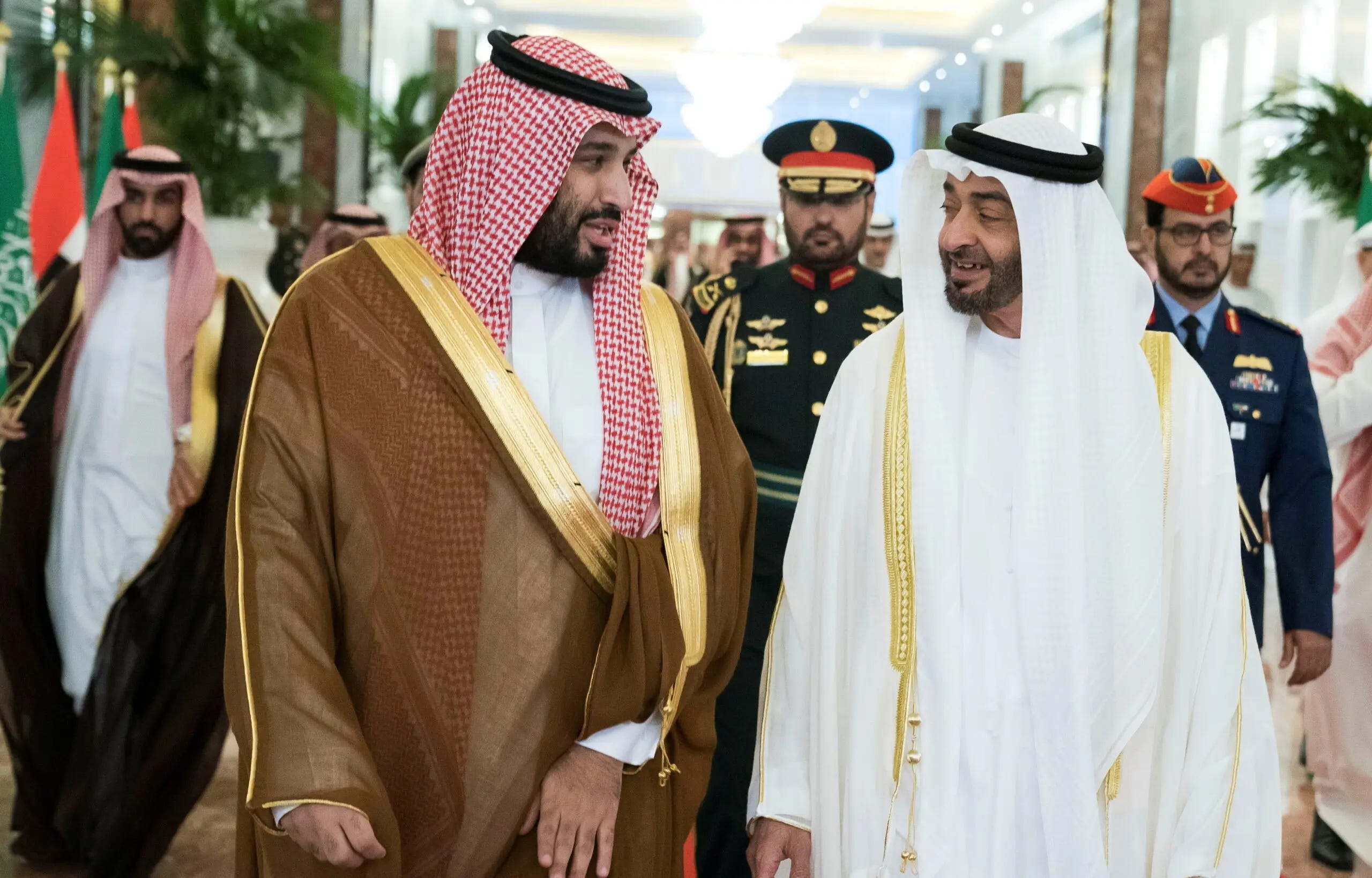
Sixty-seven days into a regional war that has kept the Strait of Hormuz functionally closed and placed Israeli troops on Arab soil for the first time in history, Iran has not struck Saudi Arabia in twenty-seven days. It struck a UAE tanker in the Strait of Hormuz this morning.
The ceasefire does not explain this. Iran launched seventeen ballistic missiles and thirty-five drones at the UAE on April 8, the same day its Supreme National Security Council formally accepted the ceasefire framework. It struck Kuwait, Bahrain, and Qatar on ceasefire day. The IRGC is not standing down. It is selecting. And the selection, maintained without interruption for four weeks across a conflict in which Iran’s targeting architecture has demonstrated both the reach and the willingness to hit Riyadh, Ras Tanura, and Prince Sultan Air Base repeatedly, is the most significant geopolitical fact in the Gulf today. It is not being written about correctly, because writing about it correctly requires saying that Saudi Arabia and Iran are running a quiet bilateral accommodation in the middle of a war that Washington believes it is managing, and that the accommodation was built across three years of moves that the international press covered as normalization, economic repositioning, and diplomatic routine.
The moves were none of those things. They were the deliberate, sequential construction of a strategic position that has now, under live war conditions, delivered Saudi Arabia the following: its oil infrastructure exporting through a bypass route that no other Gulf state possesses, its territory not under Iranian fire, its diplomatic credibility intact with every actor who will write the postwar order, and its principal regional rival absorbing saturation bombardment while hosting Israeli troops and requesting emergency financial support from Washington. Mohammed bin Salman did not improvise this. He built it, piece by piece, across years in which Mohammed bin Zayed was too busy building a different kind of power to notice what kind of power actually survives a real war.
Two months before the first US-Israeli strike on Iran, Saudi Arabia intervened militarily in Yemen and expelled the UAE from the country entirely. This fact was reported and then forgotten inside the noise of the conflict’s opening weeks. It should not have been forgotten. It is the precondition for every subsequent advantage Riyadh now holds.
The Southern Transitional Council was Abu Dhabi’s operational foothold in Yemen: Emirati-trained, Emirati-funded, Emirati-directed. The STC controlled Yemen’s southern coast, which runs along the eastern approach to the Bab al-Mandeb, the seventeen-mile-wide strait between Yemen and Djibouti through which the Red Sea’s entire northbound traffic must pass. Every barrel Saudi Arabia pumps west through the Petroline to Yanbu, every VLCC loaded at the Red Sea terminal and dispatched toward the Suez Canal, depends on that strait remaining open. The Houthis, who control the Yemeni coast directly across from Djibouti, have demonstrated since late 2023 that they can close it when they want to. They chose, for fourteen months of Red Sea attacks between 2023 and 2025, not to close it entirely, preferring selective interdiction. The capability is not in question.
In December 2025, Saudi Arabia reversed the STC’s seizure of Yemen’s eastern governorates and Aden, the seat of the internationally recognized government, expelled Emirati forces, and reasserted itself as the dominant external power in the country that controls the eastern shore of the only functioning oil export route from the Gulf. The operation was swift, overwhelming, and calibrated to a specific strategic purpose that its timing now makes obvious. Saudi Arabia was not resolving a Yemen complication. It was preparing the ground for a regional war it had reason to believe was coming.
The Houthis did not close the Bab al-Mandeb when Epic Fury began. In the third week of the conflict, Houthi officials told Reuters they were considering it. By late March, IRGC senior commanders were publicly pressing the Houthis to act, describing the strait’s closure as the weapon that would “break the American siege” of Iran’s economy. The Houthis declined. Retired Egyptian brigadier Samir Ragheb, speaking to the Middle East Monitor in early April, stated plainly that the Houthis had “a deal with the Americans and perhaps also an understanding with the Saudis.” The International Crisis Group’s Michael Hanna, careful with his language, described the restraint as possibly reflecting “strategic patience at Tehran’s direction.” Both explanations can be simultaneously true. What they agree on is that the restraint was not accidental. It was agreed.
The content of whatever agreement or understanding governs Houthi behavior is not in the public record. What is in the public record is the December 2025 intervention that repositioned Saudi Arabia as the controlling external power in Yemen before the war began, and the subsequent four months in which the Bab al-Mandeb has remained open while the Strait of Hormuz has not. Saudi Arabia arrived at this war holding the exit route. The UAE arrived at this war dependent on a bypass pipeline, Fujairah, whose 1.5 million barrel per day capacity represents roughly a third of Abu Dhabi’s pre-war output, and whose oil terminal was struck on April 8.
The 1,200-kilometer pipeline from Abqaiq to Yanbu was built in 1981 because the Iran-Iraq War demonstrated that Persian Gulf access could not be assumed. Saudi Arabia spent four decades developing it precisely for the scenario that arrived on February 28, 2026. When Hormuz closed, Aramco brought the Petroline to full emergency capacity, including converted natural gas liquids lines, in under three weeks. By the week ending March 23, Yanbu was loading 4.6 million barrels per day. Oil was leaving Saudi Arabia while the Gulf was a closed sea, at $120 per barrel, which is roughly double the pre-war price, which is the price created by the same closure that forced Saudi to use the route it had spent forty years preparing. The financial arithmetic is not complicated. Saudi was selling less volume at twice the price, and the Petroline was the instrument that made selling possible at all.
On April 8, hours after Tehran formally accepted the ceasefire framework, an IRGC drone struck a pumping station on the Petroline, reducing throughput by approximately 700,000 barrels per day. This is the event that complicates the simpler version of the Saudi-Iran accommodation thesis. The White House acknowledged on ceasefire day that halt orders would take time to reach IRGC units operating autonomously, and the IRGC’s command architecture is designed precisely for decentralized action. Whether the April 8 Petroline strike was a rogue unit operating before a halt order reached it or a deliberate final message delivered on the way out of active hostilities, it was repaired, and nothing has touched the pipeline since.
The contrast with the UAE’s experience on the same day tells the story precisely. On April 8, Iran launched seventeen ballistic missiles and thirty-five UAVs at the UAE. The Habshan gas complex was hit, injuring two Emiratis and one Indian national. The Fujairah oil terminal was struck, with documented fires and damage. Since April 8, Iran has struck a UAE tanker in the Strait of Hormuz and has maintained a posture of continued pressure against Emirati economic infrastructure. Saudi Arabia’s single April 8 pumping station strike was followed by twenty-seven days of nothing. The UAE’s ceasefire-day bombardment was followed by continued targeting.
These are not two versions of the same Iranian ceasefire policy. They are two different Iranian policies, applied to two different Gulf states, during the same nominal ceasefire period. The differentiation is the evidence. It does not require a published agreement to be real. It requires only that someone in the IRGC’s command structure decided, and kept deciding, every day for twenty-seven days, that the pumping stations along a 1,200-kilometer Saudi pipeline were not worth hitting while Emirati tankers in the strait were.
In September 2025, five months before Epic Fury began, Saudi Arabia signed a mutual defense treaty with Pakistan. The agreement stipulates that an attack on either signatory constitutes an attack on both. When Iranian missiles were landing on Saudi territory in March 2026, Pakistan’s Foreign Minister publicly reminded Tehran of the agreement’s existence. Pakistan then sent 13,000 troops and fighter jets to Saudi Arabia after the ceasefire.
This is one half of what Pakistan was doing simultaneously. The other half was serving as the primary ceasefire mediator between Washington and Tehran. Pakistan’s Prime Minister Shehbaz Sharif announced the April 7 ceasefire framework. JD Vance and Iranian parliament speaker Mohammad Bagher Ghalibaf met in Islamabad on April 11 and 12 for the highest-level direct US-Iran engagement since 1979, again on Pakistan’s territory and under Pakistan’s facilitation. The country that brokered the ceasefire is contractually obligated by a treaty Saudi Arabia drafted to treat Iranian aggression against Saudi Arabia as aggression against itself.
Saudi Arabia did not discover Pakistan’s value as a diplomatic intermediary in March 2026. The September 2025 mutual defense agreement came after the 2023 Saudi-Iranian rapprochement brokered by China, itself a construction that Riyadh pursued over years of back-channel engagement that Washington watched with growing unease. Saudi Arabia had spent 2022 and 2023 making itself simultaneously indispensable to Washington as a basing platform for CENTCOM operations and indispensable to Beijing as a supplier of the crude China needs to maintain economic growth without dependence on American-aligned energy markets. The China-brokered rapprochement was the formal statement of that position: Saudi Arabia would not be exclusively aligned with any external power, and the instrument of non-alignment was a documented institutional relationship with Iran’s closest great power patron.
The Foundation for Strategic Research noted in April 2026 that Saudi Arabia remained hesitant about deeper military involvement because it “could undermine the remaining diplomatic channels with Tehran.” The word “remaining” carries the weight. The channels were not created by the war. They survived it. They exist because the 2023 rapprochement, which Washington framed as a Saudi concession to Chinese pressure and the UAE framed as a naive accommodation of a predatory neighbor, was in fact the institutional infrastructure through which the back-channel that now governs Iranian targeting decisions against Saudi territory operates. It was built in peacetime to function in exactly this scenario.
The UAE has no equivalent construction. It closed its embassy in Tehran on day one of the conflict. It arrested IRGC-linked money changers. It revoked residency permits for Iranian nationals. It demanded, through its ambassador’s Wall Street Journal op-ed and through its foreign minister’s public statements, reparations, Iranian asset freezes, and permanent Emirati sovereignty over its airspace and maritime approaches as conditions for any ceasefire. These are the conditions of a state that believes its external protectors will enforce them. They are not the conditions of a state that has preserved the diplomatic architecture to negotiate anything.
The September 2020 Abraham Accords normalized UAE-Israel relations and were received in Washington as the signature foreign policy achievement of Trump’s first term. They were received in Riyadh as a unilateral UAE departure from the Arab Peace Initiative of 2002, which Saudi Arabia had authored and which made Palestinian statehood the collective Arab precondition for any Gulf normalization with Israel. MBS was reportedly informed of the deal’s finalization after the terms were set. The discourtesy was not incidental. It was a signal of where Abu Dhabi believed its interests lay and with whom it believed it needed to clear its strategic decisions.
The Accords gave the UAE direct access to Israeli defense technology, NSO Group-developed surveillance systems, F-35 procurement discussions, and the political positioning as Washington’s indispensable “moderate” Arab partner. The Israeli Iron Dome deployment to UAE soil in the current conflict, the first time Iron Dome has operated outside Israeli borders, the first time Israeli military personnel have been stationed in an Arab state, is the logical conclusion of that architecture. It intercepted dozens of Iranian missiles. It also created a political fact that every government in the Islamic world is now processing: Israeli troops operate from UAE soil, under Israeli command, defending UAE infrastructure. The calculus of every country that has maintained normal economic and diplomatic relations with Abu Dhabi now includes a factor it did not include before February 28.
Turkey’s position is instructive. Erdogan condemned both the US-Israeli strikes on Iran and Iranian retaliation against Gulf states, positioning Ankara as equidistant and therefore credible to both sides. Turkey has proposed reconstruction investment in Iran. It is a member of the Pakistan-Saudi-Egyptian mediation coalition. Its forward military base in Somalia covers the western approach to the Bab al-Mandeb. Its equidistance is the diplomatic asset that Abu Dhabi’s explicit alignment foreclosed. Saudi Arabia, by not normalizing with Israel, by not expelling Iranian nationals, by maintaining formal condemnation of Iranian strikes while preserving the channels that modulate their intensity, has kept roughly the same options that Turkey is currently exercising. The UAE bet everything on one side of a war that has not ended and will produce a settlement that neither Washington nor Tel Aviv will write alone.
China’s involvement in the ceasefire negotiations, confirmed by Melissa Leavitt at the White House, is the metric that matters most for what comes after. Beijing’s interest in the postwar Gulf order is not in the UAE’s maximalist ceasefire demands. It is in Hormuz reopening, Saudi oil flows resuming at volume, Iranian political survival, and a settlement that reduces American military dominance of the Gulf’s energy geography. China holds Iranian nuclear negotiation cards, holds Saudi debt and investment exposure through the Belt and Road financial architecture, and holds the relationship with Pakistan that makes the mediation channel function. Saudi Arabia, which China brokered a rapprochement for, which sends Beijing 18 percent of its total oil exports, which has signed currency swap agreements with the People’s Bank of China, is positioned inside every framework Beijing cares about preserving. The UAE, whose relationship with China runs primarily through Dubai’s trade finance and real estate sectors, is not a structural partner in any framework Beijing is defending.
From here, watching the war from a city that has spent five centuries at the intersection of imperial projects and their consequences, the contours of what happened are not surprising. They are familiar.
The Ottoman reformers of the nineteenth century who structured the Tanzimat around European capital, European administrative models, and European diplomatic guarantees discovered that European interest in Ottoman survival was conditional on Ottoman usefulness. When the calculus changed, the guarantees dissolved. The postcolonial Arab nationalists who structured their states around American security commitments and American investment discovered the same thing in a different century: that a protector’s commitment extends precisely as far as its own interests, and not one inch further. The UAE built the most sophisticated version of the dependency model the Arab world has ever seen. A financial hub calibrated to Western capital. A military architecture sourced from American and Israeli suppliers. A diplomatic posture so aligned with Washington’s regional project that Abu Dhabi became, in the years before this war, the city where American officials went when they needed someone to say what Washington couldn’t say officially.
The model produced extraordinary wealth. It produced the infrastructure of a modern city-state. It produced the military hardware that has intercepted thousands of Iranian projectiles. What it did not produce, and what no amount of F-35 procurement and Iron Dome deployment can substitute for, is the capacity to exist when the protector’s interests diverge from the protégé’s survival.
Saudi Arabia, for all its political brutality and internal repression, built something different. It built redundancy. The Petroline is redundancy. The China relationship is redundancy. The Pakistan treaty is redundancy. The Houthi understanding, whatever its specific content, is redundancy. The 2023 Iran rapprochement is redundancy. Redundancy is not glamorous. It does not produce the headlines that a $1.4 trillion investment pledge to Washington produces, or that an Iron Dome deployment generates. It produces the capacity to function when the primary architecture fails. Saudi Arabia’s primary architecture, OPEC, Gulf Arab solidarity, American protection, failed simultaneously in February 2026, and Saudi Arabia functioned anyway. Its pipeline exported. Its ceasefire channels operated. Its territory went unstruck.
The UAE’s primary architecture, American military commitment, Israeli deterrence, and the Abraham Accords framework, held in the narrow technical sense that Iron Dome intercepted most of what Iran fired. It did not hold in the strategic sense. Abu Dhabi absorbed 2,469 projectiles by April 1. It is in preliminary discussions with Washington about emergency financial support. Its ambassador is writing Wall Street Journal op-eds arguing for permanent war. Its foreign minister is demanding reparations from a country with which it has no diplomatic channel left to demand anything through.
MBS read this war correctly before it began, which is the only time reading a war correctly matters. MBZ read the weapons procurement catalogue and mistook it for a strategy.
The postwar Gulf order will be negotiated between Washington, Tehran, Beijing, Riyadh, and Islamabad. Abu Dhabi will wait outside.


