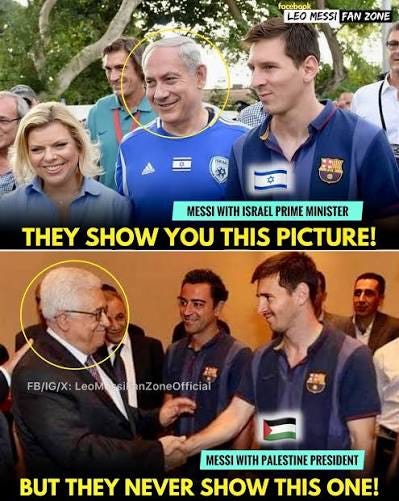
Messi's Zionism
Lionel Messi’s brand has spent thirteen years performing a symmetry between an occupying state and the people it occupies. Israel is the occupier. Gaza is a genocide. There is one victim in this record, and Messi’s public conduct exists to obscure that there is only one.
Bothsidesism is not a rhetorical accident. It is a manufactured position, built deliberately by states that need the world to believe a conflict between an occupier and the occupied is instead a dispute between two equally aggrieved parties. Israel has run this operation for decades through diplomats, think tanks, and embassy cultural programs. What it has increasingly leaned on since 2013 is something more valuable than any of them: a global footballer so beloved that his mere presence in a room launders the premise that the room’s two sides are equivalent. Lionel Messi has been that footballer. He has never called Gaza a genocide. He has never named Israel as an occupying power. He has instead spent thirteen years walking into rooms engineered to say, without a single word from him, that this is a conflict between two sides rather than a war waged by one state against a population with no army, no navy, and no air defense of its own.
On March 5, 2026, Messi stood in the East Room of the White House in a navy suit, flanked by his Inter Miami teammates, while Donald Trump opened a ceremony meant to honor an MLS championship with a briefing on an active war. “The United States military, together with the wonderful Israeli partners, continues to totally demolish the enemy, far ahead of schedule and at levels that people have never seen before,” Trump said, days into a bombing campaign that had by then killed more than 1,200 people in Iran. Messi applauded. So did Luis Suárez, standing beside him. So did the rest of the squad. Footage of the moment spread within hours. Spanish journalist Leyla Hamed called the scene “bizarre.” Palestinian-American commentator Ali Abunimah called the players “vacuous.” Messi did not clarify the applause, walk it back, or explain it afterward. He returned to talking about soccer, and the sport’s press pack, largely, let him.
This is not an isolated image. It is the latest entry in a thirteen-year record of Messi lending his brand to the precise mechanism that keeps bothsidesism alive: appear next to both flags, speak about neither injustice, let the cameras do the work of telling the world that this is a story with two equal sides.
In August 2013, FC Barcelona flew to Israel and the West Bank for what the club branded a “Peace Tour,” a name that itself performs the bothsidesism this record turns on. There is no peace to broker between an occupier and the occupied. There is only an occupation to end. But the itinerary was built precisely to obscure that distinction: a stop in Bethlehem at the Basilica of the Nativity and a meeting with Palestinian Authority President Mahmoud Abbas, followed by a crossing into Jerusalem, yarmulkes at the Western Wall, a reception at the Israeli president’s official residence, and a football clinic at Bloomfield Stadium in Jaffa attended by 12,000 children. Shimon Peres kicked the opening ball to Messi personally and told the assembled press that Barcelona’s players could “teach us and the Palestinians to play tiki-taka so we can score the goal we all hope for: the goal of peace.” Netanyahu, present at the reception, used the platform to talk about tourism revenue, telling the room he hoped a fraction of Barcelona’s global fanbase would visit Israel. Club president Sandro Rosell framed the trip as timed deliberately to coincide with the US-brokered peace negotiations then restarting in Washington.
The framing did exactly the diplomatic work it was built to do. A four-day itinerary balanced between an occupied city and an occupying one was sold, and largely received in the international sports press, as evenhandedness. It was not evenhanded, because there is no evenhandedness to be had. Bethlehem sits inside a matrix of Israeli-controlled permits, checkpoints, and settlement expansion that the Palestinian Authority does not command. Jerusalem’s Western Wall sits inside a city whose full annexation the international community has never recognized. A photograph of Messi in a yarmulke at the Wall and a photograph of Messi at the Basilica were presented to a global audience as symmetrical gestures, one occupier’s holy site balanced against one occupied people’s holy site, as though the two carried equal political weight. They do not. One photograph documents a visit to a site of contested sovereignty. The other documents a visit staged inside an active military occupation, and the itinerary’s genius, Israel’s genius, was in making the two look identical to a viewer who knew nothing else about the region. Messi did not design that itinerary. He walked through it, on schedule, without public comment, becoming its most valuable prop precisely because he said nothing that would break the illusion of balance the trip was built to sell.
The one moment in thirteen years that even gestured beyond this pattern lasted eighteen days, and it is worth reading closely for what it actually says rather than what it is often credited with saying. On August 7, 2014, with the Gaza death toll from that summer’s war climbing past 1,800, Messi posted, in Arabic and English, on his personal Facebook page: “As a father and a UNICEF Goodwill Ambassador, I am terribly saddened by the images coming from the conflict between Israel and Palestine, where violence has already claimed so many young lives and injured countless children. Children did not create this conflict, but they are paying the ultimate price. This cycle of senseless violence must stop. We must reflect on the consequences of military conflicts and children must be protected.” He attached a photograph of a wounded Palestinian child. Read the sentence again: it does not say Israel killed these children. It says violence “claimed” them, as though violence were weather arriving on its own rather than an Israeli military campaign with a chain of command, a named defense minister, and a named military objective. Even the one moment Messi is retroactively credited with speaking up for Gaza was written in the exact grammar of bothsidesism: two sides, a cycle, a tragedy with no author.
Even that hedge proved too much for the machine it was up against. Within three weeks, following the death of a four-year-old Israeli boy, Daniel Tregerman, in a mortar strike from Gaza, a campaign accusing Messi of sympathizing with terrorism gathered force online, amplified by the fact that Barcelona’s shirt sponsor at the time was the Qatar Foundation. Messi never posted about Gaza again. Not later in 2014. Not during the 2018 Great March of Return, when Israeli forces killed over 180 Palestinians at the Gaza fence over the following year. Not during the eleven-day 2021 bombardment that killed 256 Palestinians, sixty-six of them children. Not in the two years that followed October 7, 2023, a war that has, by the count of Gaza’s Ministry of Health, killed more than 60,000 people, the vast majority civilians, in what the International Court of Justice has found plausibly constitutes genocide and what United Nations human rights experts, B’Tselem, and Amnesty International have each independently concluded meets the legal threshold for genocide outright. A passive, both-sides sentence about a “cycle of violence” was too dangerous to Messi’s brand to survive three weeks of pressure. A campaign that international courts and human rights bodies now call genocide has not drawn a single sentence from him since.
Any honest record has to include the single episode that critics of this argument will point to first. In June 2018, days before the World Cup, Argentina was scheduled to play a warm-up friendly against Israel in Jerusalem, a fixture Israeli authorities had relocated from Haifa and funded with a $760,000 payment specifically to secure the more politically charged venue, an explicit attempt to stage the same brand of symmetry Barcelona had staged in 2013. Palestinian Football Association president Jibril Rajoub campaigned openly against the match, calling on fans to burn shirts bearing Messi’s name if he played. Argentina cancelled the fixture on June 5, and the Israeli embassy attributed the cancellation to “threats and provocations directed at Lionel Messi.” Argentine federation president Claudio Tapia cited safety, not politics, at the press conference announcing the withdrawal, and explicitly denied the decision reflected any position on the Israeli or Jewish community. Hamas’s political arm publicly thanked Argentina. Israeli Defense Minister Avigdor Lieberman condemned the decision as capitulation to “anti-Semitic terrorist supporters.” Rajoub, hostile days earlier, reversed course and stood beside a sign reading “From Palestine, Thank you, Lionel Messi.”
This episode is not evidence that Messi ever broke from the pattern. It is evidence of how completely the decision was never his to begin with. Messi issued no personal statement before, during, or after the cancellation. The official framing, from both the Argentine federation and the Israeli government itself, attributed the withdrawal to security threats against one man, not to any Argentine or Messi-driven position on occupation, apartheid, or the killings at the Gaza fence that had made the fixture radioactive in the first place. A footballer who had spent five years walking through Israeli state functions without comment did not suddenly find a conscience in 2018. His own federation found a security problem, and the cancellation happened around him. The one occasion Messi’s brand did not deliver the symmetry Israel wanted was not chosen. It was the single instance where the machine that manufactures his silence briefly failed to secure the venue, and Messi’s own conduct inside that failure, saying nothing, taking no credit, offering no explanation, was consistent with everything that came before and after it.
When Messi married Antonella Roccuzzo in June 2017, the ceremony took place in his hometown, guarded by roughly 300 personnel drawn from local police and, according to reporting at the time in Diario AS and repeated across the Spanish and English-language sports press, “the same private team of Israeli specialists used by Messi for his various excursions around the world.” This detail did not surface as scandal. It surfaced as a footnote in wedding-planning coverage, filed alongside menu leaks and guest lists. But it is the one moment in this entire record where no federation, sponsor, or government scheduled the room for him. This was Messi’s own choice, made for his own family, on his own money. When there was no bothsidesism left to perform, when the cameras that need him standing between two flags were gone, the security apparatus he trusted with his wife and his guests was still Israeli. The symmetry he performs in public dissolves the moment the audience disappears, and what is left underneath it is not neutrality. It is a standing relationship.
On August 6, 2025, Suleiman al-Obeid was killed by Israeli fire while waiting in a crowd for humanitarian aid at a distribution site in Rafah operated by the Gaza Humanitarian Foundation, the US- and Israel-backed body that had replaced the UN-coordinated aid network that spring. Al-Obeid was forty-one. He had played twenty-four times for the Palestinian national team, scored more than a hundred goals across a club career spent entirely inside Gaza, and was known across the territory as the “Palestinian Pelé” for a scissor-kick goal against Yemen in the 2010 West Asian Football Federation Championship that Gazan football still talks about. He left a wife and five children. The Palestinian Football Association put the total number of sports-affiliated deaths in the territory since October 2023 at over 660, with more than 320 of them from the footballing community specifically, and the UN human rights office had by then recorded more than 1,300 Palestinians killed at Gaza Humanitarian Foundation aid sites since the operation began that May. There is no second casualty count to weigh against this one. There is no Israeli footballer killed waiting for flour. The record has one victim, and his name was Suleiman al-Obeid.
UEFA’s public tribute to al-Obeid ran two sentences and did not mention how he died, itself a small act of the same bothsidesism this record has traced from Bloomfield Stadium onward: name the loss, erase the killer. Mohamed Salah replied publicly, asking the governing body to say what actually happened, and the reply was viewed more than 100 million times within three days. Eric Cantona posted his own tribute. The sport’s most famous living Egyptian forced an accounting that the sport’s most famous living Argentine did not attempt. Messi, a UNICEF Goodwill Ambassador for over two decades, the same man whose single sentence about Palestinian children once reached sixty-eight million Facebook followers in an afternoon, said nothing publicly about the killing of a fellow international footballer waiting for flour. In a war that Amnesty International, B’Tselem, Physicians for Human Rights Israel, and UN human rights experts have each independently concluded meets the legal definition of genocide, the world’s most famous footballer had nothing to say about the killing of one of his own.
None of the five episodes above happened by accident, and understanding why requires naming the mechanism producing them. Elite athletes at Messi’s altitude rarely choose their own itineraries. Barcelona’s 2013 tour was negotiated between the club’s commercial department and the Israeli state apparatus built specifically for this purpose. The 2013 trip landed in the same month that US-brokered peace talks resumed in Washington, a timing Rosell himself flagged as deliberate. This is the same mechanism the Gulf states now run at industrial scale through LIV Golf, Newcastle United’s ownership, and the Riyadh Season calendar: borrow an athlete’s global affection to soften a state’s record, and let the athlete’s silence finish the job once the cameras leave. Israel’s version predates the Gulf model by a decade and runs through fewer, more concentrated gestures, precisely because a single photograph of Messi at the Western Wall does more diplomatic work than an entire golf tour roster.
Messi’s UNICEF role complicates this reading rather than excusing it. Goodwill ambassadorships are themselves diplomatic instruments, calibrated to project humanitarian concern while avoiding any statement that would embarrass a government, any government, in a position to complicate the ambassador’s access. The 2014 Facebook post was, in that light, the closest Messi ever came to breaching the terms of the role: specific enough to invoke Gaza, vague enough to avoid naming Israel as the actor conducting the bombing. Even that carefully hedged sentence proved too costly once a coordinated backlash campaign attached itself to Barcelona’s Qatar sponsorship. The lesson Messi appears to have drawn from 2014 was not that the sentence had been too weak. It was that any sentence carried a price, and he has spent the eleven years since paying nothing rather than risk paying that price twice.
The White House appearance in March 2026 shows the mechanism has simply changed venue. Trump did not need Messi’s endorsement of the Iran campaign. He needed the half-second of applause, captured on White House video and distributed through the administration’s own channels, that let an active war and a soccer championship ceremony collapse into a single frame. Messi supplied it by doing nothing more than following the room’s social script, the identical reflexive courtesy that had him don a yarmulke at the Western Wall thirteen years earlier. Across both rooms, separated by more than a decade, Messi has never once treated a politically loaded setting as one he could decline, interrupt, or publicly complicate. He has only ever treated it as a room to be polite in.
None of this requires inventing anything, and the 2018 cancellation is proof the record does not need inflating to make its case. It requires setting five documented events beside each other and asking why the same man appears, gesture after gesture, on one side of an asymmetry he has never once been compelled to acknowledge existed. He toured occupied Bethlehem and occupied Jerusalem as a single package built by a government eager for the imagery. He wrote one sentence about Palestinian children in 2014 and let a coordinated backlash campaign retire the sentence permanently. He was pulled out of a 2018 Jerusalem fixture by his own federation, citing threats against his safety rather than any position on the conflict, and never personally addressed the episode either way. He married under the protection of the same Israeli security apparatus that guards Israeli officials and installations abroad. He applauded, in real time, a sitting American president narrating an active bombing campaign as entertainment for a soccer team. And when a Palestinian international footballer was shot dead waiting for food less than a year before that applause, the silence that has governed his public conduct on Palestine since August 2014 held without interruption.
The standard defense offered on Messi’s behalf is that he is an athlete, not a diplomat, and that expecting political courage from a man whose job is scoring goals mistakes celebrity for citizenship. That defense collapses the moment Messi accepts an invitation that is itself political, which he has now done at least four separate times across thirteen years, the only exception forced on him by outside threats rather than chosen. Nobody compelled him to Bloomfield Stadium in 2013. Nobody compelled him to stand beside Trump in March 2026 while the president opened a sports ceremony with a war briefing. Those were choices, made by a man with the global standing to decline either room without any measurable professional consequence, the way Salah has declined to stay silent without it costing him a single sponsorship. Messi chose to enter both rooms. The neutrality he is routinely credited with is not an absence of politics. It is a politics that has, in over a decade, never once required him to say a Palestinian’s name in public, even in the year a Palestinian footballer with his own international caps and his own five children was shot dead waiting in a food line.
What the record raises and cannot answer on its own is whether Messi’s alignment reflects a considered political position he has simply never been forced to articulate, or something closer to the default drift of a man who has spent his entire adult life inside institutions, Barcelona, UNICEF, Inter Miami, MLS, the Argentine federation, that have consistently steered him toward Israeli state functions and away from any accounting of what those functions have cost Palestinians. The 2018 cancellation suggests the calculation, whatever its true source, is not entirely his to make even when it goes the other way. That distinction matters less than the outcome sitting in front of it. Thirteen years, five rooms, one sentence walked back under pressure, one absence forced by threat rather than chosen by conscience, and a silence that has now outlasted a genocide.