Modi’s Bengal, and What Comes Next for Its Muslims
In Metiabruz, a garment wholesale district in South 24 Parganas where the river-facing lanes smell of dye and pressed cotton, 65-year-old Masooda Bibi found her name missing from the voter rolls months before a single ballot had been cast. Her husband’s relatives, all Bengali Muslims occupying the same three-story house, found the same. Of the roughly 80 adult voters under that roof, 30 had been struck from the electoral register. Bibi held her nine-year-old granddaughter, looked at journalists from The Diplomat who had traveled to document the deletions, and asked a question that the governing architecture of India has spent a decade refusing to answer: “Do you see any Bangladeshis here among us?”
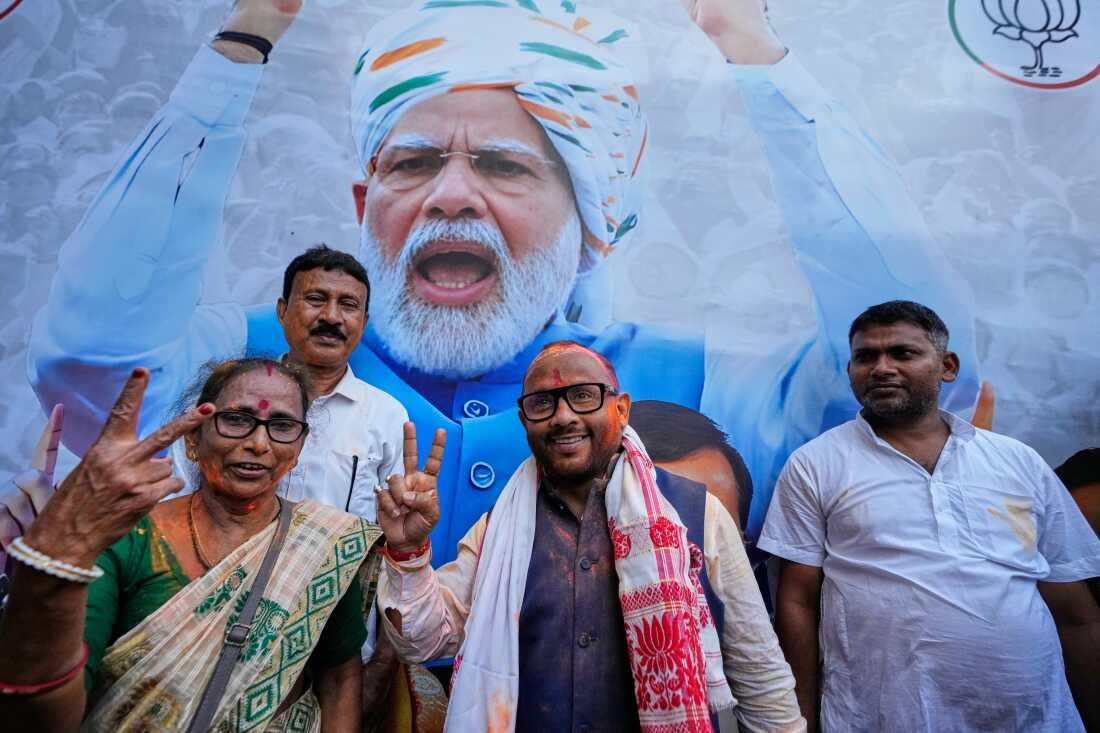
The Election Commission of India did not need to prove that Masooda Bibi was Bangladeshi. It needed only to delete her name and wait for her to prove she was not. That is the core mechanism of the Special Intensive Revision, the exercise the Modi government and its Election Commission ran across twelve Indian states beginning in October 2025, and which in West Bengal alone removed 9.1 million voters from the rolls before the state went to the polls in two phases on April 23 and 29, 2026. The results were announced on May 4. The Bharatiya Janata Party won 206 of West Bengal’s 294 assembly seats. Mamata Banerjee, the 71-year-old Chief Minister who had governed the state since 2011 and who had made her defense of Bengal’s Muslims the central argument of her politics for fifteen years, lost her own Bhabanipur constituency to BJP’s Suvendu Adhikari by 15,105 votes. Narendra Modi, standing at BJP headquarters in New Delhi as confetti fell, told the crowd: “From Gangotri to Gangasagar, the lotus blooms everywhere.”
He had been working toward that sentence for eleven years.
The SIR was presented by the Election Commission as bureaucratic maintenance. Dead voters, duplicate entries, names of people who had shifted residence: these are real phenomena in any large electoral roll, and the ECI’s stated purpose was to clean them. The BJP called the exercise a necessary purge of “bogus entries” and “illegal migrants.” Both framings served the same function, giving the operation a name that sounded administrative rather than political.
The numbers do not sustain that framing. West Bengal lost 9.1 million voter names, the largest deletion total among all poll-bound states. The most Muslim-dense districts sustained the heaviest deletions by a wide margin. Murshidabad, where Muslims constitute more than 66 percent of the population: 460,000 names removed. North 24 Parganas, which includes Metiabruz: 330,000 removed. Malda, where Muslim voters had historically provided the TMC its majority: 240,000 removed. Tamil Nadu, with a larger electorate than West Bengal, lost 7.4 million names. Gujarat lost 6.8 million. No other poll-bound state produced a deletion pattern this precisely concentrated in its minority-dense districts.
As West Bengal’s first voting phase began on April 23, more than 2.7 million challenged cases remained unresolved. These were voters who had formally contested their removal, submitted paperwork, appeared before Booth Level Officers, and done what the system required. They were not permitted to vote. The Election Commission’s position was that adjudication was ongoing. The people most determined to exercise their franchise, the ones who had fought to stay on the rolls, were the ones denied it on polling day.
Psephologist Yogendra Yadav, who had previously challenged an SIR exercise in Bihar before the Supreme Court, identified the design flaw precisely. Women who changed their surnames after marriage were flagged as suspicious entries. Re-enrollment required documentation from the father’s address, a place these women no longer lived. For Muslim women in rural Bengal, where early marriage is common, surnames change, and the paper trail runs across two households and two decades, the requirement was not a formality. It was a wall. The Sabar Institute found the same pattern: the SIR’s design systematically disadvantaged large families, rural women, and the poor. It also happened to target the TMC’s core constituency in the three districts that mattered most to its majority.
Researcher Ahamed of the Sabar Institute was direct when speaking to The Diplomat: “The SIR exercise, in my view, is a proxy NRC.” The National Register of Citizens exercise in Assam, which between 2013 and 2019 produced a list of 1.9 million people deemed potentially stateless, disproportionately Bengali-speaking Muslims, provided the template. The SIR did not require the NRC’s formal finality to produce its effect. Door-to-door household mapping, documentation demands, burden placed on individuals to prove their right to remain in the register: the mechanism was the same. What changed was the label.
Mamata Banerjee challenged the SIR in the Supreme Court in February 2026, calling it “opaque, hasty, and unconstitutional.” The Court did not restore a single name to the rolls. It ordered the Election Commission to publish the list of affected voters. The list arrived after the process it was meant to scrutinize had already run its course.
Chief Election Commissioner Gyanesh Kumar did not need to hide what the exercise was for. The BJP’s own Bengal leadership handled that openly.
Suvendu Adhikari, who would go on to defeat Mamata Banerjee in Bhabanipur, said in an interview during the campaign: “The EC has done its job. Now, the sanatandharmis in Bengal have to do theirs.” The sanatandharmis are practicing Hindus. The sentence did not require interpretation. The Election Commission had performed a preparatory function; Hindu electoral consolidation was the follow-through.
Kumar dismissed every allegation as politically motivated. The ECI issued no public response to the geographic concentration of deletions in Muslim districts, offered no accounting of why 2.7 million challenged cases could not be resolved before voting began, and produced no data to counter the Sabar Institute’s findings on gender and community bias. Congress leader Jairam Ramesh called Kumar’s tenure an “absolute disgrace” and accused him of doing Modi and Amit Shah’s “bidding.” The Federal, in its post-election analysis, documented Kumar as the only Chief Election Commissioner in Indian history under whom the ECI directly attacked a political party without attempting to disguise the alignment.
None of this is legally actionable in the immediate term. Kumar serves a fixed term. The BJP governs. The Supreme Court issued orders that arrived after the outcomes they might have altered.
To understand what Narendra Modi’s first Bengal government means for the state’s 27 million Muslims, the relevant evidence is twelve years of documented practice, and before that, twelve more years in Gujarat.
Modi became Chief Minister of Gujarat in 2001. In February 2002, following the burning of a train carrying Hindu pilgrims at Godhra, communal violence swept the state for three months. Between 1,000 and 2,000 Muslims were killed. The Citizens’ Tribunal on Communal Violence documented systematic police inaction, the presence of state government officials at sites of organized violence, and the failure to deploy the army for three days despite standing protocol requiring it. The Special Investigation Team appointed by the Supreme Court later found insufficient evidence to prosecute Modi personally. What the same SIT documented was that mobs operated with lists of Muslim-owned properties, that the state apparatus provided no meaningful protection during the initial 72 hours, and that senior police officers who attempted to act were transferred or sidelined.
Modi governed Gujarat for twelve years after those events. No apology was offered. No acknowledgment of state failure was ever made. The BJP subsequently marketed his Gujarat tenure, including the years that followed the 2002 killings, as a development governance model. He became Prime Minister in 2014 on that record.
In twelve years as Prime Minister, the architecture of Muslim civic exclusion was built at the national level with deliberate precision. The CAA, passed in December 2019, established a religious criterion for expedited citizenship covering refugees from Afghanistan, Bangladesh, and Pakistan across six religions. Muslims were excluded by explicit statutory text, the only community in the subcontinent’s neighborhood ineligible by name. Amit Shah announced a nationwide NRC would follow. The Shaheen Bagh sit-ins, which ran for months through the Delhi winter of 2019 and 2020, ended under COVID-19 lockdown orders in March 2020. The nationwide NRC has not been formally implemented, but Assam’s NRC remains the operational model, and Assam’s Chief Minister continues to administer it.
Under Modi, the Enforcement Directorate and the Central Bureau of Investigation have been deployed against political opponents with documented selectivity. The Editors Guild of India has recorded a sustained decline in press freedom. Reporters Without Borders ranked India 159th out of 180 countries on press freedom in 2023, down from 140th in 2014. Several Muslim journalists and commentators who covered the BJP critically were arrested under the Unlawful Activities Prevention Act, a terrorism statute with no bail provision as standard. None of these were isolated incidents. They were the iterative construction of an environment in which Muslim civic participation, political opposition, and journalistic scrutiny all carry heightened risk.
This is the person whose party now governs West Bengal.
Himanta Biswa Sarma’s Assam is not an outlier in the BJP’s governing ecosystem. It is the design brief for what follows.
Sarma secured his third consecutive term on May 4, winning 82 of Assam’s 126 assembly seats outright. His allies, the Bodoland People’s Front and Asom Gana Parishad, took 10 seats each. The Congress, which once governed Assam across multiple decades, finished with 19 seats. In two terms, Sarma has built a governing model whose instruments are now fully legible: the NRC, which produced its 1.9 million statelessness list and which Sarma has continued to administer with selective intensity against Bengali-speaking Muslims; a 2023 delimitation exercise that the Congress formally argued reduced Muslim-majority constituencies’ effective voting power by approximately twelve assembly seats; a campaign of property demolitions targeting Muslim homes and market structures in Silchar, Dhubri, and several other districts, labeled anti-encroachment enforcement; and a sustained rhetorical campaign in which Sarma personally describes Bengali-speaking Muslims as presumptively Bangladeshi, placing the burden of proving Indian identity on the community rather than on the state.
Sarma campaigned for the BJP in West Bengal. He traveled there, spoke at rallies, invoked demographic threat and border infiltration for Bengali audiences. The BJP went from 77 seats in West Bengal in 2021 to 206 in 2026. It went from two seats in Murshidabad to nine. Sarma’s model exported cleanly.
The BJP’s Bengal majority was not a uniform swing. In the Muslim-heavy belt covering Murshidabad, Malda, and Uttar Dinajpur, the TMC held 35 of 43 seats in 2021. On May 4, that total fell to 22, with the BJP taking 19. The remaining seats went to Congress, CPI(M), and Humayun Kabir’s Aam Janata Unnayan Party, each drawing portions of what had been a near-total TMC consolidation of Muslim votes.
Political analyst Biswanath Chakraborty, speaking to Business Standard on election day, framed it directly: the fragmentation of votes among Congress, CPI(M), and AJUP amplified the damage from the SIR deletions in closely contested constituencies. In Murshidabad’s Raninagar, the Congress edged past the TMC by a narrow margin while the CPI(M) pulled significant vote share from the same pool. In Domkal, the CPI(M) won outright in a seat that had been TMC territory. Individually, each result reads as local political complexity. Collectively, they read as the arithmetic of a vote divided before it was counted.
The BJP’s official narrative attributes the Muslim belt losses to voter disgust with TMC corruption, the teachers’ recruitment scandal, and the anti-incumbency that follows fifteen years in power. All three factors are documented and real. Anti-incumbency contributed to results across every state where the ruling government lost ground this cycle: Kerala’s Left Democratic Front fell to the UDF Congress coalition, which took 71 of 140 seats; in Tamil Nadu, the DMK was reduced by the emergence of actor-politician Vijay’s Tamilaga Vettri Kazhagam, which took 107 seats. But neither Kerala nor Tamil Nadu ran a simultaneous SIR that deleted 9.1 million voters before the count. Anti-incumbency explains some of what happened in Murshidabad. It does not explain Murshidabad’s 460,000 missing names.
Seema Das, a domestic worker in New Delhi, took a two-day journey back to her village in Bengal to vote. She had always voted TMC. This time, her mother-in-law had convinced her that Mamata Banerjee “favours Muslims.” Das switched to the BJP. Her testimony is the clearest account of what the BJP’s campaign actually produced: not ideological conversion, but the activation of a communal anxiety cultivated across fifteen years of relentless messaging, applied at sufficient scale until it became self-confirming.
Neelanjan Sircar, senior fellow at the Centre for Policy Research, told Al Jazeera after traveling across West Bengal before the vote: “We found urban men are very polarised. In Bengal, the Muslim population is disproportionately rural, and given the levels of polarisation, the result ended up in a big difference for the BJP.”
The BJP’s Bengal campaign operated on one central argument: that Mamata Banerjee’s protection of Muslim communities was a form of appeasement that came at Hindu expense. Every instrument deployed in the campaign, its rhetoric, the CAA acceleration pledge, Sarma’s rallies, the SIR, communicated the same premise. The Muslims whose protection was framed as the problem are now governed by the party that framed them.
In Uttar Pradesh, Yogi Adityanath’s government has since 2017 used demolition orders against Muslim-owned properties following communal incidents, with Amnesty International and the People’s Union for Civil Liberties documenting their selective application against Muslim homes and commercial premises while Hindu-owned property on the same streets was left standing. The Supreme Court ruled in September 2024 that demolitions without prior court orders were unconstitutional. Enforcement has been inconsistent.
In Gujarat, Modi’s home state, no senior official has ever been convicted for enabling the 2002 violence. The state government’s documented facilitation of the conditions in which mobs operated with property lists produced a political outcome: a Muslim population that became effectively invisible in Gujarat’s civic life, a community that learned to make itself small.
That governance lineage now arrives in Bengal.
BJP leaders stated during the campaign that a Bengal BJP government would accelerate CAA citizenship processing. The CAA covers Hindu, Sikh, Christian, Buddhist, Jain, and Parsi refugees from Afghanistan, Bangladesh, and Pakistan. Muslims are excluded by name. At the level of formal law, it strips no rights from existing Indian Muslim citizens. At the level of political signal, deployed in a state where the SIR labeled hundreds of thousands of Bengali Muslims as suspected foreigners and where BJP campaigners routinely used “Bangladeshi” as a synonym for Bengali Muslim, it operates as a declaration: the state will formally extend protection to every refugee category from the subcontinent except Muslims.
The NRC is the third instrument. Sarma’s campaign presence in West Bengal was not ceremonial. If a Bengal NRC follows the SIR, it will not begin from scratch. The SIR has already produced household-level documentation audits, identified names whose records carry inconsistencies, and built a database of documentation vulnerabilities concentrated in Muslim communities. The groundwork is complete. What remains is a political decision.
The BJP governs the central government, West Bengal, Uttar Pradesh, Assam, Gujarat, Madhya Pradesh, and a significant portion of India’s remaining states. It fell short of a parliamentary majority on its own in 2024, for the first time since 2014, and has since governed through coalition. The 2026 state results, Bengal above all, restore its authority going into the 2029 Lok Sabha elections. Analyst Praveen Rai assessed the result plainly: the Bengal win “substantially increases the national standing of Modi’s leadership and extends the hegemonic power of the party to govern India.”
The institutions designed to prevent a governing party from engineering its own re-election produced, in West Bengal, a Chief Election Commissioner whose partisan alignment was called an absolute disgrace by the principal opposition; a Supreme Court that acknowledged procedural problems with the SIR and left 9.1 million deletions standing; a national press that covered the SIR story without sustained investigative pressure; and civil society whose reporting was thorough but whose legal challenges were not resolved before the voting was done.
These are not individual failures of corruption. They are the predictable outcome of twelve years of pressure on every institution with authority to check the executive. The CBI and the ED were deployed against opposition leaders until their independence became theoretical. The press was not nationalized; it was bought, as the majority of India’s large media organizations are now controlled by conglomerates with financial relationships to central government infrastructure and regulatory decisions. The Supreme Court received cases and moved at a pace the political calendar of the government whose appointees staffed it could accommodate.
Modi did not build this architecture accidentally. Every instrument has a public record: judicial appointments, ED filings, media ownership transfers, SIR notifications. They are the construction diary of the state West Bengal’s Muslims now inhabit.
Suvendu Adhikari won Mamata Banerjee’s own seat by 15,105 votes. This is the man who told the public, weeks before the vote, that the Election Commission had already “done its job.” Bhabanipur is in Kolkata. It is not a border district. The rhetoric of Bangladeshi infiltration does not carry the same charge there as it does in Murshidabad. It is the Chief Minister’s home constituency, the place where her political identity was most locally embedded, the seat she had held for years.
She lost it. The BJP ran its campaign, the SIR did what it did, the Muslim vote fragmented in the districts where it was needed, the Hindu vote consolidated in the districts where it was leveraged, and Mamata Banerjee, who had for fifteen years positioned herself as the principal obstacle between Modi’s project and one of India’s largest Muslim populations, lost by fifteen thousand votes.
Set that margin against Murshidabad’s 460,000 missing names.
West Bengal’s 27 million Muslims will navigate welfare access, property rights, documentation requirements, and any future NRC or demolition campaign under a state government that campaigned against their political existence. The BJP has not announced what it will do. It rarely does in advance. The instrument arrives first; the label comes after.
What remains unanswered is whether the Indian Constitution’s formal protections for religious minorities, Articles 25 through 30, its guarantee of equality under Article 14, its prohibition on religious discrimination under Article 15, will be enforced in West Bengal by courts that took months to not restore a single Muslim voter’s name to an electoral roll.
That is the question Masooda Bibi was asking in Metiabruz when she pointed at her house and her family and looked at the journalists and asked them to say what they saw.


