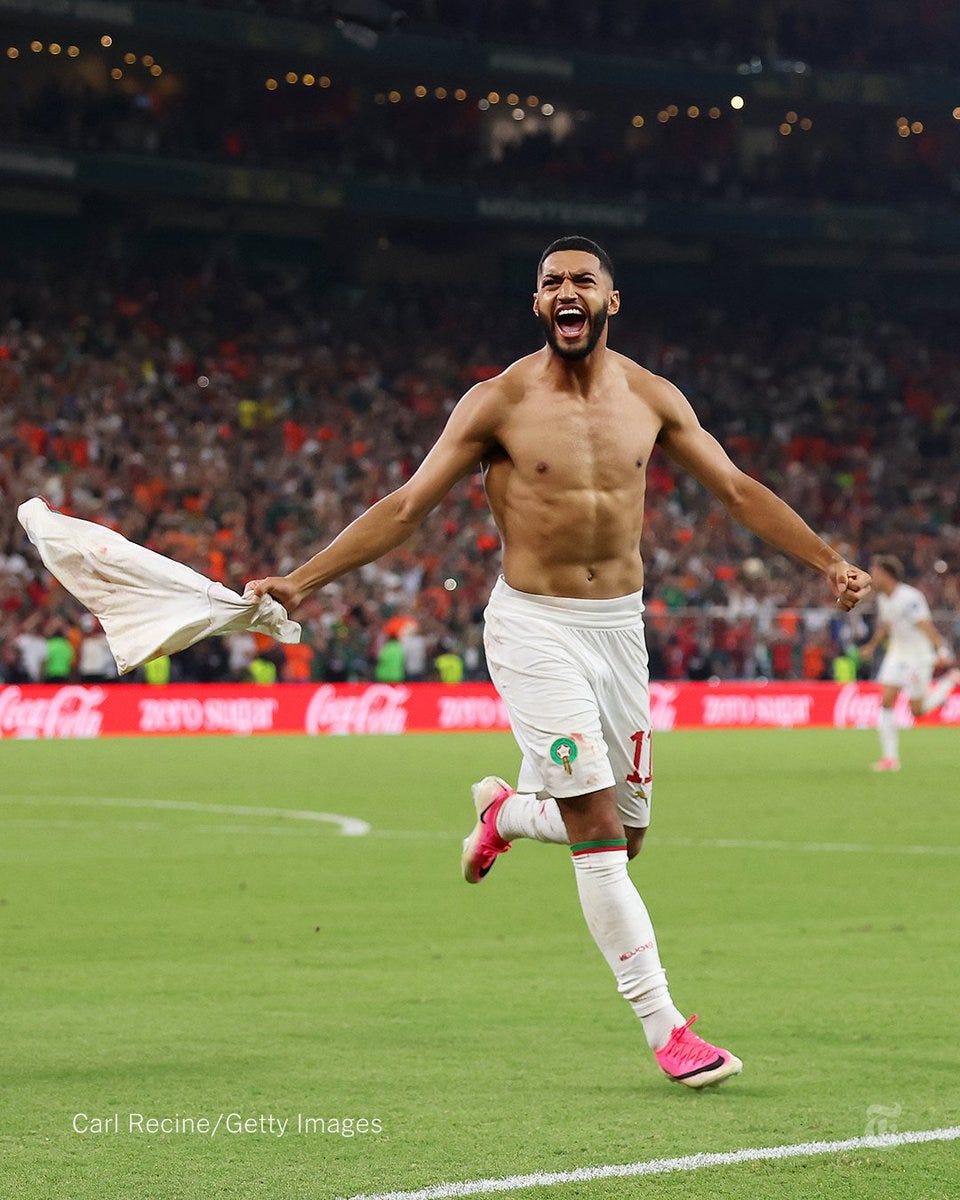
Morocco eliminated the Netherlands at the 2026 World Cup with a squad that European academies assembled, and the machine that spent seven decades extracting this talent never designed an off switch for the one choice it cannot control.
Three days after Morocco drew 1-1 with Brazil at MetLife Stadium in East Rutherford, New Jersey, a man boarded an early morning flight from London to Newark. He worked in Liverpool Football Club’s scouting department and his ticket had been purchased the morning after the match, because someone in Anfield’s football operations office had watched ninety minutes of Ayyoub Bouaddi taking Brazil’s midfield apart and decided that a second opinion, filed by someone physically present and writing a report with their own eyes, was worth the cost of a transatlantic return. Bouaddi was eighteen years old. He played his club football for Lille, in Ligue 1, and by the time Liverpool’s representative filed whatever he filed, Paris Saint-Germain and Arsenal and Bayern Munich were in the same news cycle, linked to Bouaddi in pieces that ran before Morocco’s training session the following morning had ended. The bids had not formally opened. The auction had.
What the scout was pricing, as he flew west with his notes, was a player who is Moroccan, who plays for a French club, and who was about to continue performing at a World Cup hosted in the United States for a national team that draws most of its senior squad from the European football system he was helping to price. This situation, which sounds complicated only until you understand that it is the single most normal thing in contemporary international football, is what Monday night’s result in Monterrey was about, even if the scoreline read as a penalty shootout and even if the coverage described it as an upset and even if the word upset is what gets written when an institution has spent decades failing to understand what it built.
The man who took Morocco’s decisive penalty was named Ismael Saibari, and before he walked to the spot he had spent the entirety of his professional career in the Dutch Eredivisie, playing for PSV Eindhoven, inside the training infrastructure and tactical philosophy that the Netherlands built after Johan Cruyff and Rinus Michels gave European football an entirely new vocabulary in the 1970s. He was not a peripheral figure in that system. He was a working first-team player at one of the Eredivisie’s two or three most important clubs, the league’s product in an entirely representative sense, shaped by Dutch coaching from adolescence upward, the precise kind of technically complete central midfielder that the Dutch system has been producing at scale for fifty years. He was also eligible to represent the Netherlands at senior international level. He chose Morocco. On Monday night at the Estadio Monterrey, what PSV had given him was applied precisely enough to the penalty kick that the Dutch goalkeeper was still moving when the net had finished shaking.
The sports press will call this poetic, and poets would call it structural, and the difference between those two readings is the difference between finding the result surprising and understanding why it was not. What Saibari’s penalty describes is not coincidence or irony or the charming unpredictability of football. It is the logical and foreseeable outcome of a system that builds players in one country and then watches those players exercise the one right the system was never designed to prevent: which passport to carry when a World Cup arrives. That the Dutch federation had not accounted for this, from a player it trained and retained in its own domestic league through the qualifying cycle, is not a failure of intelligence. It is what happens when an institution mistakes the product of its labor for a loyalty that was never in the contract.
To understand how Saibari arrived at the penalty spot, you have to understand what the Eredivisie became after it built the template the rest of Europe spent twenty years adopting, because the Dutch domestic league’s position in the global football economy is relevant to his biography in ways that go beyond the coincidence of geography. After the Total Football years, as the Netherlands gradually lost the ability to retain its best players against the wage differentials that the Premier League’s broadcast deal and the Spanish and German leagues’ commercial expansion created, the Eredivisie became something its own administrators would not describe in these terms but that the transfer data describes clearly: a finishing school. Players arrive from across the Netherlands and from its immigrant communities and from the residual networks of Dutch colonial presence in Suriname and the Antilles, they are developed inside a culture that remains genuinely excellent at producing technically complete midfielders and fullbacks, and then they leave for richer leagues at the peak of their market value, and PSV and Ajax collect the fees and begin the cycle again with the next cohort. Saibari is one iteration of the cycle. His penalty is the thing the cycle did not calculate for.
Morocco’s squad at this World Cup is the concentrated expression of a decision that each player made individually and that adds up, collectively, to something the Moroccan Football Federation has been deliberately cultivating for roughly fifteen years. Achraf Hakimi, PSG’s right back and one of the most complete defenders in European club football, was born in Madrid and raised in Spain and eligible for the Spanish national team and chose Morocco. His father sold goods in a Ceuta market. His mother worked as a domestic cleaner. He was identified by Real Madrid’s academy at an age when his family was doing the labor that sustains the city where Real Madrid’s supporters live, and he was developed by the same club system, and when the international eligibility question came he chose Rabat. The Atlas Lions’ starting eleven in Monterrey included players who could have represented France, the Netherlands, Spain, Belgium, and Germany, and who looked at those options and did not take them, and what appears from a certain angle to be sentiment is, from another, a structural fact about what the European football economy produces when it recruits labor from immigrant communities and then asks the labor which flag it wants to carry.
What the Moroccan federation understood, before the players made the choices, was that the choices needed to be made attractive, and it spent a decade and a half making them so. The diaspora recruitment operation that Rabat has run since the mid-2000s identifies eligible players in European leagues early, maintains contact through national youth programs, and has steadily raised the technical level of the senior squad to a point where choosing Morocco over a wealthier passport does not require a player to sacrifice the quality of football environment he trains in. What the federation could not have designed was the generation: a cohort of diaspora players who were technically outstanding, developed in European academies, and genuinely interested in representing the country their families had left. Walid Regragui inherited this cohort. He turned it into a semi-final in Qatar in 2022, the first time any African and Arab and Muslim-majority nation had reached that stage in ninety-two years of World Cup football, and the European press wrote extensively about the exceptional nature of the moment, which is what the European press writes when it does not want to reckon with what produced the moment.
The European press was not writing at sufficient length about Raffaele Poli, a researcher at the International Centre for Sports Studies in Neuchâtel, whose work on what the academic literature calls the muscle drain has been accumulating since the early 2000s. Poli’s basic finding, extended and documented by Paul Darby at Ulster University and by James Esson and Christian Ungruhe through two decades of fieldwork across West Africa, is that the direction of talent flow in world football — from Global South academies and diaspora communities into European clubs and league systems — is not a natural sorting of quality or a reflection of preference but a structural condition produced by specific institutional arrangements that have been in place, in various forms, since colonial sporting networks first began identifying talent in territory the metropole already controlled. The Belgian clubs that recruited from the Congo, the Portuguese federation that shipped Eusébio north from Mozambique at eighteen to play for Benfica and become European Footballer of the Year while the empire that took him refused him the right to leave for Inter Milan, the Dutch academies drawing Surinamese and Moroccan and Antillean footballers into their youth systems across three generations: the logic is identical in each case. Find the talent where it grows, certify it where the market will pay, and retain the value inside the system that certified it rather than the territory that produced the raw material.
Eusébio da Silva Ferreira was born in 1942 in Lourenço Marques, the colonial capital of Portuguese East Africa, now Maputo. Scouted as a teenager, he was shipped to Lisbon at eighteen and became the defining player of his era: European Footballer of the Year, top scorer at the 1966 World Cup in England, a forward of such electric precision that the historian Todd Cleveland has described his Mozambican neighborhood as a recruiting ground for clubs in the metropole. When Inter Milan decided they wanted him, Eusébio personally petitioned António de Oliveira Salazar, the dictator running the empire that had produced him, for permission to accept the offer. Salazar said no. His stated reason was that Eusébio belonged to the Portuguese people. The colony’s most valuable export was not permitted to negotiate his own price. He played for Benfica until he was thirty-four years old. There is a bronze statue of him outside the Estádio da Luz, one hand raised, facing outward, which is not exactly a monument to the arrangement but which functions as one if you know where he came from and what Salazar told him when he tried to leave.
That was 1966. The arrangement did not end. It upgraded its paperwork.
FIFA’s answer to the underlying problem is the solidarity mechanism, buried in Annexes 4 and 5 of its Regulations on the Status and Transfer of Players, which requires five percent of every transfer fee to route back to every club that trained the player between twelve and twenty-three, regardless of where in the world that club sits. By FIFA’s own 2019 accounting, roughly eighty percent of solidarity payments owed worldwide go unpaid. The Asser International Sports Law Blog’s analysis of FIFA dispute resolution data documents where the failure concentrates: African clubs filed roughly half as many solidarity claims against European respondents as South American clubs did across the same transfer windows, and the gap is not about transfer volume but about legal infrastructure — which clubs have the lawyers to identify that a payment is owed and pursue it through FIFA’s Clearing House, and which clubs allow the claim to expire because they do not. The training compensation clause, meanwhile, permits the payment to be waived by mutual agreement between buyer and seller, a provision the same Asser analysis calls a neo-colonial feature of the rule book, since the side with leverage to demand the waiver is the European buyer, and the side without leverage to refuse is the African seller. The ledger was designed to appear balanced. It was not designed to balance.
The match itself deserves at least a paragraph before the analysis fully swallows it, because the match was not comfortable and the result was not preordained and what made it possible was the specific quality of will that Regragui has built into this squad through four years of competitive football. Cody Gakpo scored for the Netherlands in the second half, a clean finish from a team that had arrived in Monterrey expecting to win and that spent long stretches of the ninety minutes playing with the confidence of a side that believes expecting to win is sufficient preparation for actually doing it. The Netherlands have contested three World Cup finals. Their academy system produces footballers who feature at the highest level of every European league. They are, in any structural accounting of the international game, a genuine power, and they led Monday’s match, and they held the lead long enough that the small relaxations began — the loosening that happens when men believe the question is settled — and then, in the ninety-first minute, Issa Diop drove through precisely those relaxations and found the net, and the question was not settled, and Morocco held through a hundred and twenty minutes of football that absorbed every Dutch attempt at a second goal, and then Saibari walked to the spot, and then the net moved, and then the Netherlands were out.
The people watching from Morocco and from the diaspora in Europe and from across the Muslim world, which has followed this tournament with the specific intensity of communities who have very rarely seen one of their own at this stage, did not need a majority in the Estadio Monterrey. The Trump administration’s visa bond requirements, which imposed bonds of up to fifteen thousand dollars on citizens from dozens of countries including Morocco, had been suspended for World Cup ticket holders but too late for families who had already abandoned plans to travel, which meant the stands held fewer Atlas Lions supporters than Morocco’s run deserved. The result came anyway, from a squad of men who grew up in Madrid and Paris and Eindhoven and Brussels and Rotterdam and chose, deliberately and with full knowledge of the alternatives available to them, to be in Monterrey for Morocco. It is the second result of this kind in four years. The word exceptional was doing considerable analytical work after Qatar. It has run out of credibility entirely.
The transfer window will open when this tournament ends, and Bouaddi will be sold, because that is what happens when the machine has identified something this precisely and priced it this publicly, and the Liverpool scout’s report will have been read and acted on, and Bouaddi will move from Lille to somewhere with a Champions League slot and a correspondingly adjusted wage bill, and the solidarity payment owed to whatever academy first developed him will join the eighty percent that FIFA’s own figures say never arrive. The machine will absorb Monday’s result the way it absorbs everything: as a data point in a larger ledger, as a market event to be priced, as a demonstration that the diaspora cohort currently representing Morocco produces players worth watching, which the clubs have known since Hakimi first played a full season for Real Madrid’s B team at seventeen and they started making calls.
What the machine cannot absorb is the result itself, which stands, which does not become different in the morning, which placed Morocco in the last sixteen of the 2026 World Cup through a penalty scored by a man the Dutch football system built and could not keep. The question the result raises, and that the transfer market will not answer, is how many more iterations of this it takes before the institutions that built the players begin asking what they built them for.


