Morocco, Israel and the United States Punished Spain for Palestine
Morocco opened Ceuta, Israel protected Rabat and Washington blamed Madrid after Spain turned support for Palestine into state policy.
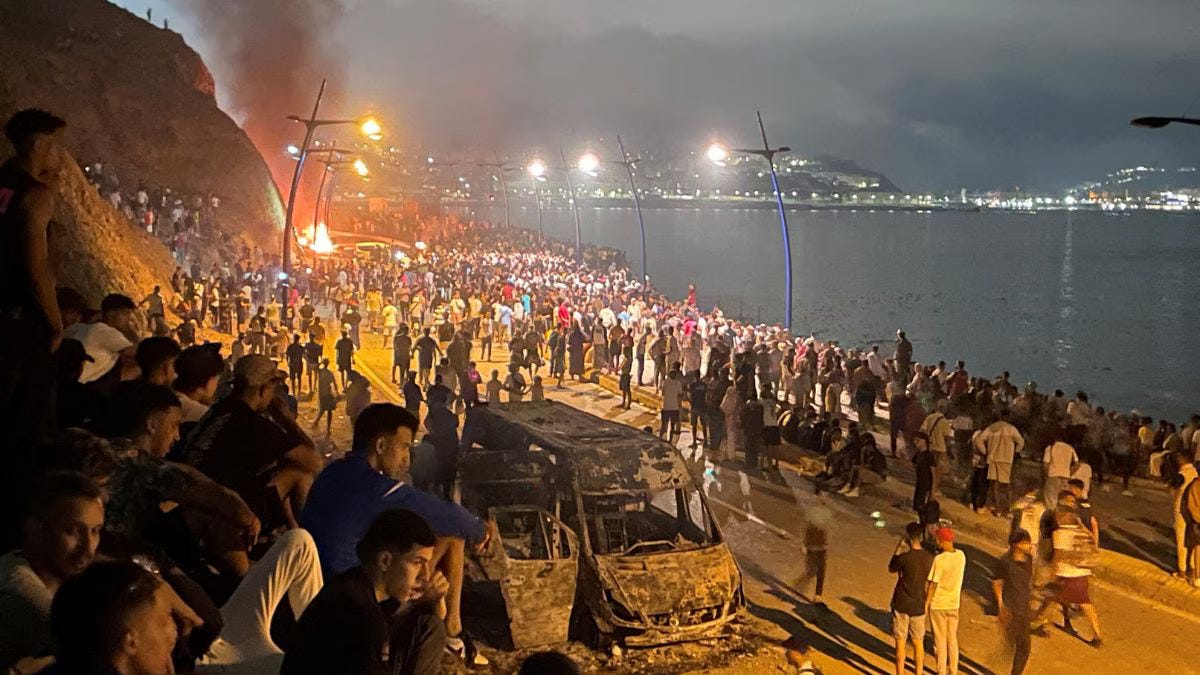
The shoes were still in the water at Tarajal, among buoys, clothes and the belongings people had dropped as they tried to swim around the breakwater separating Morocco from Ceuta, the Spanish enclave on the African coast. Some drowned and others were crushed in the rush at the fence. By Friday afternoon, El País reported that fifty-seven bodies had been recovered, most of them from the water around Tarajal, while rescue crews continued to search.
Abdulah Buji had come from Tetouan, about twenty-five miles south of the border. He was twenty-one and told the Associated Press that staying home meant working twelve-hour shifts for a wage on which he could not build a life. He crossed into Ceuta hoping Spain might contain an opening that Morocco did not. Instead he found a city drowning in its own emergency, and by Friday he was going back. “I haven’t found any opportunities here either,” he said.
Ahmed Karim, thirty-three, gave much the same reason for crossing: there were no jobs. These were the men whom American officials would soon compress into a photograph of invasion, stripping away their names, wages and motives so that their presence could be used against the Spanish government. Morocco had already used their movement to deliver one political message, and Washington used the same people to deliver another.
Morocco, Israel and the United States aligned against Spain to punish it for Palestine. Morocco controlled the border and had opened it before to force a Spanish concession, Israel had turned recognition of Morocco’s Western Sahara claim into military and intelligence cooperation, and the United States had granted the territorial recognition that made Rabat more difficult to discipline. Tens of thousands of people entered Ceuta during the hours when Moroccan enforcement disappeared, and yet the Trump White House directed its fury at Spain, the ally receiving them, rather than Rabat, the government that had stopped preventing their departure. The three governments brought different powers and grievances to the same punishment: Morocco supplied the border, Israel supplied strategic protection, and Washington supplied diplomatic cover and public approval.
Spain’s Interior Ministry estimated that about 50,000 people entered the enclave within a day. Juan Jesús Vivas, Ceuta’s regional president, put the number near 60,000, equivalent to almost seventy per cent of the city’s population. Pedro Sánchez flew to Ceuta and called the crossing “an attack” and “a violation of Spain’s territorial integrity.” By mid-afternoon on July 31, Spain said that roughly 37,500 people had been returned to Morocco.
The return of Moroccan control was almost as sudden as its absence. Police used water cannon and fired warning shots into the air. Achraf Maimouni, a human-rights activist in Fnideq, the Moroccan town adjoining Ceuta, told the Associated Press that people continued to cross through the water despite the new police presence while the land border remained closed. A frontier that had ceased to function was functioning again, and a state supposedly overwhelmed by spontaneous movement had recovered its capacity once the damage to Spain was complete.
Morocco’s ambassador in Madrid, Karima Benyaich, said the crossings ran against her government’s wishes. Spanish ministers publicly thanked Rabat for the cooperation that followed. Spanish officials nevertheless acknowledged to El País that an entry on this scale could not have occurred without Moroccan passivity. Surveillance on the Moroccan side had been reduced in the preceding days; on Thursday the gendarmes disappeared, and families walked through Tarajal without requiring the trafficking networks that Madrid later blamed. Spanish specialists quoted by the newspaper believed the effect had been sought.
Coercion by an ally arrives without a declaration of hostilities or a government claiming ownership of the dead. The pressure ends before the target can prove its origin, the gatekeeper is thanked for closing the gate it opened, and the people used to carry the message are returned to the conditions that made them available for use.
On February 6, 2014, at least fifteen people died trying to swim into Ceuta at the same beach. Spanish Civil Guard officers fired rubber projectiles and smoke canisters as people struggled in the water. The government defended the officers, investigations stalled, and Tarajal entered Europe’s border record as another place where a death count could be acknowledged without disturbing the policy that produced it.
The earlier tragedy matters because the 2026 crossing did not occur at an unknown hazard. Spanish and Moroccan authorities knew what the breakwater does to a crowd, what panic does in narrow water, and how quickly a person carrying a plastic buoy disappears beneath other bodies. The border is monitored by cameras, patrols, fences, police posts and two governments that have spent years describing it as one of Europe’s most sensitive security points. Fifty-seven people did not die because nobody understood the terrain.
They died inside a political decision about when that terrain would be controlled. Morocco could allow hope to gather near a border that is ordinarily sealed, remove the men who make crossing impossible and wait for poverty to do the rest without ordering anyone into the sea, and Spain then had to recover the bodies, house the living and face the cameras while Rabat restored the service Europe pays it to provide.
That method depends on the habits of European reporting. People “flood” an enclave, a “wave” reaches shore and a border comes “under pressure,” as if water had made a decision in Rabat. The grammar transfers agency from the officials controlling roads, beaches and patrols to the people with the least power in the story. Abdulah Buji chose to cross after Moroccan gendarmes had vanished, and Ahmed Karim looked for work in Spain after a state decided that tens of thousands of people could approach Tarajal at once; their decisions were real, and yet the decisive permission belonged to Rabat.
European governments have paid Morocco hundreds of millions of euros for border management, returns and action against smuggling. The arrangement gives Brussels distance from the violence required to police its southern edge and gives Rabat a valuable state asset: the power to regulate what European voters see on their television screens. Morocco is praised as a reliable partner while the gate remains closed, and when it opens, the resulting fear becomes a negotiation conducted through people who may never know which dispute placed them in the water. At Tarajal, outsourced border control acquired a body count and then resumed business.
Madrid first pointed to a Spanish Supreme Court judgment. Judgment 814/2026, issued on June 29 and publicised on July 8, restricted summary returns of people who reach Ceuta or Melilla by sea. Spanish authorities must provide an administrative procedure, legal assistance, interpretation, a reasoned decision, access to asylum and judicial review. News of the ruling travelled through northern Morocco and plainly changed the calculations of people considering the crossing.
The judgment governs what Spanish officers must do after a person reaches Spanish jurisdiction, not when Moroccan officers report for duty. It cannot explain why surveillance was reduced before the crossing, why gendarmes left their positions, why families could walk through a frontier Morocco ordinarily seals, or why Moroccan control returned after Ceuta had been overwhelmed. The law made the crossing seem more worthwhile, and Rabat’s absence made it possible.
Spanish officials also blamed criminal organisations. Smugglers operate along the coast and exploit people every day, but a smuggling syndicate cannot stand down Moroccan police, suspend border enforcement or allow 50,000 people to enter a city of about 84,000 within hours. Those are state-scale facts. To attribute them to traffickers is to assign the cause to men who sell places in boats while ignoring the government that decides whether the boats can leave.
The court ruling remains useful to every government involved. Rabat can describe the episode as spontaneous interest in a new legal protection, Madrid can praise restored cooperation without publicly accusing a neighbour it needs, Washington can blame progressive migration law and erase the foreign-policy dispute beneath the crossing, and Israel can remain silent while a government it has spent two years attacking is weakened. Each explanation removes one state from the scene, and together they leave the dead responsible for their own deaths. Morocco supplied the simpler test on Friday: police returned with water cannon and warning shots, the border began to close, and the Supreme Court had issued no second judgment.
Morocco had already demonstrated the method. On May 17, 2021, its forces relaxed control around Ceuta after Spain admitted Brahim Ghali, the leader of the Polisario Front, to a hospital for treatment. Ghali’s movement seeks independence for Western Sahara, the former Spanish colony that Morocco occupies and calls its southern provinces. Within two days, roughly 8,000 people entered Ceuta, including about 1,500 minors, with some swimming around the breakwater while Moroccan officers watched.
Rabat denied retaliation, and yet the European Parliament condemned “the use of border controls and migration, and unaccompanied minors in particular, as political pressure against a Member State.” Europe rarely describes the conduct of a migration partner so plainly. The resolution named the children because their presence made the calculation impossible to disguise: a government had relaxed a border to burden another government, and it had understood that minors would produce the greatest legal, administrative and emotional pressure once they arrived.
Spain initially maintained that Ghali’s treatment was a humanitarian matter and that its position on Western Sahara had not changed. Ten months later, Sánchez endorsed Morocco’s autonomy proposal as the “most serious, realistic and credible” basis for resolving the dispute. Relations recovered, migration cooperation resumed and the gate closed. Morocco had applied pressure at Ceuta and obtained a Spanish reversal on the issue the monarchy considers central to its legitimacy.
The sequence taught Rabat that the instrument worked. It also taught Brussels that condemnation would not end the arrangement, because Europe still wanted Moroccan forces to do the policing that European governments preferred not to see. Spain absorbed the hardest lesson: a state can possess fences, officers and sovereignty on paper while the neighbour controlling the approach decides how much of that sovereignty survives a difficult night.
The 2026 crossing was therefore no improvisation. It was the same mechanism at a scale large enough to make the earlier crisis look like a warning shot. Morocco did not need to claim Ceuta or threaten Spain in a communiqué. It let the enclave watch its streets, shelters and police capacity buckle under a population increase of more than half in one day, then restored enforcement before Spain could answer without risking the cooperation required to prevent a second opening.
The first operation helped force Madrid to change its position on Western Sahara. The question left at Tarajal is what Spain is now being told to change.
On December 10, 2020, Donald Trump proclaimed that the United States recognised Moroccan sovereignty over Western Sahara. The decision broke with decades of international diplomacy and arrived as the price of Morocco entering the Abraham Accords. Rabat restored official relations with Israel. Washington gave the palace recognition of its claim to a territory whose people had been promised a vote on self-determination and whose status remains unresolved at the United Nations.
The agreement was sold as peace between countries that were not at war. Its currency was land belonging to people excluded from the transaction. Morocco offered relations with Israel, the Trump administration offered Western Sahara, Israel received another Arab government willing to treat Palestinian dispossession as separable from regional diplomacy, and the Sahrawis were expected to accept that a White House proclamation had disposed of their future.
Israel then made the exchange military. In November 2021, the Israeli and Moroccan defence ministers signed a memorandum covering intelligence, training and defence industry. In July 2023, Israel formally recognised Moroccan sovereignty over Western Sahara. Israeli systems and expertise strengthened Morocco’s air power in the territory, while security cooperation turned the relationship announced at embassies into one enforced by weapons.
Neither the United Nations nor the European Union accepted Moroccan sovereignty, and yet legal status is only one measure of possession. American recognition gave Rabat cover from the state most capable of imposing a diplomatic price, Israeli recognition added the support of a military power prepared to deepen the occupation materially, and the bargain left the monarchy with its claim fortified, its armed forces better connected and its confidence enlarged.
Spain occupies a peculiar place in that calculation. It is the former colonial power in Western Sahara, the European state most exposed to Moroccan migration pressure and the government responsible for Ceuta and Melilla, which Rabat claims. Madrid’s dependence is geographical and political. It needs Morocco to police the approaches to its enclaves, cooperate against armed groups, manage trade and contain disputes over waters, customs and territory. The palace knows that every Spanish government inherits the same map.
The American-Israeli-Moroccan alignment changed what Rabat could do with that map. Washington and Israel did not create Morocco’s claim to Ceuta, its hostility to Polisario or its willingness to use migration, and yet they reduced the external price of acting on each. The United States supplied diplomatic protection over Western Sahara, Israel supplied recognition, weapons and security cooperation, and Morocco supplied the geographic instrument that could hurt Spain without a formal confrontation. A monarchy carrying both American backing and an Israeli defence relationship can open pressure on Spain with far more confidence than one still seeking either.
Inside Morocco, the arrangement carries another betrayal. Large demonstrations have repeatedly shown the depth of public support for Palestine and public hostility to normalisation, while the palace has maintained relations with Israel and expanded security cooperation. Moroccan citizens marched for Gaza, and their government used the rewards of normalisation to strengthen its regional position. Then, when Spain turned support for Palestine into policy, Rabat used other Moroccans, many of them poor and young, to place that government under pressure. The Palestinians and Sahrawis were traded at the diplomatic table, and yet the Moroccans at Tarajal were the people spent at the border.
Spain recognised the State of Palestine on May 28, 2024, alongside Ireland and Norway. Recognition alone would have angered Israel without threatening the system that sustains it, and Sánchez’s government continued: a month later, Spain filed a declaration of intervention in South Africa’s genocide case against Israel at the International Court of Justice, placing Madrid behind a legal process that Washington had attacked and Israel had treated as an assault on its legitimacy.
In September 2025, the Spanish government announced nine measures intended, in its own words, “to stop the genocide in Gaza.” It legally consolidated an arms embargo applied since October 2023, prohibited ships carrying fuel for the Israeli armed forces from using Spanish ports, barred aircraft carrying military material for Israel from Spanish airspace and moved to stop goods originating in illegal settlements from entering the Spanish market. Sánchez also promised more funding for the United Nations agency for Palestinian refugees and additional humanitarian assistance.
Madrid had attached state power to its language. Recognition challenged the assumption that Palestinian statehood required Israeli permission, intervention at The Hague challenged legal immunity, and the arms, port and airspace measures touched the physical chain through which war is sustained. Spain had done what the governments delivering carefully balanced speeches about Gaza refused to do: it imposed costs.
Israel answered by treating the Spanish government as an enemy. Its ministers accused Sánchez and members of his cabinet of antisemitism, barred two Spanish ministers from entering Israel and drove relations to the point at which neither country had an ambassador in the other’s capital. The accusation of antisemitism did the work demanded of it, redirecting attention from embargoed weapons and closed ports to the alleged moral corruption of the government imposing the restrictions.
Spain continued, and that persistence mattered more than the individual measures because it gave other Western governments a sequence they could copy. Palestine could be recognised, the genocide case could be supported, arms could be embargoed, military cargo could be denied ports and airspace, settlement trade could be restricted, and diplomatic relations with Israel could be allowed to worsen without a government collapsing the next morning. Madrid had turned solidarity into a state practice.
The challenge extended to Washington. Sánchez resisted Trump’s demand that NATO members commit five per cent of gross domestic product to defence. Spain denied a White House claim that it had agreed to cooperate with American military operations against Iran and refused the use of the US-operated bases at Rota and Morón for strikes it considered to lack a legal basis. At the July NATO summit, Trump called Spain a “wasted cause” and threatened to punish it through trade.
These disputes concerned different files, but they asked the same question: could a European ally with American bases on its soil decide that alliance did not mean obedience? Spain’s Palestine policy supplied the sharpest answer because it challenged Washington’s most protected regional client, gave legal force to the word genocide and interfered with the movement of material supporting the Israeli military. Morocco, Israel and the United States each had reason to stop that example from travelling, and their interests aligned at the place where Spain was exposed and Washington could pretend not to see the hand turning the valve.
The Trump administration responded before the water at Tarajal had given up all its dead. Trump circulated the images as a warning to American voters: “Remember that image. That will be us in three years if the wrong side gets into power.” Vice-President JD Vance called the crossing the result of “radical left globalist policies” enabling an “invasion of the West.” Stephen Miller and White House communications director Steven Cheung joined the attack.
Anna Kelly, a White House spokeswoman, told Fox News that Spain and other countries following what she called a “destructive philosophy” should reverse course “or risk their own demise.” Her statement landed while Spanish crews were recovering bodies and Ceuta was processing a population movement without precedent in the enclave’s modern history. The ally retrieving the dead was accused of engineering its own destruction, while the government whose officers had left the frontier escaped a word of public criticism.
Washington could have asked Rabat why its border force vanished, pressed for immediate control and offered assistance to a NATO ally. The White House instead converted Spain’s distress into evidence for Trump’s domestic politics and placed Sánchez among the authors of the crisis, assuring Morocco that pressure on Spain would be rewarded with pressure from the United States.
The American response also told the Spanish right how to use Ceuta. Sánchez had angered Washington over NATO spending, Iran and the bases; he had angered Israel over Palestine; and he now faced images of disorder at a border that Spain could not control without Morocco. Trump, Vance and Miller supplied the language through which these disputes could be collapsed into one charge of national betrayal. The deaths became campaign material before families knew whom the sea had taken.
No public document establishes a joint American, Israeli and Moroccan command ordering the border opened. That absence preserves deniability without erasing the alignment visible in each government’s conduct. Morocco controlled the means of coercion and used it against Spain, Israel had armed and politically protected the Moroccan state applying that coercion, and Washington celebrated the result while attacking the government being coerced. Three governments performed three different functions against the same Spanish policy.
Protected states rarely need written instructions for every service they provide. They study what the patron rewards, what it ignores and whom it has chosen to punish. Rabat could hurt Spain over Algeria, Ceuta and Western Sahara while carrying out its part in a wider punishment for Palestine, Israel could retain distance behind its military relationship with Morocco, and Washington could deny involvement while broadcasting approval of the pain. Their motives were not identical, and yet their actions converged against the same government for the same act of disobedience.
Spanish intelligence officials told El País that they had not established Morocco’s final motive. Several disputes could have determined the timing. Sánchez visited Algiers on July 20 as Spain repaired relations with Algeria, Morocco’s regional rival and the principal supporter of the Polisario Front. Madrid and Rabat were preparing a high-level meeting. A proposed Spanish law could grant citizenship to people born in the former Spanish Sahara and their descendants. Morocco continues to claim Ceuta and Melilla and sometimes links their future to Spain’s position on Gibraltar.
The Supreme Court judgment added another clock. So did domestic politics in Morocco, where the monarchy must manage public anger over Gaza while maintaining its Israeli relationship. A state action can carry several messages at once, particularly when the instrument is deniable and every recipient already knows the dispute. Rabat could warn Madrid over Algeria and Sahrawi citizenship, remind Spain who controls access to Ceuta, and execute its part in the American-Israeli-Moroccan alignment against Spain through one calculated absence.
Each additional dispute gave Morocco its own stake in an alignment already beneficial to Washington and Israel. Algeria, Sahrawi citizenship and the Supreme Court judgment can explain why Rabat chose this week, while Palestine explains why Washington joined the attack on Spain, why Israel had already made Sánchez a diplomatic target, and why Morocco could expect its two strategic partners to protect rather than restrain it. The government selected for punishment had recognised Palestine, joined the genocide case, embargoed arms, closed ports and airspace to military supply, restricted settlement goods and resisted American war policy.
The harder inquiry concerns permission. Why could Rabat assume that overwhelming Ceuta would cost Morocco less than it cost Spain? American recognition of its Western Sahara claim, Israeli recognition and military cooperation, European dependence on Moroccan border policing and the success of the 2021 operation supplied the answer: Spain had law and sovereignty, and yet Morocco held the approach to the gate and had powerful friends willing to blame Madrid when it opened.
The immediate grievance may be recorded one day in a diplomatic cable, a palace instruction or the testimony of an officer ordered away from Tarajal. It may never be recorded at all. The public record already shows who controlled the border, who had used it before, who benefited from Spain’s humiliation and who chose to attack the victim while the bodies were still being counted, which is enough to name the political design without inventing the missing order.
Europe’s answer will probably strengthen the same machinery. Morocco will receive more money and equipment to prevent a repetition. Spain will accelerate returns and defend the cooperation as indispensable. European officials will speak of stability, smuggling and orderly migration, and the state whose withdrawn enforcement produced the crisis will be hired again to prevent the next one.
Abdulah Buji will not appear in those agreements. His twelve-hour shifts, his crossing and his return belong to the disposable human ledger beneath Mediterranean diplomacy. Ahmed Karim’s unemployment will be treated as an origin-country problem until a government discovers that it can be converted into pressure on Europe. The fifty-seven dead will become a number attached to July 31, stripped of the decisions that gathered them at a known killing place.
The final utility of migration as coercion is the division of responsibility until it disappears. Morocco attributes the crossing to individual will, Washington blames left-wing policy, Israel remains silent behind its alliance with Rabat, Spain points to its court ruling and Europe demands faster returns. The fragments protect the alignment because no participant has to acknowledge the whole: Morocco opened the pressure point, Israel helped make Morocco strategically secure, and the United States converted the punishment into an attack on Spain.
The people at Tarajal had inadequate wages, absent work, families, ambitions and the ordinary belief that life might be less punishing a few miles away. Their humanity made the operation possible because democratic governments are expected to rescue, shelter and process human beings even when another state has placed them under impossible pressure. Morocco used Spain’s legal obligations against it, and Washington then mocked Spain for having them.
Ceuta therefore belongs to the history of Gaza even though no bomb fell there. Gaza has become the test of whether Western law binds an ally, whether Palestinian life can alter trade and military policy, and whether a European government can oppose Israel with acts rather than condolences. Spain answered with recognition, courts, an embargo and closed routes for military supply. The response travelled through Western Sahara, an Israeli security partnership, a Moroccan border post and the bodies of people who had never been consulted about any of it.
There is no honour in pretending the connection must be written in a single secret order before it can be seen. Morocco, Israel and the United States built their alignment in public: Trump exchanged recognition of Moroccan sovereignty over Western Sahara for normalisation with Israel, Israel converted that exchange into military cooperation, Morocco demonstrated that migration could force Spain to reverse policy, and Spain then made itself their European dissenter over Palestine. Morocco opened the border, Israel’s partnership protected Rabat, and the White House blamed Spain.
The gate is still in Rabat’s hands.


