Naked Empire: The Day America Stopped Apologizing
Rubio's Munich Speech Revealed What the West Always Is And Why European Leaders Applauded Their Own Exposure
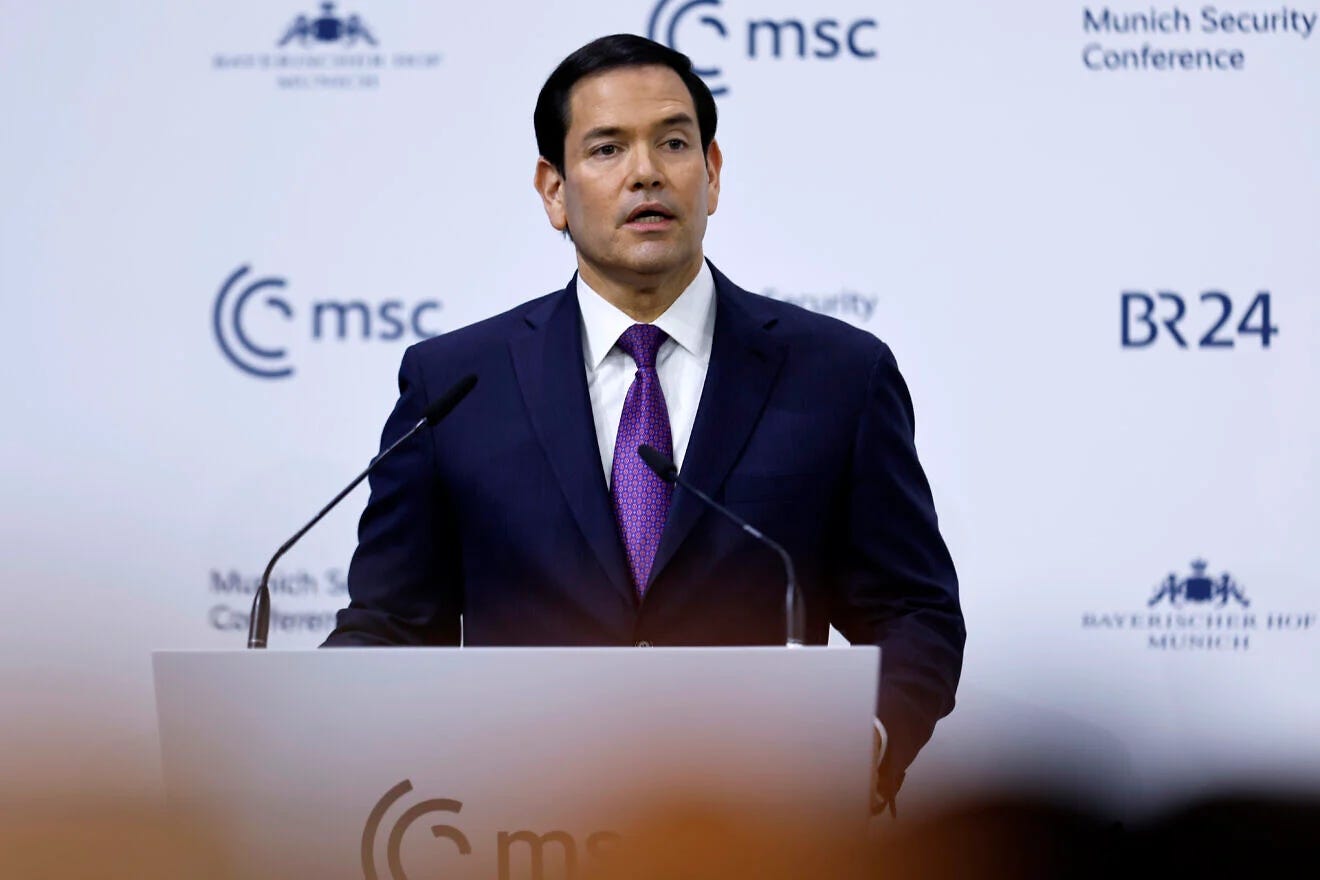
The 62nd Munich Security Conference concluded Sunday with a standing ovation for Washington’s top diplomat, yet the applause marked not a moment of alliance repair but the unveiling of a doctrine the Trump administration had struggled to articulate clearly: a return to Western imperial dominance dressed in the language of civilizational renewal.
Secretary of State Marco Rubio’s address on Saturday crystallized something that has been lurking beneath Trump’s “America First” rhetoric since his 2024 return to power. What began as a campaign promise to end endless wars, withdraw from imperial commitments, and prioritize American citizens has evolved into something far more dangerous, a reinvigorated imperial project wrapped in appeals to shared Christian heritage and civilizational bonds.
The Munich conference itself revealed the actual state of the Western alliance. By the final day, the fiction of transatlantic partnership had been exposed entirely. Yet European leaders applauded anyway, understanding that Washington’s message was not ambiguous: accept a restructured hierarchy where the United States leads the West in reasserting dominance over the global South, or lose access to the security architecture that underwrites European power.
This is not a repair of the transatlantic alliance. It is the redefinition of what vassalship means in the 21st century.
The Conference Context: An Alliance in Structural Collapse
Conference chairman Wolfgang Ischinger announced what should have been obvious: “transatlantic relations are currently in a significant crisis of confidence and credibility.” He said this at an event explicitly designed to manage that crisis, suggesting the moment had moved beyond management into something structural.
The causes were documented plainly. Germany’s Chancellor Friedrich Merz opened Friday by stating that “a deep divide has opened between Europe and the United States” and warned that Washington’s “claim to leadership has been challenged, and possibly lost.” He revealed something more telling: he had held confidential talks with France about European nuclear deterrence independent of American guarantees. This is not diplomatic negotiation. This is the beginning of strategic divorce.
Britain announced a carrier strike group deployment focused on Arctic operations alongside American forces, a message that Europe was preparing to lead its own defense. The European Union’s foreign affairs chief Kaja Kallas pushed back directly against American framing, rejecting what she called “European-bashing” and insisting that contrary to Trump administration claims, Europe was not facing “civilizational erasure.”
Yet when Rubio arrived Saturday afternoon, all of this disappeared. European leaders traded structural concerns about alliance reliability for the reassurance of symbolic affirmation. They received promises that America would not abandon Europe, framed in language about shared heritage and Christian foundations. In exchange, they applauded a doctrine that reframed their subordination as partnership.
This was not weakness on Europe’s part. It was the calculation of declining powers with no alternatives.
The Speech: Imperial Rhetoric as Civilizational Necessity
Rubio’s address requires close attention because it articulates with unusual clarity the ideological framework undergirding Trump’s second-term foreign policy. It is not, as mainstream commentary suggests, a “softer” version of Vice President JD Vance’s attack on Europe last year. It is something more sophisticated and far more dangerous, a complete inversion of America First into America as the permanent custodian of Western imperial order.
The central argument is worth examining directly. Rubio framed the fundamental question of national security not as “how do we protect American interests” but rather “what exactly are we defending, because armies do not fight for abstractions. Armies fight for a people; armies fight for a nation. Armies fight for a way of life.”
That formulation collapses American national interest into defense of “Western civilization” itself. The move is deceptive in its subtlety. By making the unit of defense not the United States but rather an entire civilizational bloc, Rubio justifies any intervention, any military commitment, any alliance obligation as inherently in America’s interest because Western civilization’s survival is at stake.
He made this explicit: “We are part of one civilization, Western civilization. We are bound to one another by the deepest bonds that nations could share, forged by centuries of shared history, Christian faith, culture, heritage, language, ancestry, and the sacrifices our forefathers made together for the common civilization to which we have fallen heir.”
This is the language of empire. The specific civilization being defended is not incidental, it is Christianity, whiteness, Western heritage, and shared ancestry. Rubio listed the cultural monuments: Mozart, Beethoven, Dante, Shakespeare, Michelangelo, Da Vinci. He was not describing a political system or a set of values susceptible to universal application. He was describing a racial and religious identity.
The mechanism by which this becomes imperial policy is in what he defined as threats to that civilization. Rubio identified three existential dangers:
First, migration. He stated directly: “Controlling who and how many people enter our countries is a fundamental act of national sovereignty. The failure to do so is an urgent threat to the fabric of our societies and the survival of our civilization itself.” This inverts the typical conservative position. It is not merely about national borders or resource allocation. Rubio positioned immigration control as a prerequisite for Western civilizational survival. By implication, countries that do not implement strict migration controls are complicit in their own erasure.
Second, climate action. He attacked what he called the “climate cult,” describing it as “a foolish idea that ignored both human nature and the lessons of 5,000 years of recorded human history.” The framing matters. By positioning climate policy as a civilizational threat equivalent to migration, Rubio aligned the Trump administration with petro-states and extractive economies globally. The implication is that Western nations must prioritize economic dominance over environmental regulation, precisely the framework that has justified exploitation of the Global South.
Third, the post-World War II order itself. Here Rubio became most revealing. He described Europe’s postwar decline not as a geopolitical fact but as a moral failure rooted in the “euphoria” of defeating communism. This euphoria, he argued, led to a “dangerous delusion that every nation would now be a liberal democracy, that the ties formed by trade and commerce alone would replace nationhood.” He explicitly lamented that this period saw the decline of “great Western empires” and “anti-colonial uprisings that would transform the world.”
He was naming it precisely: the postwar international order, built on the principle that colonialism was finished and that nations had the right to self-determination, was a mistake. The “task of renewal and restoration” under Trump means reversing the postwar settlement and restoring Western imperial dominance.
The America First Betrayal: Empire as National Interest
This is where the speech becomes a direct repudiation of the platform on which Trump was elected. America First was premised on a specific idea: that American military commitments abroad drain resources from American citizens, that overseas alliances benefit the military-industrial complex more than ordinary Americans, and that the United States should pursue its interests narrowly defined rather than policing the globe.
Rubio’s Munich speech inverts every element of that argument. He positioned American global leadership not as a burden but as a civilizational necessity. He framed American military commitments not as expenditures for other peoples’ benefit but as essential defense of “what we are defending: a great civilization that has every reason to be proud of its history, confident of its future.”
The rhetorical sleight of hand deserves emphasis. By making “Western civilization” the unit of analysis rather than American national interest, Rubio transformed interventionism from an imperial project into a defensive necessity. Defense of “Western civilization” justifies military bases across Europe, NATO expansion, weapons supplies to Ukraine, confrontation with Russia and China, and deepened alliance commitments.
This is precisely the opposite of America First. America First meant reducing overseas military commitments. Rubio’s position means expanding them and rebranding them as defense of shared heritage rather than imperial interest.
Several Trump administration officials accompanying Rubio were explicit about the continuity with Vance. They told reporters his message was “much the same as Vance’s last year but intended to have a softer landing on the audience.” The substantive position had not changed. Only the tone had been refined.
Rubio stated it plainly himself. When asked if his approach differed from Vance’s, he responded: “I think it’s the same message. I think what the Vice President said last year very clearly was that Europe had made a series of decisions internally that were threatening to the alliance and ultimately to themselves.”
The difference is marketing. Vance lectured Europe about its failures. Rubio invited Europe to join America in a grand civilizational project. The outcome is identical: American domination of European foreign policy, justified not by naked power but by appeals to shared values and heritage.
Geopolitical analyst Arnaud Bertrand identified what was actually occurring: “Basically the man is openly saying that the whole post-colonial order was a mistake and he’s calling on Europe to share the spoils of building a new one.” Bertrand called it “one of the most revisionist and imperialist speeches I’ve ever seen a senior American official make.”
The Fine Print: What Europe Actually Agreed To
What was Europe applauding? The standing ovation that greeted Rubio’s address should be read carefully. European Commission President Ursula von der Leyen called it “very reassuring.” What she meant was that the United States was not, in that moment, threatening military action against European NATO members.
The actual content of what Rubio demanded is in the details. He called on Europe to:
Massively increase military spending and rearm independently, but coordinated with American strategy. He praised European leaders who were now discussing stronger defense capabilities but made clear this was not independent European power. It was Europe arming itself to support American interests.
Reject “liberal” policies on migration, climate, and social issues. European nations that maintain inclusive immigration policies or aggressive climate action were positioned as obstacles to the alliance. The “renewal and restoration” Rubio described requires European nations to abandon social democratic governance.
Reform international institutions rather than abandon them, but only to strengthen Western dominance. When Rubio said “we do not need to abandon the system of international cooperation we authored,” he meant the UN, NATO, and the postwar institutional structure that has guaranteed American primacy. “Reform” means restructuring these to exclude non-Western powers more effectively.
Most critically, accept American leadership in a renewed Western imperial project. The specific framing matters: “And while we are prepared, if necessary, to do this alone, it is our preference and it is our hope to do this together with you, our friends here in Europe.”
The message is transparent. The United States will proceed with its agenda regardless. Europe’s choice is whether to participate as a junior partner in the renewal of Western dominance or be excluded from the benefits. This is not a partnership. This is the offer of a position in a hierarchical system.
Nathalie Tocci, a professor at Johns Hopkins, captured the dynamic precisely: “When an imperial power is speaking to you of sentiments, of how much they like you and how they want to partner with you, the much weaker party, that’s cause for worry, not applause.”
The Global South Dimension: Who the Speech Was Really For
Rubio’s Munich address was not primarily about Europe. It was a message to the entire Global South about America’s refusal to accept the postwar order.
The timing and content matter here. The speech came after Trump had threatened military action against Greenland (a Danish territory), after the administration had explicitly discussed annexing Canadian territory, and while the US was expanding military operations against Iran. It came as the administration was embracing the Monroe Doctrine globally, justifying unilateral intervention in Latin America on civilizational grounds.
Rubio positioned Western civilization as explicitly Christian and explicitly based on European heritage. By doing so, he was drawing a line: the nations and peoples of the Global South whether Muslim-majority, Hindu-majority, Buddhist-majority, or postcolonial in orientation are outside this civilization and its protection. Their resources, territories, and labor are positioned as legitimate subjects of Western competition and dominance.
The speech referenced the postwar order’s failure to prevent conflicts in Ukraine and Gaza without acknowledging that the American role in creating those conflicts. It positioned American military power as necessary because international institutions have “no answers.” What this actually means: international institutions constrain American power, and the Trump administration will not be constrained.
Pakistan, which was present at Munich through its military chief, witnessed this directly. When General Asim Munir was stopped by security and asked for his ID—an incident that went viral on social media, it exposed something barely concealed: Pakistan’s actual standing in the new Western order. Despite Trump’s repeated references to Pakistan as strategically important for South Asian stability, Pakistanis at Munich experienced the humiliation of not being recognized even as conference participants.
This is the structure Rubio was announcing. Pakistan remains useful for counterterrorism coordination and as a bulwark against Chinese influence in the region. But Pakistan has no status as an equal, no voice in shaping the rules of the international system, no protection under the civilization Rubio described. Pakistan is a client state, useful when it complies with American interests and negligible when it does not.
The same applies to every nation outside Western civilization. Rubio’s speech was an announcement that the United States was abandoning any pretense of a rules-based international order open to all nations. It was replacing that with explicit civilizational hierarchy: Western civilization, led by America, at the apex, with everyone else positioned as either subjects or competitors.
The Contradiction Concealed: America First vs. American Empire
Here lies the deepest hypocrisy, and the one that reveals something important about Trump’s actual project.
America First as a campaign slogan promised that American foreign policy would be reorganized around the interests of working-class Americans. It promised to end endless wars, stop nation-building, and redirect the trillions spent on military commitments toward infrastructure and domestic needs.
Rubio’s Munich speech abandons this completely. It repositions military commitments abroad as essential defense of American civilization. It calls for a “reinvigorated alliance” and describes America’s destiny as “intertwined” with Europe. It positions American military power as the custodian of Western dominance globally.
This is not America First. This is America as Empire.
The mechanism of the contradiction is important to understand. America First appealed to working-class Americans exhausted by wars in the Middle East and frustrated by spending that benefited military contractors more than citizens. It promised to abandon the liberal international order premised on free trade, multilateral institutions, and supposed commitment to universal values.
What Rubio is describing is a replacement of that order with an explicit civilizational hierarchy based on Christian heritage, Western culture, and racial identification. Instead of claiming universal principles (democracy, human rights, rule of law), the administration would base alliance on civilizational identity.
The appeal of this to working-class Americans is supposed to be that it prioritizes “their” civilization and “their” values. Implicitly, this means positioning Muslims, Chinese, Indians, and other non-Western peoples as threats to be managed or defeated rather than partners in a universal order.
The actual policy outcome is identical: massive military spending, extensive overseas commitments, alliance structures designed to maintain American primacy, and military interventions justified by existential threats to American interests.
The only change is that the justification shifts from “promoting democracy” to “defending Western civilization,” and the beneficiaries remain identical: defense contractors, oil companies, arms manufacturers, and the military-industrial complex.
Working-class Americans see no benefit from either. The resources flow to the same corporate interests. The military bases remain. The weapons shipments continue. Only the rhetoric has changed.
Munich as Inflection Point: The End of Liberal Internationalism, Not Its Replacement
The 62nd Munich Security Conference marked a genuine threshold in international affairs, but not the one organizers intended. The conference exposed that the liberal international order, already fractured, is now being openly abandoned by its former custodian in favor of something more nakedly hierarchical.
The conference’s stated theme was “Under Destruction.” This proved prescient. The order built after World War II, whatever its flaws and crimes, was premised on the principle that colonialism was finished and that nations had equal status in international law. That order is now being destroyed in real time.
Rubio’s speech provided the ideological framework for that destruction. It positioned the postwar era as a dangerous delusion brought on by the euphoria of defeating communism. It mourned the decline of Western empires. It called for a return to Western dominance on a global scale. And it invited the remaining Western powers to join America in this project, promising them junior partnership in the new order.
Europe’s applause should not be read as enthusiasm for this vision. It should be read as the sound of declining powers accepting their reduced circumstances. They applauded because the alternative, exclusion from American protection and markets, is untenable for them.
The Global South, meanwhile, has received a message with crystalline clarity: the United States is abandoning any pretense of rules-based order and returning to naked imperial competition. Resources, territories, and labor are now explicitly positioned as subjects of Western competition and dominance.
This is not a new order. It is the old imperial order, rechristened and reorganized for the 21st century.
Conclusion: The Machinery of Vassalship Under New Management
What Rubio delivered in Munich was not American foreign policy adjusted for changed circumstances. It was a complete statement of intent: the Trump administration intends to reorganize the international system explicitly around Western, specifically Christian, civilizational identity, with America as the permanent custodian of that civilization’s dominance.
The machinery of this is already visible. Military commitments expand under the guise of civilizational defense. Alliances deepen under the banner of shared heritage rather than shared interests. International institutions are reformed to concentrate power further in Western hands. And the Global South is positioned as a space where Western competition and dominance will be pursued with renewed intensity.
For nations like Pakistan, positioned at the intersection of South Asian geopolitics and American strategic interest, the message is stark: utility in the new order depends on alignment with American civilizational projects. This means deepening military dependencies, accepting American strategic priorities over Pakistani ones, and positioning hostile relationships with Muslim-majority neighbors as essential to Western security.
The cruel irony is that Trump’s America First rhetoric promised liberation from exactly this kind of imperial commitment. It promised that American power would be reorganized around American interests narrowly defined, that other nations could pursue their own paths without American interference, and that the resources for American primacy could be redirected toward American citizens.
Instead, Trump’s second term is delivering a return to American empire, only with more explicitly ideological framing and less apologetic rhetoric.
Rubio’s Munich speech will be remembered not for the sigh of relief it produced from anxious European leaders, but for the clarity with which it articulated what comes next: a world reorganized explicitly around civilizational hierarchy, with Western powers led by America at the apex, and everyone else positioned as subjects or competitors in a renewed imperial order.
The applause that followed should be understood for what it was: not enthusiasm, but the sound of resignation.


