


He called delegates cowards, treated scripture as a land deed, erased Palestinian life and hurried home to an election that needs permanent war.
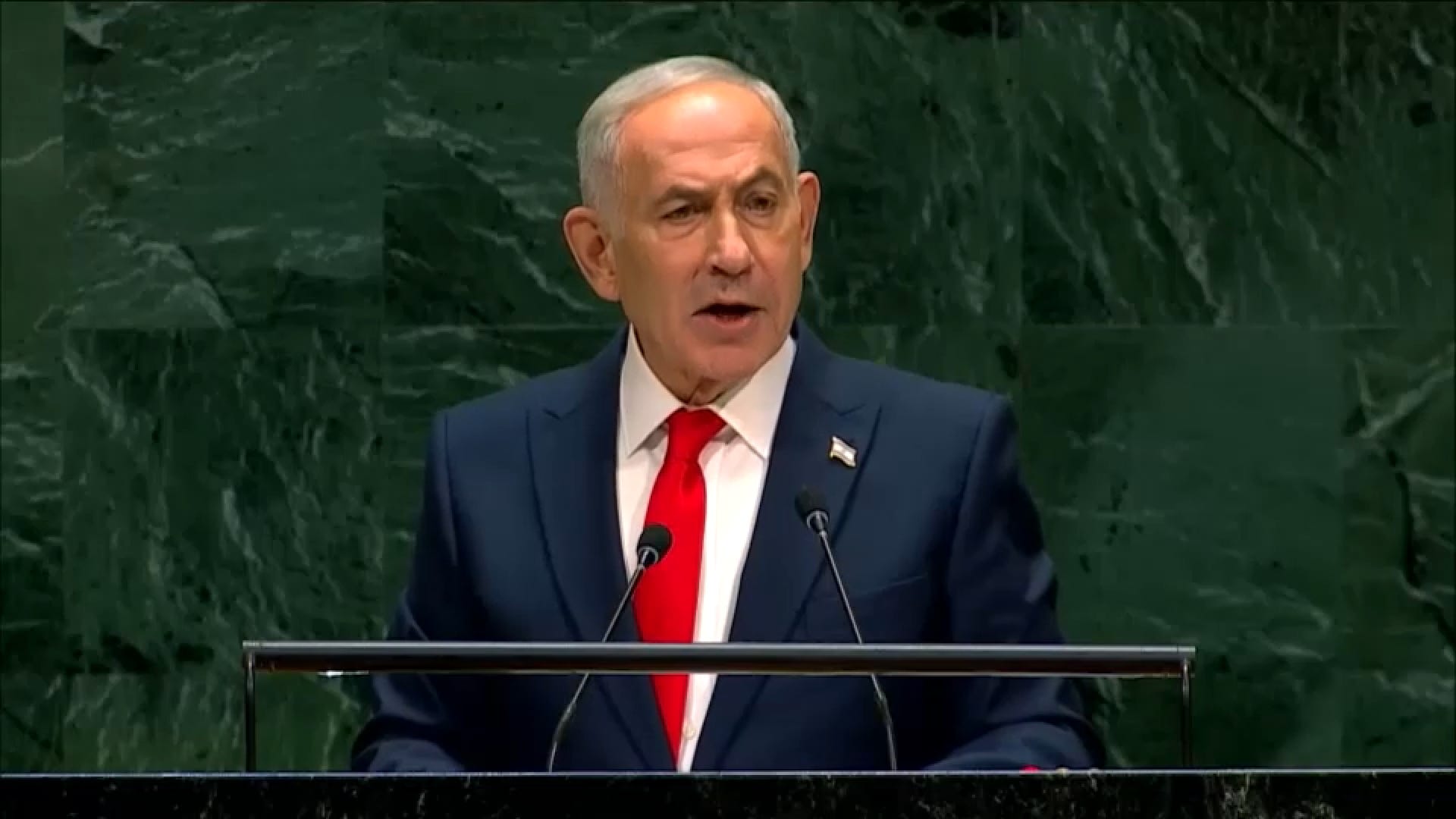
Benjamin Netanyahu arrived in New York late on Wednesday, spoke at the United Nations on Thursday afternoon and was due to fly back to Israel that night. He came for the camera and left before the city could become anything more than a backdrop. There was an election campaign waiting at home, an arrest warrant following him abroad, and a speech timed for prime television in Israel. Thirty-seven minutes at the rostrum were enough.
Video: Netanyahu is booed as he begins his UNGA speech, with many delegations walking out of the General Assembly hall.
Scores of delegates stood and walked out when his name was announced. The General Assembly president repeatedly called for order as the seats emptied, and Netanyahu looked across the hall and opened with an insult: “If there are any other moral cowards who have not yet left the hall, please do so now.” A prime minister wanted by the International Criminal Court for alleged war crimes and crimes against humanity had entered the institution built from the wreckage of 1945 and decided that the people refusing to sit politely through his defence were the cowards. He had barely begun, and the whole arrangement was already visible. The delegates would supply the enemy footage, the empty chairs would certify his persecution, and Netanyahu would return home as the lone defender of Israel against a hostile world.
That was the purpose of the trip. A fact mattered when it could serve an alibi, history could be bent into title deeds, and Jewish grief could be conscripted into his campaign. Gaza entered as an accusation against Israel, while Palestinians were cast as recipients of Israeli benevolence, shields for Hamas or an inconvenient number to be denied. A people reduced to rubble were granted no politics, no memory, no claim on the future and no name that did not pass through his mouth as a threat. Then came the refrain: “We have no other choice.”
Netanyahu borrowed the words from his brother Yoni, recalling a conversation before the 1967 war and Yoni’s later death at Entebbe, and he returned to them until a family memory became a doctrine of state immunity. They sound brave because they close every door before anyone can ask who locked it. The claim of necessity erases the decision, the erased decision removes responsibility, and the result places the warrant in The Hague among the insults, the dead among the unfortunate costs of Jewish survival, and every new front among the wars Israel says it was forced to open. Listen carefully and the confession sits inside the defence: his government recognises a choice only when it leaves Israeli power untouched.
Eight days before Netanyahu spoke, a six-storey residential building damaged during the war collapsed in Gaza City. Twenty-one people died, including twelve children. Talal al-Harazin, who had lived with his family in a tent beside the building, told the United Nations that the dust became so thick that he could not see his fingers. Displaced families had been sheltering inside because a cracked building was still better than the alternatives available to them. Rescue teams arrived with too little heavy equipment because Israel continues to restrict machinery, spare parts and construction material entering Gaza. Hundreds of bodies have been recovered from collapsed buildings since the ceasefire. Thousands more remain under the rubble.
Netanyahu mentioned polio vaccines. “What genocidal regime gives a million polio vaccines to the enemy population?” he asked. He expected the question to function as an acquittal. Yet a vaccination campaign does not cancel starvation, bombardment, forced displacement, destroyed hospitals, blocked medical equipment or the burial of families beneath their homes. Polio also crosses military lines, reaches Israeli towns and threatens Israeli children. Vaccinating Gaza’s children served a public-health necessity for everyone in the region, and Netanyahu turned that necessity into an act of personal mercy, as though a child receiving two drops on the tongue had surrendered any claim not to be bombed, starved or made homeless.
The legal record does not disappear because a prime minister holds up a vaccination count. In September 2025, the UN Independent International Commission of Inquiry concluded that Israeli authorities and security forces had committed and continued to commit four of the five genocidal acts defined by the Genocide Convention. The commission found killing, serious bodily and mental harm, the deliberate imposition of conditions of life calculated to destroy Palestinians in Gaza in whole or in part, and measures intended to prevent births. Israel rejected that conclusion. The case brought by South Africa remains before the International Court of Justice, which has issued binding provisional measures while it considers the merits. Evidence and law can answer these institutions. A syringe cannot.
The same defence has long come with an arithmetic line about food. Netanyahu has cited two million tonnes of food and aid, then translated the mass into one tonne for every person in Gaza. Tonnage is a fine unit for a dock ledger and a useless measure of whether a particular child ate dinner. It does not say what crossed the inspection point, what sat for days in the sun, what was rejected, what reached a warehouse, what entered a market, what a family could afford, or how many calories survived the route from the truck to the mouth. It certainly does not answer the International Criminal Court, whose judges found reasonable grounds to believe that Netanyahu and former defence minister Yoav Gallant bore criminal responsibility for starvation as a method of warfare, along with the crimes against humanity of murder, persecution and other inhumane acts. The warrant was issued on 21 November 2024, and it still carries his name.
Nearly 74,000 Palestinians have been killed in Gaza since October 2023, according to the Gaza Health Ministry, whose totals international organisations have generally treated as reliable. More than 174,000 have been injured. The October 2025 ceasefire reduced the heaviest fighting, and yet the killing continued: by 21 September 2026, Gaza health officials had recorded at least 1,394 Palestinians killed and 4,839 wounded after the agreement took effect. The week before Netanyahu reached New York, the United Nations reported that nine children had recently been killed or had died from their injuries, including two sisters aged six and twelve. The moral content of these figures is not altered by the number of aid trucks Israel says it inspected.
Netanyahu knows how legal argument works. He has spent years fighting a corruption case at home, challenging procedure, attacking investigators and distinguishing an allegation from a conviction whenever his own liberty is involved. At the UN, he replaced that precision with theatre, as a vaccine became proof against genocide and gross tonnes became proof against starvation. The same man who demands every protection of due process for himself offered Palestinians a PowerPoint acquittal written by the accused.
Netanyahu has always preferred props because an object can occupy the camera while the dead remain off-screen. In 2012, he drew a red line across a cartoon bomb. In 2025, he brought maps and visual aids to sell the next stage of the war. This year he held up a pager.
The reference was to Israel’s September 2024 operation in Lebanon, when thousands of pagers distributed to Hezbollah members exploded. The operation killed twelve people, including two children, and wounded more than 3,000. At the UN, Netanyahu displayed the device as a trophy. He knew that viewers would remember technological mastery, penetration of the enemy and a state capable of reaching into a pocket from hundreds of kilometres away. Two dead children were absent from the prop because dead children interfere with the sales demonstration.
Later he raised a Starlink terminal and said he would leave it with the president of the General Assembly for the Iranian delegation. Their seats were empty. A photograph of Qasem Soleimani had been placed on them, and Netanyahu joked that when Iranian diplomats defected they could use the terminal to tell their stories on social media. The hall had become a showroom for war run by a man who mistook access to American technology for moral authority.
The Starlink stunt compressed Netanyahu’s regional order into one object. Elon Musk’s satellite hardware became the gift of freedom, American military power was praised as the partner of Israeli power, and the people of Iran were spoken for by the same government that had just bombed their country. Netanyahu said the decision to attack Iran’s nuclear facilities was “one of the easiest decisions” he had made as prime minister because, without the strikes, “we would all be dead.” Fourteen years after his cartoon bomb, apocalypse remained one enrichment cycle away, and every failed deadline had become the reason to accept the next one.
He thanked Donald Trump and spoke of American and Israeli pilots as partners in the campaign. There was no embarrassment in the dependency. Israel presents itself as a lonely fortress abandoned by the world, and yet its aircraft, munitions, diplomatic protection and strategic reach sit inside an American security system that no other state in the region enjoys. Netanyahu’s political genius has been to turn decades of American weapons, aid and diplomatic cover into evidence of solitude. Washington supplies the weapons, vetoes the consequences and sanctions the court, and Netanyahu still returns to the microphone as the last Jew standing alone.
His “seven-front war” belongs to the same inversion. Gaza, Lebanon, Syria, Yemen, Iraq, Iran and the West Bank become proof that enemies surround Israel, while Israeli bombs and troops crossing those fronts disappear into the passive voice. A state with nuclear weapons, advanced aircraft, American resupply, intelligence reach across the region and the capacity to detonate thousands of devices at once casts each escalation as something done to it. The map expands, the targets multiply, and yet the refrain never changes because “no other choice” is the phrase that converts appetite into defence.
The speech became most honest when Netanyahu discussed land. He told Syrian President Ahmed al-Sharaa that Jews had lived on the Golan Heights since biblical times and invited him to read the Bible. The United Nations Security Council had already done the relevant reading. Resolution 497, adopted unanimously in 1981, declared Israel’s attempt to impose its laws, jurisdiction and administration on the occupied Syrian Golan “null and void and without international legal effect.”
Netanyahu answered a Security Council resolution with scripture. The Book of Numbers had become a cadastral survey, Moses had become a land registrar, and three thousand years of history had become permission for a modern army to hold Syrian territory by force. He mocked Britain and France for their colonial histories while asserting permanent ownership of occupied land on the strength of an ancient text. The joke did not require a writer. It only required him to keep speaking.
The West Bank passage removed any remaining ambiguity. Netanyahu used the names “Judea and Samaria” and declared, “That’s our land.” He reduced settler violence to about 150 “juvenile delinquents” who throw stones, chop down olive trees and sometimes set fires. He smiled through the minimisation.
An olive tree sounds small from a podium in Manhattan. On a Palestinian farm it can be annual income, inherited property, food, collateral and proof that a family has worked the same ground across generations. More than 6,000 trees and saplings were damaged during settler attacks in the 2025 olive harvest alone, according to the UN Office for the Coordination of Humanitarian Affairs. By mid-September 2026, OCHA had recorded more than 1,600 settler attacks causing casualties, property damage or both since the start of the year, across 275 Palestinian communities. Settler attacks and related access restrictions accounted for about 60 percent of more than 4,300 Palestinians displaced in the West Bank during 2026.
Netanyahu called the perpetrators delinquents because the word places them outside the state. The record places them inside a state project. His government is dominated by settlers and their allies. Settlements receive roads, protection, permits, weapons and political sponsorship. Palestinians face checkpoints, demolitions, land seizures and a permit system that makes lawful construction close to impossible. Settlers create the fact on the hilltop, soldiers defend it, ministers regularise it and Netanyahu appears at the UN to describe the resulting violence as misbehaviour by teenagers.
This is dispossession with an administrative department. The teenager with the match is visible, and yet the minister who protects the outpost, the planning body that connects it to water, the army unit that blocks the Palestinian farmer and the cabinet that authorises the expansion all stand behind him. Netanyahu isolated the violent settler from the system so that the system could escape judgment.
Israel votes in October, and Netanyahu’s address was scheduled for prime time at home. The diplomats who remained in the General Assembly mattered mainly as scenery for the political audience watching from living rooms between Ashkelon and Ariel.
The walkout became proof of international hostility, and the empty chairs told Israeli viewers that only Netanyahu could be trusted. Protesters outside completed the campaign reel. He landed at Stewart Air National Guard Base beyond New York City’s jurisdiction, kept the visit to a few hours and left without the usual presidential meeting that once supplied the prestige of these trips. Isolation could have embarrassed another leader. Netanyahu converted it into content.
He turned on New York Mayor Zohran Mamdani and called him “the antisemitic mayor of New York.” He accused Mamdani of praising people convicted of supporting Hamas, invoked the streamer Hasan Piker and claimed that Jews had become unsafe in the city since Mamdani’s election. The prime minister of a foreign state used the General Assembly to attack an American municipal official because Mamdani had called him a war criminal and urged the federal government to enforce the ICC warrant.
Mamdani has acknowledged that the city lacks independent authority to execute the warrant. Netanyahu was targeting every Western politician considering whether criticism of his government might carry a domestic price. A reference to genocide, the warrant or his presence can bring accusations of antisemitism, claims that Jews are in danger, fundraising appeals and campaign footage in which accountability becomes persecution.
This tactic forces Jewish communities abroad into a role they did not choose. Netanyahu takes the fear produced by antisemitic attacks in Manchester, Sydney, Boulder and elsewhere, attaches that fear to the policy of his government, and treats opposition to his war as an attack on Jewish life itself. Jews who march against the war, refuse conscription, defend Palestinian rights or reject his claim to speak in their name are pushed out of the picture because their existence breaks the equation. He needs Israel, his government and the Jewish people to occupy the same political body, since a demand to stop arming his cabinet can then be recast as hatred of a people.
That manoeuvre is dangerous. It gives antisemites the collective identity they want, tells the world that every bomb dropped by an Israeli aircraft belongs to Jews everywhere, and then blames critics for accepting the identification he imposed. A leader who cared about Jewish safety would place a hard wall between a government’s crimes and a people’s identity. Netanyahu tears down that wall each time he needs cover.
He ended with Mark Twain, Isaiah and the eternity of Israel. He spoke across three thousand years and could not find a Palestinian future anywhere inside them. Palestinians entered his speech as terrorists, shields, rioters, vaccine recipients and obstacles to Jewish survival. They did not enter as a people entitled to security, land, political agency or grief.
That silence carried more truth than his numbers. Netanyahu placed Israelis inside history, memory, brotherhood, scripture and permanence, while Palestinians received calories, inoculations and instructions to move. His dead brother became the moral centre of a nation while nearly 74,000 Palestinian dead became an allegation to be defeated. He made Israeli suffering individual, named and inherited, and kept Palestinian suffering aggregated, disputed and stripped of cause.
You could hear the method in each passage. He personalised every Israeli fear and bureaucratised every Palestinian death. He placed Yoni in the days before the 1967 war, named Israeli victims, recalled Entebbe and addressed the wounds of Jewish history, and yet twelve Palestinian children killed in a collapsing Gaza building eight days earlier did not qualify for one sentence. The omission was deliberate because recognition would impose a duty, and duty is the choice Netanyahu has spent his career denying.
The delegates who walked out understood the exchange being demanded of them: their presence would be photographed as normality and their silence would be used as consent. Netanyahu called them cowards because he needed to make refusal look shameful, and yet remaining seated while a wanted man turned a genocide finding into a question about vaccines would have been the easier act.
The United States will not arrest him because it rejects the ICC’s jurisdiction, has sanctioned court officials and continues to arm his government. Britain, France and other states will issue statements, defend the legal order in theory and preserve enough commercial and military ties to ensure that the cost of ignoring it remains manageable. The court’s warrant, the UN commission’s genocide finding and the active ICJ case now sit beside Gaza’s graveyard, its field of rubble and a ceasefire under which Palestinians still die.
Accountability begins with material acts: stop the weapons, end diplomatic cover, enforce the warrant wherever jurisdiction permits, protect the evidence in Gaza, sanction the officials and institutions driving settlement expansion, and refuse every attempt to place Netanyahu’s government inside the shield of Jewish identity. International law cannot remain a language reserved for defeated states and disposable leaders. If it has no force against a government protected by Washington, its weakness is a policy decision made by the states that claim to uphold it.
Netanyahu flew to New York to say that he had no choice. He had choices at every stage, and he chose the siege, the widening war, the occupied land, the American weapons, the empty chairs and the flight home to ask Israeli voters for more time.