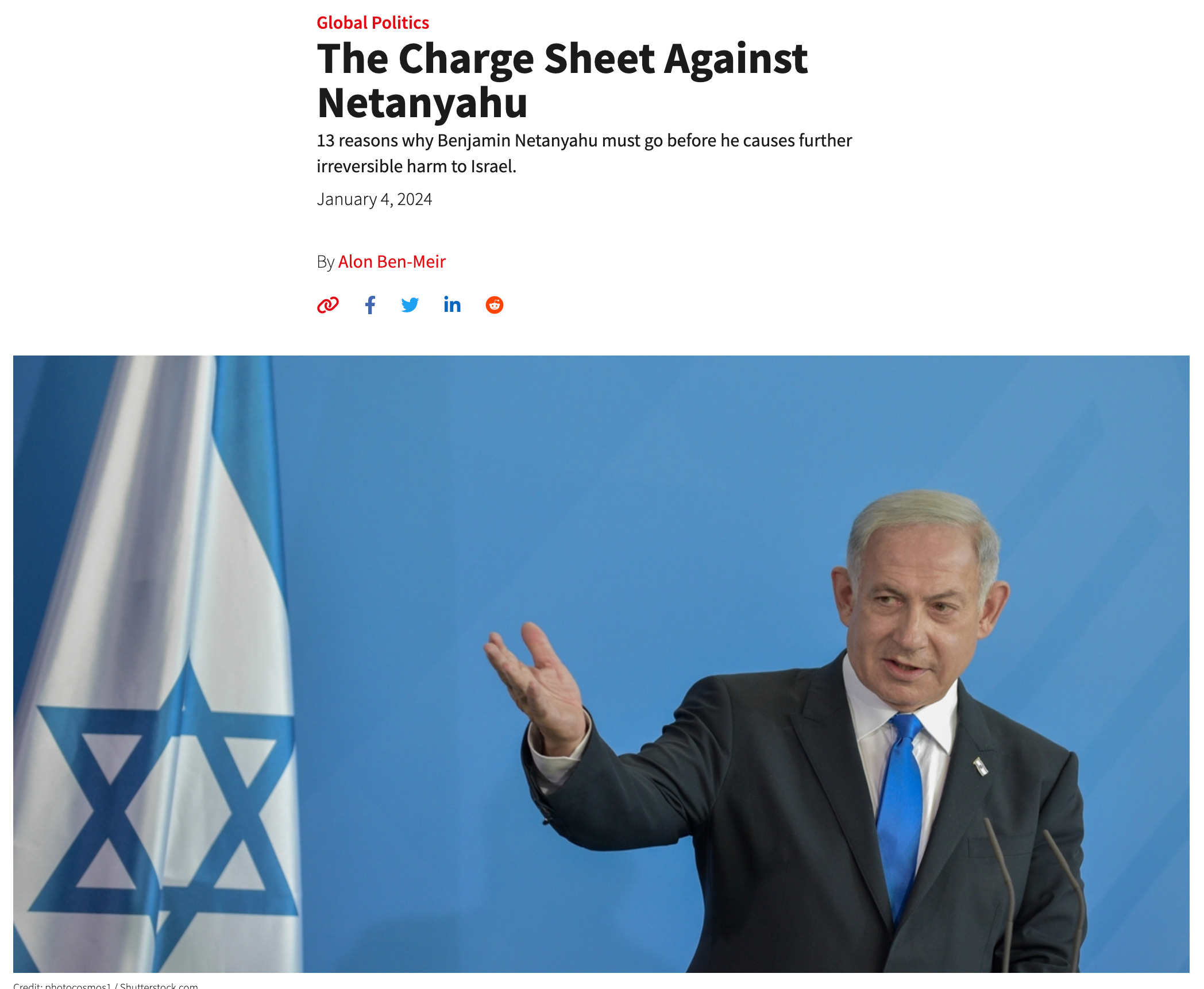
Netanyahu's Mafia Doctrine
Gangster Influenced The White House
The Israeli Air Force strike near Tehran that killed Ali Larijani was announced not by a communiqué from the intelligence services, not through the back-channel confirmations that give a government plausible distance from its own operations, but directly by Defense Minister Israel Katz, in a statement that read less like a military briefing than a receipt. “We will continue hunting down Iran’s leadership,” Katz said. No diplomatic framing. No qualification. The IDF followed within hours, calling Larijani “the de facto leader of the Iranian regime” since the killing of Supreme Leader Ali Khamenei on February 28, and describing his death as “a further blow to the regime’s ability to manage the war.”
That phrase, “further blow,” carries its own logic. It implies a sequence. It implies an accumulation that eventually reaches a terminal point. It is the logic Netanyahu has now sold to Donald Trump, absorbed by Trump, named Operation Epic Fury, and executed against a country of 90 million people: kill the heads, and the body fails. The Islamic Republic, in this model, is not an ideology embedded across forty-seven years of state institutions, a revolutionary guard with its own sprawling economy, a clerical apparatus woven into the judiciary, the education system, the Friday mosques. It is a Mafia family. Take out the bosses, and the network dissolves.
The problem with the model is that Israel already tested it. Twice. Against organizations it knew better than it knows Iran. It did not work either time. And Iran, watching those tests for twenty years, built a structural answer before the first American bomb fell.
The official Israeli framing runs as follows. Iran is a state held together by a small number of indispensable decision-makers. The Supreme Leader authorizes. The IRGC commander executes. The Basij enforces domestically. The security council coordinates. Remove them in rapid succession, deny replacements the time to consolidate, and the apparatus seizes up. The people of Iran, long suffering under theocratic rule, then do the rest.
Trump stated it in the language he reaches for naturally. “To the members of the Islamic Revolutionary Guard, the armed forces and all of the police, I say tonight that you must lay down your weapons and have complete immunity or, in the alternative, face certain death.” This is not the language of foreign policy. It is the language of a mob negotiation: lay down your weapons, accept the terms, or we keep going down the list.
Netanyahu told a press conference on March 12 that he “wouldn’t provide life insurance policies for any of the leaders of the terrorist organization,” referencing Iran’s newly named Supreme Leader and Hezbollah’s Naim Qassem. No life insurance. The phrase is not accidental. It is the doctrine, condensed to a sentence.
The Soufan Center confirmed what had been visible in the operational architecture since Day 1: “Netanyahu has influenced Trump on Iran policy to a far greater degree than has been publicly reported, and Netanyahu might potentially be able to veto an early end to the operation.” Veto. A foreign prime minister holding effective veto power over the exit conditions of an American war is not a detail any administration puts in a briefing paper. It is the structural consequence of a theory fully sold, not partially endorsed. Trump did not merely approve the target list. He absorbed the doctrine behind it.
In 2006, Italian authorities arrested Bernardo Provenzano, the Sicilian Mafia’s all-powerful boss, after 43 years as a fugitive. In 2007, they arrested Salvatore Lo Piccolo, his likely successor, along with Lo Piccolo’s son, who had been groomed for the role. Two bosses in two years. The decapitation of Cosa Nostra was, by any operational measure, extraordinary.
Cosa Nostra did not collapse.
A senior Palermo investigator who worked the Lo Piccolo case told TIME: “Cosa Nostra is built on a capacity to adapt to the time and situation, to camouflage itself and raise its head only when necessary.” Giuseppe Lumia, of Italy’s Anti-Mafia Commission, warned that the arrests would force remaining bosses to absorb the losses and that some might feel compelled to “impose new leadership through violence,” producing intensified internal brutality before a new equilibrium settled. The game continued. TIME’s own analysis put it plainly: “The Thing is always bigger than even its most powerful bosses.”
The ‘Ndrangheta, the Calabrian crime syndicate that absorbed the power vacuum created when Italian authorities decapitated the Sicilian Mafia through the 1990s, grew stronger after each arrest. Its structure was horizontal and cellular. It had no single capo dei capi whose killing ended the organization. It proliferated precisely because the decapitation of its hierarchical competitor removed a check on its own expansion.
Netanyahu sold Trump the Cosa Nostra model, the vertically organized family where the boss’s death paralyzes the structure. Iran has spent twenty years building the ‘Ndrangheta model: distributed, cellular, ideological, designed to operate without the man at the top because it built itself to survive without the man at the top.
Hamas was founded in 1987. Israel killed founder Sheikh Ahmed Yassin in Gaza in March 2004. His successor Abdel Aziz al-Rantisi was killed thirty-three days later. Khaled Mashal survived multiple assassination attempts and led the political bureau from Doha for two decades. Ismail Haniyeh, the political chief, was killed in Tehran in July 2024. Yahya Sinwar, the military architect of October 7, was killed in Rafah in October 2024.
Hezbollah’s Hassan Nasrallah was killed in Beirut in September 2024. His designated successor Hashem Safieddine was killed two weeks later. Naim Qassem leads the organization today and Hezbollah fired on Israeli positions on March 2, 2026, in retaliation for Khamenei’s killing. The CSIS, writing after the launch of Operation Epic Fury, documented the pattern directly: “Decapitating the regime seems to offer a tidy way to ‘solve’ a problem that has resisted solution for almost half a century. Unfortunately, meaningful improvement through decapitation is unlikely. The most common outcome of external military intervention is instability or civil war; in some cases, new strongmen replace the old ones.”
The Foundation for Defense of Democracies, which advocates from a posture broadly supportive of Israeli military operations, acknowledged in June 2025 that Israel’s “underestimating of Hamas enabled the October 7 attack.” The same analytical tradition then concluded the answer was more decapitation, applied to a state forty times the size of Gaza. The lesson Netanyahu drew from two decades of failure was that the strikes needed to be faster and bigger. Iran would get the larger version.
The CIA assisted in identifying a gathering of senior Iranian officials at the Tehran government compound on the morning of February 28. The United States and Israel had planned a night strike. The intelligence changed the timing.
Supreme Leader Ali Khamenei, killed alongside family members including his daughter and granddaughter. IRGC Commander Hossein Salami, killed in the opening wave. Amir Ali Hajizadeh, head of the IRGC Air Force and architect of Iran’s missile and drone program, killed at a command center alongside aerial unit commanders. Gholamreza Soleimani, head of the Basij paramilitary, killed in the overnight strike of March 16. Ali Larijani, security chief and de facto operational leader since Khamenei’s death, killed by an Israeli Air Force strike near Tehran, confirmed by the IDF on March 17.
In seventeen days, Israel and the United States have killed the sitting Supreme Leader, the top IRGC commander, the head of the IRGC Air Force, the Basij commander, and the man who had stepped into the vacuum to hold the apparatus together.
The IRGC has not broken. Iran has not confirmed several of these deaths publicly. Iran rejected de-escalation offers. Blasts were reported near the US embassy in Baghdad. Iran fired on Turkey, a NATO member. Iran told the White House it was “easy to start a war on Twitter; it is not easy to get out of it.”
The Jerusalem Post reported on March 3, citing Reuters, the operational detail that sits at the center of why the decapitation doctrine has not produced what Netanyahu promised: “Anticipating the decapitation of their leadership, the Guards had already delegated far down the ranks before Saturday’s US-Israeli attack, a resilience-building strategy that could also risk miscalculation or a wider war with mid-ranking officers empowered to attack neighboring states.”
Radio Free Europe/Radio Liberty named it on March 6: Iran’s IRGC “Mosaic” strategy. Defense capabilities dispersed across provinces. Missile launches, drone operations, and internal security functions continuing despite leadership losses because those functions were never concentrated in the leadership. Iran International confirmed what this looked like in practice: “The Islamic Republic has continued firing missiles and drones despite the elimination of senior figures, showing the Islamic Revolutionary Guard Corps can sustain operations through a decentralized chain of command.”
The doctrine was not improvised. It was developed after watching the collapse of Iraqi forces during the US-led invasion in 2003, and it has been embedded in IRGC operational planning for nearly twenty years. The IRGC watched Saddam’s army dissolve when its command structure was decapitated and drew the operational conclusion: never build a command structure that can be decapitated. Build one where decapitation is the trigger for dispersal, not collapse.
Israel and the United States designed an operation to destroy a vertical hierarchy. They struck an organization that had spent twenty years converting itself into a horizontal network specifically because it had watched Israel destroy vertical hierarchies.
The killing of Khamenei did not weaken the IRGC. It freed it.
On March 8, 2026, Iran’s Assembly of Experts announced Mojtaba Khamenei, 56, as the new Supreme Leader. The announcement came after a delay of hours that sources described as the result of the IRGC “bludgeoning aside the concerns of pragmatists.” The Times of Israel, citing Reuters and three senior Iranian sources, reported that “Iran’s Islamic Revolutionary Guard Corps forced through the choice of Mojtaba Khamenei as the new supreme leader, seeing him as a more pliant version of his father who would back their hardline policies.”
Mojtaba Khamenei is 56 years old. His father, who had held the position for thirty-five years, was 85. Mojtaba had spent years as head of his father’s household and had built, through that proximity, deep operational relationships with the IRGC’s second-tier commanders, the layer of mid-ranking officers who replaced the top generals killed in the war. Not the men Israel killed. The men who replaced the men Israel killed, younger, more radical, shaped by the war itself.
One of the senior sources told Reuters directly: “The IRGC were now running Iran.” The reformist former official’s assessment of what this produces: “A foreign and domestic policy moving in a more radical direction with the IRGC finally having what they sought for years: full control.”
This is the structural consequence of the decapitation doctrine that Netanyahu did not model. Ali Khamenei had been able to rein in the IRGC, balancing its views against those of political and clerical elites. He was the institutional check on its most aggressive instincts. The IRGC had resented that check for years. Israel killed the check. The IRGC selected its own man to sit in the Supreme Leader’s chair.[18]
Just Security’s analysis, published March 16, named it: “The IRGC-backed Supreme Leader and Domestic Maneuvering.” The clerical legitimizing layer has been preserved in form. In substance, the IRGC now has what it has sought since 1989. The decapitation strategy removed the one figure capable of constraining the organization the strategy was designed to destroy.
Fortune’s reporting on March 2 established what the IRGC’s institutional strength means in material terms. The organization began as a paramilitary force after the 1979 revolution. It is now a parallel economy. It controls core industrial sectors including oil and transportation, banking, telecommunications, agriculture, medicine, and real estate. Its engineering firm Khatam al-Anbiya has built refineries, a railway line, a dam, a natural gas pipeline, and controls Tehran’s international airport. The IRGC-affiliated foundations that form its financial architecture were estimated by Clingendael to account for more than half of Iran’s GDP.
Western sanctions did not weaken this structure. They strengthened it. As governments sought to rein in Iran’s nuclear program through economic pressure, the IRGC expanded under the framing of “economic resistance” and “self-reliance,” absorbing sectors that private Iranian business could no longer reach because of sanctions. Every sanction round that isolated Iran from the global economy created a vacancy. The IRGC filled the vacancy. The organization Trump is asking to lay down its weapons controls the economy of the country those weapons defend.
This is not a criminal family that loses its revenue streams when the boss is killed. It is a military-industrial complex that has spent forty-seven years converting the Islamic Republic into the organizational infrastructure through which it operates. It does not need Khamenei to collect the revenue. It does not need Larijani to authorize the missile launches. The Mosaic strategy dispersed the command. The economic empire runs itself.
Netanyahu has been making this argument about Iran since at least 2012. It is the same argument he made about Hamas and about Hezbollah. The Soufan Center established what reporting on the Trump-Netanyahu relationship had been tracking since January 2025: the launch of Operations Epic Fury and Lion’s Roar “indicates Netanyahu has influenced Trump on Iran policy to a far greater degree than has been publicly reported, and that Netanyahu might potentially be able to veto an early end to the operation.”
The architecture of the sell is legible from Trump’s own language. He described Khamenei as “one of the most evil people in History.” He gave the IRGC an ultimatum in the language of organized crime. He announced a four-week timeline without specifying what success inside that timeline would look like. These are not the statements of a president walked through the counterinsurgency literature on the Islamic Republic. They are the statements of a president shown a target list and told: take out the heads, and the structure falls
Netanyahu had run the experiment on Hamas for seventeen years before October 7. He ran it on Hezbollah through the autumn of 2024. In both cases, the decapitation strategy extended the conflict, produced successor commanders from younger and more radical cohorts, and generated new recruitment from the casualties it created. The lesson drawn was not that the strategy failed. The lesson drawn was that it needed more scale. Iran would provide the scale.
Bloomberg on March 6: “There Is No Iran Endgame That Doesn’t Risk Chaos.” That assessment has not aged poorly.
On March 17, 2026, Joe Kent, Director of the US National Counterterrorism Centre, resigned. His stated reason: Iran does not present an “imminent threat.” The counterterrorism director of the country conducting the war resigned during the war, on the grounds that the target did not meet the threshold that would ordinarily justify the action.
This gap is not procedural. It is the same gap that preceded Iraq in 2003, when the intelligence was shaped to fit the target rather than the target assessed against the intelligence. The difference is that this time the dissent arrived during the operation rather than before it, and it came from inside the executive branch rather than from a single analyst writing a dissenting footnote in a classified annex. The administration had the assessment. It proceeded.
For the decapitation-to-collapse model to work, several things must happen in sequence. The IRGC must fracture along factional lines after losing its top commanders. The clerical establishment must fail to produce a credible successor whose authority the IRGC accepts. The Iranian population, under active bombardment, must interpret the killing of its leaders as liberation rather than invasion. A political structure must form in the resulting vacuum compatible with American and Israeli interests, without the ground presence Trump has ruled out.
The IRGC selected its own Supreme Leader. The successor Khamenei has “very close ties with the Guards, exercising significant control over them and enjoying extensive support, including from more radical junior ranks.” The factional rivalries that exist within the IRGC have been subordinated: six Iranian and regional sources with close knowledge of the Guards confirmed to Reuters that they are “more united than ever when Iran is under attack.” The Iranian population has not risen. The regional network continues to function across Iraq, Yemen, and Lebanon.
Truthout named it on March 2: “This Is Not a Regime Change War. Iran Is Being Pushed Toward State Collapse.” The distinction is not semantic. Regime change implies a replacement is waiting. State collapse implies a vacuum: forty-seven years of institutional infrastructure dissolving without a successor structure, 90 million people without functioning governance, a nuclear program with its documentation distributed across a disintegrating security apparatus whose mid-ranking officers are now empowered to act unilaterally. The Mosaic strategy was designed to survive strikes. It was not designed for the scenario where the strikes never stop and the mid-ranking officers keep getting promoted one rank at a time until a captain is running a missile battery with no general above him and no orders restraining him.
THIS IS ALSO A WAY FOR THE ISRAELI PROPAGANDA MACHINE TO CONVINCE ITS POPULATION THAT THIS IS A FOREVER WAR
The scaling from Gaza to Iran is not strategic evolution. It is the same instrument applied to a state forty times the size, with ballistic missiles, a business empire controlling half the national economy, regional proxies across five countries, and a decentralization doctrine twenty years in the making. Gaza took eighteen months and the displacement of more than two million people without ending Hamas as a functional political organization. Hezbollah survived Nasrallah, survived Safieddine, and fired on Israeli positions within months of both killings.
Iran watched all of this. It watched for twenty years. It distributed its command. It promoted from within. It appointed its most ideologically committed second-tier commanders to fill the slots left by Israeli strikes. It selected a Supreme Leader from a younger generation, embedded in the IRGC’s second tier, bound to the most radical cohort of an organization that has now achieved, through the deaths Israel caused, the full institutional control it has sought since 1989.
The boss replaced the boss. The family restructured. The soldiers are younger now, and they have no one above them old enough to remember restraint.
The question the evidence raises and cannot yet answer: when every name on Netanyahu’s list has been killed and the IRGC has promoted from within one more time, who does Washington negotiate with?
No One Fucking Knows …


