


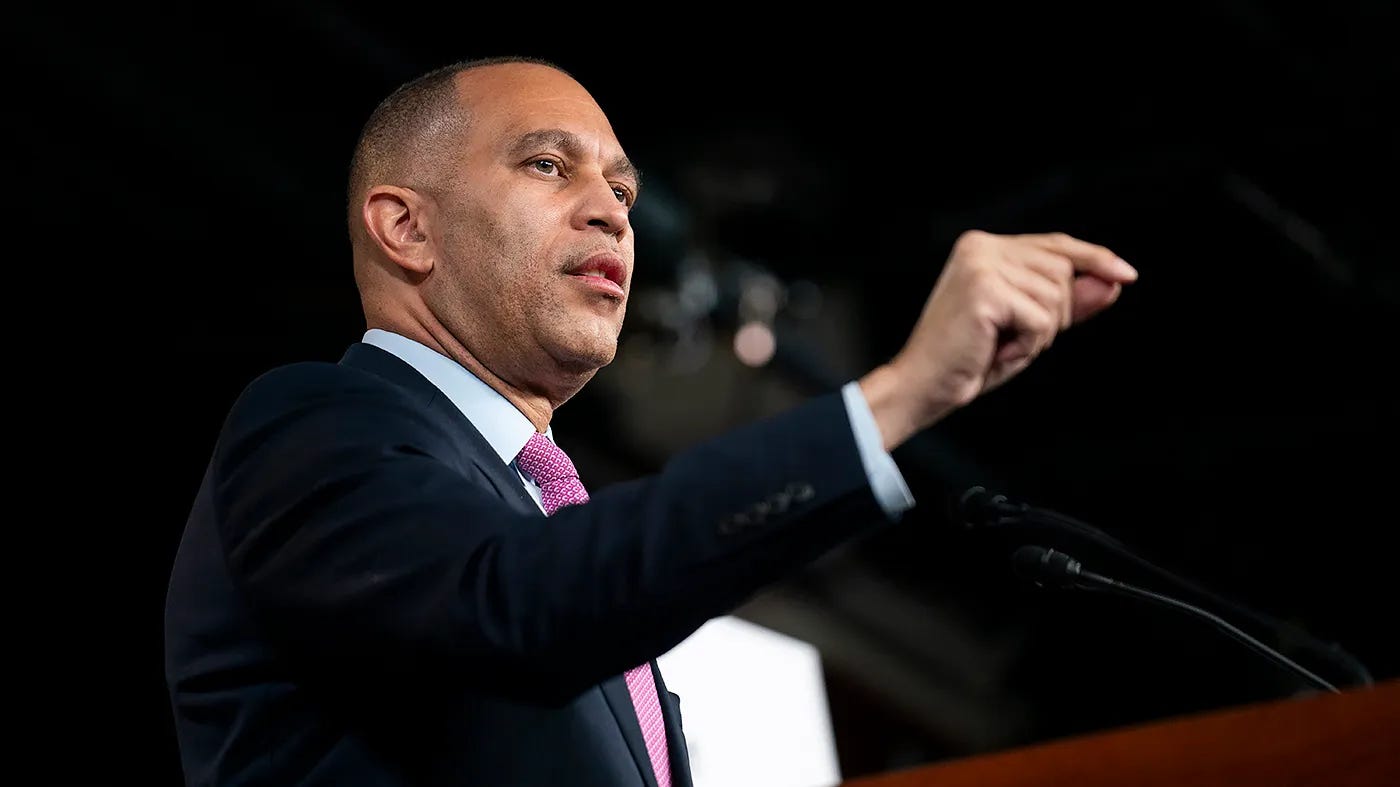
Hakeem Jeffries wants the first vote of the new Democratic House to be a vote of confidence in him. He sent colleagues a letter the morning after the midterms asking to become speaker, with promises to lower costs, check Donald Trump and stop the war with Iran. The letter had room for a long account of what House Democrats had resisted. It had no account of the Israeli weapons he helped fund when the House last faced a consequential choice, no explanation for his opposition to cutting aid in July, and no reason a caucus elected amid anger at war and unaffordable care should put its floor schedule in his hands.
No to Jeffries. Brooklyn has elected him to represent its Eighth District, and House Democrats can respect that decision without giving him control over the legislation of the 120th Congress. A speaker decides which fights reach the floor, who sits on key committees and how must-pass bills are assembled. The choice will determine whether the new majority tests its promises against the American arms pipeline to Israel, the cost of private health insurance and the powerful interests that finance its own leaders. Jeffries has already made those choices as minority leader when the opportunities arose, and his answers give the anti-war wing no reason to surrender the gavel before the session begins.
The House must elect a speaker when it convenes in January 2027; the November victory did not confer the office. National coverage has begun to describe Jeffries’ elevation as a formality, while progressive members are being invited to treat a vote for him as the price of opposing Trump.
Those members will have to answer to people who spent the past three years asking Democrats to stop arming Israel and the past two years asking them to resist an expanding war with Iran. A new majority can make a different choice at its first meeting.
The votes he cast when Gaza needed more than concern
Jeffries stood at the March for Israel in Washington in November 2023 and told the crowd that Congress would support Israel in a bipartisan fashion, always. He spoke about the October 7 attacks, the hostages and antisemitism, and he endorsed President Biden’s request for military and humanitarian funding. The massacre of Israeli civilians and the taking of hostages demanded condemnation; protecting Jewish Americans from antisemitism remains an obligation. By the time he delivered that speech, Palestinian children were also dying under Israeli bombardment, and his prepared remarks did not name them or propose a condition on the weapons Congress was preparing to send. His public commitment to Israel’s security was described as ironclad. Palestinian civilian protection had no comparable legislative commitment in the speech.
That allocation of urgency traveled into law. The House voted in March 2024 on a government funding package that barred American contributions to the United Nations Relief and Works Agency until March 2025. UNRWA was the largest provider of direct services to Palestinian refugees, including families in Gaza. Israel had accused a small number of agency employees of involvement in the October 7 attacks, allegations that required investigation and accountability for any individual involved. Congress chose a funding restriction on the entire agency during a humanitarian disaster. Jeffries voted yes on the package. The restriction was enacted as part of Public Law 118-47, and a later security supplemental contained another prohibition on funds for UNRWA. He had two chances that spring to demand a different arrangement for Palestinian relief, and he voted to move both packages.
The House returned to the issue in April 2024. Republican Speaker Mike Johnson brought the Israel Security Supplemental Appropriations Act to the floor as part of a broader national-security package. Jeffries voted for the rule that let the package advance, then voted for the Israel bill itself. The roll calls show 165 Democrats voting for the procedural rule and 173 voting for the Israel measure, while a smaller group of Democrats voted no. The final package included billions in Israeli security assistance, money for U.S. military operations and replenishment, and humanitarian appropriations. Those categories should not be flattened into a single claim that every dollar went to Israel’s military. The decision still supplied the military relationship with fresh resources during the destruction of Gaza, without making compliance with humanitarian law an enforceable condition of the central security assistance.
Jeffries gave a floor speech in support of the package and celebrated its passage. His office later said House Democrats had provided votes needed to secure aid, both on procedure and on substance. This was leadership rather than reluctant assent to an unavoidable compromise. The House had a visible dissenting bloc and a public record of civilian deaths, and yet its Democratic leader chose to make passage possible. A prospective speaker who says his concern for Palestinians should be judged by his words has already supplied a better test in the votes that moved weapons and restricted a relief agency.
The strongest defense of Jeffries is that his positions have changed as the war has continued. He has criticized Benjamin Netanyahu’s government, condemned settler violence and called for urgent change in American policy toward Israel and Palestinians. Those statements belong in an honest account. The most direct recent test came in July 2026, when Representative Thomas Massie proposed an amendment that would have removed U.S. aid to Israel from a State Department appropriations bill. Jeffries told colleagues he would vote against it. His letter argued that Massie’s wording reached beyond military aid to humanitarian assistance, refugee resettlement, embassy operations and other programs; it also said leadership would not whip members against the amendment. A blanket cut posed issues a more carefully drawn restriction could avoid.
Jeffries nevertheless used the occasion to preserve current funding while promising a better policy in the future. He has still not identified an offensive transfer he would stop, an aid condition he would enforce immediately or a floor vote he would guarantee when his own caucus controls the calendar.
Now the question may arrive from an unexpected direction. Trump announced after the midterms that he wanted to end roughly $4 billion in annual aid to Israel in 2027 while continuing arms sales. A president’s announcement is not a completed change to an appropriations law, and Congress will have a central role in whatever follows. Jeffries’ July position makes his response worth watching. If an opening to reduce the annual assistance comes before a Democratic House, will he use it to impose a meaningful human-rights condition, protect the baseline against cuts, or trade the issue into a larger budget deal? His record makes the second and third outcomes plausible enough to contest his claim to the gavel now, before the answer becomes another late-night continuing resolution.
Money through the leadership office
An investor’s check entered the Jeffries Battleground Protection Fund twice in May 2026. Federal Election Commission filings list Daniel Och, founder of Willoughby Capital Holdings, as the original source of payments of $87,500 and $61,800. AIPAC’s political action committee transmitted those earmarked contributions to the joint fundraising fund, which collected money for multiple Democratic recipients. The two checks total $149,300. They were not $149,300 deposited into Jeffries’ personal campaign account, and AIPAC’s transmission entry is not a second donation to be added to the first. The point is more interesting than an inflated total: an identified wealthy donor used AIPAC’s political channel to help finance a fundraising operation attached to the man asking Democrats to elect him speaker. Another set of AIPAC-routed contributions, totaling $250,000, reached the Jeffries Victory Fund in February 2025. Those transactions and Och’s two payments identify at least $399,300 through one documented conduit into two Jeffries-named joint committees. The recipients and allocation rules differ, and the figure is a subtotal rather than a complete accounting of every pro-Israel contribution associated with him. AIPAC is an American lobbying organization and political network. Calling these entries payments from the Israeli government would misstate the filings. Calling the conduit politically irrelevant would ignore why donors use a named organization to direct money into a leader’s fundraising apparatus.
Jeffries also raises money for colleagues, a function that gives leadership fundraising a value well beyond his own reelection. A newly elected member may have received help from the party committee, a joint fund and local volunteers; when the speaker vote comes, the person who organized a substantial part of that money is asking for loyalty. No FEC form proves a colleague promised a vote in return for support. The arrangement does help explain how a leader becomes difficult to challenge inside a caucus even when voters outside the Capitol disagree with him. His campaign, his leadership PAC and his joint committees are distinct legal entities, but they form one political career.
The donor universe is wider than AIPAC. FEC records show a $100,000 contribution from Anduril chief executive Brian Schimpf to the Jeffries Battleground Protection Fund and $44,300 from Anduril co-founder Matthew Grimm to the Jeffries Victory Fund. A Palantir employee, Mehdi Allhassani, gave $44,300 to the Victory Fund. These were personal contributions by named people, not corporate payments by their employers, and the filings do not show that the donors obtained a contract or a vote. They do show people tied to firms that sell military and surveillance technology entering a leadership fundraising operation at the moment Congress is being asked to scrutinize federal procurement and war spending.
Jeffries’ leadership PAC has also received identified $5,000 checks from committees associated with Boeing, Lockheed Martin, Raytheon, General Dynamics and Northrop Grumman. A PAC check differs from an executive’s personal contribution, just as an earmarked donation through AIPAC differs from a super PAC’s independent advertising. The political connection survives those distinctions. The next House will consider appropriations for weapons, contractors and military operations; its prospective speaker receives help from individuals and committees connected to that economy. Readers should be able to ask whether the person who controls the agenda can challenge an industry that has helped fund his rise without being told that the question itself is unfair.
Jeffries’ supporters can fairly answer that campaign contributions do not purchase every legislative choice. His public pro-Israel record predates the 2025 and 2026 checks, and voters in Brooklyn have repeatedly elected him with knowledge of his positions. The donations do not prove bribery; the political problem is visible without it. Donors finance a leader whose priorities are already compatible with theirs, the leader helps finance colleagues, and the caucus is then asked to accept his control of its agenda. The machinery can operate in plain sight without a whispered bargain.
Medicare for All, then the leadership retreat
Jeffries’ healthcare history is more complicated than the accusation that he never supported single payer. He co-sponsored Medicare for All legislation in 2019 and again in 2021. New York organizers pressed him on the issue, and for a time his name appeared beside a proposal that would replace private insurance as the central means of paying for care. Any rebuttal that erases those signatures will fail the first reader who checks the bills. The serious question is why a policy he was willing to endorse as a member became one he would no longer endorse as a leader.
Kristen Welker put that question to him on Meet the Press in August 2026. Jeffries acknowledged that he had not co-sponsored the Medicare for All legislation introduced in recent years and pointed instead to expanding coverage through the Affordable Care Act, reversing Republican cuts and reducing costs. Representative Ro Khanna argued that Democrats should hold a vote on Medicare for All if they regained the House. Jeffries declined to make that commitment in the interview. After the midterm victory, when reporters again asked about a single-payer vote, he named the areas of agreement he preferred: restoring Medicaid funding and extending Affordable Care Act tax credits. Those goals matter to families facing immediate harm. They do not answer why the House leader moved away from a bill he had once backed, or why he should control whether the caucus can debate it.
The new majority’s health policy planning may yet include a Medicare for All vote. An internal working-group blueprint reported after the election contemplated one during the first year, alongside votes on a public option and a Medicare buy-in. That is a proposal to the leadership, not a guarantee made by the speaker candidate. It prevents us from declaring in advance that a Jeffries House could never vote on single payer. It also gives House members a simple way to test him before they vote for him: insist that the proposal, a committee hearing and a recorded floor vote be included in an enforceable schedule. A name on a bill from five years ago is weaker evidence of his present priorities than the answer he gave on television this summer.
His November letter places Medicaid restoration and the Affordable Care Act at the top of the agenda. There is a practical case for both, and families facing immediate cuts cannot wait for an entirely new system. Jeffries has chosen this narrower case in public while asking for an office that could make a broader debate possible.
An insurance card can coexist with deductibles a household cannot meet; a subsidized premium can coexist with a denied claim. People who organized for single payer did so because the cost of treatment and the power to refuse it remain in private hands under the present system. Members who want more have reason to seek a speaker prepared to let the House test that argument in public.
Jeffries voted against the 2018 bank deregulation law that weakened parts of Dodd-Frank, as the House clerk’s roll call shows. He also voted against the House censure of Representative Rashida Tlaib in November 2023 and against a 2025 bill sanctioning the International Criminal Court over its Israel investigation. Those were defensible votes, and they sit beside the March and April 2024 appropriations votes, his July 2026 aid position and his present healthcare retreat. The case against his speakership can withstand the full record.
The floor belongs to the members
The speaker does not rule the House alone. Committees draft bills, members can press discharge petitions, the Rules Committee operates under adopted House rules, and the president can veto legislation. Describing Jeffries as able to guarantee that Medicare for All will never receive a hearing, or that every Israeli weapons shipment will pass without a condition, gives him powers he does not possess in isolation. The danger is more concrete: a speaker can place his priorities first, negotiate the rules for debate, decide what goes into the leadership’s spending proposal and use party relationships to make dissent expensive. These are large powers in a chamber where major bills often arrive under tight deadlines.
Jeffries and Johnson demonstrated the value of those powers in April 2024. A divided Republican conference had left Johnson unable to move the security package by himself; Democrats supplied votes on the rule and the underlying bills. The result came through a procedure that made passage possible. A member wishing to condition Israeli aid could object, but leadership had already decided to move a broader package containing military assistance, Ukraine aid and humanitarian funding. The House’s rules are often treated as technical furniture. They determine whether an objection becomes a vote or a speech delivered to a nearly empty chamber.
The same structure will matter for Iran. Jeffries promises to stop Trump’s war, and Democratic opposition to it has been real. A House majority can demand reports, hold hearings, pass a War Powers resolution and seek restrictions on spending. None of those actions by itself ends hostilities when a president vetoes a bill or relies on existing funds and asserted authority. A speaker determined to force a confrontation must decide where to place restrictions in an appropriations measure, how long to hold the line when the White House refuses them, and whether to let troop pay and unrelated domestic programs become bargaining cover for continued operations. Jeffries’ letter announces the objective. His past willingness to carry a controversial military package through the House gives members a reason to demand the method before rewarding the announcement.
Trump’s reported plan to end annual military aid to Israel sharpens the test. Some supporters of Israel may welcome a change from grants to arms sales because it preserves the weapons relationship while altering who pays. Others may resist any cut. A Democratic speaker should be prepared to explain whether the next bill stops offensive transfers when civilian harm is documented, whether military grants are renewed, and whether sales receive the same scrutiny as grants. Jeffries’ July letter promised a better relationship in the future; a prospective speaker can state the terms now. Members should refuse to treat general concern about Netanyahu as an answer to a funding question.
Nor should they mistake subpoenas for a full program of accountability. Jeffries’ letter promises to pursue corruption in the Trump administration, investigate the Epstein files and ban congressional stock trading. Those are legitimate undertakings. A House that exposes Trump’s conflicts while declining to examine military contractors, its own donor networks and its own role in funding Gaza will leave the most convenient institutions untouched. The speaker decides what committees receive support, what records they pursue and which findings produce legislation. A vote for another speaker would be a vote to widen that investigation before it begins.
The progressive endorsement
Zohran Mamdani and Alexandria Ocasio-Cortez have both indicated support for Jeffries as speaker. Mamdani has argued for taxing wealth and remaking the material terms of working-class life in New York; Ocasio-Cortez has spent years demanding a different Democratic relationship with corporate money and Israeli military policy. Their support is therefore politically useful to Jeffries. It tells voters who distrust his donors that the left’s most recognizable figures are willing to accept him as the leader of a new majority. The endorsement buys no written assurance that he will bring their priorities to the floor.
Mamdani’s relationship with Jeffries contains its own history. Jeffries waited until late October 2025 to endorse the mayoral candidate, months after Mamdani won the Democratic primary. He had the right to make that decision on his own timetable. Mamdani has the same right now, and his supporters have the right to ask why a leader cautious about their candidate should receive their unqualified support for a position that controls federal legislation. A mayor may need cooperation from Washington on housing and transit; that practical need does not make an endorsement free of cost. If the speaker’s agenda excludes a meaningful change in military aid or health care, New Yorkers who helped elect Mamdani will be asked to absorb the cost of his accommodation.
Ocasio-Cortez has a vote in the chamber. She knows the difference between a member signing a Medicare for All bill and a speaker allowing a debate over it; she also knows that Israel aid has passed through House rules and appropriations votes under Democratic as well as Republican leaders. Supporting Jeffries may be a calculation that coalition unity offers more influence than a contested leadership election. The public should be allowed to see the terms of that calculation. If she and other progressives believe Jeffries will permit recorded votes on arms conditions, single payer and war spending, they can obtain written commitments before January. If they cannot, a vote for him asks their constituents to accept faith where leverage was available.
The 2023 Republican speaker election showed that an organized minority within a caucus can force repeated ballots and negotiate rules. It did not show that every demand won is wise, or that the same number of dissenters will wield the same power under a different House margin. The exact 2027 arithmetic depends on final membership and how members vote. The speaker is elected by a majority of votes cast for a person by name; members voting present reduce that denominator, which can make election easier rather than harder. Progressives who intend to challenge Jeffries need to vote for an alternative candidate, stay organized across ballots and recruit enough colleagues that no nominee reaches a majority until the caucus chooses someone else or makes enforceable concessions. A threat made only for a television interview will disappear on the first roll call.
Those concessions should be legislative rather than theatrical. A candidate for speaker can commit to a floor vote on a narrowly written condition for offensive arms to Israel, including reporting on civilian harm and consequences for violations. The candidate can commit to hearings and a recorded vote on Medicare for All, a public schedule for Iran War Powers and appropriations measures, and committee oversight of defense procurement and political access. Caucus rules can require transparent treatment of consultants who help outside groups attack incumbents and challengers in Democratic primaries. None of this requires the House to publish unredacted records that would expose victims of sexual abuse, nor can a speaker promise to end a war by declaration alone. The point is to make the House use the powers it actually has and force members to account for their decisions.
Jeffries can offer those commitments himself, but a promise made after a challenge begins would have to be weighed against the record that required the challenge. He has had years to say which military transfers should stop. He had the March and April 2024 votes to oppose a funding arrangement he now describes as needing urgent change. He had the July 2026 amendment to present a narrower substitute that would cut offensive aid without touching humanitarian work. A speaker candidate who asks for trust before providing that record is asking the caucus to surrender its most valuable bargaining moment for a pledge to discuss policy later.
A majority worth using
The voters who removed Republicans from control of the House did not all agree on Medicare for All, Palestine or the war with Iran. Some elected moderates in competitive districts; others elected outspoken critics of Israel’s conduct who survived heavily financed attacks. Their coalition should not be invented into a unanimous mandate. It does, however, contain enough people who want the new Congress to do more than investigate Trump on television while preserving the foreign-policy and donor arrangements that survived the election. Leadership must answer that conflict, not conceal it under a claim that voting for Jeffries is the only way to oppose the president.
Jeffries will say that he raised the money, held the caucus together and helped win the majority. All three claims deserve a hearing. They do not confer ownership of the victory. Volunteers knocked on doors, candidates survived difficult races, and voters decided that the cost of another Republican House was too high. Jeffries’ reward for helping elect them is the right to ask for their votes in public. Their obligation is to judge the request by the decisions he made when Palestinian families needed relief, by the healthcare promise he no longer makes, and by the donors who have learned that his leadership funds are a useful place to send money.
Every elected Democrat who wants a different speaker can name one and vote for that person in January. They can publish the terms on which they will support anyone for the office and keep negotiating until the House has a leader willing to put those terms before the country. If Jeffries wins anyway, the roll call will tell voters who chose him after the 2024 aid votes, the 2026 letter against cutting Israel aid and the abandonment of a Medicare for All commitment he once signed. Members still have time to deny him the gavel.