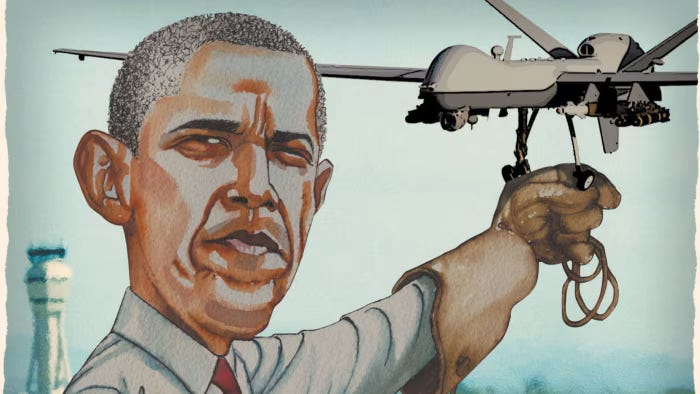
Obliterating the Illusion: Barack Obama’s Dark Legacy of Drone Warfare
How a Peace Prize President Escalated Covert Killings, Hid Civilian Carnage, and Eclipsed His Own Greatness
Barack Obama’s admirers like to remember the soaring speeches, the symbolism of the first Black president, the calm technocrat who promised to restore law and morality after the excesses of George W. Bush. Less convenient for that story is the arithmetic of his drone wars: hundreds of covert strikes, thousands of people killed, and civilian death tolls that independent investigators say are many times higher than the White House ever admitted. For anyone who believes innocent life is the ultimate metric of a leader’s greatness, this single issue is enough to puncture the myth of Obama as a fundamentally “good” or “peaceful” president.
Under Bush, drones were an experiment: a few dozen covert strikes in Pakistan, Yemen, and Somalia between 2001 and 2009. Under Obama, they became routine. The Bureau of Investigative Journalism (TBIJ), which compiles one of the most detailed public datasets on U.S. drone operations, estimates that during Obama’s two terms there were about 563 covert strikes in those three countries alone, roughly ten times more than under his predecessor. One year into his presidency, Obama had already ordered more strikes than Bush did in eight. This is not the record of a reluctant warrior dragged into war; it is the signature of a president who embraced drones as his weapon of choice.
Behind those numbers lies a harsher truth. Obama’s own late, narrow casualty disclosure claimed that from 2009 to the end of 2015, 473 strikes “outside areas of active hostilities” killed between 2,372 and 2,581 people, including just 64 to 116 civilians. That implies a civilian share of roughly 2 to 4 percent, a figure deployed to sell drones as exquisitely precise instruments of war. Independent monitors, working from the ground up, tell a very different story. TBIJ’s analysis of roughly the same period in Pakistan, Yemen, and Somalia concludes that between 384 and 807 of those killed were civilians, a range around six times higher than the U.S. government’s top-line figure. A political science review that synthesizes independent work places Obama-era drone-caused civilian deaths in the 400–800 band, underscoring how far the “surgical” narrative diverges from the evidence.
That discrepancy is not just about foggy data; it is about who counts as human in the spreadsheets. Reporting and subsequent research show that Obama’s team adopted a method of counting casualties that treated all “military-age males” in a strike zone as combatants unless posthumous intelligence proved otherwise. This flips the presumption of innocence into its mirror image. A 20-year-old man killed near a suspected militant is automatically a “terrorist”; a farmer with a rifle in rural Pakistan becomes an “enemy fighter” by default. Groups focused on civilian harm have argued that this definitional move is central to the implausibly low official civilian tally, especially when set against fieldwork by journalists and NGOs. If you tighten the rules of counting, you can make almost any war look clean.
Independent projects refused that bargain. TBIJ scoured local media in Urdu, Arabic, and Somali, interviewed families and tribal leaders, and cross-checked hospital and court records to identify victims one by one. Their “Naming the Dead” work in Pakistan put names, ages, and lives to people the U.S. never acknowledged: children killed in their beds, elders hit while mediating local disputes, women shredded in their homes. Other syntheses drawing on similar methods note that, across U.S. drone campaigns in Afghanistan, Pakistan, Yemen, and Somalia over roughly a decade, total deaths run into the many thousands, with civilians numbering in the high hundreds to over a thousand, depending on how “unknowns” are treated. The highest independent ranges exist not because activists are careless, but because they refuse to let “military-age male” be a grave marker.
Zoom in and the abstraction disintegrates. In Yemen, TBIJ’s reporting highlights Obama’s first known strike there in December 2009, an attack commanders believed was hitting an al-Qaeda camp. Instead, the munitions, including cluster bombs, tore apart a Bedouin community, killing 55 people: 21 children, 10 of them under five; 12 women, five of them pregnant. Rights organizations have documented similar incidents elsewhere: wedding convoys mistaken for militant gatherings, funeral processions struck because a pattern of behavior looked suspicious from three thousand meters up. Each time, the official line clung to the language of “precision” even as the list of dead told another story.
Defenders of Obama’s record usually fall back on two arguments. First, that drones were still “better” than the alternatives, better than invasion, better than occupation, better than massed troops. Second, that Obama tightened the rules over time, especially after 2013, when new guidance supposedly imposed a “near certainty” standard that no civilians would be harmed. Some research suggests that reported civilian casualties in Pakistan did drop after these guidelines, at least in that theater. But there is an uncomfortable reality beneath the talking point: by then, Obama had already normalized the idea that a U.S. president could run a permanent, global kill program in the shadows, guided by legal memos the public never sees, accountable mainly to his own conscience. Making killing smoother, smaller, and more distant does not cleanse it; it only makes it easier to sustain.
The “better than the alternative” argument also smuggles in a false inevitability. Obama inherited a sprawling “war on terror,” but he did not have to expand its covert, unaccountable face so dramatically. TBIJ’s tally of 563 covert strikes under Obama versus 57 under Bush points to a president who chose escalation, not mere stewardship. New America’s work on Pakistan’s drone war traces how the campaign surged in 2009 and 2010, turning the tribal areas into a laboratory of constant, hovering threat. In doing so, Obama built legal and bureaucratic architecture for targeted killing that his successors Donald Trump foremost among them could inherit and expand, even as they dismantled what little transparency he had been pressured to provide.
Hovering over all of this is the Nobel Peace Prize. In 2009, the Nobel Committee awarded Obama the prize for what it described as his “extraordinary efforts to strengthen international diplomacy” and his vision of a world less reliant on nuclear weapons. Within a few years, that same laureate had quietly presided over a global campaign of cross-border targeted killing that, according to high-end independent estimates, left hundreds of civilians dead and eroded long-standing norms against extrajudicial execution. Commentators from across the spectrum have since questioned whether the prize should be revoked, not as a punishment that changes anything for the dead, but as a minimal act of honesty about what the Obama era actually meant for people living under the drones.
None of this erases the other sides of Obama’s legacy. He expanded health insurance at home, pulled combat brigades out of Iraq, negotiated a nuclear deal with Iran, and restored a sense of competence to the White House after the chaos of the Bush years. Those achievements are real. But greatness is not a balance sheet where domestic legislation can cancel out foreign corpses. If there is a line that cannot be crossed without staining a presidency, it is the deliberate choice to institutionalize remote killing, accept civilian death tolls that independent researchers count in the hundreds or more, and then present the result to one’s own public as almost bloodless.
To write honestly about Obama’s drone war is to say that one of the most admired leaders of his generation made continuous, hidden violence a core instrument of American power. It is to concede that the world’s most celebrated democracy spent eight years refining its ability to kill from a distance while shielding its citizens from the true human cost. And it is to insist that the lives ended in dusty villages far from Washington carry as much moral weight as any bill signed in the East Room. The myth of Obama as a great president shatters on that reality. For those who believe innocent lives are the final measure of power, no rhetoric, no symbolism, no domestic reform can redeem what was done in their name beneath the unblinking eye of his drones.
References
The Bureau of Investigative Journalism – “Obama’s Covert Drone War in Numbers: Ten Times More Strikes than Bush” and related “Drone Warfare” project datasets on Pakistan, Yemen, and Somalia.
Council on Foreign Relations – analyses of Obama’s final drone strike data and strike counts in Pakistan, Yemen, and Somalia.
New America – “America’s Counterterrorism Wars” and “The Drone War in Pakistan” quantitative tracking.
Amnesty International and other human rights organizations – reports on specific drone strikes and documented civilian casualties.
Academic and policy articles on U.S. drone warfare and civilian casualties (including political science reviews and legal analyses of Obama-era targeting and counting practices).


