Oil, Power, and the Shadow Map of 2026
How Washington’s bid to control Venezuelan crude, pressure Iran, and manage a global surplus is quietly rewriting the rules of the energy world
Washington’s emerging oil strategy linking Iran, Venezuela, and global markets is best understood as a deliberate effort to convert short term military and diplomatic leverage into long term structural power over energy flows. It is not simply about one country or one conflict, but about using a moment of surplus and volatility to reshape who sets the price of oil and who captures its rents.
A market already tilting toward surplus
Global oil fundamentals in 2026 give Washington unusual room to maneuver.
The U.S. Energy Information Administration projects that global oil production will exceed consumption throughout 2026, with inventories building by more than 2 million barrels per day.
Independent outlooks likewise describe a bearish consensus, with major forecasters expecting persistent surplus and Brent prices gravitating toward the mid 50s per barrel, and West Texas Intermediate often in the high 40s to low 50s range.
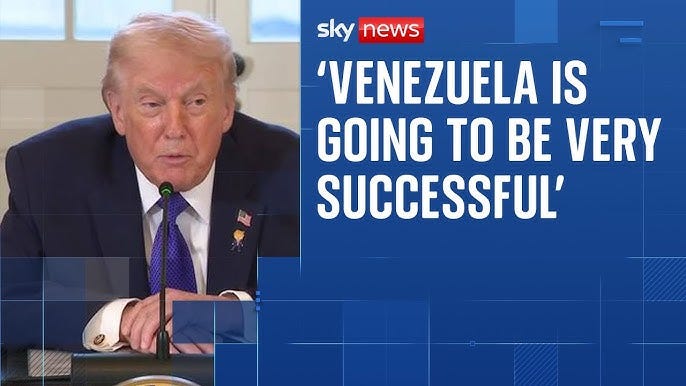
In such an environment, any large, discretionary injection of supply has outsized influence. When President Trump signals that the United States will place between 30 and 50 million barrels of Venezuelan crude into the market, that move lands on top of an already swollen inventory base. The policy does not create the surplus so much as weaponize it.
Iran, Venezuela, and the shadow infrastructure
The Iran–Venezuela connection is not primarily ideological; it is logistical and technical.
Venezuela’s Orinoco Belt crude is among the heaviest in the world and typically requires imported diluents and specialized blending to move through pipelines and reach export terminals.
Iran has become a critical supplier of those diluents, moving cargoes through a shadow fleet of largely uninsured, often re flagged tankers that help both countries evade Western sanctions.
Recent U.S. actions have targeted this infrastructure as much as they have targeted any single government. Treasury has sanctioned traders and tankers tied to Venezuelan exports, explicitly highlighting the expansion of a global shadow fleet used to keep sanctioned oil flowing. U.S. and allied forces have seized vessels connected to Iranian and Venezuelan trades in the Caribbean and North Atlantic, raising both the legal and operational risk premiums for such routes.
Against that backdrop, renewed pressure on Tehran serves two overlapping purposes. It constrains Iran’s ability to supply diluents and logistical cover to a sanctioned Venezuelan system. It also signals to shipping, insurance, and trading firms that association with the shadow fleet carries escalating penalties, further isolating residual Iranian and Venezuelan flows.
The point is not simply to punish Iran, but to narrow Venezuela’s non U.S. options. Once the Iranian lifeline is degraded, any future Venezuelan government seeking to increase output must look to actors that can operate inside the U.S. sanctions and insurance architecture.
Venezuela as test case for security for investment
The seizure of Venezuelan tankers and the redirection of their crude toward U.S. refineries mark more than a tactical adjustment. They presage a new model in which U.S. political and military power is explicitly leveraged to create room for American firms in otherwise uninvestable jurisdictions.
Key elements now in play include the following.
The administration has publicly framed Venezuelan barrels as both a strategic asset and a domestic benefit, pledging that sales of tens of millions of barrels will support Venezuelans while contributing to U.S. energy security.
A recent executive order firewalls Venezuelan oil revenue held in U.S. Treasury accounts, defining it as sovereign property protected from private claims while remaining under American custodial control.
For U.S. majors, this creates a hybrid environment. On one hand, they confront a country where assets have been expropriated before and where political risk remains extremely high. On the other, they are told that access, security, and revenue streams will be underwritten or at least heavily structured by Washington, transforming political risk into something closer to a managed, bilateral arrangement.
Executives have publicly signaled caution, with some describing Venezuela as uninvestable absent clear guarantees and legal continuity. Yet the presence of Chevron, ExxonMobil, and ConocoPhillips at White House discussions about a prospective 100 billion dollar reconstruction program underscores that the scale of the prize still commands attention. In a pricing environment where margins are thin, such government backed ventures can look more attractive than competing frontier projects without comparable political support.
Price as a tool, not an outcome
The implicit target of roughly 50 dollars per barrel is not arbitrary; it sits near the lower bound of many 2026 forecasts but still within the range that major consuming economies can tolerate and some producers can survive.
At that level, high cost or capital intensive projects in Russia’s Arctic, deepwater ventures in the Atlantic, and some marginal U.S. shale plays become difficult to justify. Sanctions affected producers such as Iran, already facing elevated financing and logistics costs, find their effective realized price cut even further. OPEC plus is forced into a defensive posture, weighing deeper production restraint to keep prices from falling below levels needed for fiscal stability.
By pushing additional Venezuelan barrels into this environment, Washington pressures competitors’ cash flows while simultaneously deepening the dependence of any future Venezuelan administration on U.S. markets and infrastructure. The aim is less to keep prices at 50 dollars indefinitely than to use a period of suppressed pricing to reorder who can survive and expand.
Excluding rivals without formal blocks
Russia and China have played central roles in sustaining Venezuela’s oil sector, from financing and joint ventures to participation in shipping networks that move sanctioned barrels to Asia. Recent U.S. steps steadily close off these avenues without announcing a formal embargo on their participation.
Mechanisms include sanctions on specific tankers and intermediaries associated with Venezuelan and Russian shadow trade, which complicate China’s ability to receive discounted Venezuelan crude without heightened legal and reputational exposure. The physical redirection of seized Venezuelan barrels away from dark fleet shipments to China and into U.S. Gulf Coast refining systems diminishes the volume available for non Western buyers. Legal structures around Venezuelan sovereign assets in U.S. custody give Washington de facto gatekeeping authority over how oil revenue is allocated and which firms receive contracts tied to future production.
This is not a blanket ban on Russian or Chinese participation in Western Hemisphere energy, but it sharply raises the cost and uncertainty of any such involvement. Over time, that differential in risk can be enough to tilt major new projects toward companies that can operate with U.S. political cover.
Human and political costs on the ground
Behind the abstractions of supply curves and investment flows lie communities absorbing the shock of these policies. In Venezuela, the removal of Nicolás Maduro by force and the subsequent U.S. control over key export channels have come at a substantial human cost, with reports of Venezuelan and Cuban security personnel killed in the operation. The new acting leadership in Caracas governs under the implicit condition that energy policy remains acceptable to Washington, while billions in sovereign revenue remain offshore under U.S. supervision.
In Iran, a renewed focus on shadow fleet interdiction and sanctions enforcement tightens the squeeze on an economy already accustomed to external pressure, with civilians bearing much of the adjustment burden. Officials in Washington frame these steps as necessary to restore democracy in Venezuela and counter destabilizing behavior by Tehran. Critics, including regional analysts and some industry voices, argue that the concentration of decision making in Washington and the central role of U.S. corporations risk reproducing older patterns of dependency disguised as stabilization.
OPEC plus and the prospects for pushback
The durability of this emerging strategy depends in part on how other major producers respond. Forecasts already assume that OPEC plus will underproduce relative to its formal targets in 2026 in an effort to offset non OPEC supply growth.
Possible counter moves include deeper coordinated cuts among core OPEC members and Russia, designed to firm prices above the 50 to 55 dollar band and blunt the impact of U.S. releases of Venezuelan crude. Producers could expand non dollar denominated oil trade or long term fixed price contracts with key consumers, insulating some flows from spot market volatility and U.S. financial jurisdiction. They might also push harder into investment and political ties in alternative regions, from Africa to Central Asia, to diversify away from Western Hemisphere exposure.
Yet such responses carry their own risks. Saudi Arabia and other fiscally exposed producers need higher prices but must weigh that need against fears of eroding market share if cuts are too deep for too long. Russia, dealing with sanctions of its own, has limited flexibility. For now, the structural surplus projected for 2026 and the fragmented interests inside OPEC plus give Washington room to press its advantage.
From doctrine to precedent
Seen as a whole, the pattern that connects Tehran, Caracas, and the U.S. Gulf Coast is not of a campaign uniquely focused on Iran or Venezuela, but of a broader experiment in energy statecraft. Seizure of tankers, custodial control of sovereign revenues, and explicit negotiation of security for investment packages with domestic firms together sketch a model that could, in theory, be replicated elsewhere.
Whether this becomes a lasting doctrine depends on three tests. The market test is whether prices can be kept low enough, long enough, to pressure rivals without inflicting unacceptable damage on U.S. producers and on fiscal balances in key allied states. The political test is whether partner governments and domestic constituencies will tolerate the visible fusion of military power, sanctions policy, and corporate advantage that this model entails. The strategic test is whether Russia, China, and OPEC plus can develop credible workarounds that dilute Washington’s leverage over shipping routes, payment systems, and investment channels.
What is clear is that energy is once again at the center of how Washington understands power. The effort to shape who moves Venezuelan oil, who insures Iranian tankers, and who decides the marginal barrel price is not an incidental by product of crisis management; it is the core of the strategy. The question now is not only whether the plan succeeds on its own terms, but how many states and societies will find their futures recalibrated around decisions made far from their own oilfields.


