


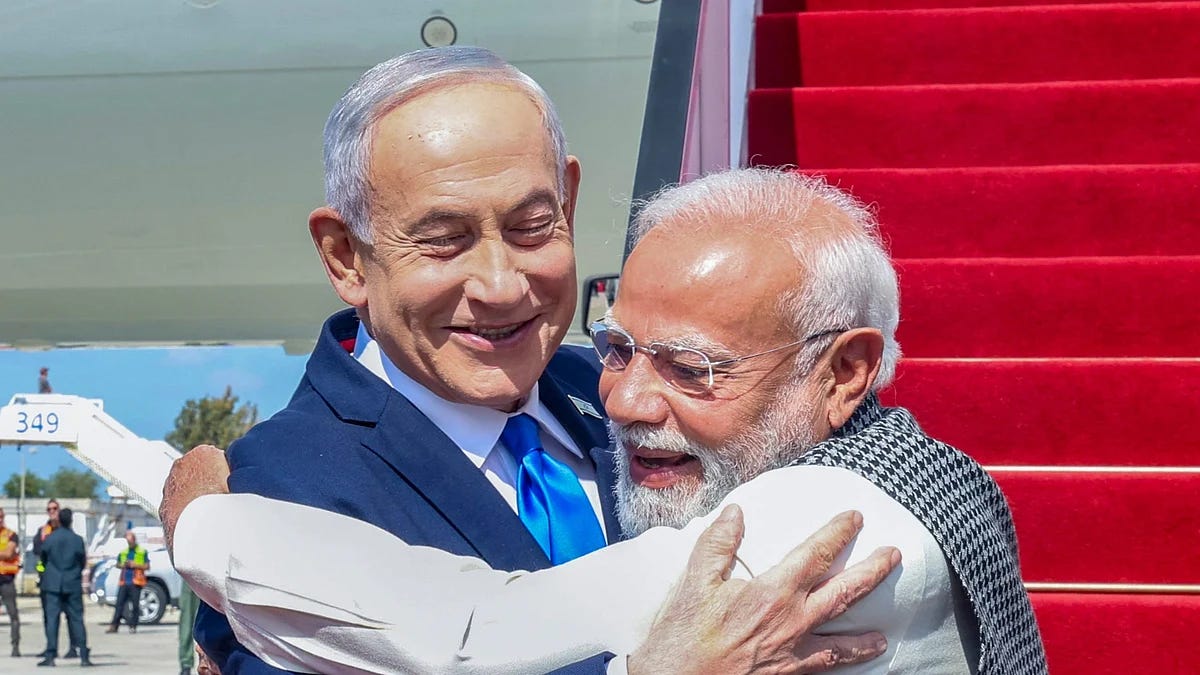
Netanyahu met Modi at Ben Gurion airport on February 25 and hugged him in front of the cameras. The Knesset building had been lit in the colours of the Indian flag the night before. In the chamber, Netanyahu introduced the Indian prime minister as his dear friend and thanked him for standing by Israel without offering excuses. The welcome honoured a relationship that had supplied Israel with weapons, workers and diplomatic support while Palestinians were being killed.
Modi became the first Indian prime minister to address the Israeli parliament and received a medal from Speaker Amir Ohana. His visit gave Israel a public demonstration of friendship after its standing had suffered over Gaza. The Indian leader promised stronger ties in security, technology and investment. Netanyahu’s gratitude described what Delhi had already done; Modi’s speech committed it to more.
By September 20, Gaza’s Health Ministry had reported 73,821 people killed and 174,897 wounded. The ministry warned that the count remained incomplete because people lay beneath destroyed buildings and in areas rescuers could not reach. The ceasefire that began in October 2025 had failed to end the killing: by mid-September 2026, the ministry reported
On September 16, 2025, the UN Commission of Inquiry chaired by Navi Pillay concluded that Israel had committed genocide in Gaza. It documented four acts defined in the 1948 Convention: killing members of the group, causing serious bodily and mental harm, imposing conditions of life calculated to destroy the group, and measures intended to prevent births. The commission called on states to stop arms transfers that could contribute to those acts and prevent companies from assisting them. Israel rejects the finding. The commission’s conclusion is distinct from a final judgment in South Africa’s case at the International Court of Justice.
Netanyahu’s tribute deserves to be read literally. India stood beside Israel through the destruction of Gaza, supplying military equipment, replacing excluded Palestinian workers and deepening investment ties while abstaining on demands for accountability. Delhi and Tel Aviv were on the same page from the first week of the war, and the Indian government gave material support to a state whose conduct the UN commission subsequently identified as genocide. The government authorised that assistance through decisions recorded in court proceedings, company statements and UN votes.
Two projects, one page
Gandhi wrote in 1938 that Palestine belonged to the Arabs as England belonged to the English. He opposed imposing a Jewish state on the people already living there. India voted against partition at the UN in 1947, recognised the PLO as the representative of the Palestinian people in 1974 and recognised the State of Palestine in 1988. Full diplomatic relations with Israel came in 1992. Support for Palestinian self-determination belonged to India’s anticolonial account of itself.
The Hindu right had a different inheritance. Savarkar, the ideologue Modi’s movement reveres, supported a Jewish state in Palestine and condemned India’s opposition to partition. Israel offered the Sangh Parivar a state organised around a dominant religious identity, with military power enforcing its relationship with a Muslim population denied self-determination. The affinity extends beyond diplomatic convenience. Each movement can point to the other’s survival and international acceptance as evidence that religious majoritarianism carries manageable costs.
Modi brought that admiration into government. In 2017 he became the first Indian prime minister to visit Israel, without including Ramallah in the trip; Netanyahu visited India the following year. A defence relationship cultivated by earlier governments acquired the public intimacy of two leaders who use hostility towards Muslims to consolidate their constituencies. Their embrace placed the weapons trade within a political relationship that celebrated the methods of the partner supplying them.
In August 2019, Delhi revoked Jammu and Kashmir’s special constitutional status, divided the state, cut communications and detained political leaders. Subsequent domicile and land changes widened access for outsiders. In November, India’s consul general in New York, Sandeep Chakravorty, invoked the Israeli example while speaking to Kashmiri Pandits about returning to the Valley. The recorded remark linked the two projects in an Indian official’s own words.
Israeli surveillance technology had also become part of India’s security apparatus. The 2021 Pegasus investigations identified Indian journalists, opposition politicians and activists among targets or potential targets, with forensic evidence in a number of cases. In 2022, the Supreme Court said its appointed committee had reported that the government did not cooperate. The committee’s examination of 29 phones found malware on five but did not conclusively establish Pegasus on those devices. Official non-cooperation left an inquiry into surveillance without the answers the executive could have supplied.
When Hamas attacked on October 7, 2023, Modi promptly declared solidarity with Israel. The two governments were already close, and the war gave their shared security language a further purpose. India continued to profess support for Palestinian statehood and sent humanitarian aid, and yet neither position prevented military cooperation with the state destroying Gaza. For Delhi, Israeli impunity offers reassurance that a government can subordinate a Muslim population, invoke security and retain profitable international relationships.
Made in Hyderabad
The Hermes 900 can remain airborne for more than 30 hours. Israeli forces use the drone model for surveillance and military operations over Gaza. In 2018, Adani and Elbit opened a manufacturing facility in Hyderabad, establishing production outside Israel. On February 2, 2024, defence publication Shephard Media reported that the joint venture had delivered more than 20 Hermes 900 drones to Israel. The Wire subsequently reported confirmation from unnamed Adani sources; Elbit confirmed Adani’s place in its unmanned-aircraft supply chain. Those reports do not identify where each India-made aircraft was deployed.
The reported delivery came as Israel prepared its offensive against Rafah, where more than a million displaced Palestinians had sought refuge. An Indian factory was supplying a drone model used by the Israeli military while the destination of that military’s campaign was visible to the world. Delhi’s responsibility for permitting the supply does not depend on assigning an individual aircraft to an individual strike. Export controls exist precisely because a government must assess how equipment may be used before sending it.
The petition later filed in India’s Supreme Court also identified Munitions India, a company under the Ministry of Defence, and Hyderabad-based Premier Explosives. It alleged that Munitions India had received permission to export to Israel in January 2024 and sought cancellation of licences for military exports. Premier held licences under India’s controls on sensitive exports and continued its commercial relationship with Israel after the war began. Those were matters Indian authorities could examine through their own companies and permissions.
In May 2024, Spain refused permission for the Danish-flagged Marianne Danica to dock at Cartagena. Reporting identified a cargo of 26.8 tonnes of explosives loaded at Chennai and bound for Haifa, with Siddharta Logistics as shipper and Israel Cargo Logistics as consignee. Spain’s foreign minister announced the refusal as part of his government’s opposition to arms shipments to Israel. A European government was willing to deny access to its harbour for a shipment originating in India while Delhi continued to permit its military trade.
In September 2024, petitioners represented by Prashant Bhushan asked the Supreme Court to halt military exports, invoking India’s obligations under the Genocide Convention. The bench headed by Chief Justice D. Y. Chandrachud dismissed the petition. Its reasons included the executive’s authority over foreign affairs, Israel’s absence from the proceedings and the possible effect on international contracts. The request concerned Indian export permissions, and yet the court’s refusal left the government’s decisions beyond the review the petitioners sought. The judgment did not determine that the exports complied with the Convention.
The larger trade runs in the other direction. SIPRI identifies India as the destination for 34 per cent of Israel’s major-arms exports in 2020–24. That figure measures the volume of transferred equipment, not a dollar share of sales. India’s purchases sustain a customer relationship with Elbit, Rafael and Israel Aerospace Industries that predates Gaza’s destruction and continued through it. The buyer pays for equipment developed by an industry whose access to Palestinian territory supplies opportunities for operational use and marketing.
By 2021–25, Israel had become the world’s seventh-largest major-arms exporter, ahead of Britain, with 4.4 per cent of global exports. The five-year figures cover several years before the Gaza war, but show an industry whose international expansion continued through it. On November 4, 2025, India and Israel signed a defence memorandum promoting advanced technology, co-development and co-production, seven weeks after the UN commission’s finding. India’s response to the demand for an arms halt was a commitment to build more together.
The wages of siege
Israel’s exclusion of Palestinian workers removed wages from households already made dependent on access to the Israeli economy. Before October 2023, tens of thousands of Palestinians worked on Israeli building sites. The cancellation of permits cut that income and left construction employers short of labour. The replacement programme offered Israel a way to maintain the exclusion while reducing its own economic losses. Palestinian families lost jobs; Indian recruitment supplied part of the workforce their employers needed.
Israel’s construction lobby sought up to 100,000 Indian workers. The Indian state answered through its recruitment machinery. Israel’s Population and Immigration Authority requested 10,000 construction workers on November 15, 2023, and the National Skill Development Corporation organised recruitment in Haryana and Uttar Pradesh. It qualified 9,727 applicants. The first group of 64 departed in April 2024 under the government-to-government arrangement. A policy that had removed Palestinians from their workplaces was followed by an organised programme to put other workers into those jobs.
AFP reported in December 2024 that around 16,000 Indian workers had arrived over the preceding year. Its account placed them on construction sites where Palestinian workers had previously laboured. During Modi’s February 2026 visit, the two governments announced plans for visas for another 50,000 Indian nationals over five years, across specified employment sectors. The programme extended a labour relationship whose expansion had followed Palestinian exclusion.
Two governments negotiated the arrangement while workers on both sides bore its risks. Palestinian households lost wages and Indian labourers entered a country at war because the wages could exceed what they earned at home. Suresh Kumar Verma, a worker from Uttar Pradesh, told AFP that earning money for his family’s future was necessary. The report described earnings that could reach three times those available in India. His need for work explains his decision; it does not excuse a government that used that need to make Palestinian exclusion easier to sustain.
AFP quoted a Bank of Israel economist who put construction activity in late 2024 about 25 per cent below its pre-war level. Recruitment from India helped relieve the labour shortage while Israel continued to exclude Palestinian workers. Delhi supplied labour to relieve Israeli employers and called the arrangement an opportunity, and yet the opportunity existed because another workforce had been barred from its livelihood.
India’s trade unions opposed the policy from the beginning. In November 2023, the Joint Platform of Central Trade Unions and Independent Federations condemned the proposed replacement of Palestinian labour and demanded that the government reject it. Palestinian unions also appealed to their Indian counterparts to oppose the arrangement. Their objection identified the relationship between recruitment and collective deprivation while ministers promoted skills and mobility. The labourers seeking higher pay were being placed inside a policy the unions had already recognised as complicity.
The art of abstention
On October 27, 2023, India abstained on the General Assembly resolution calling for a humanitarian truce. It voted for ceasefire resolutions in December 2023 and December 2024. Delhi voted for a ceasefire and sent aid while maintaining the military and commercial relationships that supplied Israel. Its export permissions continued alongside its statements of concern.
In April 2024, India abstained on the Human Rights Council resolution calling on states to halt arms transfers to Israel. In September, it abstained on the General Assembly demand that Israel end its unlawful occupation within 12 months, following the ICJ’s advisory opinion. India was one of 43 abstentions on the latter vote. Its diplomats spoke about dialogue and building bridges while declining to support demands directed at the institutions enforcing the occupation.
On June 12, 2025, the General Assembly demanded an immediate, unconditional and permanent ceasefire and an end to the Gaza blockade. The resolution passed with 149 votes in favour, 12 against and 19 abstentions. India abstained. Pakistan, Bangladesh, Sri Lanka, China, Russia, Brazil and South Africa supported it. The government’s explanation objected to elements of the text involving the ICJ, making judicial accountability part of its stated reason for withholding support.
South Africa’s genocide case gave states another means of acting. Several sought to intervene, including Colombia, Mexico, Spain and Türkiye. India’s claim to leadership of the Global South was not matched by participation in that effort. Delhi retained diplomatic room to describe itself as a friend of Palestine while avoiding the confrontation with Israel that the case represented. Support for a Palestinian state at some future date coexisted with assistance to the government destroying Palestinian life in the present.
An abstention has limits as well as consequences. India’s vote did not defeat the June resolution, which passed overwhelmingly, and the General Assembly could not enforce its demands through that vote alone. Delhi nevertheless withheld its support from a ceasefire demand backed by most of the world. Its weight as a major state gave Israel grounds to claim that condemnation remained divided, while its arms and business relationships supplied benefits that words at the UN could not cancel.
The port and the treaty
In 2022, the Adani-Gadot consortium won the tender to buy Haifa Port Company for 4.1 billion shekels, about $1.18 billion. Adani held 70 per cent of the consortium and Gadot 30 per cent; the port concession ran to 2054. Reporting based on Haaretz placed the bid 55 per cent above the next offer. The purchase established a long-term Indian corporate interest in Israeli infrastructure, with ownership extending decades beyond the immediate diplomatic relationship.
Adani marked the deal by invoking the 1918 Battle of Haifa, when Indian soldiers captured the port while serving the British Empire. A colonial military episode supplied the celebration for a modern Indian investment in Israel. The group’s interests now included a port exposed to regional conflict and a factory supplying Israeli military production. When the Israel-Iran ceasefire was announced in June 2025, Adani Ports shares rose nearly 5 per cent. That market response shows the port’s exposure to war; it cannot establish that war itself benefits every part of the group.
In September 2025, Finance Minister Nirmala Sitharaman welcomed Bezalel Smotrich to New Delhi and signed a bilateral investment agreement. Smotrich had described starving two million Gazans as potentially justified and moral, and Britain, Canada, Australia, New Zealand and Norway had sanctioned him in June for inciting violence against Palestinians. India gave him an official platform while creating protections for investment between the two states. A sanctioned minister received an official welcome and an investment agreement from a government professing support for the people he had threatened with starvation.
The trade negotiations followed. Terms of reference were signed in November 2025, formal talks opened in Delhi in February 2026 and the second round took place from July 20 to 23. India’s commerce ministry put bilateral merchandise trade at $3.93 billion for 2025–26. The governments were building a framework for greater commerce after the genocide finding, with the labour and defence arrangements advancing alongside it.
Spain denied port access to an arms shipment and other European governments debated restrictions, and yet Delhi expanded the relationships through which Israel could obtain customers, labour and investment. India alone could not cancel every sanction or replace every departing partner. Its policy made isolation harder to achieve. A government demanding Palestinian statehood while opening new commercial arrangements with Israel weakened the economic pressure that might make its stated demand costly to ignore.
Silencing the street
In 2025, the CPI(M) sought permission for a Gaza solidarity gathering at Azad Maidan in Mumbai. Police refused it on public-order grounds. On July 25, a Bombay High Court bench of Justices Ravindra Ghuge and Gautam Ankhad rejected the challenge, with remarks questioning the petitioners’ patriotism and telling them to look at their own country. Weeks later, the police agreed to permit a peaceful assembly on August 20, and the court recorded that decision on August 12. The permission eventually granted does not remove the earlier refusal or the effort required to reverse it.
The court’s concern about diplomatic friction placed India’s foreign relationships inside an argument for restricting its citizens’ speech. The state could deepen cooperation with Israel while people opposing Gaza’s destruction had to litigate for a place to gather. The eventual assembly demonstrated that the restriction could be challenged, but the burden fell on the protesters. Ministers conducted diplomacy as executive business; citizens were asked to justify why another people’s suffering belonged in their public life.
Online, Indian accounts helped circulate falsehoods about the war. BOOM’s review of 100 claims checked between October 7 and December 22, 2023 found that 42 per cent of the 104 verified X users propagating claims in its sample were Indian accounts. The sample concerned misinformation favouring both sides, though pro-Israel claims were the larger category. BOOM’s findings describe the accounts in its sample; they cannot measure the share of all wartime misinformation produced in India.
For Hindutva politics, Gaza supplies material that can be turned against Muslims at home. Sympathy for Palestinians becomes suspect when it is presented as loyalty to a foreign security threat. Kashmir gives that argument its sharpest domestic application: the revocation of autonomy, communications shutdowns and detention had already made security the government’s answer to political demands. The Israeli example invoked by India’s consul general places the comparison within the official record. Palestinians and Kashmiris have different histories, but the governments controlling their futures share an interest in making coercion acceptable to their international partners.
Who profits
On May 31, 2024, Premier Explosives’ management told investors that it had received pending revenue from an Israeli export order and recorded its highest quarterly revenue. Defence and aerospace revenue had grown 135 per cent in the quarter. The earnings call put the commercial benefit into the company’s own account of its results while Rafah was under attack and hunger spread in Gaza. The order’s revenue belongs to a named firm; responsibility for permitting the export belongs to the authorities issuing its licences.
Adani’s businesses hold interests in drone production and Israeli port infrastructure. India’s defence bureaucracy buys Israeli systems and promotes joint production, while the labour programme places Indian workers in jobs Palestinians have been denied. The profits and strategic benefits accrue to firms and governments able to negotiate the terms. Workers make decisions within the conditions those authorities create: lost permits for Palestinians, scarce well-paid employment for Indians and exposure to war for those recruited to Israel.
That class relationship gives Modi’s Israel policy its economic force. Hindutva supplies the political affinity and commercial agreements make it profitable to continue. Indian workers seeking wages bear no responsibility for the state’s decision to use their labour as a substitute for excluded Palestinians. Responsibility rests with the ministers approving the programme and the companies benefiting from it. Unions and protesters opposed the arrangement while the government presented it as an opportunity for Indian workers.
What must be done
New Delhi must revoke military export permissions to Israel and stop the Adani-Elbit line supplying the Israeli military. The November 2025 co-production agreement must be suspended, trade negotiations halted and the investment treaty reviewed for suspension through the applicable procedures. Recruitment to replace excluded Palestinian workers must end, with protection for Indians already employed in Israel. India must support South Africa’s case at the ICJ and match its professed support for Palestinian statehood with decisions that impose costs on the government denying it.
Trade unions, students and opposition parties have already contested the policy; Indian Muslims should not be left to carry that burden alone. Dockworkers can organise against military cargo, companies can be required to disclose orders and export licences can be published. The government has treated employment, defence and investment as separate transactions while each has helped sustain its partnership with Israel. Public pressure can make the officials authorising those transactions answer for the consequences.