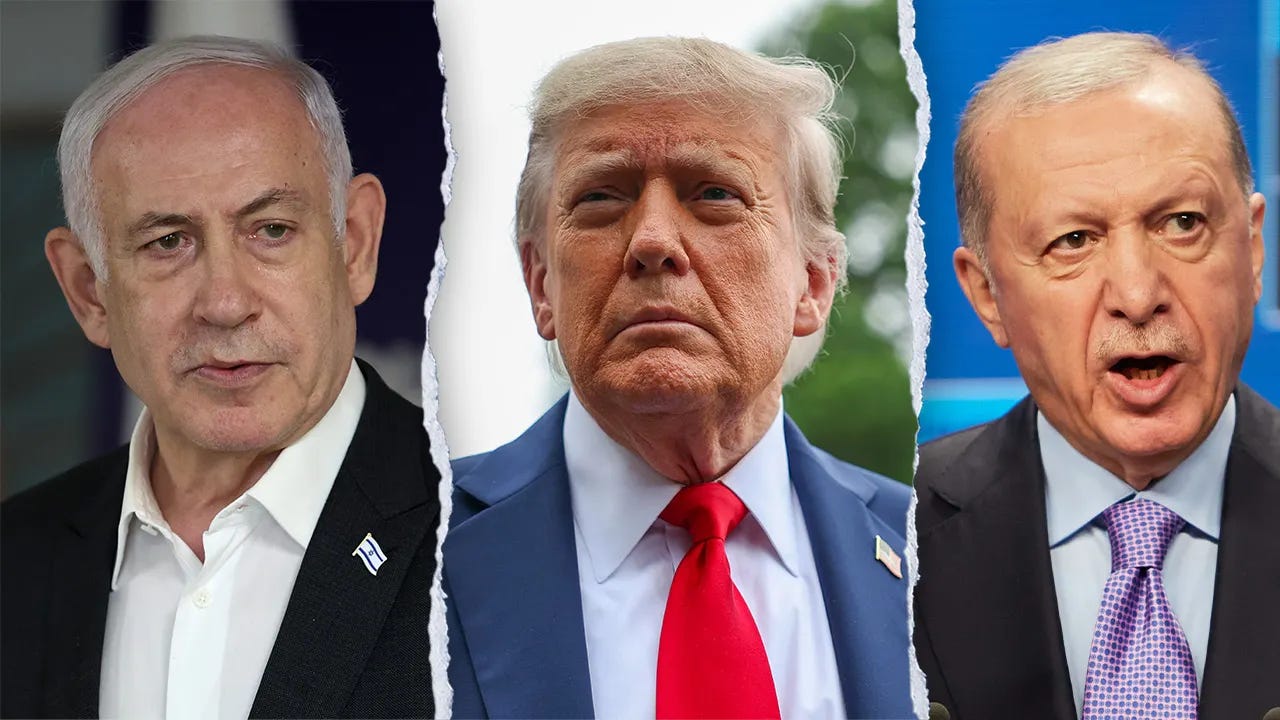
Opinion: Why Trump Listen's to Erdogan and Lectures Netanyahu on Syria
How a Leader’s Grip on Power Determines America’s Middle East Alliances
Washington is consumed by arguments about Syria. Republicans accuse Democrats of abandoning allies. Democrats accuse Republicans of enabling autocrats. Think tanks publish competing assessments. Cable news dissects every statement. Social media explodes with confident takes about betrayal, realpolitik, and regional architecture. Everyone has a theory about why Trump’s Syria policy favors Turkish interests over Israeli ones. Almost everyone is wrong.
This is not a story about regional alliances or strategic realignment or economic interests or even personal relationships. This is a story about something far more fundamental: Trump’s visceral contempt for leaders who are constrained by democratic institutions and his corresponding admiration for leaders who wield power without apology or limitation. Trump listens to Erdogan on Syria because Erdogan acts decisively and consolidates control. Trump sidelines Netanyahu because Netanyahu is weak, hemmed in by coalitions and courts and opposition parties that dictate his agenda.
The pattern has been visible for months, but everyone misses it because they are looking at geopolitics when they should be looking at Trump’s psychology. The key moment came in June 2025, when Trump posted on Truth Social calling for Netanyahu’s corruption trial to be canceled. He called it a witch hunt and said Israel should either drop the charges or grant Netanyahu a pardon. “It was the United States of America that saved Israel, and now it is going to be the United States of America that saves Bibi Netanyahu,” Trump declared.
This was not diplomatic support. This was Trump expressing raw frustration that Netanyahu remains constrained by legal proceedings. Trump has called for this twice now. He cannot understand why a prime minister cannot simply make criminal charges disappear. The fact that Israel has an independent judiciary that prosecutes leaders regardless of political pressure baffles and annoys him. In Trump’s worldview, a strong leader should be above such constraints.
Compare this to how Trump talks about Erdogan. In April 2025, during a White House meeting with Netanyahu, Trump praised Erdogan as “very smart” and a “tough leader.” When reporters asked about Erdogan’s autocratic measures, including arresting his main political rival, the mayor of Istanbul, Trump called him “a good leader” without acknowledging the crackdown. Trump has consistently described Erdogan with genuine admiration. The language is not transactional or grudging. It is respectful.
The distinction becomes even sharper when you look at what Trump actually admires about Erdogan. According to analysts who brief the administration, Trump respects Erdogan specifically for his ability to “establish strategic autonomy outside multilateral alliances.” In other words, Trump admires that Erdogan acts unilaterally without being constrained by NATO protocols, international law, or democratic oversight. When Erdogan decides something needs to happen, it happens. He does not need coalition approval. He does not face judicial review. He does not negotiate with opposition parties. He commands, and the Turkish state obeys.
Netanyahu offers Trump the opposite spectacle: a leader in perpetual crisis, managing an unstable coalition, facing criminal prosecution, constrained by court decisions, and repeatedly humiliated by opposition maneuvers. In November 2025, during Vice President Vance’s visit to Israel, opposition parties forced votes on West Bank annexation bills specifically to embarrass Netanyahu and create friction with Washington. The bills passed with support from across the political spectrum, including Netanyahu’s own coalition members defying him. Netanyahu had to issue statements distancing himself from votes in his own Knesset.
An opposition source told Israeli media: “The opposition dictated the agenda today, caused cracks in the coalition, showed how weak the prime minister is, made it clear to everyone that there is a minority government in Israel.” This is exactly the kind of democratic constraint that Trump views with contempt. In Trump’s mind, a real leader would not allow opposition to dictate anything. A strong leader would crush opposition, not negotiate with it.
The contrast shapes Trump’s entire approach to Syria. When Erdogan explains what needs to happen in Syria, he speaks with the authority of someone who controls the apparatus of state power. He tells Trump that Kurdish autonomous zones threaten Turkish security. Then he coordinates Turkish military forces, Turkish intelligence networks, and Turkish-backed proxy militias to eliminate that threat. When Trump asks if it can be done, Erdogan does not talk about coalition management or parliamentary approval. He simply does it. By January 2026, the Kurdish autonomous administration is dismantled, the SDF is forced into capitulation, and Erdogan calls Trump to report success.
When Netanyahu talks to Trump about Syria, he speaks as someone managing constraints rather than exercising power. He explains what his coalition demands. He worries about opposition reactions. He discusses court rulings that might limit military operations. He needs American diplomatic cover because his government faces domestic pressure. When Trump asks Netanyahu what Israel wants in Syria, Netanyahu cannot simply do things. He has to navigate Ben-Gvir’s demands, Smotrich’s red lines, opposition criticism, and Supreme Court oversight.
Trump has no patience for this. His entire political identity is built on the fantasy of unconstrained executive power. He spent his first term raging against judges who blocked his orders, bureaucrats who slow-walked his directives, and Congress members who refused to rubber-stamp his decisions. He views democratic institutions as obstacles rather than safeguards. When he looks at Netanyahu, he sees a weak leader shackled by exactly the kinds of constraints Trump himself tried to demolish in America.
When he looks at Erdogan, he sees what he wishes he could be: a leader who consolidates power, eliminates opposition, controls the judiciary, and wields state force without apology. This is not about Turkey being more important than Israel strategically. It is about Erdogan embodying a model of leadership that Trump admires and Netanyahu embodying a model Trump despises.
The Syria policy flows directly from this dynamic. In January 2026, when Turkish-backed forces launched the offensive that displaced 150,000 Kurds and forced SDF capitulation, Trump did nothing to stop it. No warnings to Ankara. No protection for American partners. No diplomatic intervention. When the integration deal was signed under duress, Trump praised it as progress. His special envoy Tom Barrack called it a milestone.
Why? Because Erdogan identified a problem, used state power decisively to solve it, and delivered results. The fact that the solution involved military coercion against American partners was irrelevant. What mattered was the demonstration of power. Erdogan said Kurdish autonomy was a threat, mobilized Turkish forces, eliminated the threat, and told Trump it was done. This is the kind of decisive action Trump respects.
Contrast this with Netanyahu’s approach. Israel has conducted over 1,000 airstrikes on Syrian territory since Assad’s fall. Netanyahu visits troops in occupied buffer zones. Israel expands operations when it deems necessary. But Netanyahu constantly asks for American support, coordination, and diplomatic cover. He needs Trump’s backing because domestic constraints limit his freedom of action. His coalition demands certain operations. Opposition criticizes others. Courts issue rulings about proportionality. Netanyahu must manage all these pressures while pursuing security objectives.
From Trump’s perspective, this is pathetic. If Netanyahu was a strong leader, he would not need to ask permission or seek cover. He would simply act, as Erdogan does. The fact that Netanyahu frames everything in terms of coalition management and domestic constraints makes him look weak. And Trump has bottomless contempt for weakness, especially when it stems from democratic accountability.
The personnel structure of Trump’s Syria policy reinforces this dynamic. Tom Barrack, the special envoy, is a businessman who understands transactional relationships between powerful individuals. He does not navigate coalition politics or build institutional frameworks. He brokers deals between leaders who can make decisions and implement them. When Barrack coordinates with Erdogan, he talks to someone who controls Turkey’s foreign policy apparatus completely. When Barrack talks to Netanyahu, he encounters someone who must balance Smotrich’s demands against Ben-Gvir’s threats while managing opposition criticism.
Barrack naturally gravitates toward Erdogan because Erdogan offers clarity and decisiveness. You make a deal, Erdogan implements it, the matter is settled. With Netanyahu, you make a deal and then opposition forces Knesset votes that undermine it, or coalition partners demand modifications, or courts issue rulings that complicate implementation. This is why Trump’s Syria framework has empowered Turkey while constraining Israel. Not because Turkey is more important, but because Turkey offers efficient decisive action while Israel offers democratic complications.
The irony is that Trump probably does not consciously understand his own pattern. He likely believes his Syria decisions are based on strategic calculation and regional interests. But look at which leaders he consistently empowers and which he constrains. He empowers Erdogan in Turkey, Orban in Hungary, Putin when he can get away with it, and historically backed strongmen throughout the developing world. He constrains Merkel, Macron, and any democratic leader who faces parliamentary oversight.
The pattern is not about ideology or national interest. It is about Trump’s fundamental belief that democracy is weakness and consolidated power is strength. This belief shapes his Syria policy more than any geopolitical calculation. Erdogan succeeds with Trump because he demonstrates the kind of authoritarian decisiveness Trump admires. Netanyahu fails because he is constrained by the democratic institutions that Trump spent years trying to undermine in America.
This explains specific Trump decisions that otherwise seem contradictory or irrational. When Netanyahu asked Trump to maintain some sanctions on Syria, Trump overruled him. Why? Because Erdogan and Sharaa, Syria’s transitional president, wanted sanctions lifted. Both leaders exercised enough control over their respective systems to promise that reconstruction would proceed efficiently. Sharaa’s government may be fragile, but Sharaa himself centralizes power without apology. The U.S. State Department criticized Syria’s constitutional declaration for giving Sharaa too much personal authority. Trump ignored that criticism because concentrated executive power is exactly what he respects.
When Israeli strikes hit Syrian government targets in July 2025, Trump officials publicly criticized Netanyahu. Why? Not because the strikes threatened regional stability, but because they revealed Israeli weakness. If Israel was truly dominant, it would not need to conduct defensive strikes. It would have already established such overwhelming deterrence that threats would not emerge. The fact that Israel feels compelled to strike repeatedly suggests ongoing vulnerability, which Trump interprets as failed leadership.
When Erdogan demanded complete elimination of Kurdish autonomous institutions, Trump enabled it despite knowing the costs. The SDF maintained detention facilities holding 9,000 ISIS fighters. The autonomous administration provided governance to millions. Dismantling these structures creates obvious security risks. But Trump prioritized Erdogan’s demand because Erdogan framed it as a sovereign decision and implemented it decisively. The Kurdish alternative of federal democratic governance within Syria was never seriously considered because it represented exactly the kind of constrained power-sharing that Trump views with contempt.
The deeper pattern extends beyond Syria. Trump’s National Security Strategy, released in December 2025, explicitly pivots away from democracy promotion and toward working with “strong sovereign partners.” The language is revealing. Not “democratic partners” or “like-minded allies.” Strong sovereign partners means leaders who consolidate power and can deliver outcomes without institutional constraints.
This is why the Abraham Accords expansion, which should be a priority for both Israel and America, has stalled. Saudi Arabia demands progress on Palestinian statehood as a condition for normalization with Israel. Netanyahu’s coalition prevents him from making meaningful concessions on Palestinian governance. Trump sees this as Netanyahu being weak rather than principled. A strong leader would either force coalition compliance or eliminate opposition entirely. Netanyahu negotiates and compromises, which Trump interprets as failure.
Erdogan faces his own domestic constraints, from economic crisis to political opposition. But he has been far more effective at hiding these vulnerabilities from Trump. When Trump and Erdogan speak, the conversation focuses on what Turkey can deliver, not what domestic politics prevents. Erdogan projects strength and decisiveness even when constrained. Netanyahu projects constraint even when Israel maintains military dominance.
The tragedy is that democratic accountability actually makes leaders more effective over time. Coalition politics force compromise that produces durable policies. Judicial oversight prevents catastrophic mistakes. Opposition criticism identifies problems before they metastasize. These constraints make governance harder in the short term but more sustainable long term. Netanyahu’s weakness is also Israeli democracy’s strength.
But Trump does not think in terms of sustainable governance or institutional resilience. He thinks in terms of who can deliver what he wants immediately. Erdogan can deliver Kurdish dissolution, Syrian integration, and American withdrawal. Netanyahu can only deliver requests for sustained American engagement and complaints about coalition constraints. The choice is obvious to Trump.
Looking forward, this dynamic will continue shaping Syria policy in ways that have nothing to do with regional strategy and everything to do with Trump’s authoritarian instincts. Sharaa’s government will receive American support not because it protects minorities or builds democratic institutions, but because Sharaa consolidates power decisively. The constitutional declaration that concentrates authority in Sharaa’s hands is exactly what Trump respects, regardless of State Department concerns.
If Sharaa’s government fragments or if sectarian violence escalates, Trump will blame him for being weak rather than questioning the policy framework that empowered consolidation over inclusion. If ISIS breaks out of detention facilities, Trump will demand military action but not institutional capacity building. If Turkey overreaches and triggers regional backlash, Trump will view it as Erdogan facing challenges that strong leaders overcome rather than as consequences of unconstrained power.
The pattern is clear once you stop looking at geopolitics and start looking at psychology. Trump listens to Erdogan because Erdogan exercises power the way Trump wishes he could. Trump sidelines Netanyahu because Netanyahu is constrained by the democratic institutions Trump tried to destroy. Syria policy is not driven by regional strategy or alliance management or economic interests. It is driven by Trump’s fundamental belief that strength means eliminating constraints and weakness means tolerating them.
This is why everyone debating Syria strategy on cable news and in think tanks is missing the point. They are analyzing Trump’s decisions as if he is pursuing coherent regional objectives. He is not. He is making decisions based on which leaders demonstrate the kind of authoritarian decisiveness he admires and which leaders demonstrate the democratic constraints he despises.
Netanyahu will continue being sidelined not because Israeli interests conflict with American strategy, but because Netanyahu embodies the constrained democratic leadership model that Trump views with contempt. Erdogan will continue being empowered not because Turkish interests align with American objectives, but because Erdogan embodies the authoritarian decisiveness Trump admires.
Understanding this does not make the policy any less dangerous or destructive. But it explains why the policy persists despite mounting costs and obvious contradictions. Trump is not trying to build a regional order or manage alliances or advance American interests. He is exercising his authoritarian instincts by empowering leaders who mirror his values and constraining leaders who embody democratic accountability.


