Pakistan Bans Azad Kashmir’s Largest Rights Movement, Kills Eleven, and Plans for an Election
Azad Kashmir generates enough hydroelectric power to light much of Pakistan and its residents pay some of the country’s highest electricity tariffs, and when a movement finally organised to demand that someone explain the gap, the state called it a terrorist organisation and shot eleven people dead and turned off the internet so the rest of the world couldn’t count them. The federal government’s full public accounting for those eleven dead is a parliamentary affairs minister telling reporters that 35 of the movement’s 38 demands have been fulfilled. The three that have not been fulfilled are the only ones that matter: the investigation into the dead from the last round of protests, the reduction of electricity costs to something proportional to what the territory actually produces, and the abolition of twelve assembly seats that have been returning Islamabad’s preferred government to Muzaffarabad since 1975. Those twelve seats are constitutionally protected. The election is set for July 27. The math has already been done.
You already understand the architecture. Ban the movement and any organisation that forms in its name. Kill enough people at the flashpoint to frighten the rest. Cut the communications so the body count stays contested. Hold the election before the dead can be named in full. The twelve seats produce the result. This is electoral engineering conducted with live ammunition in plain sight.
The Joint Awami Action Committee was not born from ideology and it was not organized from outside and it did not arrive with a foreign sponsor’s agenda, and yet the AJK government has listed it in the First Schedule of the Anti-Terrorism Act as a proscribed organisation alongside its aliases, treating a coalition of traders, students, lawyers, and schoolteachers as equivalent to a militant network. JAAC was formed in 2023 in direct response to two decisions the government made about money: the planned removal of wheat flour subsidies, and electricity bills that had become impossible for ordinary households to pay. Its demands were in the language of people who know what their bills say. Cheaper flour. Lower electricity costs. Accountability for officials who had been collecting revenues from a territory that received little back.
AJK is among the largest contributors of hydropower to Pakistan’s national grid, and the Mangla Dam alone built on AJK land, displacing AJK communities, producing over a thousand megawatts has been running for nearly sixty years, and yet the tariff structure applied to AJK residents has consistently placed them among the highest-paying electricity consumers in the country. The disparity is not a bureaucratic accident and it is not a consequence of infrastructure costs and it is not a mystery that requires expert analysis, and yet no government in Islamabad has ever been required to explain it in a forum where the explanation could be rejected.
When JAAC finally demanded that explanation in the streets, the government reached an agreement in October 2025 that promised a rollback of electricity costs, the continuation of wheat subsidies, a judicial commission to investigate the deaths from the protests, and a reduction in ministerial cabinet expenditure. The agreement was used to end the protests, not to fulfill them. The judicial commission was not established. The structural demands the investigation into the dead, the constitutional question of the seats were deferred into a 38-point charter that the government now claims to have substantially resolved while leaving intact everything the movement was actually about.
The AJK Legislative Assembly has 53 members. Forty-one are elected by people who live in Azad Kashmir. Twelve are reserved for Kashmiri refugees living elsewhere in Pakistan, and those twelve seats are elected not from polling stations inside AJK but from stations in Punjab, Sindh, Khyber Pakhtunkhwa, and Balochistan. The allocation is where the mechanism lives. Six of the twelve seats represent an estimated 30,000 Kashmir Valley refugees. The other six represent an estimated 434,000 Jammu refugees. A Kashmir Valley refugee’s vote carries roughly fifteen times the weight of a Jammu refugee’s vote, and both carry dramatically more weight than the vote of a resident of Rawalakot or Muzaffarabad, because these are not constituencies designed to represent people, they are constituencies designed to produce outcomes.
They have produced those outcomes reliably since the 1975 assembly, the first elected under the 1974 Interim Constitution, and they have done so in every election cycle since, delivering to Muzaffarabad the coalition that the federally ruling party needs to govern AJK, regardless of what the residents of AJK actually voted for. The AJK Council, chaired by the Prime Minister of Pakistan, spent decades controlling 52 legislative subjects, banking, insurance, nuclear energy, electricity, education, tourism, and while a 2018 constitutional amendment marketed as devolution nominally reduced that jurisdiction, thirty-two of the fifty-four legislative subjects remained under exclusive federal control and twenty-two more required Islamabad’s concurrence. What changed in 2018 was the vocabulary of control. The control did not change.
JAAC’s central demand has been the abolition of those twelve seats. The argument is not technical: these seats function as the instrument that ensures Islamabad’s preferred coalition governs Muzaffarabad regardless of the popular vote, and as long as they exist, every other demand, cheaper electricity, cheaper flour, accountability for the dead, can be granted temporarily and reversed after the next election. The AJK Supreme Court, responding to a presidential reference filed ahead of the July elections, ruled that the seats are protected under Articles 22 and 33 of the 1974 Interim Constitution and can only be abolished through a constitutional amendment passed by the Legislative Assembly, the same assembly whose composition the twelve seats help predetermine. The court made this ruling one day before the government formally proscribed JAAC. It also ruled that the election cannot be delayed for any political reason. Arab News and AP confirmed both findings. The government banned the movement the next morning.
Shahzeb Habib was a trader and JAAC activist from Rawalakot who was shot dead by AJK police near Barmang bridge late one night, and the police account published in Dawn describes armed occupants in a vehicle firing first during a stop, and JAAC and community accounts describe an extrajudicial killing, and the internet blackout imposed within hours made it impossible to verify either account and it remains impossible today. What followed his death follows the same logic. Word reached JAAC supporters before dawn and they gathered outside the Combined Military Hospital where his body had been taken, and the AJK Inspector General describes what came next as a planned armed terror attack using automatic weapons and petrol bombs, and JAAC describes a funeral gathering met with live fire, and by the end of the day Reuters and Al Jazeera confirmed eleven dead, seven civilians and four security personnel, with more than seventy wounded and seventy-two arrested.
JAAC’s count is twenty-seven civilian dead or higher. That figure cannot be verified while the blackout holds. What can be stated is that the state has now produced two disputed casualty counts from two rounds of AJK protests between nine and twelve dead in October 2025, between eleven and twenty-seven dead in June 2026 and has reconciled neither, and the instrument that prevents reconciliation is the same communications shutdown that prevents independent counting. NetBlocks confirmed the internet was cut at 11:30 p.m. on June 4, before the formal proscription had even been published which means the blackout preceded the justification for it, and the sequence was: cut the communications first, announce the ban second, deploy the force third, contest the body count fourth.
The AJK government sealed JAAC’s central office. It advised tourists to leave the region before the protest date and set the advisory to run through June 20. It arrested seventy-two people and characterized the movement’s leadership as terrorist commanders. AJK Prime Minister Raja Faisal Mumtaz Rathore warned against “mob rule.” He said this four days before the election in which his government’s coalition will benefit from the seats the mob was asking to dismantle.
The federal government has not issued a statement specifically addressing the crackdown, and the Interior Minister met the Prime Minister to discuss law and order without producing any AJK-specific output, and the Foreign Office published a response rejecting “unwarranted” remarks about AJK from the UK diaspora while affirming constitutional rights to peaceful assembly, and yet the most substantive accounting Islamabad has offered for eleven dead and seventy-two imprisoned is a fraction 35 of 38 points delivered by a parliamentary affairs minister to a reporter. PPP chairman Bilawal Bhutto-Zardari said he would raise the situation with the prime minister. He did not specify what he would say, or by when, or to what end. That is the full picture of federal accountability.
Outside Pakistan, the record was being made by others. More than fifty British MPs, led by Imran Hussain of the All-Party Parliamentary Group on Kashmir, wrote to Foreign Secretary Yvette Cooper demanding the immediate lifting of the communications blackout, consular access for arrested British nationals, direct representations to Islamabad, and renewed dialogue with JAAC. The letter cited “significant distress” among the British Kashmiri community unable to reach family inside AJK. Hundreds of diaspora members staged coordinated protests outside Pakistani diplomatic missions across the United Kingdom, blockading the Pakistani High Commission in London. The legal community inside AJK boycotted judicial proceedings in protest at the arrest of Raja Amjad Ali Khan, a JAAC core member and advocate who had previously been detained at Islamabad Airport returning from the United Kingdom where he had spoken publicly about the rights movement. The bar association’s boycott was one of the few institutional acts of resistance that could be confirmed from outside the territory, because it happened inside a courthouse.
The Human Rights Commission of Pakistan condemned the use of excessive force, the proscription, and the blackout, and announced a fact-finding mission, and warned that banning popular movements narrows democratic space ahead of elections. HRCP’s statement is the only independent institutional record accessible from outside AJK right now. The Washington Post, reporting from Rawalakot, noted that the banned group’s strike call was being observed across the city without visible enforcement capacity to stop it streets empty, shops shuttered, transport halted, a territory in shutdown that the state had already exhausted its visible capacity to control.
The July 27 election is the load-bearing fact in everything that has happened in AJK this month. Nomination papers opened on the same day as the long march toward Muzaffarabad, as the bodies were still being counted, and the AJK Supreme Court has ruled the date cannot be moved for any political reason which means the ban, the dead, the blackout, and the disputed figures are all being absorbed into a calendar that does not pause for them. This is not incidental to the strategy. It is the strategy.
The twelve seats guarantee that the election produces a government acceptable to Islamabad regardless of how the rest of the vote breaks. That guarantee is now constitutionally protected by the same court that ruled the election cannot be delayed. JAAC understood from the beginning that the economic demands cheaper electricity, cheaper flour could be conceded and then reversed after the next election if the assembly remained constituted the way it has been constituted since 1975. The structural demand, the seats, is the one the state cannot concede without dismantling the mechanism it has used to govern AJK for fifty years. So the state did not concede it, and when the movement came back demanding it again, the state called the movement a terrorist organization and shot eleven people dead and cut the internet and scheduled an election.
The October 2025 agreement was supposed to include a judicial commission to investigate the deaths from that round of protests, and the commission was not established, and the death count from that round nine according to the government, twelve according to JAAC was never officially reconciled, and the people who died in those streets have no institutional record, and yet the government pointed to that same October 2025 agreement as evidence that 35 of 38 demands have been fulfilled. What the agreement fulfilled was the immediate crisis. What it deferred was the reckoning. June 2026 is the deferred reckoning, and the state’s response to it is the same: force, blackout, contested count, election.
This sequence has been running since 1975 and it does not require extraordinary cruelty to function. It requires the suppression of the record while the force is applied, and the restoration of normal communications after the seats have done their work and the government has been formed and the dead have been absorbed into a figure that nobody in Islamabad has been asked to explain. The architecture does not break under the weight of the dead. It was built to hold them.
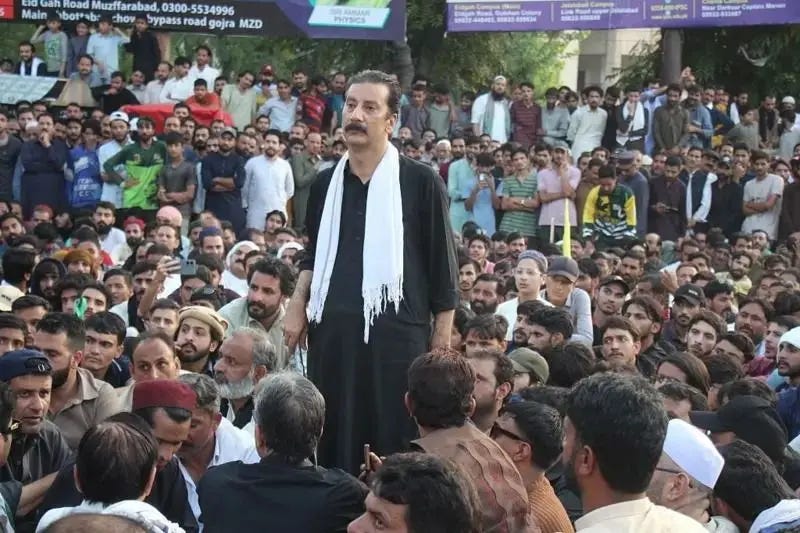
Shaukat Nawaz Mir, JAAC’s public face, has said again today that the movement is entirely peaceful. The state has said again that it is a terrorist organization. Neither statement determines what happens next. What determines what happens next is July 27, and the twelve seats, and the seventy-two people in custody who were the movement’s most organized voices, and the internet that will not come back until the immediate crisis has passed and the record has been shaped by the only accounts the state has allowed to circulate.


