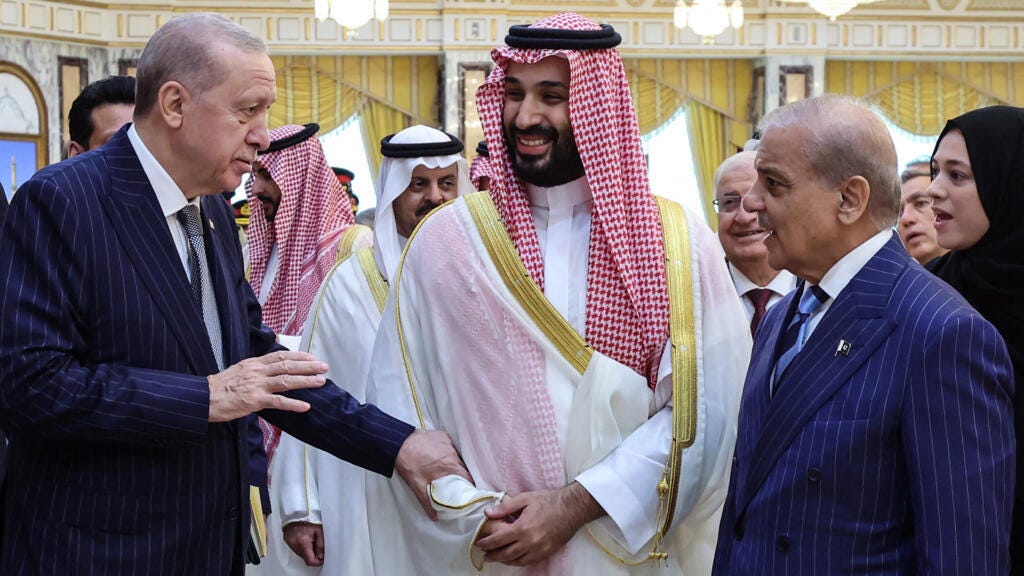
The Mecca agreement carries an Article 5-style clause, extends Pakistan’s military and nuclear weight across two regions, and leaves Pakistani citizens to pay for a commitment they were told not to name.
DG ISPR instructed Pakistan’s local media not to describe the new defence pact with Saudi Arabia and Türkiye as an Article 5-style arrangement. The instruction asks journalists to ignore a clause released by the three governments themselves: “any armed attack against any one of the three states shall be regarded as an attack against them all.” GHQ can tell television channels which comparison to avoid, its preferred anchors can deny the obligation and officials can bury it beneath talk of collective deterrence, and yet the sentence remains Article 5 in substance.
NATO’s version rests on the same formula, supported by a treaty structure, an integrated command and procedures developed over seventy-seven years. The Mecca pact does not reproduce that machinery, nor does it need to for the comparison to hold. Pakistan has promised to treat aggression against Saudi Arabia or Türkiye as aggression against itself, and its military is lying to the public about that promise while withholding the full text and keeping Parliament outside the room.
The phrase “Article 5” had to be suppressed because every Pakistani understands where it leads. A Houthi strike on Saudi territory, a clash involving Turkish forces in Syria or Iraq, or a crisis between Türkiye and Russia could arrive in Rawalpindi as a request for assistance. The published statement gives no geographical limits, no definition of an armed attack, no procedure for refusal and no answer on whether the national nuclear deterrent reaches Ankara. These are the operating terms, and the people expected to supply the money and bodies have been shown none of them.
Saudi Arabia brings cash to this bargain and Türkiye brings NATO access, an established arms industry and reach across several theatres. Pakistan brings the bomb and trained men whose orders can be issued without their consent. DG ISPR cannot allow that contribution to be named because the rulers have placed Pakistani lives at the disposal of two foreign governments and called the transaction brotherhood.
Riyadh purchases some of the world’s most advanced aircraft, missiles and surveillance systems, but the kingdom has long depended on foreign personnel, advisers and guarantees. Ankara commands NATO’s second-largest army while carrying deployments in Syria and Iraq, commitments around the Black Sea and eastern Mediterranean, and an economy under pressure. Rawalpindi supplies what ceremonial solidarity cannot: soldiers, pilots, planners, air defence crews and the strategic ambiguity of a nuclear-armed country.
The correct description for Pakistan’s contribution is military slave labour. A Pakistani soldier does not negotiate the treaty, decide whether a Turkish confrontation is his war or receive a share of the billions deposited at the State Bank. His family has no vote on whether Saudi infrastructure should be defended with his life. He joins to serve Pakistan, and the rulers convert that duty into an exportable asset which they can attach to loans, diplomatic access and their own institutional importance. Pakistani soldiers are treated as military slaves because the state sells the use of their service while denying them, their families and their elected representatives any control over the bargain. The accusation is directed at the seller.
A 1982 protocol formalised the deputation and training of Pakistani personnel in Saudi Arabia, and forces served in the kingdom during the Gulf crisis before later deployments were described as training or advisory missions. Religion, strategic partnership and protection of the holy sites were used to defend the relationship, allowing successive governments to avoid where Saudi territorial defence ended and participation in its foreign policy began.
Parliament answered in April 2015. Riyadh wanted aircraft, warships and troops for Yemen, and after five days of debate Pakistani representatives voted unanimously to remain neutral while affirming support for Saudi territorial integrity and the Haramain. They separated defence of the kingdom from manpower for a war chosen by its rulers, debated the request in public and refused the deployment.
A decade later, that restraint has disappeared. The bilateral defence pact was signed in September 2025, Pakistani forces and aircraft arrived in the kingdom in April 2026, and Reuters reported the following month that the deployment had reached 8,000 troops, a fighter squadron and an air-defence system. The Foreign Office said in July that triggers, red lines and operational limits would be determined by the forces. Parliament once decided whether soldiers could enter a Saudi war, and now the institution supplying them decides what activates the commitment, where they go and how much the public may know.
Those 8,000 troops show how any number can be deployed: the government signs, GHQ interprets, DG ISPR manages the language and the citizen is informed after the military slave trade completes its transaction. Türkiye has now entered the same structure, extending the supply line from the Red Sea to the Black Sea.
Turkish forces operate in northern Syria and Iraq, confront Kurdish armed groups, patrol seas shared with Russia and maintain bases beyond their own territory. Pakistan has signed an attack-on-one pact with a state already holding a separate guarantee from thirty-one NATO allies.
Pakistan receives no NATO protection; its exposure runs in the other direction. If Russian action in the Black Sea escalated into a strike on Türkiye, Ankara could consult the alliance under Article 4, invoke Article 5 if its conditions were met and ask Islamabad for support through Mecca. An assault on Turkish troops in Syria would raise the question of whether forces deployed abroad count as Türkiye. Pakistanis cannot judge that risk because the governing document remains secret.
The ambiguity follows Turkish vessels, aircraft, overseas bases, pipelines and critical infrastructure. A guarantee confined to recognised territory carries one level of risk, while protection for assets wherever they operate carries another, and the public statement settles nothing while Islamabad presents maximum vagueness as maximum deterrence.
Ankara joined so adversaries would believe Pakistani help can follow aggression, and Islamabad cannot then tell its own people that the words carry no consequence. A credible guarantee can bring Pakistani manpower into a Turkish war; one that cannot is worthless. GHQ wants its prestige abroad and its comfort at home, and yet deterrence permits no such division.
The Russian scenario tests an undisclosed obligation involving a NATO state across the Black Sea and shows how far the potential cost has travelled from Pakistani territory. Before Mecca, such a clash belonged to Ankara, Moscow and NATO. Pakistan’s rulers have written the country into that calculation without explaining why its soldiers should carry it.
American weapons, training, intelligence and systems remain central to Gulf defence, and Riyadh has spent years seeking a stronger formal guarantee from Washington. Why add Mecca? Dependence on Washington still leaves the kingdom subject to American timing and priorities, while a regional pact allows it to diversify without surrendering American protection. Riyadh can retain US hardware and intelligence while adding forces Rawalpindi can dispatch, Turkish weapons production and a nuclear question no adversary can dismiss. Saudi Arabia loses nothing by multiplying its shields. Pakistan assumes the risk required to make the additional shield credible.
From Riyadh, the calculation is rational: Saudi capital joins two capable states under economic strain and purchases their declared interest in the kingdom’s survival. From Karachi, the foreign-exchange reserves protected by Saudi deposits belong to the country whose soldiers now stand on Saudi soil. The relationship is valuable to Pakistan, and the abuse lies in rulers capturing its value while passing the obligation downward.
Türkiye’s annual inflation stood above 32 per cent in May 2026, its central bank rate was 37 per cent in April and war across the region had raised energy costs for an import-dependent economy. Pakistan remains under an IMF programme, carries a heavy debt burden and relies on friendly states to roll over deposits that keep its reserves from falling into crisis. Neither Ankara nor Islamabad entered Mecca from economic strength, and Saudi Arabia knew the price of that weakness before the photographs were taken.
MBS is the sugar daddy here, and the Saudi ledger makes the point. Riyadh announced another $3 billion in balance-of-payments support in April 2026 and extended an existing $5 billion deposit, helping Islamabad manage a multibillion-dollar repayment to the United Arab Emirates. Troops, aircraft and an air-defence system were in the kingdom within weeks, and Türkiye joined the pact within months.
No published document records a direct exchange of dollars for soldiers. Financial dependence rarely requires a receipt that says what the money purchased. A government negotiating while billions in Saudi support sit between solvency and a balance-of-payments crisis does not meet Riyadh as an equal, and Rawalpindi understands that as well as MBS. Pakistan’s rulers need the deposit, Saudi Arabia wants additional protection, and the men available to settle the difference wear Pakistani uniforms.
The ordinary citizen encounters this deal through a familiar ledger. Debt is taken in the country’s name, IMF discipline arrives through electricity tariffs and taxes, Saudi support is celebrated as rescue, and the ruling structure turns the dependence created by that rescue into another commitment made beyond public inspection. The benefits travel upward as reserves, access, contracts and institutional relevance; the costs return as repayment, secrecy and the possibility that a family will be told its son died defending a policy it was never allowed to debate.
Pakistan’s own defence minister placed the bomb inside the record. After the bilateral pact was signed in September 2025, Geo TV asked whether the national deterrent would be available to Saudi Arabia. He replied that the country’s capabilities “will be made available” and described an umbrella beneath which aggression would receive a joint response.
Riyadh now says the trilateral pact has nothing to do with nuclear endeavours or an arms race. That reassurance cannot erase the strategic meaning created by Islamabad’s earlier statement. Pakistan is the only nuclear-armed signatory, a cabinet minister publicly placed national capabilities beneath the Saudi umbrella and the new clause treats an attack on Türkiye as an attack on Pakistan, and yet the public is expected to believe that adversaries will notice the bomb for deterrence while Pakistanis should forget it when calculating their own risk.
A formal warhead assignment to Ankara is beside the point. A nuclear umbrella begins as a political promise that aggression against an ally may engage the deterrent of the state making it. The classified text may contain limits and thresholds, but secrecy cannot deny the meaning projected abroad while preventing scrutiny at home. Türkiye has gained Pakistani nuclear ambiguity, and a distant crisis has gained a route into Pakistan’s strategic command.
Pakistan did not need this pact to make its own deterrent credible. Its nuclear posture was built around threats in South Asia, chiefly India, and neither Riyadh nor Ankara supplies what was missing in that equation. The expansion serves the needs of an indebted regime which can turn capabilities built and paid for by Pakistanis into influence with states whose money, markets and diplomatic support help keep the ruling structure in command.
The timing matters. The Twenty-seventh Amendment rewrote Article 243 in November 2025, made the army chief concurrently chief of the defence forces, abolished the chairman of the Joint Chiefs of Staff Committee and created the Commander of the National Strategic Command. The prime minister appoints that commander on the recommendation of the current army chief, and the appointment was made in July 2026, shortly before the Mecca signing. Control across the armed forces was concentrated, decisive influence over the new strategic post was secured and a NATO state was then placed under a collective-defence clause, all without a parliamentary statement explaining the nuclear doctrine now operating behind it.
DG ISPR forbids the Article 5 comparison to protect this chain of decisions from examination. Once the clause is named, Pakistanis can follow it from soldiers in Saudi Arabia to Turkish exposure, NATO, Russia and a strategic command reorganised under the current occupant of the army chair. The language is controlled because the architecture cannot survive an open reading.
The Mecca setting supplied the religious language. The prime minister called the pact a shield for the wider Muslim community, while Türkiye’s president wrote on X that it strengthened collective deterrence under Article 51 of the UN Charter and remained open to other brotherly countries. “Muslim NATO” soon became the sales pitch, a name grand enough to turn a bargain among three governments into protection for an entire ummah.
Gaza makes that claim indefensible. Pakistan, Saudi Arabia and Türkiye joined the American-led Board of Peace in January 2026, promising support for a ceasefire, reconstruction and Palestinian statehood. Palestinians remained under an external plan governing disarmament and administration, Israeli attacks continued under the ceasefire and the three governments issued condemnation without creating a collective-defence obligation for the people whose suffering supplies so much of their public rhetoric.
The binding clause protects three states while Gaza receives statements. No Pakistani troops were offered to protect Palestinian civilians, no nuclear ambiguity was placed behind their safety and no assault on them was declared an attack on the signatories, and yet the word Mecca discourages Muslim publics from asking who sits beneath this shield and who remains outside it. A Muslim NATO that can mobilise for palaces, pipelines and state borders but not for Palestinians is a brand attached to power.
The three governments are preparing for a larger war. Saudi infrastructure has already been attacked, Türkiye sits across several fault lines and Pakistani personnel and aircraft are deployed in the kingdom. That preparation may bring contracts, Turkish technology, Saudi investment and closer intelligence co-operation, all of which Pakistan can use, and yet none gives GHQ the right to treat national manpower as military slave labour, commit the nuclear deterrent through ambiguity or hide the price from the people expected to pay it.
Pakistani life matters to this ruling structure when it can be taxed, enlisted, deployed or displayed as evidence of national power. It matters less when the citizen asks what the alliance returns to his household, why Parliament was bypassed or whose war his child may be ordered to fight. The regime receives money and relevance, the foreign partners gain protection, and the public inherits an undisclosed liability stretching from the Red Sea to the Black Sea.
DG ISPR knew exactly why “Article 5” had to disappear from television. The words connect the published clause to Türkiye, NATO, Russia, Saudi debt and the military slave trade through which Pakistan’s rulers make the country’s people available to wealthier states. Who gave them the right?