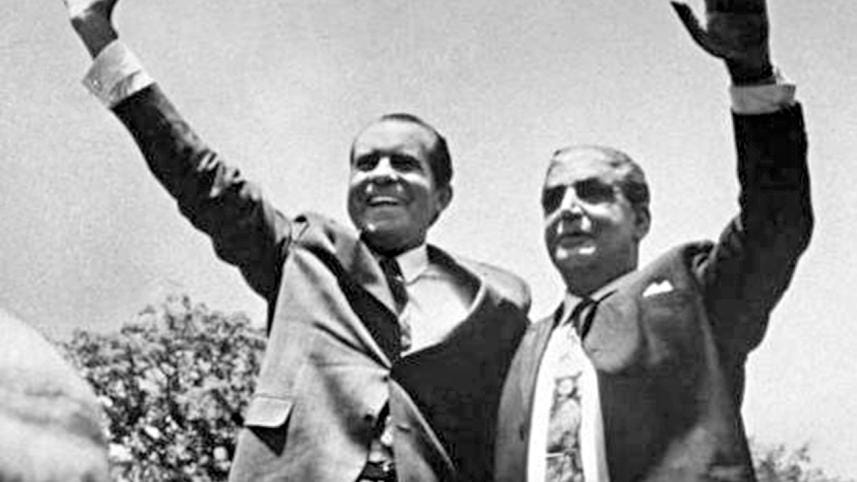
Pakistan's Doctrine Of Military Led Diplomacy
How Yahya Khan sold America a back-channel to China
On the morning of November 5, 1971, President Richard Nixon and his National Security Advisor Henry Kissinger met in the Oval Office of the White House to debrief after Nixon’s meeting the previous day with Indian Prime Minister Indira Gandhi. Gandhi had come to Washington to press Nixon on the humanitarian catastrophe unfolding in East Pakistan. Seven months after Operation Searchlight had begun, approximately ten million Bengali refugees had crossed into India. Gandhi wanted the United States to pressure Yahya Khan to stop the killing.
Nixon told Kissinger what he thought of the meeting.
“We really slobbered over the old witch,” Nixon said.
Kissinger was not sentimental about Gandhi either. “The Indians are bastards anyway,” he replied. “They are starting a war there.” Then, reflecting on what he felt he had achieved by receiving Gandhi cordially while conceding nothing: “While she was a bitch, we got what we wanted too. She will not be able to go home and say that the United States didn’t give her a warm reception and therefore in despair she’s got to go to war.”
This exchange is documented in the State Department’s Foreign Relations of the United States series, published as part of the declassified record of US policy in South Asia during 1971 and 1972. It is not an outlier. It is representative of how Nixon and Kissinger discussed the subcontinent, its leaders, and the genocide then in progress across East Pakistan in private, while maintaining a public posture of careful neutrality. The declassified record of 1971 is one of the most comprehensively documented cases of deliberate American complicity in mass killing in the twentieth century. The documents are in Washington. The conversations are on tape. The logic, stated plainly by the participants themselves, was transactional. Pakistan was running a back-channel to Beijing. The back-channel was worth more than the lives being lost in Dhaka.
What has never been fully reckoned with is the institutional conclusion Pakistan’s military drew from the episode, and how that conclusion has shaped every major foreign policy maneuver the institution has conducted in the fifty-five years since.
The Architecture of the Deal
The formal record of the arrangement begins on December 19, 1969, when Pakistan’s Ambassador to Washington, Agha Hilaly, walked into Kissinger’s White House office. NSC staffer Harold Saunders attended and drafted the memorandum of conversation, now published as part of FRUS 1969-1976, Volume E-13. The subject: Pakistan’s formal role as secret communications channel between the United States and the People’s Republic of China.
Kissinger told Hilaly that the Pakistanis could inform the Chinese that the United States “appreciated this type of communication.” He added a clarification that would define the operational parameters of everything that followed: this was to be a strictly White House matter. No discussion outside the building. The State Department was not informed. Congress was not informed. The US Ambassador to Pakistan, Joseph Farland, was informed only on a need-to-know basis for logistics.
Nixon had chosen Pakistan through a process of elimination. He needed a conduit to Beijing that would not alert Moscow, would not run through the State Department bureaucracy he distrusted, and would allow him and Kissinger to claim exclusive personal credit for the diplomatic breakthrough. Romania had been considered. French contacts with the Chinese embassy in Paris had been explored. Pakistan won because, as Kissinger’s aide Winston Lord explained in a 1998 oral history interview with the Association for Diplomatic Studies and Training: “Pakistan had the advantage of being a friend to both sides. There was no danger of Russian involvement.”
Nixon had visited Islamabad in August 1969 and quietly tasked Yahya with passing an opening message to Beijing. Over the following year and a half, Pakistani officials carried messages in both directions. Hilaly in Washington served as the primary American-side conduit, hand-delivering messages from Kissinger to the Chinese and returning with Beijing’s replies. Yahya in Islamabad communicated with Chinese Premier Zhou Enlai through the PRC’s ambassador to Pakistan. When Kissinger needed a message moved, he annotated State Department memos. On one, describing how Yahya had been tasked to convey Nixon’s openness to China, Kissinger wrote directly: “This is to be strictly WH matter. I want no discussion outside our bldg.”
By April 1971, after eighteen months of indirect exchanges, Beijing confirmed through the Pakistani channel that it was willing to receive Nixon. The mechanism that would produce Nixon’s February 1972 visit to China, the handshake with Mao Zedong, and the normalization of US-China relations after twenty-five years of hostility, was now fully operational.
March 25, 1971, was the night Operation Searchlight began.
Two Operations, One Calendar
On March 20, 1971, five days before Searchlight commenced, Yahya Khan convened an emergency meeting at the Dhaka Cantonment. Present were General Hamid Khan, military administrator of East Pakistan General Tikka Khan, General Peerzada, General Omar, and senior military commanders. The operation was approved. On March 22, Yahya cancelled the National Assembly session scheduled for March 25, the session that should have transferred power to the Awami League, which had won 160 of 162 East Pakistan seats in the December 1970 general election. On the evening of March 25, Yahya left Dhaka. After midnight, the army moved.
Operation Searchlight’s targets included the Dhaka University campus, Bengali intellectual and political leadership, Awami League organizers, Hindu populations across the province, and Bengali police and military personnel. Yahya’s planning documents, later examined by the Hamoodur Rahman Commission, described objectives including seizing radio stations and telephone exchanges, disarming Bengali security forces, and eliminating the independence movement’s leadership structure in the province’s main cities.
Archer Blood was the US Consul General in Dhaka. A career Foreign Service officer with twenty-three years of experience, recently promoted to the Senior Foreign Service, he had served in Dhaka before and had asked for this posting. He spent the night of March 25 on the roof of his official residence, watching tracer bullets and listening to tank fire. Over the following two weeks, his consulate filed detailed cables to Washington describing what the army was doing.
On March 28, three days after the operation began, Kissinger informed Nixon of the cables coming out of Dhaka. The conversation was recorded. The transcript, held at the Library of Congress, Manuscript Division, Kissinger Papers, and published by Tom Wells in The Kissinger Tapes, captures what happened when the Consul General’s warnings reached the President of the United States.
Kissinger: “We’ve had a bleeding cable from our Consul in Dacca who wants us to put out a statement condemning what the West Pakistanis are doing. But of course we won’t consider it.”
Nixon’s response: “Well, now remove him. I want him out of the job.”
Kissinger’s private assessment of Blood: “this maniac in Dhaka.”
Then Nixon added: “I wouldn’t put out a statement praising it, but we’re not going to condemn it either.”
Blood was not immediately removed. He continued filing cables. He filed spot reports describing the army’s systematic targeting of civilians, the burning of villages, the killing of students at Dhaka University. He described seeing the tracer fire from his roof. Washington maintained its silence. In Blood’s own words, later recorded in an oral history with the Association for Diplomatic Studies and Training: “The silence from Washington was deafening.”
On April 6, 1971, twelve days after Searchlight began, Blood dispatched a formal dissent telegram to Washington. Twenty-nine of his consular colleagues signed it alongside him. The cable read in part:
“Our government has failed to denounce the suppression of democracy. Our government has failed to denounce atrocities. Our government has failed to take forceful measures to protect its citizens while at the same time bending over backwards to placate the West Pakistan-dominated government and to lessen any deservedly negative international public relations impact against them. Our government has evidenced what many will consider moral bankruptcy.”
The cable used the word genocide. Blood was recalled. Senator William Fulbright, chairman of the Senate Foreign Relations Committee, formally requested the Blood telegrams and other Dhaka cables from the State Department. The State Department refused to provide them.
The Invoice: What Yahya Extracted
The exchange is documented across multiple primary government records. What Pakistan’s military government received in return for running the back-channel has been softened in popular accounts by the language of diplomatic favor. The actual transaction was material, structured, and conducted in deliberate violation of existing American law.
In October 1970, as the back-channel was entering its most productive phase, Nixon approved what his administration termed a “one-time exception” to the arms embargo on South Asia. Secretary of State William Rogers described the package in a memorandum to Nixon, now published as FRUS 1969-1976, Volume E-7, Document 108: it included interceptor and bomber aircraft, armored personnel carriers, and maritime patrol aircraft, and Rogers noted it “could cost Pakistan $40 million or more, depending on the models of equipment chosen.” Nixon had initialed his approval and on his own initiative expanded the package to include tanks and B-57 bombers, overriding the objections of his own Secretary of Defense. The 300 armored personnel carriers specifically are confirmed in a later NSC memorandum published as FRUS Documents on South Asia, Document 111, which notes the Pakistanis “have made a down payment and the equipment is being held in storage for them.”
During Yahya’s visit to Washington in October 1970, Nixon had told him privately: “Nobody has occupied the White House who is friendlier to Pakistan than me.” Yahya’s information minister, G.W. Choudhry, later recorded his analysis of what this assurance produced inside the Pakistani military’s decision-making. Yahya, Choudhry wrote, believed he was “insured” by the United States. That whatever happened in East Pakistan, Washington would not allow his government to face serious consequences. Choudhry concluded that minus this false confidence, Yahya would have made a more realistic assessment of what the army was doing in the east.
When Congress moved to cut off this arrangement, Nixon and Kissinger went around it. The Foreign Assistance Act was amended in July 1971 to formally block direct military aid to Pakistan. Nixon’s response was not to comply. On December 4, 1971, a day after India and Pakistan went to war, a telephone conversation between Nixon, vacationing in Key Biscayne, Florida, and Kissinger in Washington was recorded and later published as FRUS 1969-1976, Volume XI, South Asia Crisis 1971, Document 222. Kissinger: “We have had an urgent appeal from Yahya. Says his military supplies have been cut off, in very bad shape. Would we help through Iran?” Nixon: “I like the idea. The main thing is to keep India from crumbling them up.”
The same conversation included Nixon’s instruction on how to handle domestic accountability: “Keep as much of it under the hat as you can. What I mean is let’s do the carrier thing and I would tell the people in the State Department not a goddamn thing they don’t need to know.”
Later that day, at 12:15pm, Nixon called Kissinger a second time. The transcript, sourced to the Library of Congress, Kissinger Papers, Box 397, and published by The Daily Star Dhaka, records one exchange:
Nixon: “Did the Jordans send the planes?”
Kissinger: “17.”
The Jordanian aircraft in question were US-manufactured Lockheed F-104 Starfighters. American law prohibited a client state from transferring US-origin equipment to a third country without Washington’s approval. The Nixon administration not only approved the transfer but encouraged it, covertly, through channels designed to leave no direct American fingerprint on the transaction.
By December 10, Nixon and Kissinger were managing a full multilateral covert arms operation. A memorandum from Deputy National Security Advisor Alexander Haig to Kissinger that day, published as FRUS Vol. XI, Document 273, confirmed that Jordan had agreed to send aircraft to Pakistan with authorization to go up to twenty-two. Turkey had separately agreed to provide six F-5 fighters pending US approval. Kissinger informed Nixon of the status at 10:51am:
Kissinger: “The carriers, everything is moving. Four Jordanian planes have already moved to Pakistan, 22 more are coming. We’re talking to the Saudis, the Turks we’ve now found are willing to give five. So we’re going to keep that moving until there’s a settlement.”
Nixon: “Could you tell the Chinese it would be very helpful if they could move some forces or threaten to move some forces?”
Kissinger: “Absolutely.”
Nixon: “They’ve got to threaten or they’ve got to move, one of the two. You know what I mean?”
Nixon then added: “How about getting the French to sell some planes to the Paks?”
Kissinger replied: “Yeah. They’re already doing it.”
On December 8, 1971, the US Seventh Fleet’s Task Force 74, led by the nuclear-powered aircraft carrier USS Enterprise, received orders to enter the Bay of Bengal. The stated public purpose was evacuation of American citizens. Kissinger wrote later that the actual purpose was “to give emphasis to our warnings against an attack on West Pakistan.” The Enterprise arrived on station on December 15.
On December 12, as Indian forces closed toward Dhaka, the conversation in the Oval Office turned to its most extreme point. Kissinger told Nixon: “If Pakistan is swallowed by India, China is destroyed, defeated, humiliated by the Soviet Union, it will be a change in the world balance of power of such magnitude that the security of the United States, for maybe forever, certainly for decades, we will have a ghastly war in the Middle East.” Nixon interjected with his own global calculation before raising the nuclear question directly: “When I say the Chinese move and the Soviets threaten and we start lobbing nuclear weapons, that isn’t what happens.” Kissinger walked him back: “We don’t have to lob nuclear weapons. We have to go on alert.”
The conversation about nuclear alerts over the fate of East Pakistan took place while Archer Blood’s cables describing the killing of civilians sat unread in State Department files.
Nixon’s handwritten instruction, April 1971, recovered from the National Archives and published by Dawn in December 2002, was addressed to his entire national security apparatus. It read: “To all hands, don’t squeeze Yahya at this time.”
Nathia Gali: The Operation Behind the Diplomacy
The mechanics of the Kissinger mission to Beijing in July 1971 are where the institutional template was built. Not the diplomatic content, which was Kissinger and Zhou Enlai’s work across forty-eight hours of meetings. The staging of the operation, who controlled it, and how the deception was run on Pakistani soil are what mattered institutionally.
Kissinger arrived in Islamabad on July 8 on a public tour of Asia. Pakistani officials announced the following morning that he had fallen ill and was resting at a government villa in Nathia Gali, a colonial hill station in the Murree Hills at approximately 8,000 feet elevation and several hours from the capital. A Pakistani government limousine made the journey to Nathia Gali visibly. The international press corps, Nixon’s cabinet members, and the US Embassy staff who had dined with Kissinger the evening before were not informed that the vehicle was a decoy.
Yahya Khan ran the actual operation through two people: Foreign Secretary Sultan Mohammed Khan and Ambassador Agha Hilaly. In the early hours of July 9, Yahya Khan’s personal driver took Kissinger and three senior aides to a military airfield. A Pakistan International Airlines Boeing 707 was waiting on the runway. When the Americans boarded, they found four Chinese officials already seated on the aircraft. These Chinese officials had been in Pakistan without the knowledge of a single American official outside the handful of people in the White House basement who knew the operation existed.
The aircraft flew overnight to Beijing. Kissinger spent forty-eight hours in meetings with Zhou Enlai before returning to Pakistan. In a backchannel message to Alexander Haig transmitted on July 11, 1971 at 1330 Zulu, now published in the National Security Archive Electronic Briefing Book No. 66, Kissinger described the meetings as “the most intense, important, and far-reaching of my White House experience.”
The CIA was brought in for logistics: Winston Lord’s 1998 ADST oral history records that the Agency provided combination-locked briefcases and facilitated Ambassador Farland’s classified consultations in California before the mission. But the mission’s conception, its cover story, its physical staging, and its operational execution on Pakistani soil were the army’s. Yahya did not share control of this with any civilian institution in Pakistan. The foreign ministry held the title of foreign secretary. The army ran the mission and owned the outcome.
The decoy car returned from Nathia Gali. The world was told Kissinger had recovered from a stomach ailment. Pakistan’s military had just demonstrated that it could run a covert operation of global consequence on behalf of a superpower without that superpower’s formal institutional apparatus, and without the knowledge of Pakistan’s own civilian government, parliament, or public.
Indira Gandhi and the Private Language of Power
The Nixon-Kissinger conversations about India provide the clearest window into the psychology driving the tilt toward Pakistan. They are not aberrations. They form a continuous record across 1971 of how two men who controlled American foreign policy privately understood the subcontinent and the people dying in it.
On November 5, 1971, the morning after Gandhi’s White House visit, Nixon and Kissinger were explicit about what they thought of her and about what American policy was designed to achieve. Kissinger’s analysis of the meeting: “While she was a bitch, we got what we wanted too. She will not be able to go home and say that the United States didn’t give her a warm reception and therefore in despair she’s got to go to war.” Nixon’s contribution to the assessment of Indian women in general, recorded in the Oval Office in June 1971 in the presence of Kissinger and White House chief of staff H.R. Haldeman: “Undoubtedly the most unattractive women in the world are the Indian women. Undoubtedly.” He repeated it for emphasis.
On December 3, 1971, hours after Pakistan launched simultaneous attacks on six Indian airfields, prompting India to declare war, Nixon called Kissinger. Kissinger told him: “If they lose half of their country without fighting they will be destroyed. They may also be destroyed this way, but they will go down fighting.” Nixon replied: “The Pakistan thing makes your heart sick. For them to be done so by the Indians and after we have warned the bitch. Tell them that when India talks about West Pakistan attacking them it’s like Russia claiming to be attacked by Finland.”
Three days later, on December 8, Nixon told Kissinger and Attorney General John Mitchell: “Well, my point is they’re going to lose anyway. At least we make an effort, and there is a chance to save it.” By December 10, the framing had hardened into something Nixon stated without qualification: “Our desire is to save West Pakistan. That’s all.”
On December 10, 1971, in the same Oval Office meeting, Nixon said: “Get a white paper out. I want the Indians blamed for this, you know what I mean? We can’t let these goddamn sanctimonious Indians get away with this. Here they are raping and murdering. They talk about West Pakistan. These Indians are pretty vicious.” This exchange is published in FRUS 1969-1976, Volume E-7, Document 172, sourced to National Archives, Nixon Presidential Materials, White House Tapes, Oval Office Conversation No. 635-8.
What is absent from all of these conversations, across nine months of documented discussion between Nixon and Kissinger about the 1971 crisis, is any substantive discussion of the people dying in East Pakistan. The Blood cables are mentioned as a bureaucratic irritant. The genocide is treated as Pakistan’s internal affair. The three million dead are not in the record at all, because the two men running American foreign policy had decided by March 28, 1971 that the back-channel to Beijing was worth more than anything coming out of Dhaka.
Kissinger eventually said this in public. In an interview with The Atlantic, asked why the United States had not condemned Pakistan’s actions in East Pakistan, he explained: Doing so “would have destroyed the Pakistani channel, which would be needed for months to complete the opening to China, which indeed was launched from Pakistan.” He said it with his name attached, decades later, without apparent discomfort.
The Commission That Was Classified for Twenty-Nine Years
Pakistan established its own judicial inquiry into the 1971 catastrophe. Zulfikar Ali Bhutto appointed the commission on December 26, 1971, ten days after the army’s surrender in Dhaka. Chief Justice Hamoodur Rahman, a Bengali jurist, led it. Two Supreme Court justices sat alongside him. Military officials served as advisers. Over two years, the commission interviewed 213 officials and witnesses under oath. Among those who testified: Yahya Khan, Bhutto, former army chiefs, senior field commanders, Awami League figures, and journalists who had been in East Pakistan during the operation.
The commission submitted its final report to the government in 1974.
The government immediately classified it. Twelve copies were produced. Eleven were ordered destroyed. The one surviving copy was deposited in a government archive and its contents legally suppressed. For twenty-six years, the official Pakistani position was that no comprehensive judicial record of 1971 existed in usable form. This was false, and the government knew it.
The report was not officially released until December 30, 2000, when Pervez Musharraf declassified it, and only after Indian newspapers had already begun printing excerpts leaked through unofficial channels. The public had been denied access to the official record of 1971 through five different governments, military and civilian, across three decades.
When the report did become public, it was specific. The commission found that a “considerable number of senior army officers” had engaged in “large-scale acquisition of lands and houses and other commercial activities” and had “adopted highly immoral and licentious ways of life which seriously affected their professional capabilities and their qualities of leadership.” It found Yahya Khan’s military strategy fundamentally flawed and his political judgement catastrophically poor. It recommended trials of senior military figures for neglect of duty and conspiracy.
The commission also confronted the casualty question directly, and its handling of that confrontation is itself a document. It acknowledged early in the report that “it was hardly possible to obtain an accurate estimate of the toll of death and destruction” given conditions in the field. Having acknowledged that precision was impossible, it then chose the army’s own lowest-end figure, approximately 26,000 killed, declared it “reasonably correct” on the basis that there was “no other reliable data,” that data being the General Headquarters’ self-reported submission about its own conduct. Bangladesh has consistently maintained three million died. Independent demographic surveys of the period yield figures between 269,000 and 500,000 at minimum. The commission, having stated the record was impossible to read accurately, read it in the army’s favor.
None of the recommended trials took place. Yahya Khan lived under house arrest in a government property until his death in 1980. No general faced criminal proceedings. The commission report was classified for twenty-nine years. The international record, held in Washington, remained partially classified for its own reasons. The two archives reinforced each other’s silence across the same three decades.
The Institutional Lesson
Senator Clifford Case of New Jersey posed the question that the declassified record answers. He asked, on the record, in his capacity as a member of the Senate Foreign Relations Committee: “Did the US make any commitment to Pakistan on military assistance in connection with the arrangement for your visit to Peking?” NSC staffer Harold Saunders memorialized the question in a July 19, 1971 memorandum to Kissinger. The administration never answered it publicly. The answer, across the arms shipment records, the telephone transcripts, and the backchannel messages in the National Archives, is not difficult to reconstruct.
Pakistan provided the conduit. In exchange, it received arms, political cover, American silence on a genocide, covert weapons pipelines through third countries when Congress formally blocked direct aid, the deployment of a nuclear carrier group to the Bay of Bengal, and an American president privately telling his National Security Advisor to threaten nuclear alerts on Pakistan’s behalf. The channel granted indemnity. The institution survived without accountability. The commission was classified.
What Pakistan’s military absorbed from this is the core of its foreign policy doctrine across every subsequent generation of leadership. The argument is structural: position Pakistan as the indispensable intermediary between adversarial powers, and the calculation of whether to hold Pakistan accountable for anything it does shifts permanently in the institution’s favor. The channel justifies the silence. The silence enables the conduct. The conduct is insulated from accountability because the channel cannot be closed.
The Afghan jihad of the 1980s was the first full recycling of the blueprint at scale. The ISI became the CIA’s primary operational arm for distributing several billion dollars in US and Saudi-supplied weaponry to Afghan mujahideen factions. Pakistan did not conduct this as a subordinate executing American strategy. It conducted it as the indispensable intermediary whose cooperation could not be withdrawn without collapsing the entire American project in Afghanistan. The leverage was structurally identical to Yahya’s leverage in 1971. The consequences, including the permanent militarization of Pakistani society and the institutionalization of armed non-state actors as instruments of state policy, were distributed to the Pakistani public and to Afghanistan. The institution took the rewards.
The A.Q. Khan nuclear proliferation network sold uranium enrichment technology to North Korea, Iran, and Libya across nearly two decades. Multiple US administrations declined to press Pakistan seriously on the network. The calculation, documented in State Department cables from the period, was explicit: confronting Pakistan on Khan would cost the cooperation required for the post-2001 Afghan operation. The channel, again, granted indemnity.
Osama bin Laden was found in Abbottabad in May 2011, one kilometer from the Pakistan Military Academy, where he had lived for five years. The question of what Pakistani state institutions knew and when has never been formally adjudicated.
Tehran, March 2026
On March 25, 2026, fifty-five years to the day after Operation Searchlight, Pakistani Foreign Minister Ishaq Dar confirmed that Islamabad was relaying a US fifteen-point ceasefire proposal to Tehran as the US-Israeli war against Iran entered its second month. Chief US negotiator Steve Witkoff confirmed Pakistan’s role the same day. Hours later, Trump announced a ten-day pause on threatened strikes against Iranian power plants.
As of this writing, the Pakistani delegation was in Tehran attempting to secure a clear Iranian response to US demands. The atmosphere was not close to optimism. Iran was holding its original redlines on enrichment and its highly enriched uranium stockpiles. The status of the Strait of Hormuz remained tied to whether Washington would lift its naval blockade. Quds Force commander Esmail Qaani had just visited Baghdad to discuss the selection of an Iraqi prime minister, a deliberate signal that despite the military pressure Iran had absorbed, it had not abandoned its regional architecture. Everyone was waiting on Washington’s next move.
Pakistan is describing its role as responsible diplomacy. Neutral. Indispensable. The framing is not wrong in its own terms. Pakistan does have access to Tehran that Washington lacks. The channel is real.
The problem is not the back-channel. Back-channels exist. Great powers use them. The problem is the specific institutional structure through which Pakistan’s military conducts this diplomacy. In 1971, Yahya Khan ran the Beijing channel as a unilateral military operation, outside Parliament, outside any civilian oversight mechanism, extracting weapons, political cover, and American silence for his institution while three million people paid the price in East Pakistan. No elected Pakistani institution voted on the arrangement. No civilian body had full visibility into what was being offered or what was being received.
The structure has not changed. Whatever is being offered or withheld in the room in Tehran tonight, no Pakistani parliament voted on it. No civilian institution controls it. The military is conducting foreign policy on behalf of a state whose elected government does not have full visibility into the transaction.
In 1971, Nixon told his entire national security apparatus, in his own handwriting, not to interfere with what Yahya was doing. The commission that documented what Yahya was actually doing was classified for twenty-nine years.
The question history keeps placing in front of Pakistan is not whether the channel is useful. It is who pays for it, and whether anyone is ever asked to account for the cost.
References
Back-channel establishment and operational records
Arms package: one-time exception and 300 APCs
FRUS 1969-1976, Volume E-7, Document 54 — Nixon approval of one-time exception for Pakistan
Nixon-Kissinger telephone transcripts: December 1971 arms pipeline
“Did the Jordans send the planes?” / “17”
November 5, 1971 Oval Office: “The Indians are bastards anyway” / “While she was a bitch”
“Keep as much of it under the hat” / State Department excluded
Blood Telegram, April 6, 1971
“Well, now remove him” — Blood recalled, March 28, 1971 tape
The Kissinger Tapes (Tom Wells, 2004) — reported by New Kerala citing the tape transcript
Nixon handwritten note: “Don’t squeeze Yahya at this time”
Dawn, December 2002 — reporting on 46 declassified National Archives documents
Winston Lord oral history, 1998
Kissinger on destroying the channel — The Atlantic interview
Cited in Al Jazeera, March 2026
Hamoodur Rahman Commission
The Daily Star Dhaka — commission declassified December 30, 2000
The Daily Star Dhaka — analysis of commission’s handling of casualty figures
State Department FRUS Volume XI editorial introduction
US State Department Archive — Pakistan as China conduit, US intervention in South Asia crisis


