


Washington denied Mahmoud Abbas a visa for the second year, Jordan counted children killed during the ceasefire, Erdoğan called Gaza a concentration camp, Qatar’s emir called it genocide, Macron criticised blocked aid, and Netanyahu prepared for a one-day visit.
Wednesday, September 23, 2026: Mahmoud Abbas will address the General Assembly on a screen for the second year in succession. The United States denied the Palestinian president and senior members of his delegation visas, and 152 states then voted to allow a prerecorded address. The United States, Israel and Paraguay voted against the accommodation. Colombia, Honduras, Panama and Peru abstained. On opening day, António Guterres warned in his final General Assembly speech that Israeli settlement expansion, violence and displacement in the occupied West Bank were “raising the spectre of ethnic cleansing.” King Abdullah II said at least 300 Palestinian children had been killed during the first 300 days of the ceasefire. Recep Tayyip Erdoğan called Gaza the world’s largest children’s cemetery and the “most inhumane and shameful concentration camp of our time.” Qatar’s emir called the destruction genocide. Emmanuel Macron said Gaza had become a spectacle that shamed the hall. Andy Burnham defended Britain’s settlement trade ban while reaffirming British support for Israel against Iran and Hamas. Donald Trump praised his Gaza plan and Board of Peace, and the Gaza Health Ministry reported that Israeli attacks had killed 1,399 Palestinians since the ceasefire took effect on October 11, 2025.
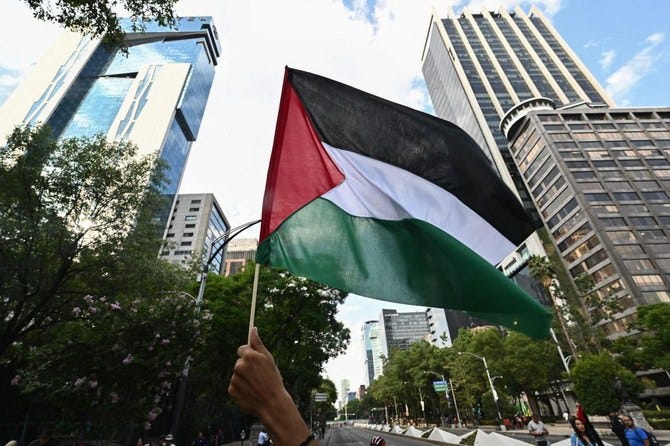
The first Palestinian image of UNGA 81 was an empty chair. Palestine’s flag stood among the others, its observer mission entered the hall and Ambassador Riyad Mansour led the delegation, while the US visa decision kept Abbas outside the country. Most member states recognise Palestine, and 152 voted for a procedure that would let its president speak by video.
The arrangement placed separate authorities in the same proceeding. The General Assembly controlled its speaking procedure, the United States applied its visa laws as host country, the Secretary-General addressed conditions in Gaza and the West Bank, and international courts remained responsible for the cases before them. The dispute concerned how those authorities interact under the Headquarters Agreement and US law.
The Day One File
The empty seat
The vote was 152 to 3, with four abstentions. On September 17, the General Assembly adopted resolution A/81/L.2, which permits Abbas to submit a prerecorded statement for playback after a representative in the hall introduces him. The United States, Israel and Paraguay opposed the resolution. Colombia, Honduras, Panama and Peru abstained.
The procedure solved the problem of hearing Abbas without settling the dispute that kept him away. Riyad Mansour said the visa decision violated the 1947 UN Headquarters Agreement, which governs access to the headquarters district and was ratified by the United States Congress. China, Iran and Russia also criticised the denial during the Assembly debate.
The United States argues that its laws permit the restriction. The State Department said the Palestine Liberation Organization and Palestinian Authority had failed to meet commitments under the PLO Commitments Compliance Act of 1989 and Middle East Peace Commitments Act of 2002. It cited cases brought against Israel at the International Criminal Court and International Court of Justice, efforts to secure recognition outside negotiations, prisoner stipends and what it described as glorification of terrorism.
Deputy US Ambassador Tammy Bruce accused the Palestinian Authority of using “diplomatic theatre as a substitute for serious governance” and said its legal and diplomatic work sought to isolate Israel while avoiding negotiation. Mansour answered that the vote did not excuse the host country from its treaty obligations.
The denial applied for a second year. The Trump administration also kept Abbas from the 2025 high-level meeting. This year it granted visas to Iranian President Masoud Pezeshkian and Foreign Minister Abbas Araghchi while the United States and Iran were at war, but continued the restriction on the Palestinian leadership.
The comparison does not establish the legal merits of either decision, but it shows how the host government applied its discretion. Officials from a state fighting American forces could enter for the debate. The president of Palestine could not.
Israel welcomed the restriction. Palestinian officials called it an attempt to obstruct their representation at the principal gathering of the organisation that granted Palestine non-member observer state status in 2012.
Palestine remained physically present through its mission. Mansour led the delegation on Tuesday. Palestinian representatives applauded Guterres when he addressed Gaza, the West Bank and the two-state settlement. They later applauded Erdoğan as Israel’s delegation left the hall.
The images could suggest participation. The structure was narrower: Palestine’s representatives could listen, applaud and introduce a video, but the official selected to speak for the Palestinian people could not enter the country.
Guterres names the danger on his way out
The Secretary-General used the phrase “ethnic cleansing.” In the Palestine section of his final General Assembly address, Guterres said Israeli violence, displacement and settlement expansion in the occupied West Bank were “bulldozing the path to peace and raising the spectre of ethnic cleansing.”
He condemned the Hamas-led attacks of October 7, 2023, as abhorrent. He then described the Israeli assault on Gaza as an onslaught with a scale of killing and destruction beyond anything he had witnessed during ten years as Secretary-General.
Guterres cited the International Court of Justice’s legally binding provisional measures in the Genocide Convention case brought by South Africa. He also referred to the Court’s advisory opinion that Israel must permit the United Nations to carry out its mandates in Gaza and protect UN and humanitarian staff.
He did not make a finding that genocide had occurred. Guterres has said that legal characterisation belongs to a competent court. UN Special Rapporteur Francesca Albanese and a UN Commission of Inquiry have used the term genocide, while Israel rejects the allegation and says its operations comply with the laws of armed conflict.
The longest applause in this section followed his defence of two states. Guterres said the international community could not allow the prospect to disappear. The applause confirmed the breadth of formal support, while the conditions he named showed how little that support had restrained settlement, displacement or attacks.
On August 18, Israel opened a tender for 1,234 homes in the E1 settlement project. Britain’s government and rights groups say construction there would divide the West Bank and separate it from East Jerusalem, damaging the territorial basis of a viable Palestinian state.
The two-state formula therefore entered the hall as both consensus and disappearing geography. Governments repeated the destination while settlement policy altered the land on which it would have to exist.
Israel answered the Secretary-General through Ambassador Danny Danon. Danon described the speech as an anti-Israel political indictment issued under the UN banner. He later told Jewish News Syndicate that anyone would be better than Guterres and criticised the Secretary-General for failing to visit Israel after October 7.
Israel’s response disputed Guterres’s conduct and framing. It did not change the cited ICJ measures, the settlement tenders or the Secretary-General’s warning about displacement in the West Bank.
Jordan counts children inside the ceasefire
King Abdullah II began with attention as a political resource. In the full text published by Jordan’s Petra news agency, he said the international community had chosen for decades to manage the Palestinian-Israeli conflict instead of resolving it.
He said the evidence from Gaza was overwhelming and that at least 300 Palestinian children had been killed during the first 300 days of what he called the ceasefire. The formulation placed one child against each day of an agreement described as peace.
Abdullah described Palestinian displacement in the West Bank as a deliberate forced-transfer policy rather than an incidental result of clashes. He called the conduct a war crime and said the expansionist ambitions of the current Israeli government had become a regional threat.
Jordan signed a peace treaty with Israel in 1994 and maintains security and diplomatic relations with it. Its king was therefore speaking as the head of a neighbouring treaty state, not as a government without formal ties.
Jordan’s own security entered the speech. Abdullah warned that threats to Jordan’s northern border and water security would be treated as threats to national security. The Palestine question remained connected to a regional system in which displacement, annexation and conflict can cross borders even when treaties remain in force.
Erdoğan centres Palestine and Israel leaves
The Turkish president opened by protesting Abbas’s exclusion. Erdoğan said the president of a state recognised by the overwhelming majority of UN members had been unable to enter the hall for two consecutive years. In the official Turkish account of the speech, he said the organisation had been deprived of the means to fulfil its founding purpose.
His Gaza figures were attributed claims, not neutral UN totals. Erdoğan said 74,000 Palestinians had been killed during three years, most of them women and children. He described Gaza as the world’s largest children’s cemetery, said it had the highest rate of child amputees and reported that more than 70 per cent of hospital generators were out of service because of fuel shortages.
He called Gaza “the most inhumane and shameful concentration camp of our time.” The Israeli delegation left during the address. Palestinian representatives applauded.
Erdoğan said more than 1,500 Palestinians had been killed after the ceasefire. The Palestinian Health Ministry figure reported on September 22 was 1,399 killed and 4,863 injured since October 11, 2025. The dates and sourcing differ, so this edition retains both figures with attribution rather than combining them.
He said Palestinian factions had accepted movement toward the second phase of the peace plan while the Israeli government refused to end the occupation. He also thanked Trump for work on the ceasefire, placing praise for the American diplomatic role beside criticism of the government Washington continued to support.
Erdoğan returned to Security Council power. He said the will of more than 190 countries should not depend on five governments and repeated his call for Council reform. Palestine supplied the evidence for the argument: a large Assembly majority could admit Abbas’s video and pass resolutions, while one permanent member could block enforcement and control physical access to the headquarters city.
Danon accused Erdoğan of using Palestinians to attack Israel. The Israeli ambassador said the Turkish president did not care about Palestinian welfare. The charge forms part of a wider Israeli argument that hostile governments use Gaza to isolate Israel while minimising Hamas’s responsibility for October 7 and the hostages.
Erdoğan’s government has continued commercial, diplomatic and regional dealings that expose it to its own credibility questions. Those questions do not erase the casualty figures or the conditions in Gaza. They define the distance between Turkish language and Turkish power.
Qatar uses the word Guterres avoided
Sheikh Tamim bin Hamad Al Thani called Gaza genocide. According to the Qatar News Agency transcript, the emir said there could be no just international order while Palestine remained its blind spot, and that future generations would be astonished by the distance between the catastrophe and the response.
He described Israeli proposals for “encouraged migration” as forced displacement. He argued that officials who treated departure as a solution had an incentive to obstruct measures that would make life sustainable for Palestinians on their land.
He accused Israel of apartheid, settler terrorism and attacks on Muslim and Christian holy sites. Israel disputes these descriptions and rejects the genocide allegation.
Qatar tied disarmament to reciprocal implementation. Sheikh Tamim said that if Palestinian factions agreed to weapons arrangements, Israel had to end military operations, withdraw from Gaza, lift the blockade and permit unconditional humanitarian aid.
Qatar has mediated between Israel, Hamas and the United States. Its speech therefore joined accusation to a negotiation position: Palestinian disarmament could not operate as a one-sided obligation while Israeli withdrawal and aid commitments remained conditional.
Foreign ministers from Qatar, Egypt, Jordan, the United Arab Emirates, Indonesia, Pakistan, Türkiye and Saudi Arabia issued a separate statement demanding implementation of the first phase, aid access, Israeli withdrawal, deployment of an international stabilisation force and rejection of forced displacement.
Macron says the hall should be ashamed
France’s president attacked the gap between declared peace and blocked aid.Macron asked what the UN’s credibility was worth if it remained inactive and said the ceasefire praised by other leaders had not reopened humanitarian routes. He called Gaza “a spectacle that shames us all”.
He included Gaza among the places where the Geneva Conventions were being dismantled and criticised daily Israeli violations in the West Bank. He also warned that attempts to secure Israel by violating neighbouring sovereignty would weaken Israeli security.
Macron’s speech followed Trump’s celebration of the Gaza plan and attack on international courts. France defended the International Court of Justice and evidence-gathering mechanisms for international crimes.
France had recognised Palestine one year earlier. The recognition changed bilateral status and strengthened Palestinian standing, but it did not compel access to Gaza, stop settlement construction or create enforcement power inside the Security Council.
France remains a permanent Council member. It supports voluntary veto restraint in mass-atrocity cases, a proposal backed by 128 states, while retaining the legal privilege it asks permanent members to use with restraint.
Britain supports Israel and condemns its government’s conduct
Burnham placed both positions in consecutive sentences. The official British transcriptrecords his condemnation of Hamas and commitment to Israel against threats from Iran, followed by his statement that those threats did not justify the Israeli government’s actions in Gaza or the West Bank.
He said too many people had died, too little aid entered and the two-state settlement was under attack. He cited the E1 project as an attempt to divide the West Bank and place a viable Palestinian state beyond reach.
Burnham defended Britain’s ban on trade in goods from Israeli settlements and sanctions on participants in illegal settlement construction. He also said the Israeli occupation of Palestinian territory was unlawful.
British policy still separates settlement pressure from the central security relationship.London can restrict settlement goods, recognise Palestine and criticise Gaza policy while maintaining military, intelligence and diplomatic cooperation with Israel. The measures impose costs at the edge of the occupation without dismantling the relationship that gives Britain influence and exposure.
The room next door
Canada, France, Saudi Arabia and Britain convened a high-level meeting on the two-state settlement. Guterres called it the only credible route to lasting peace. Burnham warned that decades of speeches without implementation were weakening public trust in diplomacy.
Canada’s Mark Carney pledged 100 million Canadian dollars, about US$71 million. He said 80 per cent would fund direct humanitarian assistance and 20 per cent would support peace and security, including Canadian training for Palestinian police in the West Bank.
Canada also said it intended to restrict settlement goods. Britain had already imposed a ban. France, Britain and Canada recognised Palestine during the coordinated UN push in September 2025.
Recognition and assistance operate within limits set elsewhere. The three governments can fund relief, upgrade diplomatic status and restrict settlement trade, and yet Israel controls crossings, airspace, most movement between Palestinian territories and the military environment in which aid enters. The United States controls the diplomatic protection available through its veto.
Trump said he did not know about the British settlement restrictions when asked. His administration praised the peace plan, Board of Peace and ceasefire while opposing Palestinian recourse to international courts and recognition outside direct negotiations.
The meeting discussed a state whose president remained outside the host country.The diplomatic arrangement placed Palestine at the centre of the agenda and at the edge of decision-making. Governments discussed recognition, security training, reconstruction and territorial viability while the Palestinian leadership participated through constrained channels.
Trump’s Gaza
The American president described the war as ended. In his General Assembly address, Trump recalled that Gaza was still at war when he spoke one year earlier and said a meeting with Arab and Muslim leaders on the sidelines had changed the trajectory. He thanked countries supporting his Board of Peace and credited the UN Security Council with endorsing the 20-point plan.
He devoted far more time to Iran than to Gaza. The Times of Israel counted one direct mention of Israel in the roughly 38-minute speech and no mention of Netanyahu by name.
Trump’s emphasis placed Gaza inside a personal record of conflicts he said he had ended. The public measure was an agreement, a board and a diplomatic structure. The Palestinian measure remained deaths, injuries, closed aid routes and reconstruction delayed by political conditions.
The ceasefire has reduced the scale of combat without ending lethal attacks. On September 22, Jordan’s Petra agency reported Gaza Health Ministry figures: 1,399 Palestinians killed and 4,863 wounded since the ceasefire began on October 11, 2025. Five people were killed and 25 injured during the preceding 24 hours.
The ministry reported 73,919 Palestinian deaths and 174,977 injuries since October 7, 2023. Israel challenges the ministry’s description of the campaign and says the totals do not distinguish civilians from combatants. UN agencies have regularly used ministry figures while noting the difficulty of independent verification during war.
The second phase remains stalled over disarmament, Israeli withdrawal and the order in which obligations must occur. Qatar and other mediators say reciprocal implementation is necessary. Israel says Hamas must disarm. Hamas and other Palestinian factions demand an end to occupation and military operations.
The Board of Peace depends on authority it does not possess by itself. The Board can coordinate financing, administration and diplomatic backing, but movement, security and construction in Gaza require Israeli cooperation, Palestinian consent or compliance, and access through neighbouring borders.
A reconstruction body that lacks independent control over land, borders, armed force and entry permits remains dependent on the parties whose conduct produced the destruction. The Board’s published milestones describe disarmament and administrative formation. Gaza’s daily casualty reports describe the gap between institutional announcement and lived ceasefire.
The law already on the page
The International Court of Justice issued provisional measures, not a final genocide judgment. In the case brought by South Africa, the Court ordered steps to prevent acts covered by the Genocide Convention, preserve evidence and improve humanitarian conditions. Guterres reminded the Assembly that the measures are legally binding.
Israel says the genocide claim is false, that it targets Hamas and other armed groups, and that civilian deaths result from combat in dense urban areas and Hamas’s use of civilian infrastructure. South Africa and supporting states argue that the conduct, deprivation and official statements satisfy the Convention’s tests.
The International Criminal Court warrant remains active. The ICC issued a warrant for Netanyahu in November 2024, finding reasonable grounds to believe he bore responsibility for alleged war crimes and crimes against humanity, including starvation as a method of warfare. Israel denies the charges and rejects the Court’s jurisdiction.
The United States and Israel are not parties to the Rome Statute. The Trump administration has sanctioned ICC personnel. New York City cannot execute the warrant on its own, a legal limit Mayor Zohran Mamdani acknowledged after earlier calls for Netanyahu’s arrest.
The courts can define obligations without supplying enforcement. The ICJ can issue orders and the ICC can issue warrants, while compliance still depends on states. Guterres cited the courts in the same hall where Trump urged members to leave the ICC. Palestine’s legal route is one of the reasons the State Department gave for excluding its president.
Netanyahu arrives tomorrow
The visit is scheduled to last about one day. Associated Press reported that Netanyahu was due to arrive late on September 23, address the Assembly on September 24 and return to Israel that night. No meeting with Trump was announced.
Last year, dozens of delegations left the hall as Netanyahu began speaking. Danon said he expected another “show” and argued that protests would create chaos in New York.
Netanyahu is campaigning in an Israeli election and attending during Jewish holidays. His short schedule limits exposure outside the speech while preserving the principal platform.
Palestinian and anti-war groups plan demonstrations. The Palestinian Youth Movement, Democratic Socialists of America, Pal-Awda, New York Jewish Voice for Peace, CodePink, the People’s Forum and the Muslim American Society of New York have backed protests. Mainstream Jewish and Israeli organisations have announced counter-demonstrations.
Mamdani has encouraged lawful protest but said he would not attend because of his responsibility for public safety. Danon accused the mayor of encouraging disorder.
The city will therefore hold two versions of the dispute at once: Netanyahu will address governments inside a protected diplomatic zone, while Palestinians, Jewish anti-war groups, Israeli supporters and other New Yorkers contest his presence outside it.
What to watch today
Abbas’s recorded address will become the central Palestinian document of the session. His language on recognition, the courts, Palestinian governance, Hamas, the ceasefire and the Board of Peace will show whether the Palestinian Authority accepts the diplomatic framework being built around it or seeks to alter its terms.
Netanyahu’s reply will test the first day’s criticism. He will speak after Guterres warned of ethnic cleansing, Jordan accused his government of forced transfer, Qatar used the word genocide, Macron condemned blocked aid and Burnham attacked E1. The question for the hall is whether delegations answer with another walkout or remain for the Israeli case.
The casualty total will continue to move during the debate. Four Palestinians were reported killed in Israeli attacks on September 23, one day after five deaths were reported. Every speech about the ceasefire therefore arrives beside a current death count.
Watch and Read
Palestinian participation: UN General Assembly vote and explanations and Associated Press on the second visa denial.
Opening record: Guterres on Gaza and the West Bank, Jordan’s full speech, Erdoğan’s official account and Qatar’s official account.
Western positions: Burnham’s official transcript, Macron, Carney and the two-state meeting and Trump’s White House transcript.
Gaza: September 22 casualty update and the Qatar-led ministerial statement on implementation, aid and displacement.
Tomorrow: Associated Press on Netanyahu’s schedule, the ICC warrant and New York’s legal limits.
Notebook: The Vote, the Visa and the Limits of Recognition
The host country exception
The General Assembly’s vote established the numerical position. One hundred and fifty-two states supported a mechanism for hearing Abbas, three opposed it and four abstained. The vote did not provide entry to the United States because the Assembly controls its programme while the host government controls admission to its territory.
The State Department supplied a legal and policy case. It cited two American statutes, Palestinian legal action at international courts, unilateral recognition efforts, prisoner payments and public incitement. The Palestinian mission supplied a treaty case. It cited the Headquarters Agreement and the host country’s duty to admit delegations. Those arguments deserve exact treatment because the dispute exposes the architecture more clearly than slogans do: the United Nations can decide whom it wishes to hear, while the host government can invoke domestic law to prevent the journey.
Palestine’s resort to international institutions sat at the centre of the American complaint. Washington said Ramallah had tried to “internationalise” the conflict through the ICC and ICJ. The conflict has occupied the UN agenda since 1947, Palestine holds observer state status, the Security Council has adopted resolutions on occupation and settlements, and the ICJ has issued orders on Gaza. The State Department included the Palestinian use of those institutions in its stated basis for the visa restrictions.
The visa dispute distinguishes recognition from access. UN members can recognise Palestine, fund its institutions and vote for its president to speak, while entry to the host country remains subject to a separate legal process controlled by the United States.
Official language and policy action
Guterres said ethnic cleansing. Erdoğan said concentration camp. Qatar’s emir said genocide. Jordan’s king said forced transfer and war crime. Macron said shame. Burnham said the Israeli government’s conduct could not be justified. These phrases came from officials with different alliances, different relations with Israel and different exposure to Washington, and their convergence documented how far official language had moved since October 2023.
Government action remained divided by category. Britain restricted settlement goods and sanctioned participants in settlement construction. France, Britain and Canada recognised Palestine. Canada pledged 100 million Canadian dollars, with most assigned to humanitarian relief. Qatar, Egypt and other mediators demanded aid, withdrawal and rejection of displacement. The measures created diplomatic and material effects, but Israel continued to control Gaza’s main access points and the West Bank remained under occupation while the United States retained its veto.
The E1 dispute shows the difference between diplomatic recognition and territorial policy. European governments describe the settlement project as a threat to a viable Palestinian state. Guterres says settlement expansion raises the danger of ethnic cleansing. Israel issued tenders for 1,234 homes.
Guterres’s own choice of language marked the institutional boundary. He invoked the Genocide Convention case and binding provisional measures but did not make a genocide determination. The Secretary-General can warn, cite and demand compliance. The Court will decide the case. States will decide whether its orders produce consequences. Gaza lives in the time between those decisions.
The ceasefire measured in Palestinian deaths
Trump described Gaza as a war ended through his diplomacy. The Board of Peace records agreements on governance and disarmament. Jordan’s king called the ceasefire “so-called.” Erdoğan used its death toll as evidence against the word. The Gaza Health Ministry counted 1,399 Palestinians killed and 4,863 wounded between October 11, 2025, and September 22, 2026.
The word still has operational meaning. The intensity of the fighting fell, hostages and prisoners moved through agreed exchanges, administrative plans advanced and the scale of daily killing decreased from the main war period. Palestinians in Gaza also continued to face air attacks, gunfire, damaged hospitals, restricted aid and buildings weakened enough to collapse on families months later. A ceasefire can reduce death and fail to produce safety at the same time.
The second-phase dispute makes that instability durable. Israel demands Hamas’s disarmament. Palestinian factions and mediators connect weapons arrangements to Israeli withdrawal, an end to attacks, a lifting of the blockade and access for aid. Each side disputes sequencing because the party that moves first gives up its protection against non-compliance by the other. The Board of Peace can write milestones, but it cannot remove the imbalance between an occupying military and a population living beneath its control.
This is where civilian time enters diplomatic time. A negotiator can leave sequencing unresolved for another week. A hospital generator without fuel cannot postpone failure on the same schedule. A family living inside a damaged building cannot wait for reconstruction governance to settle before the next wall gives way. The diplomatic process measures movement through meetings; Gaza measures it through bread, medicine, electricity and whether the bombing resumes before morning.
Recognition without control
France, Britain and Canada recognised Palestine in September 2025. The decision answered a long Palestinian demand and rejected the claim that recognition had to wait for a negotiation in which the stronger party controlled the land under discussion. One year later, the same governments were defending the territorial possibility of the state they had recognised.
Statehood usually joins population, territory and governing authority. Palestine has a recognised people, widely claimed borders and institutions with limited authority. Israel controls or constrains borders, airspace, movement, security and much of the territory’s economic life. The Palestinian Authority governs fragments of the West Bank under occupation. Hamas and other factions retain power in Gaza. External boards now discuss reconstruction and administration. Recognition confers legal and diplomatic status, and yet the essential powers associated with sovereignty remain distributed among actors who do not answer to the Palestinian electorate.
Carney assigned 80 per cent of Canada’s pledge to humanitarian assistance and 20 per cent to peace and security, including training Palestinian police. The allocation supports relief and Palestinian civil-security capacity, while Israel retains military control over the wider occupied environment.
The two-state meeting therefore carried an unresolved question: who can convert recognition into land protected from settlement, borders Palestinians control and a government able to refuse terms imposed by outside bodies? No speaker supplied an institution with that power.
Netanyahu’s twenty-four hours
Netanyahu will enter the same city Abbas could not. He will address the same Assembly that voted to accommodate the Palestinian president on video. He will speak under an ICC warrant that the United States rejects and New York City cannot enforce. He will then leave within hours.
The two visits follow different legal and diplomatic arrangements. Netanyahu received entry and federal protection, while Abbas received a video procedure after the visa denial. Israel is a UN member state and the United States recognises its government. Palestine is a non-member observer state recognised by most UN members but not by the United States.
Delegations may walk out when Netanyahu reaches the rostrum, and demonstrators and counter-demonstrators plan to gather outside. UNGA 81 placed the visa denial, the video procedure and Netanyahu’s scheduled visit on the record before either leader addressed the session.
The Assembly will play Abbas’s prerecorded address under resolution A/81/L.2.