Palestine's Endless Suffering
The document is called A/HRC/62/CRP.2, which is the kind of title that seems designed to keep ordinary people away from it. It reassures governments that what sits inside can remain within the habits of institutional reading: diplomats passing PDFs to aides, legal officers marking clauses, journalists copying a line or two before the news cycle moves on.
It is a report of the United Nations Independent International Commission of Inquiry on the Occupied Palestinian Territory, including East Jerusalem, and Israel. It is also a catalogue of what happened to Palestinian children in Gaza when the most advanced systems of surveillance, aerial targeting, siege warfare, and diplomatic protection available to a modern state were turned against a trapped civilian population.
The bureaucratic title matters because bureaucracy is part of the story. A child shot in the head by a quadcopter drone enters the international record through a form, a file, an evidentiary annex, a chain of custody, a legal characterization, a paragraph number, a footnote. The process is meant to convert death into knowledge and knowledge into consequence.
In Gaza, as in so many places where the language of international law is most developed, the process did only the first of those things. It produced knowledge. The consequence never came.
The report was released in June 2026, though much of what it contains had been visible for far longer. Visible in the most literal sense, in phone videos from hospital floors and apartment blocks, in satellite images of erased neighborhoods, in the testimony of surgeons, paramedics, and exhausted aid workers. Visible too in the flatter, more durable language of forensic records, mortality tables, detention logs, malnutrition assessments, and judicial filings.
The world did not fail to see Gaza. The world saw it continuously. What failed was the conversion mechanism by which seeing is supposed to become action.
The Commission begins where any honest record of the war must begin: with children. Of 168 Palestinian children whose gunshot wounds were forensically documented, 73 had been shot in the head and 22 in the chest. Seventy were shot by quadcopter drones. Twenty by snipers.
The slide circulating from the report contains a line in smaller type beneath the red numerals: “This is not crossfire.” It is a rare moment in institutional prose when the record appears to push back against the euphemisms waiting outside it. Crossfire suggests confusion, reciprocal danger, the unpredictability of combat. A bullet entering a child’s skull from a drone above a street does not belong to that category. It belongs to another one.
That other category expands quickly. Between October 7, 2023, and October 7, 2025, 20,179 Palestinian children were killed in Gaza and 44,143 were injured. The Commission says children constituted 30 percent of those killed and 26 percent of those wounded across the period under review, while also noting that the true number is almost certainly higher.
The caveat is not ornamental. Death counting in Gaza has had to proceed under bombardment, siege, communications collapse, hospital destruction, repeated displacement, and bodies left beneath rubble because rescue crews often lacked the fuel, machinery, or safe access to recover them. Even atrocity must wait in line for verification.
The age breakdown is one of those places where statistics lose their disguise and become accusation. Of the children killed, 5,031 were under five years old. One thousand and twenty-nine were under one. Around 420 were newborns.
The Commission notes, in a line almost unbearable for its restraint, that the youngest are killed first because their bodies cannot survive the blast. It is one of those sentences international reports sometimes produce when their authors understand that emotional language would only dilute the fact. The physics are enough.
In the first three months of the war alone, more than 1,000 children lost one or more limbs, often without anesthesia. Around 40,500 children now live with war-related injuries including burns, polytrauma, spinal trauma, and brain damage. The figure is large enough to invite abstraction, but the accompanying language resists it: a generation disabled for life. That is not metaphor. It is an administrative description of the future.
The war’s violence did not arrive only through bullets and blast waves. It arrived through the rearrangement of conditions required for life. Israel declared a total siege on October 9, 2023. Electricity, fuel, medicine, clean water, food, and the movement of people and supplies became components of military policy rather than elements of civilian survival.
The report’s section on conditions of life is among its most devastating because it records not only the destruction of bodies, but the systematic thinning of the material world around them: hospitals forced shut, incubators without power, sanitation systems collapsing, malnutrition moving from risk to emergency to famine.
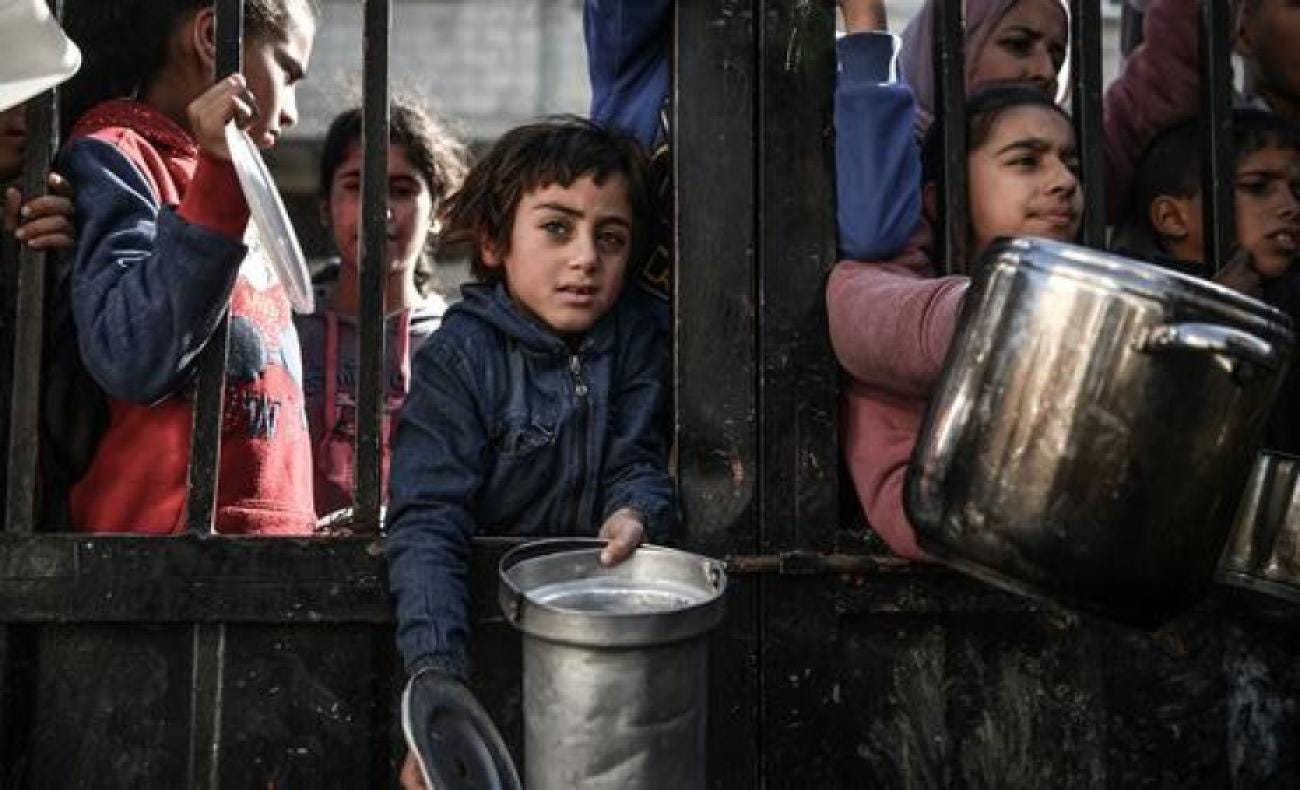
All three of Gaza’s children’s hospitals were forced to shut in the first two months of the war, and newborn care capacity was cut by half. Approximately 2,500 infants were denied care. UNICEF described newborns who froze to death as victims of preventable causes.
Preventable is an unusually brutal word when used correctly. It means the deaths did not result from the mysterious momentum of war. It means there were identifiable measures that would have kept these children alive, and those measures were not taken.
By August 2025, after 22 months of warnings, the Integrated Food Security Phase Classification confirmed famine in Gaza Governorate at Phase 5, the highest category on its scale. The WHO said more than half a million people were trapped in conditions of starvation, destitution, and preventable death. The famine review found the classification plausible for the period between July 1 and August 15, 2025, and projected its expansion.
These are technical formulations, but their plain meaning is simple. Children died because food was withheld. Doctors watched illnesses become fatal for lack of calories. Hunger was not collateral to the war. It was one of the methods through which the war was conducted.
There is a habit in Western political language, especially in Washington, of treating atrocity as a matter of rhetorical threshold. Officials wait for the right word, as though the delay itself were a form of seriousness. They hesitate over war crime, crime against humanity, ethnic cleansing, genocide, implying that once the correct designation has finally been selected, some grave procedural door will open.
In practice, the opposite often happens. The naming arrives only after the political decision not to act has already been made. The word becomes not a trigger for consequence, but a memorial to its absence.
The Commission’s legal findings are blunt. It found, on reasonable grounds, extermination and willful killing, persecution and enforced disappearance, torture and inhuman treatment, sexual and gender-based violence against children, and starvation as a method of warfare. It concluded that the documented acts constitute genocide of the Palestinian group in Gaza.
The Commission’s June 2026 release said Israeli authorities and security forces had deliberately targeted Palestinian children, resulting in genocide, crimes against humanity, and war crimes in the Gaza Strip, along with war crimes in the West Bank. The chair, Srinivasan Muralidhar, said the deliberate targeting and killing of children was one of the key elements leading the Commission to conclude that genocidal intent existed.
This was not the first warning. In September 2025, UN investigators had already alleged that Israel’s actions in Gaza amounted to genocide, stating that there was intent to destroy Palestinians in Gaza and identifying four of the five acts prohibited under the Genocide Convention. By then, the International Court of Justice had already issued provisional measures. By then, mass death, starvation, and hospital destruction had been documented across the international system. By then, the architecture of impunity was complete.
That architecture matters more than any single government statement because it explains why evidence accumulates faster than consequence. Israel does not act alone in the legal and diplomatic world that permits these operations to continue. It acts within a protection system sustained above all by the United States and, to varying degrees, by major European states that have learned to separate the language of human rights from the practice of alliance management.
Arms transfers, veto protection, intelligence cooperation, selective invocations of the laws of war, and the permanent deferral of meaningful sanctions produce a situation in which international law can fully describe a crime without interrupting it. This is not a contradiction in the system. It is one of the system’s functions.
That is why the detention findings matter alongside the casualty figures. The Commission documents 1,655 Palestinian children detained, more than half of them held under administrative detention, without charge or trial. It records torture, starvation, and sexual violence in custody. A seventeen-year-old died in Megiddo prison in March 2025 after months of deliberate deprivation.
This is not an aberrant appendix to the bombing campaign. It belongs to the same governing logic. A state that claims security while suspending ordinary legal personhood for children is not failing to distinguish between combatant and civilian. It is reorganizing the category of who counts as civilian at all.
One of the quieter violences in documents like A/HRC/62/CRP.2 is the way they force the dead to pass through the grammar of administration in order to qualify for recognition. A child must become a datum. A starvation death must become a classification. A shattered nursery must become a healthcare-capacity loss.
The transformation is necessary because states and courts rarely act on grief alone. But something is also disclosed by the need for it. Powerful governments demand ever more evidence from the powerless, and ever less explanation from those who bomb them. The burden of proof falls downward.
The slides attached to the report understand this problem better than most official communications do. They are stripped nearly bare: white background, red numerals, black type, a sentence or two of context. “20,179 children killed.” “5,031 were under five.” “2,500 infants denied care.” “Famine. Confirmed.”
There is a certain moral confidence in such spare design. The creators know that ornament would only compete with the fact. They know also that fact, if presented cleanly enough, still carries a chance of breaking through the sediment of normalization that long wars produce.
Normalization is perhaps the central political achievement of the last two years. The destruction of Gaza has been conducted in full public view and then metabolized into the routines of diplomatic life. Leaders issue concern, call for restraint, repeat formulas about humanitarian access, and return to ordinary bargaining over energy, arms, elections, and coalition management.
Each new threshold crossed becomes the background against which the next one is judged. First mass civilian death. Then school strikes. Then hospital sieges. Then starvation. Then famine. Then the formal finding of genocide. At every stage, the novelty wears off before the conduct stops.
The result is a peculiar inversion of moral time. The people doing the documenting remain in emergency because the facts continue to arrive. The people with the power to interrupt events move into post-emergency almost immediately because strategic accommodation requires emotional distance. One group counts the dead faster. The other adjusts faster. That gap is where Gaza has lived.
There is a line on the final slide: “Read it. Then share it.” It has the cadence of social media, but underneath it sits an older and more desperate faith in publication itself, the belief that if a record becomes sufficiently undeniable it may yet force a rearrangement in the behavior of states.
Journalists depend on some version of that faith. So do commissions of inquiry. So do survivors who testify into cameras and to investigators, parents who carry medical files through checkpoints, and doctors who record the dimensions of a wound because they know that without measurement there will later be denial.
The difficulty is that the record is already undeniable. The world’s most authoritative institutions have described the siege, the child killings, the destruction of healthcare, the detention regime, and the famine in terms that would have seemed politically unthinkable when the war began. The remaining barrier is not factual uncertainty. It is the decision, by states with power, that enforcement against an ally is more dangerous to the existing order than the obliteration of a people inside that order’s line of sight.
This is where editorials often lose their nerve. They reach for uplift, for a summons to conscience, for the proposition that exposure naturally tends toward justice. The recent history of Gaza allows no such comfort. Exposure has been constant. Documentation has been immense. Legal characterization has advanced from warning to finding. None of it has stopped the machinery because the machinery is protected at a higher level than the victims are recognized.
The significance of A/HRC/62/CRP.2, then, is not that it tells the world something new. It is that it closes off escape routes. The report narrows the available language. It makes evasion more cumbersome. It forces governments, editors, universities, donors, and institutions that have spent two years taking shelter in ambiguity to operate in the aftermath of a formal record that is specific, cross-referenced, and devastatingly plain.
It does not create the truth. It fixes it in place.
What remains after that is not a debate over facts. It is a ledger of choices. Who armed the state being investigated. Who blocked resolutions. Who treated famine warnings as diplomatic weather. Who insisted on evidentiary perfection from children under rubble while extending strategic patience to those who put them there.
Those questions are no longer future questions. They are present-tense facts arranged in institutional form.
The report will circulate. Governments will reject it or welcome it according to alignment. Newsrooms will excerpt its harshest lines and then move on to the next crisis. Think tanks will host panels on the erosion of the rules-based order, often sponsored by states participating in its erosion. The Commission’s annexes will remain online. The families of the dead will remain where they are.
And the most important sentence in the whole affair will stay the least bureaucratic one.


