


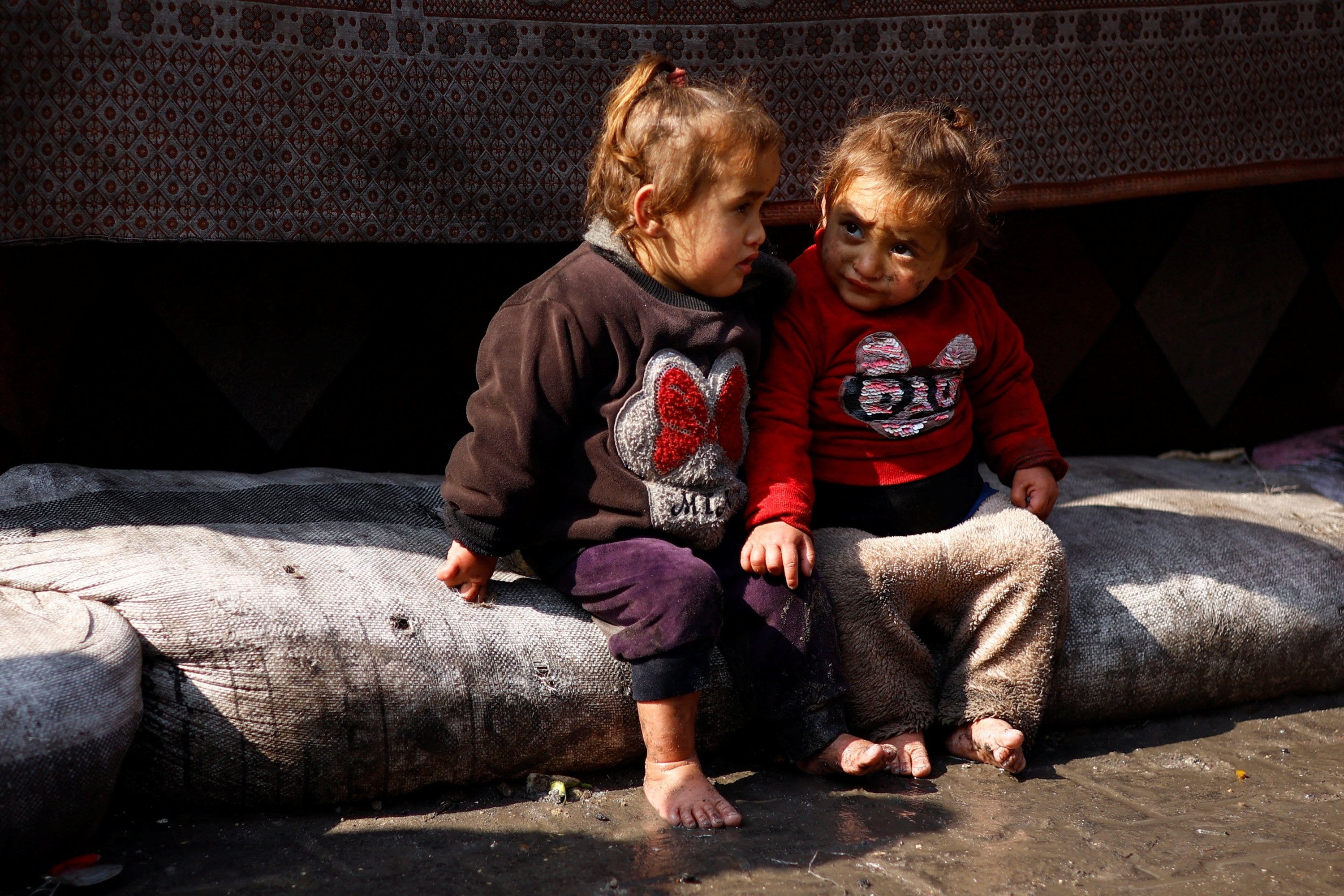
Suleiman al-Najjar had gone to the hospital for an injection when the bomb hit his family’s house in Deir al-Balah on October 10, 2023. By the time he returned, his wife Susanne and four of their children were dead. Safa was seventeen months old. Yazan was fourteen. Their daughter Farah and son Nadim were young adults; three neighbors, including seven-year-old Jana al-A’awar, were also killed. Amnesty International’s investigators photographed fragments in the rubble and identified a U.S.-made Boeing guidance kit. The bomb it guided likely weighed two thousand pounds. Suleiman’s errand to treat his kidney pain had saved his life, and the American-made parts had helped deliver the weapon that ended theirs.
Suleiman ran a car sales and repair shop. After the strike, he and his two surviving sons lived in a tent beside the ruins of their house. He had gone for medicine; his children had been at home. The photographs of the bomb fragments and the satellite images connect what happened to his family with a weapon manufactured in the United States, and with the American decisions that kept such weapons available to Israel. That is the connection people ask me to set aside when they suggest I should concentrate on problems closer to home.
PLEASE DONATE TO THE PALESTINIAN CHILDREN’S FUND.
Someone will eventually ask me why Palestine takes up so much of my political attention. The question usually comes from a decent person who cares about housing, health care, abortion rights, the next election, or the frightening ease with which an American president can turn an agency against its own citizens. Why spend so much energy on a place thousands of miles away when there is so much to repair here? I understand the exhaustion behind it. I cannot accept the geography behind it.
A child killed at home by a bomb fitted with an American guidance kit is not a distraction from the politics of the country that supplies Israel with arms, shields it in international forums, and asks its own people to regard the results as an unfortunate complication of an indispensable alliance.
There is another reason the question stays with me, and it has less to do with the distance between New York and Gaza than with the distance between what we were told and what we watched. Americans were taught to regard the United States as a guardian of civilian life, even when its methods were harsh and its allies imperfect. We watched our government defend an Israeli campaign that killed children on a scale no press briefing could explain away. Millions learned something about power from that spectacle. The learning brought no benefit to the children who died, and I refuse the consoling thought that their deaths were necessary to bring the rest of us to our senses. We were late. They paid for our lateness.
The children inside the count
UNICEF’s June 2026 accounting put the number of children reported killed in Gaza since October 2023 at at least 21,700. It recorded 45,000 injured children, including more than 11,000 with life-altering injuries. Those are reported figures, assembled amid destroyed hospitals, mass displacement, damaged communications and families who could not always reach a registrar. They are already unbearable without pretending that a statistical estimate can tell us the final number of children who died under the rubble, from untreated illness or in a tent after the fighting around them quieted.
Suleiman was not the only parent away from home when an American-equipped bomb struck Deir al-Balah. Bakir Abu Mu’eileq, an ear, nose and throat specialist, was working at a hospital on October 22, 2023, when an Israeli strike hit the adjoining homes of three brothers in his family. His wife Islam was killed with their children Do’a, sixteen; Ghanem, fourteen; Mohamed, twelve; and Lama, eleven. Twelve children died in that strike, bringing the number of children killed in the two investigated attacks to nineteen. Samaher Abu Mu’eileq had stepped out of one of the homes just before it was hit and survived with injuries. Amnesty’s investigators identified another Boeing-made JDAM guidance kit among the fragments. They found no indication of a military target in either of the two Deir al-Balah homes they investigated and reported no warning to the families before the strikes.
Bakir asked Amnesty what future his surviving daughters could have after the loss of their mother and four siblings. He had been treating patients at the hospital when the strike took place. The children were part of a household with siblings, a doctor father and relatives who had been sitting together moments before the strike. Their lives should not disappear into the phrase twelve children any more than the stamped metal from the wreckage should disappear into a general statement that America supports Israel.
The figures also need to be read as lives interrupted rather than converted into a scale of shock. A child who survives with a lost limb needs surgery, rehabilitation, an accessible home and years of care. A child who escapes an air strike can still be forced to drink unsafe water, sleep in a shelter that leaks, or miss the schooling on which an adult life depends. More than 1.3 million people were displaced in Gaza, UNICEF reported in its 2026 appeal, many of them more than once. The word displacement makes this sound orderly. For a child, it can mean learning which belongings can be carried at a run and then learning again when the next order comes.
Israel’s October 2025 ceasefire improved access for aid and helped reduce some immediate threats to food and nutrition, according to UNICEF. It did not produce safety. Fourteen-year-old Mohamed was walking home from a learning centre in Deir al-Balah when a drone strike killed him in October 2026. UNICEF reported that his school bag lay beside his body. A day later, six-year-old Misk was shot at home in al-Maghazi, and twelve-year-old Tamer was shot among the ruins of his home in Beit Lahia. By UNICEF’s count, 351 Palestinian children had been reported killed in Gaza since the ceasefire was announced. The make of the weapons used in these three killings has not been established in the material available to me. Their deaths belong in this account because an American-backed military campaign and the conditions it left behind did not end for them when diplomats adopted the language of peace.
Water tells the story more slowly. Human Rights Watch documented Israeli decisions that cut or restricted piped water, electricity, fuel and the materials needed to repair Gaza’s water system. Its investigators concluded in December 2024 that the deliberate deprivation of water amounted to acts of genocide and the crime against humanity of extermination. A damaged pipe does not look like a bomb crater on a phone screen, but the child who develops an infection from contaminated water belongs in any serious account of the war. In September 2026, the UN’s humanitarian office reported that 91 percent of assessed households in Gaza faced moderate to high water insecurity. The danger persisted while international diplomats discussed the next phase of recovery.
Schooling has also been reduced to an emergency service. UNESCO described an education system that had effectively collapsed, and humanitarian agencies have built temporary learning spaces in the places where classrooms once functioned. By September 2026, the UN’s Education Cluster counted roughly 495,000 preschool and school-aged children enrolled in learning spaces supported by aid organizations. That effort is immense, and it sits beside the fact that a child could be killed on the walk home from one of those spaces. When UNICEF mentioned Mohamed’s bag, it offered no literary symbol. It named the object he had carried to school. The war has demanded other kinds of work from children, too. An older sibling keeps a younger one close during evacuation. Children stand in queues for water and food while adults search for medicine, shelter, relatives or a signal on a telephone. I will not assign a fabricated last thought to any of them. The public record is full enough: parents trying to find treatment, teachers trying to gather pupils, health workers trying to keep patients alive without reliable supplies, and children learning the routines of danger before they have learned the ordinary freedoms of childhood.
What Washington supplied
The American part of this story can be followed through the marks left on the weapons. At the al-Najjar home, Amnesty photographed fragments bearing markings associated with Boeing’s JDAM kits; at the Abu Mu’eileq homes, it found another kit. The United States and Israel have a ten-year security-assistance memorandum covering 2019 through 2028. Its baseline is $3.8 billion a year in military assistance and missile-defense funding, subject to congressional appropriation. Washington added emergency support after October 2023. American officials openly described sending military financing, expediting transfers and sustaining Israel’s defensive capacity. Congress debated the totals in public, and the weapons moved through institutions that have names, budgets and legal authorities.
The evidence reaches beyond two family houses. Nidal Nofal, a nurse living on the ground floor of a building in Rafah, told Amnesty that relatives displaced from Khan Younis had come to stay with the family after Israeli instructions directed people south. An Israeli strike hit the building’s upper floors shortly before eleven at night on January 9, 2024. Eighteen civilians died, including ten children; one child died in a neighboring home that collapsed under the falling debris. Amnesty’s weapons experts identified fragments from a Boeing-made GBU-39 Small Diameter Bomb, a U.S. weapon, at the scene. Its smaller warhead did not save the children upstairs or the child next door. Israel did not give Amnesty an explanation for that strike when the organization published its findings.
Subhi Abu Radwan was awake downstairs when another Israeli aircraft bomb struck his family’s home in Rafah that April. Six of his grandchildren, a son, a daughter and a daughter-in-law were killed, while other relatives were injured. Amnesty identified the bomb as an Israeli-made MPR 500 and found a code on its guidance package indicating that at least one component came from AeroAntenna, a California defense contractor. The distinction between the Israeli bomb and its American-made component is worth keeping precise. The six children killed in that house were not killed by a bomb made entirely in the United States, and an American manufacturer’s part was present in the system that guided it into their home.
These investigations do not identify the manufacturer of every weapon used in Gaza, nor can a fragment tell us who selected a target. They establish something more concrete than a general association between Washington and Israel: in several investigated strikes on family homes, investigators recovered U.S.-made weapons or guidance components, and children died there. A government that can condition assistance, inspect its use, suspend a transfer or demand compliance with law bears responsibility for the choices it makes about those powers. When it keeps providing equipment after repeated evidence of civilian harm, the decision is active. No one has to discover a secret agreement between a lobbyist and a senator to understand it.
The money has another domestic life. Defense appropriations pay American manufacturers, replenish Pentagon stocks and sustain constituencies around production lines and military facilities. Canceling a weapons shipment would not automatically fund a particular clinic or rent program, but these appropriations show which demands Congress can meet quickly when its leaders choose to. A family waiting months for affordable housing hears that resources are scarce; a military supplemental arrives with urgency, floor time and a bipartisan majority. The contrast is a matter of public priorities, not a fantasy about moving cash between two household envelopes.
President Joe Biden’s administration made the choice especially plain because it said it was worried about civilian deaths while continuing to arm Israel. In February 2024, the United States vetoed a Security Council resolution demanding an immediate humanitarian ceasefire. Washington had vetoed another ceasefire resolution the previous December. Diplomats offered objections to the wording and defended Israel’s security. In Gaza, the people whose lives depended on a cessation of fire heard those distinctions while the bombardment continued. The Biden administration’s language of concern could not interrupt the aircraft or open a crossing by itself, and its refusal to use the means available to it became part of the policy.
The subsequent Trump administration inherited a military relationship with deep roots and made its own choices within it. Blaming one president, one party or one electoral cycle lets the institutional bargain escape inspection. A child born in Gaza during these years did not have the luxury of distinguishing a Democratic shipment from a Republican one. They encountered the aircraft, the restricted crossing, the damaged water line and the official promise that civilians must be protected. Washington wrote that promise with one hand and signed the procurement paperwork with the other.
Israel’s government claims that its operations answer the Hamas-led attacks of October 7, 2023, in which civilians were killed and hostages were taken. Those crimes need no euphemism. They also cannot confer a license to starve a civilian population or treat its children as expendable. The laws of war impose duties on the side using force precisely when it insists that its cause is urgent and just. American leaders routinely invoke those duties against adversaries. Their willingness to dilute them for an ally has taught a generation how selective their moral language can be.
The law and its exceptions
South Africa brought its case against Israel under the Genocide Convention to the International Court of Justice. In January 2024, the court found that the rights it was asked to protect were plausible and ordered provisional measures. It did not issue a final finding that Israel had committed genocide. That legal distinction matters, even to those of us who believe the word genocide describes what has happened. Amnesty International reached that conclusion in its own investigation in December 2024; Human Rights Watch found acts of genocide in Israel’s deprivation of water and said the broader conduct might meet the crime’s threshold. An international court will decide the case before it on its own timetable. Governments meanwhile retain their duty to prevent genocide and to stop aiding violations of humanitarian law. They cannot use the absence of a final judgment as permission to ignore the evidence in front of them.
The International Criminal Court’s November 2024 warrants against Benjamin Netanyahu and former defense minister Yoav Gallant were based on judges’ finding of reasonable grounds to believe they bore responsibility for war crimes and crimes against humanity, including using starvation as a method of warfare. An arrest warrant is not a conviction. It is also not a casual accusation from a campus protester. When politicians who once treated the court as an important forum for accountability threatened it over Israel, they taught the world a sharper lesson than any protest slogan could have delivered: the authority of international law is welcome until it approaches an ally.
Many of the same officials had defended international investigations after Russia invaded Ukraine. They were right to condemn attacks on civilians and civilian infrastructure there. That position should have made them more rigorous about Gaza. Instead, the legal vocabulary they had used with confidence became tentative, procedural or absent when Palestinian families asked for its protection. The hypocrisy was visible to people in countries that have spent decades hearing Western lectures about rules. It was visible, too, to Americans who had believed the rules were intended to be general.
The institutions did not all fail in the same way. UN aid workers continued to document the damage and try to reach families. Palestinian journalists kept reporting under extraordinary danger, often without the independent access foreign correspondents expected for themselves. Human rights investigators assembled evidence in the face of denial and obstruction. The failure lay with governments that treated those records as material for a statement rather than grounds for changing their conduct. A person can praise an aid worker’s courage at a podium and then vote for the policy that makes the worker’s next delivery perilous.
That is why the charge of genocide cannot be reduced to an exercise in vocabulary. The argument concerns killing, serious bodily harm and conditions of life imposed on a protected group, along with the question of intent. It requires evidence and precision, both of which Palestinian and international investigators have supplied. Calling the case controversial does not make the dead children disappear. Neither does using the strongest available word relieve any writer of the duty to say who found what, under which standard, and what remains for a court to decide.
A political cost that can still be evaded
Palestinians and their supporters had challenged the occupation long before the current war. It would insult their work to say Western audiences discovered the issue through a phone screen in 2023. What changed was the scale and duration of the evidence reaching people who had previously found it easy to look elsewhere. Families posted names, photographs and pleas for help. Doctors described the patients arriving at hospitals that were themselves under attack. Journalists documented destruction from streets foreign reporters could not freely enter. The machinery of explanation that once kept the occupation distant had to work against a continuous account from the people living through it.
The change in American opinion is measurable, though no poll can tell us exactly what moved each respondent. Pew Research Center found in March 2026 that 60 percent of American adults viewed Israel unfavorably, up from 53 percent a year earlier. In the same survey, 59 percent expressed little or no confidence in Netanyahu to do the right thing in world affairs. Gallup’s 2026 survey found that Americans who sympathized more with Palestinians were no longer outnumbered by those who sympathized more with Israelis, a reversal of a long-standing advantage in its measurements. These surveys were taken amid other events, including the Iran war, and they cannot isolate Gaza as a single cause. The images, testimony, organizing and policy arguments surrounding Gaza are nevertheless part of the political world in which those opinions changed.
An unfavorable poll number is not an arms embargo. American politicians can hear their younger constituents reject an unconditional alliance and still take the meeting, accept the campaign support, approve the appropriation and describe their own conduct as complicated. Pro-Israel organizations retain considerable money and access; a candidate who criticizes military aid can still face a heavily financed primary. The claim that Israel has become wholly untouchable in Western political life has begun to collapse, but the institutions that sustain American support remain. A reputation can deteriorate faster than a weapons pipeline can be shut down. That uneven change is visible inside elections. Candidates who have argued for Palestinian rights have won important races, and other candidates have been punished for the same position. No single race proves that an entire lobby has lost its power, any more than an outside group’s spending proves it bought the winner. What the losses and victories together show is that support for Palestinian freedom can no longer be assumed to end a career. Some voters have forced an opening through which politicians can speak more honestly. The opening exists because Palestinian families kept telling the truth about what was happening to them, even as more families were destroyed.
There is an ugly temptation here. Western observers may congratulate themselves for becoming enlightened, as though a new poll and a braver speech redeemed the deaths that made indifference harder. I want no part of that exchange.
Palestinian children were not born to furnish the rest of the world with a political education. Mohamed was on his way home from a lesson. Misk was at home. Tamer was among the ruins of his own house. They had lives that belonged to them, and the fact that their deaths changed somebody’s mind measures the poverty of that person’s earlier attention.
The distance between Gaza and home
Back in the United States, the dispute over Palestine has already changed the terms on which people can protest, study and remain in the country. Mahmoud Khalil, a Palestinian graduate of Columbia University who had participated in negotiations over the campus protests, was arrested by federal immigration agents in March 2025. His lawyers challenged his detention as punishment for protected speech. The government denied that account. Whatever the final disposition of his case, the spectacle of an immigration arrest tied to a prominent protest organizer carried a message to other students, especially those whose status depended on a visa or green card: speaking about Gaza could place their future here at risk.
University administrators called police onto campuses during the 2024 encampments, and students faced arrests or discipline over protests against their institutions’ ties to Israel. Some demonstrations involved misconduct that deserved an individual response; that fact does not turn every student demand for divestment into a public-safety emergency. The broad official reaction deserves attention because it joined donor pressure, university governance, policing and immigration enforcement around the defense of a foreign-policy position. Those are domestic institutions. Their conduct bears directly on the civil liberties Americans say they are trying to protect at home.
Criticism of the Israeli state must also be kept distinct from hatred of Jewish people. Antisemitic threats and attacks are real and must be confronted. So is the political use of that danger to silence Palestinians, Jewish dissenters and others who oppose occupation or military aid. Governments and universities make the problem worse when they treat criticism of state policy as presumptively suspect; they leave genuine bigotry harder to identify and the people exposed to it less well served. A student should be able to condemn an Israeli military operation, and a Jewish student should be able to attend class without harassment. Neither freedom requires us to abandon the other.
The domestic connection reaches beyond protests. The same Congress that can postpone an ordinary family’s needs can approve another military allocation. News organizations that scrutinize a rival state’s battlefield claims can grow strangely credulous around an ally’s. University trustees who praise open inquiry can shut it down when a wealthy constituency objects. These are decisions made by people with offices in American cities. Gaza did not invent the habits; the war gave us a prolonged view of how they work under pressure.
Aimé Césaire wrote about the violence of colonial rule returning to shape the politics of the colonizing society. His warning does not mean that every surveillance program or police tactic used in America was designed in Palestine, a claim that would need evidence of its own. It means that a society accustomed to granting exceptions abroad will find it easier to grant them at home. We have watched that movement in the language used against protesters, in the willingness to threaten a student’s residency over political speech, and in the insistence that certain harms are too strategically necessary to examine closely. Foreign policy has entered the university gate and the immigration courtroom. It was never confined to a map overseas.
The question about domestic priorities often assumes there is only so much concern to go around. My concern for a child in Gaza takes nothing from a tenant facing eviction in Brooklyn. It asks more of the same political institutions that affect both. A government able to move money and diplomatic protection for a military campaign can be pressed to explain why it will not move with equal urgency to preserve housing or care. An elected official who says rights are universal can be made to apply that claim when the person demanding protection is Palestinian. The test strengthens domestic politics because it refuses to let our leaders maintain one account of law for people nearby and another for people whose deaths arrive on our phones.
What remembering requires
The child death toll is now large enough for officials to speak of it as an abstraction, but abstraction is a political service to those who made the decisions. UNICEF’s figure of at least 21,700 children killed by the end of June 2026 comes from reported deaths; it is no substitute for the names and histories of those children, and it cannot describe the years denied to those who survived with grave injuries. The public often knows a child only at the instant of death because that was the instant powerful institutions finally obliged us to look. Remembering should resist that theft of a life before it becomes another item in the briefing.
It should also change what we ask for. The demand is to stop attacks on civilians, allow reliable humanitarian access, repair water and health systems, protect children in schools and shelters, and end American assistance that enables violations. It is to investigate alleged crimes and pursue accountability under standards that apply to allies as well as adversaries. It is to refuse the political arrangement in which an official can deplore a child’s death in the morning and approve the next transfer by afternoon. These demands can be evaluated in decisions about arms, crossings, budgets and law, long after a moving speech has been forgotten.
My acquaintances are right that American democracy is fraying. That is one reason I keep talking about Palestine. The damage becomes easier to understand when we watch officials defend a distinction between the rights of children they call universal and the lives of children they treat as negotiable. Gaza has made that distinction visible to millions who once accepted the language of American leadership without asking what it covered. The clarity belongs to us only as an obligation, because the children whose deaths brought it into our homes were entitled to live without teaching us anything. Mohamed should have carried his bag home.