Part II: Christian Zionism: From the Bible Conference to Truman’s Desk (1875 to 1948)
Part 2 of 6
On a summer evening in 1876, several dozen Protestant ministers and Bible teachers gathered on the shore of Lake Ontario, in the Ontario town of Niagara-on-the-Lake, for a gathering that had begun the previous year in Swampscott, Massachusetts, and was now finding its permanent venue. They called it a Bible conference: a week or more of sustained scripture exposition, with invited speakers working through texts each morning and evening, particular attention paid to prophecy, the Second Coming, and what God intended for the Jewish people at the end of history. The attendees were not eccentrics or fringe sectarians. They were ordained ministers from Congregationalist, Presbyterian, Baptist, and independent churches across the northeastern United States and Canada, educated men who had read their Darby and found in the dispensational framework a coherent, intellectually satisfying answer to the prophetic questions their seminaries had largely evaded.
The Niagara Bible Conference met annually for nearly thirty years. It drew, over those three decades, virtually every significant figure in the formation of American fundamentalism. It produced the famous “Fourteen Points” of fundamentalist doctrine. It carried the dispensationalist framework from a British nonconformist curiosity into the bloodstream of American Protestant evangelical culture. And it built the relational network, the shared vocabulary, the recognised authorities, and the cross-denominational fellowship of the theologically like-minded, that would sustain the movement through the cultural disasters of the following century.
Dwight Moody and the Industrial Infrastructure
Dwight Lyman Moody was born in 1837 in Northfield, Massachusetts, converted to evangelical faith in Boston in 1855 as a shoe salesman, and became by the 1870s the most influential revivalist in the English-speaking world. His urban campaigns in Britain and the United States drew crowds in the tens of thousands. His methods were practical, unsentimental, and highly organised. He did not theorise about institutional reform. He built institutions.
The Moody Bible Institute, founded in Chicago in 1886 as the Chicago Evangelization Society before adopting its permanent name after Moody’s death in 1899, was the pivotal institution. Its founding curriculum embedded premillennial dispensationalism as doctrinal orthodoxy. Its graduates, pastors, evangelists, missionaries, and Bible teachers trained in intensive programmes designed to produce practical workers rather than academic theologians, carried the dispensational framework into churches and mission fields across the country and around the world. The institute’s publishing arm produced study materials, devotional literature, and eventually the Moody Monthly periodical, which reached hundreds of thousands of Protestant households with consistent dispensationalist biblical interpretation delivered in accessible, practical form.
The Moody model replicated. The Bible Institute of Los Angeles, founded in 1908 and later known as BIOLA, adopted the same framework. Prairie Bible Institute in Alberta. Gordon College in Massachusetts. Philadelphia College of Bible. By the early twentieth century, a network of Bible institutes constituted a shadow seminary system, educating ministers outside the mainline denominational seminaries and producing clergy who shared a coherent dispensationalist theology, a network of personal relationships, and a set of interpretive commitments that were, in the institutions that produced them, simply the way serious Christians read scripture.
Dallas Theological Seminary, founded in 1924 by Lewis Sperry Chafer, became the movement’s academic apex. Chafer had been Scofield’s protege and produced the eight-volume “Systematic Theology” that formalised dispensationalism as a scholarly theological system. Dallas Seminary’s graduates included the scholars who revised the Scofield Reference Bible in 1967, Charles Ryrie who wrote the competing Ryrie Study Bible, and eventually Hal Lindsey, who graduated from Dallas with a degree in Greek New Testament in 1962 and spent the next decade working out how to translate the dispensational framework into a bestseller. Every pastor trained at Dallas, every student who absorbed the Chafer-Scofield framework, every church in which those graduates eventually preached: all of them were downstream of the Niagara conference network, the Moody institutional infrastructure, and the Oxford University Press study Bible that Darby’s system had produced.
The Fundamentalist-Modernist Fracture
American Protestantism broke decisively in the first decades of the twentieth century. The fault line ran between those who accepted the findings of higher biblical criticism, Darwinian evolutionary theory, and theological liberalism, and those who rejected them in favour of what came to be called the fundamentals: biblical inerrancy, the virgin birth, the physical resurrection, the substitutionary atonement, and the literal Second Coming. The conflict had been building since the 1870s and produced its defining public spectacle in the 1925 Scopes Trial in Dayton, Tennessee, where William Jennings Bryan, defending biblical creationism, was cross-examined by Clarence Darrow into apparent incoherence, while H. L. Mencken broadcast the proceedings to a national readership as a carnival of ignorance.
The cultural consequence was a retreat. Fundamentalism withdrew from mainline denominational structures, from elite universities, from mainstream media, from the cultural apparatus that produces public opinion in a modern society. The withdrawal was not total and not uniform. But the fundamentalist subculture that consolidated through the 1930s and 1940s was, to a significant degree, insulated from the moderating pressures of engagement with secular intellectual culture and mainline Protestant theology.
This insulation had a paradoxical consequence that secular observers consistently failed to anticipate: the subculture grew. Cut off from the major denominational networks that had historically defined American Protestant life, the Bible institute networks, independent churches, and para-church organisations of the fundamentalist world built their own institutions, their own magazines, their own publishers, their own radio stations. Within those institutions, dispensationalism hardened and deepened. There was no peer pressure toward accommodation. There was no academic culture that treated apocalyptic literalism as embarrassing. There was only the framework itself, refined by successive generations of ministers and teachers, transmitted to millions of lay people who had no reason to question it and every reason, within the self-reinforcing community that produced it, to hold it with conviction.
Charles Fuller’s “Old Fashioned Revival Hour,” broadcast nationally from the late 1930s, reached an estimated twenty million listeners weekly by 1942. The programming consistently carried dispensationalist themes: the imminence of the Second Coming, the unique prophetic role of the Jewish people, the significance of events in Palestine. This was mass-market dispensationalism, delivered free of charge to households across the country through a medium that the mainline denominations had not yet figured out how to use effectively. When Gallup published its first major survey of American religious belief in 1947, the results surprised secular observers: biblical literalism and belief in the imminent Second Coming were far more widespread than the educated class had assumed. They had been building, undisturbed, in the subculture that Mencken’s mockery had helped create by driving it underground.
The Balfour Declaration
On November 2, 1917, British Foreign Secretary Arthur James Balfour sent a letter to Lord Walter Rothschild, a leading figure in the British Jewish community and a Zionist, informing him that His Majesty’s Government viewed “with favour the establishment in Palestine of a national home for the Jewish people” and would “use their best endeavours to facilitate the achievement of this object.” The declaration was the product of interlocking pressures: Zionist diplomatic lobbying by Chaim Weizmann and Nahum Sokolow, British strategic calculations about securing Jewish support in the United States and preventing Germany from making a competing declaration, and the wider cultural climate that Shaftesbury’s Victorian campaign had done much to create.
For American evangelical and fundamentalist Protestants saturated in the dispensationalist framework, the Balfour Declaration was prophetic confirmation on the front pages of every newspaper. The mechanism that Scofield’s margins had described, a political vehicle for Jewish national restoration to the ancient homeland, had appeared, exactly on schedule, in the form of an official British government commitment. The prophetic programme was running. God was keeping his appointments.
When British forces under General Edmund Allenby captured Jerusalem from the Ottomans in December 1917, six weeks after the declaration, the evangelical response reached something close to eschatological intensity. Allenby dismounted from his horse and entered the Holy City on foot, a gesture of reverence widely reported and widely interpreted by evangelical commentators as a fulfilment of the verse in Zechariah 9:9 about a king entering Jerusalem in humility. The fundamentalist periodicals and Bible conference networks processed the events in Palestine as an accelerating prophetic sequence. The clock was running visibly, at speed.
The Holocaust and the Moral Convergence
The Holocaust complicated the politics of Christian Zionism in an unexpected way. The extermination of six million Jews in the heart of Christian Europe confronted mainstream Protestant theology with an indictment it could not answer through its normal channels. The replacement theology that dominated mainline Protestant interpretation, the reading in which the church had inherited Israel’s promises and Jewish particularity was a superseded category, had coexisted for sixteen centuries with an anti-Jewish cultural tradition that, however attenuated in its modern forms, had contributed to the atmosphere of contempt in which genocide became organisable. By 1945, the liberal Protestant establishment in the United States was confronting this legacy and responding with a shift toward active support for Jewish statehood, framed as Christian repentance and moral obligation.
This was not dispensationalist Christian Zionism. It drew on entirely different theological premises. But it produced, in the immediate postwar years, a convergence of evangelical and mainline Protestant pressure on the American political establishment toward the same political conclusion: the United States should support the establishment of a Jewish state in Palestine.
Harry Truman received this pressure from multiple directions simultaneously. Mainline Protestant leaders made the moral case. Zionist organisations made the political case. Jewish voters in key states were a relevant electoral consideration. And Truman himself brought a personal framework in which biblical narrative and personal obligation were intimately connected. He kept a copy of the Hebrew Bible on his desk. He had read his Old Testament with serious attention throughout his adult life. He identified, repeatedly and privately, with the figure of Cyrus, the Persian king who had issued the decree in 538 BCE allowing the Babylonian Jewish captives to return to their land and rebuild the temple. In his private diary and in conversations with associates, Truman expressed the conviction that he was being asked to play an analogous role in modern history.
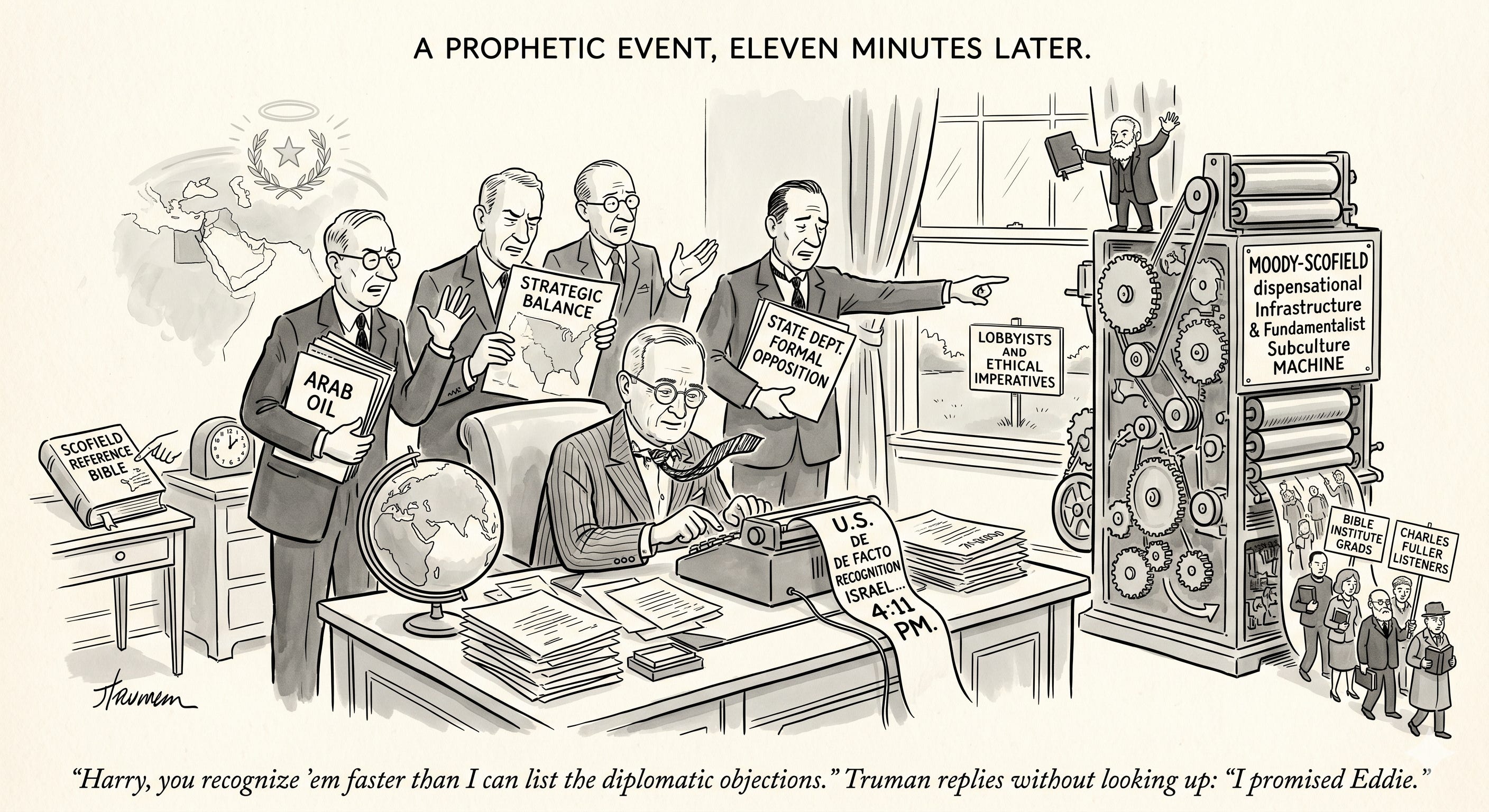
Eleven Minutes
At 4:00 p.m. Eastern time on Friday, May 14, 1948, David Ben-Gurion read the Israeli Declaration of Independence in Tel Aviv. The British Mandate over Palestine expired at midnight. At 4:11 p.m., eleven minutes after the declaration, the White House released a statement of US de facto recognition. The speed was deliberate and the decision was Truman’s alone, made against the formal recommendation of Secretary of State George Marshall, who told Truman to his face that if he recognised Israel and the Democrats subsequently lost the election, Marshall would vote Republican. The State Department’s professional diplomats were uniformly opposed. The Defence Department was concerned about Arab oil and the Middle East strategic balance. The Joint Chiefs had war-gamed the scenario and recommended against.
Truman overruled them all. He did it in eleven minutes because he wanted to be first, before the Soviet Union could extend recognition and claim the credit. But the decision itself had been forming over months, shaped by the combination of Zionist lobbying, mainline Protestant moral pressure, the counsel of his Jewish friends, including his old business partner Eddie Jacobson whose intervention at a critical moment in early 1948 has been extensively documented, and his own biblical self-understanding.
What Truman established on that Friday afternoon was not merely a diplomatic relationship with a new state. He established a precedent: that the American executive would extend political recognition to Israeli sovereignty, and eventually defend it, over the objections of its own professional foreign policy apparatus when sufficient political and moral pressure was applied. Every subsequent president has operated inside that precedent. The State Department has formally opposed, at various points, the recognition of Jerusalem as capital, the relocation of the embassy, the recognition of the Golan Heights, the effective endorsement of settlement permanence in occupied territory, and the withdrawal from the Iran nuclear agreement. Each of those decisions has eventually happened, over the department’s professional objections, when the combination of Israeli government lobbying, Jewish-American political pressure, and Christian Zionist electoral mobilisation produced sufficient political force. Truman was the proof of concept. The machine that would later generate that force at industrial scale was still being assembled.
The 1948 Inheritance
In the dispensationalist reading, the founding of Israel was not primarily a humanitarian response to the Holocaust or a product of Zionist diplomatic achievement. It was a prophetic event of the first order: the beginning of the formal restoration of the Jewish people to their ancient homeland, the starting gun for the sequence that would lead, through the years or decades ahead, to the rebuilding of the temple, the emergence of the Antichrist, the seven years of tribulation, the Battle of Armageddon, and the physical return of Christ to the Mount of Olives.
This reading had been available since 1909. After 1948, it had visible empirical confirmation. A Jewish state existed in the ancient land. The prophetic programme was manifestly advancing. Every pastor and Bible teacher who had been transmitting the dispensational framework through the Moody network and the Bible conference circuit had something to point to: this is what we told you was coming. The framework’s predictive credit soared. Its hold on the evangelical subculture deepened. And the political implications became, for the first time, not merely speculative but practical: the Jewish state in the ancient land needed American protection, and the theological framework that millions of American Protestants had absorbed gave them every reason to provide it.
The evangelical subculture did not yet have the organisational capacity to translate this conviction into systematic political pressure. That capacity would take another quarter century to develop. It would require a war, a bestselling paperback, and a politician from California who had read that paperback and was prepared to act on it.
Part III: The Six-Day War as prophetic event. Hal Lindsey and 35 million copies of the most politically consequential religious paperback of the twentieth century. Ronald Reagan’s genuine apocalyptic belief. The Moral Majority as the first modern Christian Zionist electoral machine. And George H.W. Bush’s 1991 confrontation with the lobby, the demonstration for every subsequent politician watching that the political cost of pressing Israel on settlements was real and would be collected.
References
George Marsden, Fundamentalism and American Culture (Oxford University Press, 1980)
Timothy P. Weber, On the Road to Armageddon: How Evangelicals Became Israel’s Best Friend (Baker Academic, 2004)
Matthew Avery Sutton, American Apocalypse: A History of Modern Evangelicalism (Harvard University Press, 2014)
Joel A. Carpenter, Revive Us Again: The Reawakening of American Fundamentalism (Oxford University Press, 1997)
James F. Findlay, Dwight L. Moody: American Evangelist, 1837-1899 (University of Chicago Press, 1969)
Lewis Sperry Chafer, Systematic Theology, 8 vols. (Dallas Seminary Press, 1947)
Michael J. Makovsky, Churchill’s Promised Land: Zionism and Statecraft (Yale University Press, 2007)
John Snetsinger, Truman, the Jewish Vote, and the Creation of Israel (Hoover Institution Press, 1974)
Stuart Eizenstat, President Carter: The White House Years (Thomas Dunne Books, 2018)
David Fromkin, A Peace to End All Peace: The Fall of the Ottoman Empire and the Creation of the Modern Middle East (Henry Holt, 1989)


