Part III: Christian Zionism: Armageddon in the White House (1967 to 1992)
Part 3 of 6
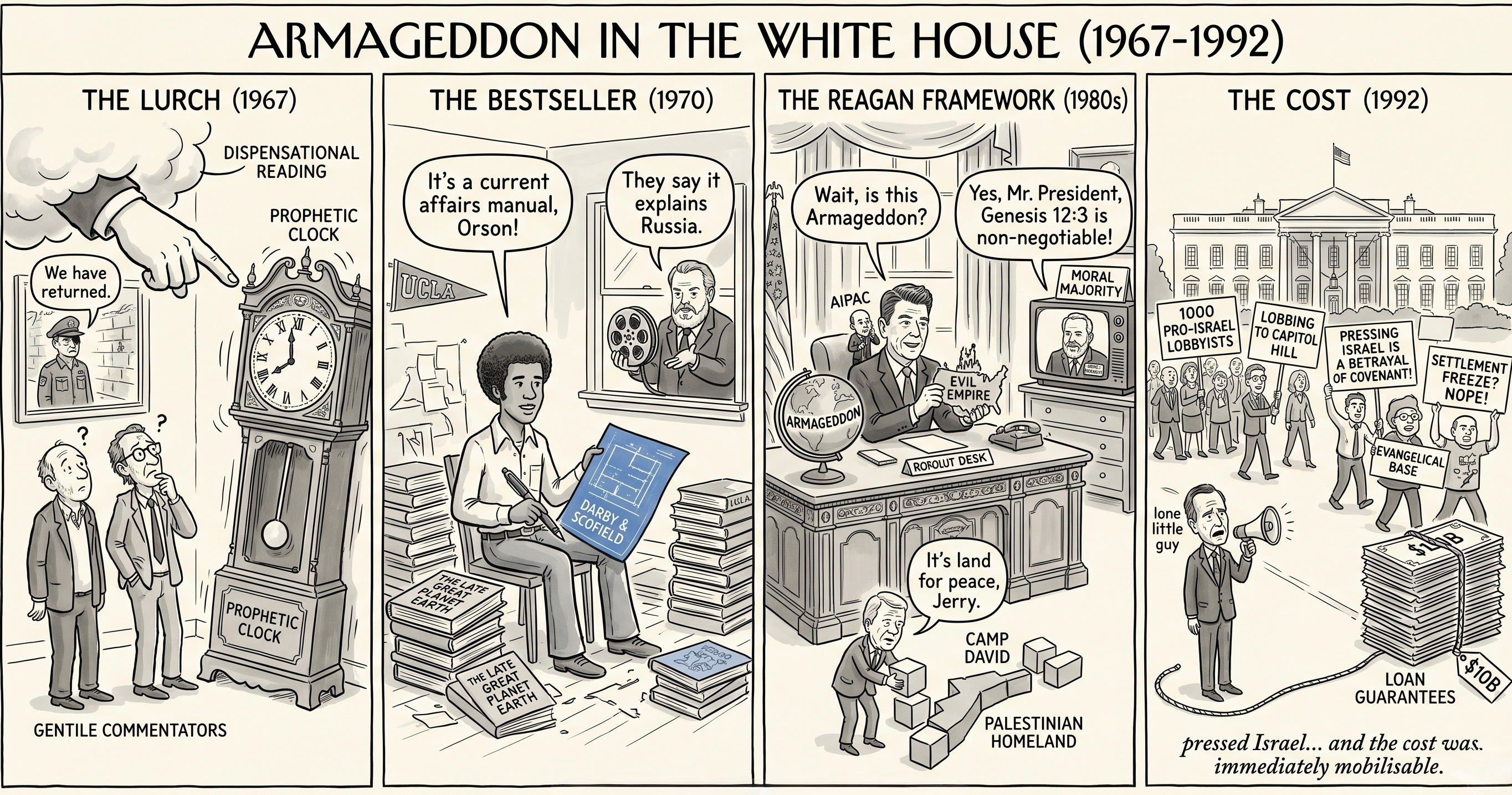
On June 7, 1967, Israeli paratroopers reached the Western Wall. The Old City of Jerusalem, divided since the armistice of 1949 and under Jordanian administration since, was now in Israeli hands. Defence Minister Moshe Dayan stood at the Wall and announced that Israel had returned to its holiest site and would never leave. Within hours, the reverberations were being processed in fundamentalist and evangelical churches across the United States in terms that secular commentators did not have the framework to understand.
The Six-Day War had given Israel not just a military victory and a territorial gain. In the dispensationalist reading, which by 1967 had been transmitted through sixty years of Scofield Bibles, Bible institute curricula, and radio broadcasts to tens of millions of American Protestants, it had delivered a prophetic milestone. Jerusalem had been in Gentile hands since 70 CE. Now it was not. The sequence in the Gospel of Luke that described Jerusalem being trampled by the Gentiles “until the times of the Gentiles are fulfilled” appeared, in this reading, to have just moved forward. The prophetic clock had not merely ticked. It had lurched.
Hal Lindsey was teaching at UCLA when Jerusalem fell. He had graduated from Dallas Theological Seminary in 1962, spent several years with Campus Crusade for Christ working with students, and was now running a teaching ministry in a house near the university called the Jesus Christ Light and Power Company, developing the lecture notes that would become his book. He finished it in 1970.
35 Million Copies
“The Late Great Planet Earth” was published in 1970 by Zondervan, a Grand Rapids evangelical house, and sold half a million copies through Christian bookstores before Bantam Books recognised what had happened and bought the rights for a commercial paperback edition. Bantam redesigned the cover to resemble Erich von Däniken’s “Chariots of the Gods,” alien mysteries and hidden forces and ancient texts unlocking contemporary reality, and placed it in newsstands, airport bookstores, and supermarket checkout lines. It became the bestselling nonfiction book of the 1970s according to the New York Times. Twenty-eight million copies were in circulation by 1990. Thirty-five million by 1999. It was translated into more than fifty languages. Orson Welles narrated the film adaptation.
The book’s argument was Darby’s argument and Scofield’s argument, rewritten in the register of a current affairs analysis. Lindsey identified the founding of Israel in 1948 and the capture of Jerusalem in 1967 as the two anchoring prophetic events of the modern era. A biblical generation was forty years. Forty years from 1948 placed the Second Coming around 1988. He qualified the estimate, giving himself room, but the implication was clear and his readers absorbed it clearly. The Soviet Union was “Gog,” the northern power described in Ezekiel 38 that would lead a coalition against Israel in the final war. China was the “kings of the east,” the eastern army of Revelation 16, whose two-hundred-million-man force would march across the dried-up Euphrates. The European Common Market was the revived Roman Empire, the ten-nation confederation of Daniel’s vision from which the Antichrist would emerge. The United Nations was either the Antichrist’s instrument or irrelevant. Arab states were among the nations arrayed against Israel. The United States did not feature prominently in the end-times narrative, which Lindsey attributed to its decline or destruction before the decisive events.
This last point deserves attention. In the dispensationalist framework, America’s absence from the prophetic script was not a minor detail. It was a structural element that generated political implications of its own. If America was not a player in the final events, its primary significance in the end times was as Israel’s protector in the period leading up to them. An America that protected Israel was an America fulfilling its prophetic function. An America that pressured Israel, that allowed international institutions to constrain it, that treated Palestinian claims as legally and morally equivalent to Israeli claims: this was an America that had abandoned its function and invited the kind of divine judgment that the absence of a United States from the prophetic script might explain.
Lindsey spent the 1970s doing more than writing bestsellers. He briefed Pentagon staff. He addressed military intelligence committees. He spoke at the American Air War College. He claimed, not implausibly given his documented access, to have consulted for the Israeli government. Religion historian Crawford Gribben documents that “The Late Great Planet Earth” exercised direct influence inside the Reagan White House, reaching cabinet members including Attorney General Ed Meese. Whether Reagan himself read the book is less important than the fact that the framework it popularised was ambient in the political culture he inhabited, and he was, by every indication, already disposed toward it before Lindsey put it in paperback.
Reagan and the Genuine Belief
Ronald Reagan had been thinking about Armageddon for years before the 1980 campaign. In a 1971 phone call with Billy Graham, he connected current events in Libya to the prophecies in Ezekiel about the coalition that would gather against Israel in the last days. He raised the subject with California Assembly Speaker Jesse Unruh in the same year. He mentioned it to Israeli Ambassador Yitzhak Rabin in a private conversation. He discussed it with television producer Doug Wead. These were not campaign performances for evangelical audiences. They were private conversations, recorded in memoirs and correspondence, reflecting a sustained and apparently sincere conviction that he was living in the final chapter of history.
Reagan’s personal eschatology was not systematically dispensationalist in the Darby-Scofield sense. It was looser, more intuitive, and he would not have been able to give a technical account of the tribulation sequence or the rapture doctrine. But he shared the core dispensationalist conviction: the Bible prophesied a final confrontation centred on Israel, that confrontation was approaching, and the United States’ relationship to Israel was not merely a strategic interest but a theologically significant alignment.
When he addressed the National Association of Evangelicals in Orlando in March 1983 and called the Soviet Union “an evil empire” and “the focus of evil in the modern world,” he was translating this framework into political language. When, in a dinner conversation with AIPAC’s Thomas Dine in October 1983, he said, “You know, I turn back to your ancient prophets in the Old Testament and the signs foretelling Armageddon, and I find myself wondering if we’re the generation that’s going to see that come about,” he was expressing, in an off-the-record context, the same conviction he had been expressing privately for more than a decade.
These were not isolated moments of rhetorical excess. They were expressions of a worldview that shaped his administration’s approach to Israel with notable consistency. Reagan deepened military and intelligence cooperation with Israel to levels his predecessors had not approached. He backed Israel’s 1982 invasion of Lebanon, sustained by the logic that Israeli security was a non-negotiable priority, even through the siege of Beirut and into the Sabra and Shatila massacre of September 1982, when Israeli-allied Lebanese Phalangist militias killed hundreds of Palestinian civilians in refugee camps that Israeli forces were positioned to observe and could have intervened to protect. He consistently shielded Israel in the UN Security Council. He presided over a transformation of the US-Israel relationship from a strategic partnership with recognisable tension points into something closer to an unconditional alliance.
Jerry Falwell celebrated this. The Moral Majority, which Falwell had founded in June 1979 in Lynchburg, Virginia, had been the crucial organisational intermediary between the dispensationalist subculture and the Republican electoral coalition. Falwell’s “Old Time Gospel Hour” was broadcast on more than three hundred television stations and five hundred radio stations. His voter registration drives in evangelical churches through 1979 and 1980 were among the most effective grassroots mobilisations in recent American electoral history. He met with Reagan before the election, framed Carter’s Middle East policy as a failure of faith and a betrayal of Israel, and directed his audience’s loyalties accordingly.
Jimmy Carter and the Evangelical Contradiction
Jimmy Carter presented Christian Zionism with its first serious paradox inside the White House. Carter was demonstrably more personally religious than most of his predecessors. He taught Sunday school, read his Bible daily, spoke openly of his born-again conversion, and regularly used the language of faith to describe his public obligations. He was also, by professional formation and personal conviction, committed to an international law framework that brought him into direct conflict with the political implications of the dispensationalist worldview.
The Camp David Accords of September 1978 were Carter’s greatest achievement. Thirteen days of intensive negotiations at the presidential retreat in Maryland produced two framework agreements: one between Egypt and Israel that would lead to the 1979 peace treaty and Israel’s return of the Sinai Peninsula, and one outlining a framework for Palestinian autonomy and a path toward resolving the status of the West Bank and Gaza. Carter considered them a step toward comprehensive Middle East peace. The dispensationalist evangelical world considered them a theological problem.
Land-for-peace was, in the dispensationalist framework, a category error. God had not promised the Sinai to Abraham, so the treaty with Egypt raised fewer theological alarms. But any framework implying Palestinian autonomy in the West Bank, in Judea and Samaria, in the biblical heartland, was a different matter. Carter spoke of a Palestinian homeland. He described Israeli settlement construction as an obstacle to peace and as contrary to international law. He treated Palestinian rights as a subject worthy of American diplomatic attention.
For Falwell, Pat Robertson, and the emerging network of evangelical political organisers, this was not merely a foreign policy disagreement. It was evidence that Carter had misread the covenant. His personal faith, which the evangelical community had initially welcomed, became an aggravating factor: this was a man who knew the scriptures and had still arrived at the wrong political conclusions. The betrayal, in their reading, was comprehensive.
Carter’s domestic policy adviser Stuart Eizenstat documented that pro-Israel donors redirected support during the 1980 primary campaign, helping finance Ted Kennedy’s challenge from within the Democratic Party. When Carter lost to Ronald Reagan in November 1980, the evangelical right’s role in that defeat was not the headline; stagflation, the Iran hostage crisis, and a sense of national drift were the dominant explanations. But Falwell’s Moral Majority had spent the preceding months systematically framing Carter’s Middle East policy as a failure of faith.
The lesson Carter taught the political class was more durable than any specific decision he made. A Democratic president with genuine evangelical faith, who treated the Middle East as a subject for negotiation and international law, would still face organised evangelical opposition that framed his positions in theological terms. Personal belief was no protection. Policy was what mattered, and the policy had to conform to the prophetic framework.
The Moral Majority as Delivery Mechanism
The Moral Majority is usually discussed in the context of social conservatism: abortion, school prayer, feminism, gay rights. This framing is accurate as far as it goes but it misses the structural role that Israel played in Falwell’s political architecture.
The connection was not accidental and not merely rhetorical. In the dispensationalist framework, America’s moral condition and America’s treatment of Israel were linked by the logic of Genesis 12:3: nations that blessed Israel would be blessed, and nations that cursed it would be cursed. The sexual revolution, the Supreme Court’s removal of prayer from public schools, the Roe v. Wade decision in 1973, the feminist challenge to traditional family structures: these were not unrelated developments. They were symptoms of a national turn away from God, of which the political willingness to pressure Israel was both cause and effect. A nation in covenant obedience would support Israel. A nation in covenant disobedience would elect Jimmy Carter and produce the Camp David framework that implied Palestinian autonomy over biblical land.
This logic made Israel not merely one issue among many in Falwell’s political programme but a binding element connecting the various components of the conservative evangelical coalition. Supporting Israel was not separable from opposing abortion. Both were expressions of faithfulness to the covenant. Both were tests that a Christian nation, and a Christian politician, could pass or fail.
Reagan passed both tests convincingly. His administration welcomed evangelical leaders to the White House with a frequency and a warmth that signalled their permanent place in the Republican coalition. The implicit contract was clear and did not need to be written down: deliver votes and mobilisation, receive policy alignment with Israel’s most expansionist positions and symbolic affirmation of the cultural conservatism the coalition required.
George H.W. Bush: The Cost Established
George H.W. Bush did not share Reagan’s eschatological convictions and made no pretence of doing so. His Episcopalian faith was of the reserved establishment type that evangelical America found cold. He had no personal rapport with Falwell’s network and no theological frame that made Israeli settlement expansion a matter of divine covenant obligation. What he had was a professional assessment, grounded in decades of foreign policy experience, that Israeli settlement construction in the occupied territories was a strategic liability, a violation of the Fourth Geneva Convention, and a primary obstacle to any negotiated resolution of the Israeli-Palestinian conflict.
In September 1991, Bush asked Congress to delay consideration of $10 billion in loan guarantees for Israel by 120 days, linking their eventual approval to a freeze in settlement construction in the West Bank and Gaza. He did this publicly, before the press corps, and in doing so touched the third rail of American Israel politics with both hands. He described himself at the press conference as “one lone little guy” against a thousand pro-Israel lobbyists descending on Capitol Hill. The self-description was accurate.
AIPAC activated its congressional network with full institutional force. Letters and phone calls flooded congressional offices. Pro-Israel donors began assessing their options for the 1992 election cycle and several began redirecting support toward Bill Clinton’s emerging campaign. Within the evangelical world, the confrontation was read through the Scofield-Falwell lens: a president who conditioned aid on a settlement freeze had placed himself, however inadvertently, on the wrong side of the covenant.
Bush lost in November 1992. The economy was the dominant factor, with a recession underway and a credible third-party candidacy from Ross Perot fracturing the Republican base. The Israel confrontation was not the primary cause of his defeat. But the episode taught a lesson that every subsequent Republican politician absorbed without needing to be told: the political cost of pressing Israel on settlements was real, it was immediately mobilisable, and it would be applied regardless of the strategic or legal justification for the position. The question of whether settlement expansion violated international law was not the question the evangelical base was asking. They were asking whether America was on Israel’s side. Bush had appeared to answer no, and the political price in the context of a close and fragile election was real.
No Republican president has attempted a comparable confrontation since.
Part IV: The Oslo years and Christian Zionist sabotage. The Left Behind series as a 65-million-copy political instruction manual. September 11 through the dispensationalist framework. The founding of CUFI and the Hagee theology examined in full. And the Bush letter to Sharon as the first formal American diplomatic endorsement of settlement permanence.
References
Hal Lindsey with C.C. Carlson, The Late Great Planet Earth (Zondervan, 1970)
Crawford Gribben, Writing the Rapture: Prophecy Fiction in Evangelical America (Oxford University Press, 2009)
Sara Diamond, Spiritual Warfare: The Politics of the Christian Right (South End Press, 1989)
William Martin, With God on Our Side: The Rise of the Religious Right in America (Broadway Books, 1996)
Frances FitzGerald, The Evangelicals: The Struggle to Shape America (Simon and Schuster, 2017)
Ronald Reagan, An American Life (Simon and Schuster, 1990)
Paul Boyer, When Time Shall Be No More: Prophecy Belief in Modern American Culture (Harvard University Press, 1992)
Lou Cannon, President Reagan: The Role of a Lifetime (PublicAffairs, 2000)
Stuart Eizenstat, President Carter: The White House Years (Thomas Dunne Books, 2018)
John Mearsheimer and Stephen Walt, The Israel Lobby and U.S. Foreign Policy (Farrar, Straus and Giroux, 2007)


