Part IV: Christian Zionism: The Lobby Matures, Clinton to Bush (1993 to 2009)
Part 4 of 6
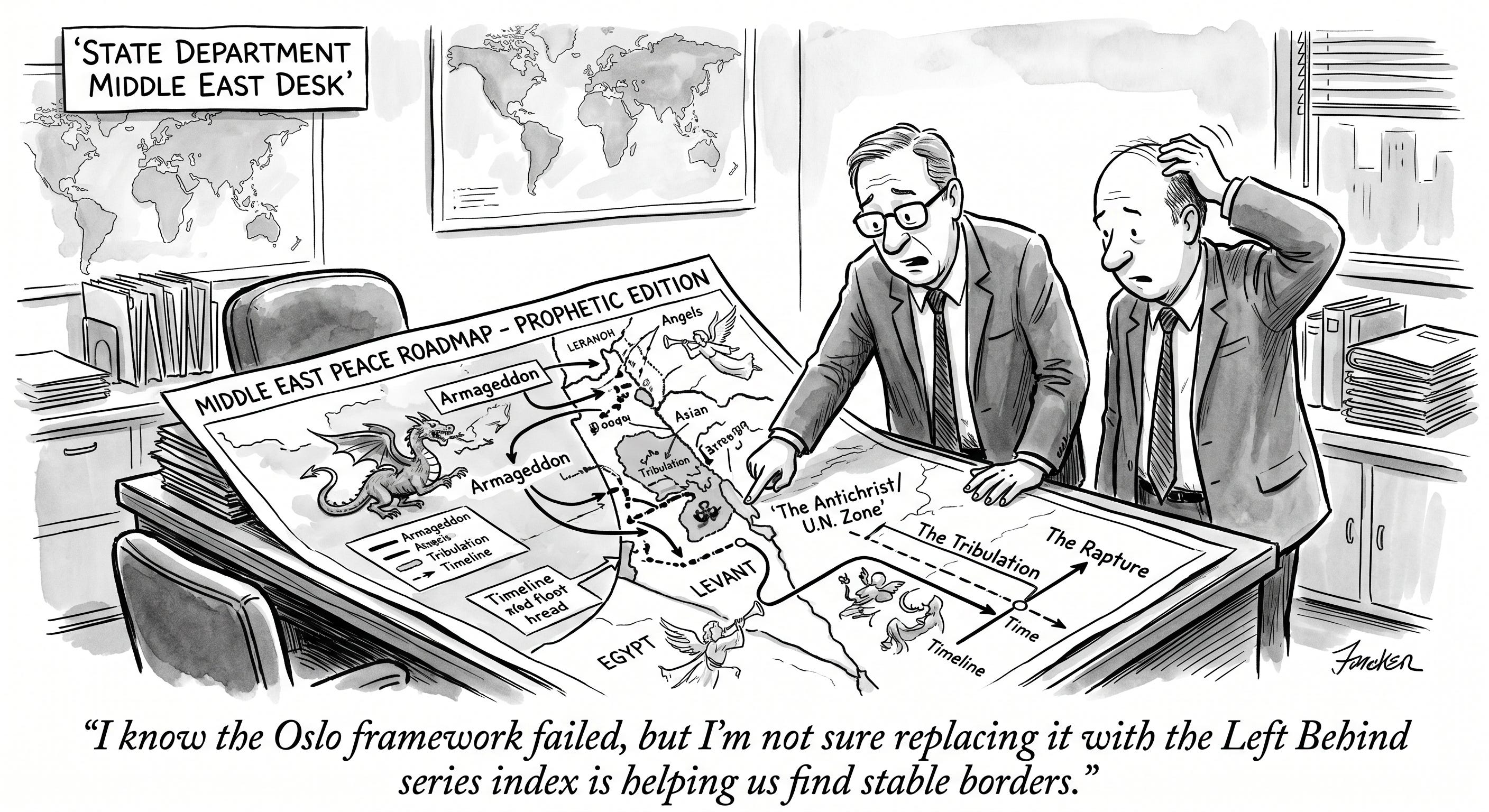
The Oslo Accords were signed on the South Lawn of the White House on September 13, 1993. Bill Clinton stood between Yasser Arafat and Yitzhak Rabin and guided the handshake that produced the photographs that ran on every front page on earth. The framework committed Israel to phased withdrawal from occupied Palestinian territories and established the Palestinian Authority as a governing body. It outlined a process for negotiating the permanent status questions, borders, Jerusalem, refugees, and settlements, within five years. It was the most advanced diplomatic framework for Israeli-Palestinian peace that had ever been achieved, and it was dying before the ink dried.
The Oslo process failed for reasons that have been extensively analysed: the continuation of Israeli settlement expansion during the negotiations themselves, which eroded Palestinian confidence in Israeli good faith; the assassination of Rabin in November 1995 by an Israeli ultranationalist; the rise of Likud under Netanyahu; Palestinian Authority corruption and its failure to deliver on governance; and the asymmetry of power that made the negotiations structurally unequal. What received less analysis in the secular postmortems was the role that American Christian Zionist networks played in organising domestic US political opposition to the Oslo framework, in terms that were explicitly theological and that mobilised congressional pressure against any administration inclined to push Israel toward compliance.
The Oslo Opposition
The land-for-peace premise at the heart of Oslo was, in the dispensationalist framework, a category error. The West Bank, Judea and Samaria in the biblical geography that the Scofield margins had made standard evangelical vocabulary, was covenanted territory. God had promised it to Abraham’s descendants. A political agreement transferring it to Palestinian sovereignty did not supersede that covenant. It violated it. And nations that facilitated its violation were inviting consequences.
Pat Robertson made this argument on the 700 Club within days of the Oslo signing. Falwell’s media apparatus ran sustained criticism of the framework throughout the mid-1990s. The organisations that would eventually consolidate into Hagee’s CUFI were communicating the same message through church networks, Christian radio, and direct mail: Oslo was not a peace agreement. It was a betrayal of divine promise, dressed in diplomatic language and celebrated by a secular press that had no framework for understanding what was actually at stake.
The practical effect of this campaign was to create a domestic political environment in which any administration that pressed Israel for Oslo compliance was potentially pressing against organised evangelical opposition that could be mobilised at congressional level. Clinton himself had no incentive to press hard. He was personally close to Israeli leaders, politically attentive to Jewish-American constituencies in key states, and temperamentally inclined toward a brokerage role that made him reluctant to apply sustained pressure on settlements. The result was that the “natural growth” exemption the Clinton administration accepted allowed the settlement enterprise to expand continuously during the Oslo years, consuming the territorial contiguity that any viable Palestinian state would require.
By the time the Camp David summit collapsed in July 2000, and Clinton’s final-hour efforts at Taba in January 2001 also failed to produce an agreement, the evangelical world was not grieving the loss. The failure of Oslo was, in the dispensationalist reading, confirmation that land-for-peace would not work and that the biblical claims of Israel to the land were irresolvable through secular negotiation.
The Left Behind Infrastructure
In October 1995, Tim LaHaye and Jerry Jenkins published the first volume of the Left Behind series. LaHaye had been a San Diego Baptist minister, a veteran of Falwell’s Moral Majority, a committed dispensationalist who had spent decades writing about end-times prophecy, and one of the most systematically organised political operatives in the history of the evangelical right. He had co-founded the Council for National Policy in 1981 as a private networking organisation for conservative leaders, and his influence inside the Republican Party ran through personnel pipelines that predated the Moral Majority and survived its formal dissolution. Jenkins was the professional novelist who translated LaHaye’s theological programme into narrative form.
The series ran to sixteen main novels plus prequels and sequels, and sold over 65 million copies. The first major film adaptation appeared in 2000. A second, with Nicolas Cage in the lead role, appeared in 2014. The cultural penetration was not confined to the evangelical subculture. Left Behind reached general audiences through airport bookstores and mass-market retail, creating a popular-culture phenomenon that made the dispensationalist eschatological sequence, rapture, tribulation, Antichrist, Armageddon, a piece of shared cultural vocabulary for millions of Americans with no formal evangelical affiliation.
The political instruction embedded in the series was comprehensive and required no decoding. The United Nations became, in the novels, the instrument of the Antichrist’s “Global Community,” a world government run by a Romanian politician named Nicolae Carpathia. The European Union was the revived Roman Empire of Daniel’s prophecy. International institutions, international law, and global governance of any kind were associated, structurally and narratively, with the forces of evil. Israel was the primary theatre of the tribulation and its Jewish population, along with converted Christians, were the heroes of the narrative. Arab states and their populations functioned largely as threats or as populations awaiting conversion or judgment.
These were not incidental narrative choices. They were the direct political implications of the dispensational framework, rendered in fiction and absorbed by 65 million readers as entertainment. A Republican voter who had read Left Behind did not need a pamphlet explaining why the United Nations was dangerous, why international pressure on Israel was suspect, or why diplomatic compromise with the forces arrayed against Israel was a form of collaboration with evil. The framework had answered those questions in advance, in the form of a thriller.
George W. Bush’s electoral coalition in 2000 and 2004 included the vast majority of white evangelical voters. Many of them had read Left Behind or lived inside the cultural world it represented. The framework that novel series had popularised was ambient in the political culture of his base, and he was acutely aware of what that base expected.
September 11 and the Prophetic Frame
Within hours of the September 11 attacks, the Christian Zionist media apparatus was processing the events through the dispensationalist lens it had been maintaining and refining since 1967. The argument was straightforward to construct within the framework: America had been attacked by forces associated with Islam, which dispensationalist prophecy literature associated with the nations arrayed against Israel in the end-times narrative. The attack was both a strategic threat and a prophetic development. The appropriate response was both military and theologically clarifying: America needed to recognise who its enemies were, to stand unambiguously with Israel against those enemies, and to prosecute the confrontation without the diplomatic equivocation that had characterised the Oslo years.
Jerry Falwell appeared on Pat Robertson’s 700 Club two days after the attacks and said, with Robertson’s agreement, that the secularists, the abortionists, the feminists, and the gays and lesbians had helped the attacks happen by making America vulnerable to God’s removal of protection. He partially retracted the statement under intense public pressure, but the underlying logic, that America’s moral and covenantal failures had created its strategic vulnerability, was not retracted and was not unusual in the evangelical world Falwell represented.
The Bush administration did not require this framework to justify its response, but it was operating in a political environment where the evangelical base had already connected the response to the Middle East with the fulfilment of prophetic obligation. Support for Israel and the War on Terror were, in that environment, the same project. Israeli military operations against Palestinian populations in the West Bank and Gaza, operations that Bush’s State Department occasionally criticised in formal statements, were, in the evangelical reading, the same war being fought on a different front.
CUFI’s Founding
John Hagee convened the founding meeting of Christians United for Israel in February 2006 at the Cornerstone Church in San Antonio, four hundred pastors and ministry leaders attending, with a stated organisational purpose that was frank in its ambition: to create a pro-Israel Christian lobby of sufficient scale to match and eventually exceed AIPAC in its domestic political reach. The target membership was the evangelical community, numbered in the tens of millions, already theologically predisposed toward unconditional support for Israel, already mobilised in churches and para-church networks, but not yet systematically organised for direct congressional advocacy.
The model was AIPAC’s. What AIPAC had done for the Jewish-American community, created a single-issue lobby capable of directing concentrated pressure on specific congressional votes, of mobilising letter and phone campaigns at short notice, of tracking individual legislators’ records and rewarding or punishing accordingly, Hagee intended to replicate at far larger scale. Where AIPAC worked with a Jewish population of six to seven million, CUFI was targeting an evangelical base of fifty million or more.
The institutional structure was designed for political leverage. CUFI’s “Rep” programme recruited individual congregation members as official church liaisons, responsible for transmitting action alerts to their fellow congregants and ensuring that CUFI’s congressional campaigns reached the pew level. CUFI on Campus extended the network to universities, training student advocates to represent Israeli government positions in campus settings. The annual Washington Summit provided the flagship event: several days of briefings, panels, and lobbying visits to congressional offices, with high-profile speakers including Republican presidential candidates and administration officials who attended as a matter of political obligation.
By March 2012, CUFI’s membership exceeded one million, making it the largest pro-Israel organisation in the United States, larger than AIPAC or any Jewish-American advocacy body. By December 2018, the membership had reached 5.1 million. The 2023 figure exceeded ten million. The scale of CUFI’s grassroots reach, its presence in every congressional district, and its capacity for rapid mobilisation were not in dispute.
The Hagee Theology
To understand what CUFI actually is, the theology of its founder must be examined rather than described in general terms and left to one side.
John Hagee built his political organisation on a theology that is, at its foundation, not pro-Jewish in any sense that most Jewish people would recognise. Dispensationalism does not support Jewish continuity. It supports Jewish instrumentality. In the end-times sequence that Darby designed and Scofield annotated and Lindsey popularised, the Jewish people are gathered to the land of Israel not because their civilisation has value or their religious tradition deserves preservation or their lives have intrinsic worth, but because the prophetic programme requires a Jewish population in the land for the tribulation to proceed, for the final wars to be fought, for two-thirds of them to die in those wars, and for the surviving remnant to convert to Christianity at the moment of Christ’s return. Jewish people who die without accepting Christ are, in this theology, damned. Hagee has confirmed this directly when pressed on it.
His historical treatment of the Jewish people is consistent with this framework. In a sermon from the 1990s, preaching on Jeremiah 16:16, “Behold, I will send for many fishers... and after will I send for many hunters. And they the hunters shall hunt them,” Hagee argued that God had sent the hunters of history to force Jewish migration toward Palestine. “Then God sent a hunter,” he said. “A hunter is someone who comes with a gun and he forces you. Hitler was a hunter.” The argument was explicit: the Holocaust had served divine purposes by driving European Jews toward their ancestral homeland, where God had always intended them to be. Jewish persecution, in this reading, was God’s migratory mechanism. Hitler was an instrument.
He extended this in print, claiming in his book “Jerusalem Countdown” that Hitler was a “half-breed Jew” and attributing Jewish persecution partly to Jewish “disobedience” toward God. The “half-breed Jew” claim recycles a theory circulated by the Christian Identity movement, which the Southern Poverty Law Center classifies as an antisemitic, racist theology asserting that white people rather than Jews are the true descendants of ancient Israel.
John McCain rejected Hagee’s endorsement during the 2008 presidential campaign when these positions surfaced, calling them “deeply offensive and indefensible.” Hagee apologised to the Anti-Defamation League for a different sermon in the same period, a manoeuvre that allowed the ADL to accept the apology without requiring him to retract the Hitler claim. He continued. By November 2023 he was speaking from the stage of the March for Israel rally on the National Mall in Washington, flanked by Senate Majority Leader Chuck Schumer, House Minority Leader Hakeem Jeffries, and House Speaker Mike Johnson. The same politicians who would refuse to share a stage with a figure who had described Hitler as God’s hunter were standing next to him in Washington before a crowd of tens of thousands, because the political alignment that CUFI represented, the organised mobilisation of ten million evangelical voters behind unconditional support for Israel, had made the association politically essential.
The Jewish Israeli leaders who accepted CUFI’s political support did so with full knowledge of this eschatology, calculating that short-term political and financial utility outweighed the longer-term theological implications. Ron Dermer, Netanyahu’s closest diplomatic advisor, called evangelicals “the backbone of Israel’s support in the United States.” Netanyahu addressed CUFI gatherings by video. The implicit contract was transactional on both sides: Christian Zionists need Israel to exist and expand for their prophetic sequence to proceed; Israeli governments need the political muscle of the evangelical constituency to maintain unconditional US support. The fact that Hagee’s theology ultimately consigns the Jewish people to conversion or damnation is the consideration that neither party discusses in public.
The Bush Letter
The most concrete single policy achievement of Christian Zionist lobbying in the Bush years was the April 2004 letter from George W. Bush to Ariel Sharon, which formally committed the United States to the position that any final status agreement would not require Israel to return to the 1949 armistice lines, and that Israel could retain “existing major Israeli population centers,” the large settlement blocs, in any permanent settlement.
The letter further stated that it was “unrealistic to expect” a full return to the pre-1967 lines, and that the Palestinian refugee question should be resolved through Palestinian statehood rather than a right of return to Israel. These positions had been informally understood in some US-Israeli conversations for years, but stating them formally in a letter from the President of the United States to the Israeli Prime Minister was a categorical departure from the framework that every previous administration had maintained. It was a formal American endorsement of the settlement enterprise as a permanent political fact, not a temporary occupation that international law and UN resolutions required to be reversed. Congress ratified the position in a near-unanimous resolution days later.
The Christian Zionist movement had been demanding this endorsement since Oslo. Settlements were not illegal outposts but communities in the biblical heartland with a divine title that superseded the Fourth Geneva Convention, the Oslo Accords, and every UN Security Council resolution passed since 1967. Bush’s letter delivered, in formal diplomatic writing, the recognition that the movement’s theology had always insisted was correct. A decade and a half of sustained evangelical lobbying, through church networks, radio broadcasts, congressional office visits, White House access, and the electoral leverage of a base that delivered Republican primary victories, had produced a presidential letter that rewrote American policy toward the most contested territory on earth.
Part V: Barack Obama’s Cairo demand and the retreat that followed. The Iran nuclear deal and the largest single lobbying campaign in CUFI’s history. Trump’s full list of policy deliverables for the Christian Zionist coalition. The October 7 attack and the evangelical polling data that revealed the base’s durability. And the generational fracture that may or may not produce political consequences in time.
References
Tim LaHaye and Jerry Jenkins, Left Behind series, 16 vols. (Tyndale House, 1995–2007)
Timothy P. Weber, On the Road to Armageddon: How Evangelicals Became Israel’s Best Friend (Baker Academic, 2004)
John Hagee, Jerusalem Countdown (FrontLine, 2006)
Stephen Sizer, Zion’s Christian Soldiers: The Bible, Israel and the Church (Inter-Varsity Press, 2007)
John Mearsheimer and Stephen Walt, The Israel Lobby and U.S. Foreign Policy (Farrar, Straus and Giroux, 2007)
Mark Grzegorzewski, The Christian Zionist Lobby and US Foreign Policy (PhD dissertation, 2012)
George W. Bush, Letter to Ariel Sharon, April 14, 2004 (White House Archives)
Frances FitzGerald, The Evangelicals: The Struggle to Shape America (Simon and Schuster, 2017)
Dan Hummel, Covenant Brothers: Evangelicals, Jews, and U.S.-Israeli Relations (University of Pennsylvania Press, 2019)
Dennis Ross, The Missing Peace: The Inside Story of the Fight for Middle East Peace (Farrar, Straus and Giroux, 2004)


