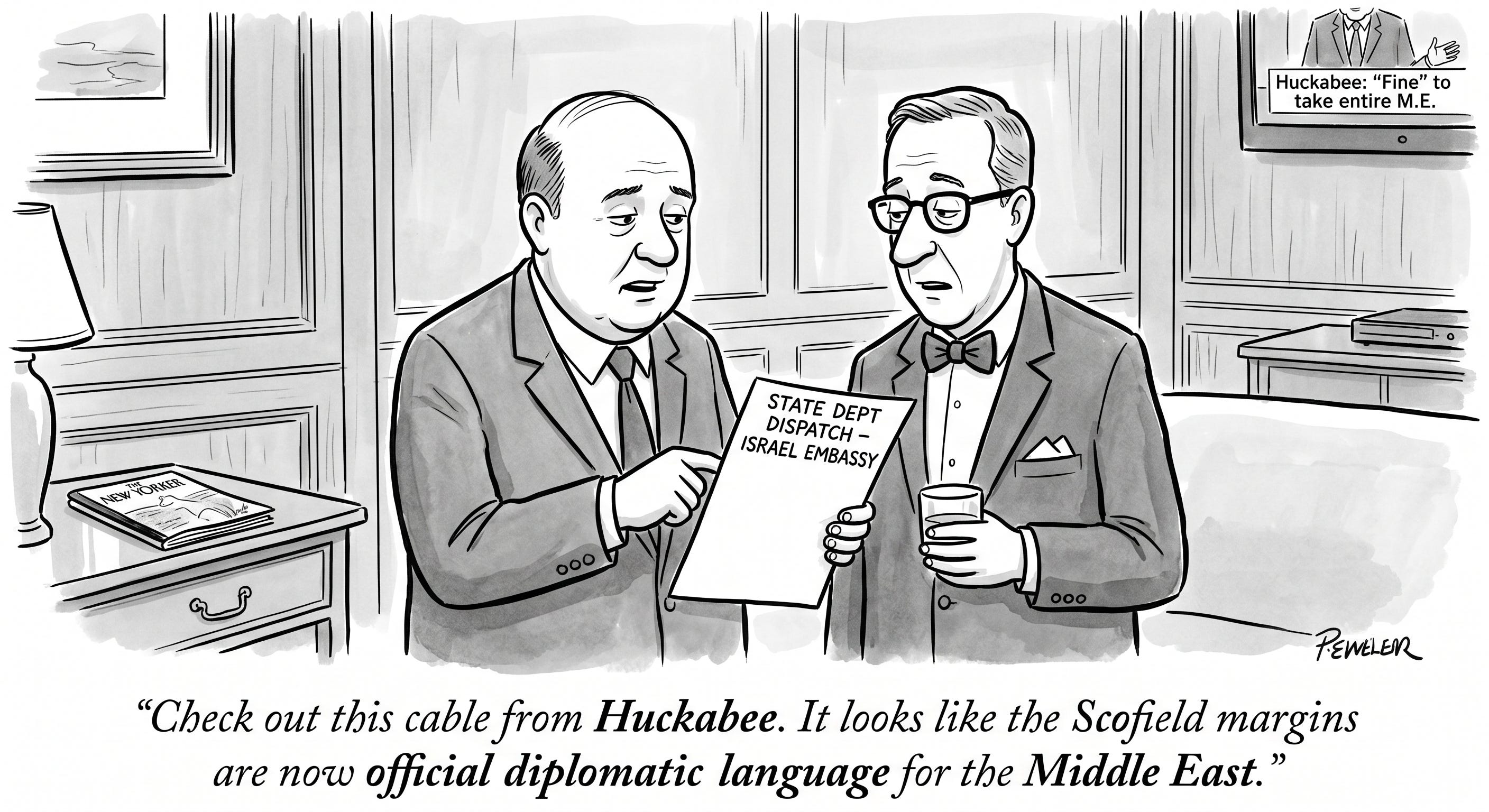
Donald Trump announced Mike Huckabee as his nominee for United States Ambassador to Israel in November 2024, three weeks after winning the presidential election. The Senate confirmed the nomination in April 2025. Huckabee arrived in Jerusalem as the first ordained minister to hold the position in the embassy’s history, carrying a set of theological convictions about the land, the people, and the purposes of God in the Middle East that he had never obscured and saw no reason to moderate once in post.
Before his nomination, his positions were documented in detail. In 2017 he had stated publicly that “there was no such thing as a West Bank, it’s Judea and Samaria,” using the biblical nomenclature that the settler movement and American dispensationalist theology had developed precisely to deny the political legitimacy of Palestinian claims to the territory. In 2018 he personally laid bricks at a West Bank settlement housing complex. He had said, in reference to Palestinians, that there was “no such thing as a Palestinian.” He had told Charlie Kirk without apology that he believed those who blessed Israel would be blessed and those who cursed it would be cursed, and that he wanted to be on the blessing side. This was not the foreign policy vocabulary of a professional diplomat. It was the theological vocabulary of the Scofield margin.
In an interview with NBC News in September 2025, Huckabee described the US-Israel value system as “rooted deeply in a biblical understanding of a worldview.” The interview was conducted in his capacity as the serving US Ambassador to Israel, the official diplomatic representative of the United States government to a country whose military campaign in Gaza had by that point killed over 50,000 Palestinians.
The Tucker Carlson Interview
In late February 2026, Tucker Carlson travelled to Israel and conducted a wide-ranging interview with Huckabee that was posted on Carlson’s YouTube platform and reached a large audience. Carlson had been conducting an increasingly pointed interrogation of the US-Israel relationship for several years, positioning himself as a voice for a Christian nationalism sceptical of the claim that American interests and Israeli interests were identical.
He asked Huckabee about Genesis 15:18-21, the passage in which God promises Abraham’s descendants land from “the wadi of Egypt to the great river, the Euphrates,” encompassing the territory of ten named peoples. Carlson read the geographic implications: this description would include, at minimum, Lebanon, Syria, Jordan, and substantial portions of Saudi Arabia and Iraq. “Basically the entire Middle East,” Carlson said. Should Israel have it?
“It would be fine if they took it all,” Huckabee said.
He added, after a pause, that they were not asking for all of it and that the remark was somewhat hyperbolic. Carlson pressed on the substance of the claim. Huckabee held to the theological position while retreating from the diplomatic implications.
The statement produced a joint condemnation from the foreign ministries of more than a dozen Arab and Muslim states, including US treaty partners Qatar and Saudi Arabia. The Organisation of Islamic Cooperation described the remarks as a threat to regional stability. Israeli Finance Minister Bezalel Smotrich, an annexationist who has advocated the erasure of Palestinian villages, posted on social media in reference to a Ben Stiller film: “I love Huckabee.” An anonymous State Department official told Politico that Huckabee did not represent “the best version of the pro-Israel position” within the administration. Trump said nothing. Huckabee remained in his post.
In a subsequent statement on social media, Huckabee wrote that labels like “Christian Zionism” were too often used in a “pejorative manner to disparage free-church believers” and that “a Zionist simply accepts that the Jewish people have a right to live in their ancient, indigenous, and Biblical homeland.” He added that it was “hard for me to understand why every one who takes on the moniker ‘Christian’ would not also be a Zionist.” The statement was received in Jerusalem by the Patriarchs and Heads of the Historic Churches in Jerusalem, the Greek Orthodox, Armenian, Catholic, Lutheran, Anglican, and other traditional Christian communities with centuries of presence in the Holy Land, as an attack on their theological integrity. They had already, in January 2026, issued a statement warning that “damaging ideologies, such as Christian Zionism,” were harming Christian unity in the Holy Land and being advanced by political actors in Israel and abroad. Huckabee’s response dismissed their concerns.
What the Absence of Consequences Means
The absence of professional consequences for Huckabee’s Nile-to-Euphrates endorsement is the most significant fact in the episode, more significant than the statement itself, which was an explicit expression of a theological position Huckabee had held and communicated for decades. The significant fact is that a US ambassador can endorse Israeli territorial expansion across the entire Middle East, drawing condemnation from a dozen allied governments, and continue in post without even a public reprimand from the administration he represents.
This is what institutional capture looks like in its completed form. It is not that Trump administration officials all share Huckabee’s eschatological convictions, though Pence did and Pompeo likely does and others in the evangelical-adjacent administration hold versions of the framework. It is that the political cost of distancing from Huckabee, alienating the evangelical base in whose vocabulary Huckabee is speaking, is higher than the political cost of the diplomatic fallout from his remarks. Qatar and Saudi Arabia, the Arab states that condemned the interview, are neither part of Trump’s electoral coalition nor, in the current administration’s calculus, worth the price of publicly chastening a Baptist minister who is telling evangelical voters what they want to hear.
The Lebanese-born analyst Nimer Sultani, speaking to Al Jazeera in February 2026, put it plainly: “A lot of the major donors to the Republican Party and also the Democratic Party are Christian Zionists. A lot of members of Congress are openly Christian Zionist. They reached the highest echelons of the state. And they bring these beliefs into their politics, into their policies.”
The Christian Nationalist Challenge
The Huckabee-Carlson interview exposed a structural tension inside the American right that has not previously been as visible: the growing incompatibility between Christian Zionism and the Christian Nationalism that Tucker Carlson represents and that has been gaining political traction in the Republican Party since approximately 2020.
Christian nationalism, in its current American form, asserts the priority of American interests, American sovereignty, and American cultural identity over transnational commitments of any kind, including commitments derived from theological interpretations of biblical prophecy. Its critique of Christian Zionism is not secular. It is internal to Christian conservatism: the claim that American foreign policy should serve American national interests, and that a theology subordinating American decision-making to the requirements of Israeli state expansion is a theology that has been manipulated, wittingly or not, into serving a foreign government’s interests at American expense.
Carlson has made this argument with increasing directness. His questioning of Huckabee was asking: if the biblical land promise runs from the Nile to the Euphrates, and if Israel is entitled to all of it, then what is the foreign policy implication for the United States, whose treaty allies would be absorbed or displaced by the fulfilment of that promise? The question is not easily answered within the Christian Zionist framework, because the framework does not primarily organise itself around American national interests. It organises itself around the prophetic programme, and the prophetic programme does not ask whether American treaty obligations to Qatar or Saudi Arabia are compatible with Israeli biblical land claims.
CUFI and the established Christian Zionist lobby have not yet developed an institutional response to this challenge. Their movement’s political durability has rested, since Reagan, on the alignment between evangelical theology and Republican foreign policy. Christian nationalism threatens that alignment by asserting a different organising principle for the conservative foreign policy imagination. Whether the tension produces a genuine political fracture, or remains a media-level debate between competing factions of the right, is not yet answerable.
What Capture Looks Like
Christian Zionism captured American foreign policy through vocabulary. Not through a single dramatic moment of institutional seizure, not through a conspiracy of the kind that circulates in online forums, but through a century-long process of embedding certain interpretive assumptions so deeply into the default language of American political culture that positions which once required theological justification now pass as common sense.
When a US senator says he stands with Israel without specifying which policy, which action, or which population is being abandoned by that standing, he is speaking Scofield’s grammar. When an administration uses the terms “Judea and Samaria” for the West Bank, it imports a vocabulary developed by the settler movement and American dispensationalist theology to deny the political legitimacy of Palestinian claims to territory. When a Republican presidential candidate attends a CUFI summit and reads from Genesis 12:3, he is not performing a calculation in isolation. He is confirming membership in a theological community and signalling that the community’s foreign policy preferences will be treated as binding.
The process began with Thomas Brightman in a Bedfordshire vicarage in 1607, writing a commentary asserting the Jewish people would physically return to their ancient land before the Second Coming. It ran through Henry Finch’s 1621 treatise, Lord Shaftesbury’s Victorian cabinet lobbying, John Nelson Darby’s seven American tours, Cyrus Scofield’s annotated Bible printed by Oxford University Press and written by a convicted fraudster from Michigan, the Niagara Bible Conference circuit, Dwight Moody’s institutional infrastructure, Charles Fuller’s twenty-million-listener radio ministry, Hal Lindsey’s thirty-five-million-copy paperback, Jerry Falwell’s Moral Majority, Ronald Reagan’s private Armageddon conversations, George H.W. Bush’s 1991 confrontation and its electoral consequences, Tim LaHaye’s sixty-five-million-copy political thriller series, John Hagee’s CUFI, the Trump administration’s delivery of the Jerusalem embassy and the Golan recognition and the UNRWA defunding, and on to Huckabee in the Jerusalem embassy in 2026, telling Tucker Carlson it would be fine for Israel to take everything from the Nile to the Euphrates.
Four hundred years of theological elaboration and a century of institutional investment produced a foreign policy in which a US diplomat’s endorsement of Israeli territorial expansion across the Middle East generates a news cycle and nothing more.
The Scofield Reference Bible was published in 1909. Its margins are now written into American diplomatic cables.
What is not yet known is whether the machine Darby built has a ceiling, or whether Huckabee in February 2026 was simply the latest milestone on a road that the Republican Party lacks the political architecture to close.
References
Mike Huckabee, Interview with Tucker Carlson, February 2026 (Carlson Network, YouTube)
Mike Huckabee, Interview with NBC News, September 2025
Nimer Sultani, Interview with Al Jazeera English, February 2026
Patriarchs and Heads of the Historic Churches in Jerusalem, Joint Statement on Christian Zionism, January 2026
Organisation of Islamic Cooperation, Statement on Huckabee Remarks, February 2026
Bezalel Smotrich, Social Media Post, February 2026
Andrew Desiderio, “State Dept. distances itself from Huckabee’s ‘Nile to Euphrates’ remarks,” Politico, February 2026
Christians United for Israel, Annual Lobbying Disclosure Reports, 2024, 2025 (US Senate Office of Public Records)
Dan Hummel, Covenant Brothers: Evangelicals, Jews, and U.S.-Israeli Relations (University of Pennsylvania Press, 2019)
Andrew Whitehead and Samuel Perry, Taking America Back for God: Christian Nationalism in the United States (Oxford University Press, 2020)


