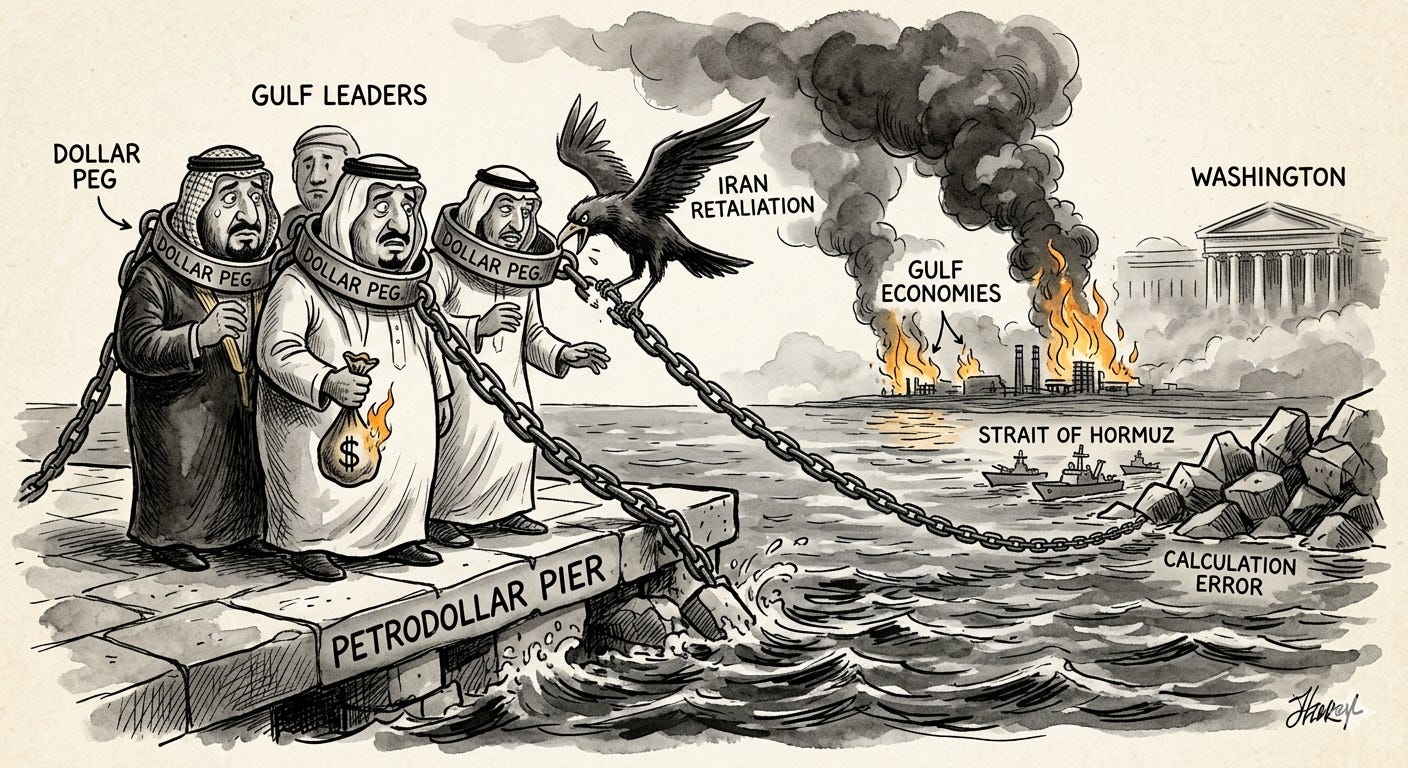
Pegged and Burning
How the Dollar Chain Turned Washington’s Iran Miscalculation Into a Gulf Catastrophe
Washington and Tel Aviv spent the better part of three years war-gaming what an attack on Iran would cost them. They planned the sequencing of strikes, mapped Fordow and Natanz and Esfahan to bunker-buster specifications, modeled the expected Iranian recoil, and arrived at a strategic judgment so breathtaking in its arrogance that it now reads like a prosecutable document. Their conclusion, at its core, was that Iran would absorb the hits and the region’s US-aligned states would hold. None of those states wanted the war. None of them had the financial architecture to say so. When the first missiles left their silos on February 28, 2026, they carried two payloads: the explosive kind aimed at Tehran, and the political kind aimed at governments that had long ago surrendered the vocabulary of sovereign dissent in exchange for currency stability, debt rollovers, and the continued goodwill of the International Monetary Fund.
By March 4, Iran had closed the Strait of Hormuz.
Saudi Arabia’s riyal has been fixed at 3.75 to the dollar since 1986. The UAE dirham at 3.6725 since 1997. Qatar’s at 3.64. These pegs do not represent monetary conviction. They represent the total, unambiguous surrender of economic sovereignty to the United States, formalized in financial instruments and held in place by a web of US Treasury exposure, dollar-denominated sovereign debt, IMF program conditionality, and correspondent banking dependency so complete that an exit would require a decade of infrastructure construction that no Gulf government has attempted to build. The peg was never a policy. It was a collar. It paid in stability and charged in servitude. February 28 was the day the collar cost more than the stability.
The architecture traces to 1974. In the aftermath of the Arab oil embargo, Henry Kissinger traveled to Riyadh and closed a deal whose terms the US government has declined to declassify in full even now, though the operational outlines are legible in every subsequent decade of Gulf-US relations. Saudi Arabia would price its oil exclusively in dollars. The resulting dollar surpluses would be recycled into US Treasury securities. Washington would underwrite the political survival of the House of Saud against all challengers: internal dissidents, regional rivals, democratic aspirations it had no intention of honoring. The arrangement required Riyadh to accept American military presence on its soil, American veto authority over its foreign policy at moments of genuine strategic consequence, and the permanent subordination of Saudi monetary policy to the requirements of dollar hegemony.
Every Gulf Cooperation Council state signed a version of the same document. Not literally. The signing was done through currency boards, central bank constitutions, and the slow structural accumulation of dollar-denominated liabilities that made exit geometrically more costly with every passing year. By 2026, the Abu Dhabi Investment Authority holds assets estimated conservatively between $700 billion and $1 trillion, the majority in dollar instruments. The Saudi Public Investment Fund has borrowed on international markets where dollar denomination is not negotiable. The Tadawul operates as a destination for Western institutional capital whose access depends on the credit ratings that dollar-system membership underwrites. These are not investments. They are hostage arrangements that their architects chose to call sovereign wealth.
The petrodollar system generates a specific political obligation. These states must align with Washington’s strategic posture not because they share its interests but because the financial architecture that sustains their governments runs through institutions Washington controls. When Washington decided to bomb Iran, the GCC states did not endorse the decision. They absorbed it. Saudi Arabia and the UAE hosted US military operations from their soil. They had no financial basis for refusal. The IMF understood this with full clarity in its April 2026 regional assessment, noting that peg economies would need interest rates to “move in line with anchor” requirements and that “excessive or disorderly foreign exchange movements could amplify the impact of higher commodity prices on inflation and financial stability.” Academic language for a simple fact: break with Washington, and the peg breaks. The peg breaks, and everything downstream of it breaks with it.
The strike architects in Washington and Tel Aviv made a single analytical error so catastrophic that it should end careers and probably will not. They modeled Iranian retaliation as a series of calibrated military responses designed to demonstrate resolve without triggering American escalation to a level Iran could not absorb. This is what Iran had done in every previous exchange. The April 2024 drone and missile salvo after the Damascus consulate bombing was theatrical. The October 2024 response was calibrated. Iran consistently chose the size of retaliation that signaled strength domestically without crossing thresholds that would bring the full weight of US and Israeli military power down on its infrastructure. The analysts at Langley and in Tel Aviv’s intelligence directorates built their assumptions on this behavioral record and called it predictive confidence.
On February 28, 2026, those analysts discovered that when you kill a country’s supreme leader in the opening hours of a military campaign and announce publicly that your objective is regime change, the adversary stops calibrating.
Iran launched retaliatory missile and drone strikes targeting US embassies, military installations, and oil infrastructure throughout the Middle East, including vessels in the Strait of Hormuz. The UAE absorbed ballistic missiles and drones within hours of the opening strikes. Three foreign workers died at the Fairmont The Palm in Dubai: a Pakistani national, a Nepali, a Bangladeshi. In Saudi Arabia, Iranian projectiles came for Ras Tanura, the kingdom’s largest refinery and principal Aramco export terminal. The US embassy in Riyadh was struck. A limited fire broke out. The refinery closed briefly, reopened March 13, then was struck again.
Then came March 4. An IRGC official said “the strait is closed.” Iranian forces attacked commercial shipping attempting to transit. US Central Command reported at least 17 Iranian ships destroyed by March 3, declaring that “there’s not a single Iranian ship underway in the Arabian Gulf, Strait of Hormuz, or Gulf of Oman.” None of that stopped the closure. Around 2,000 ships became stranded in the Gulf. The Strait, through which 20 percent of the world’s oil and liquefied natural gas passes during peacetime, became the chokepoint of the global economy. On April 17, Tehran declared the strait open. On April 18, the IRGC reversed the declaration. Trump posted on Truth Social on April 17 that it was “completely open.” The IRGC closed it again the following morning. Washington’s credibility and Iran’s operational control over global energy infrastructure were both on display in that 24-hour window, and only one of them held.
The analysts had modeled Iranian retaliation. They had not modeled an Iran that understood, better than Washington’s planners did, that the Gulf states’ dollar pegs meant Iran did not need to defeat the United States militarily. It only needed to close a waterway. The peg would do the rest.
Ras Tanura is where the money comes from. Not in the abstract sense in which analysts say “oil revenues fund the Saudi state” but in the physical, logistical, specific sense: crude pumped from the Eastern Province fields processes through Ras Tanura before it loads onto tankers, tankers transit Hormuz, and the resulting dollar flows pay for everything MBS has promised Saudi Arabia it will become. Vision 2030 is not a strategy document. It is a leveraged bet placed against future Aramco revenues, financed through PIF borrowings on international markets where the debt covenants require the credit ratings that dollar-system membership maintains. The bet was already losing before the first Iranian drone appeared over the refinery. Saudi Arabia’s fiscal deficit reached 5.3 percent of GDP in 2025. External borrowing had reached $156 billion. Net foreign assets of commercial banks showed a deficit of $57 billion at the end of January 2026, before a single Iranian missile had fired.
The East-West pipeline to Yanbu has a capacity of 5 million barrels per day. The Abu Dhabi crude pipeline to Fujairah carries 1.5 million barrels per day. Together at full capacity, these routes cover roughly one quarter of the oil that normally transits Hormuz. And they are vulnerable to attack: the Yanbu route runs toward the Red Sea, where the Houthis have demonstrated since 2019 the capacity to strike Saudi oil infrastructure. Saudi Arabia exports 5.29 million barrels per day through Hormuz under normal conditions. It can reroute perhaps a quarter of that. The rest is stranded.
The IEA’s May 2026 Oil Market Report documented cumulative supply losses from Gulf producers exceeding one billion barrels, with more than 14 million barrels per day shut in. Brent crude swung from $144 per barrel to below $100 before stabilizing near $110. The oil market remains in deficit through at least the third quarter of 2026. Higher prices and lower volumes have not produced revenue outcomes that compensate for the export losses. Chatham House noted in May that the Hormuz closure “has revealed a key vulnerability not only for trade, but also for the success of the country’s Vision 2030 strategy.” It understates the damage. The Vision 2030 pitch to international investors was built on Saudi Arabia as a stable logistics and financial hub in a volatile world. The world became volatile and Saudi Arabia is inside it, bombed by the state whose retaliatory capacity the Americans assured Riyadh they had adequately modeled.
Washington has not compensated Riyadh for hosting the war. It has not been asked to.
There is a specific ugliness to what has happened to the UAE that deserves to be named without euphemism. Abu Dhabi signed the Abraham Accords in September 2020. It accepted the political cost of normalizing with Israel in front of an Arab public that did not accept the logic of the deal and has watched, since October 2023, the footage from Gaza that makes the logic of any normalization with Israel impossible to defend on any basis that a Muslim-majority population can be asked to accept. In exchange for this political cost, the UAE was promised F-35 access, removal from the US arms watch list, and American treatment of Abu Dhabi as a first-tier security partner. Five years later, the F-35 sale has not been completed. Congressional review, Israeli lobbying, and UAE resistance to US demands about Huawei infrastructure have kept the deal suspended. The UAE paid for normalization. It received the Iran war in its neighborhood, the Fairmont The Palm burning, and Iranian missiles over Dubai’s hotel districts.
Emirates airline dropped to 75 percent of normal capacity in the first month of conflict. Etihad fell to half. flydubai to one third. The aviation sector bled between $1.5 billion and $2.5 billion in the first month. Add tourism collapse, cancelled international conferences, and Fujairah port disruption, and total UAE losses in month one reached approximately $6 billion. Saudi Arabia, UAE, and Qatar combined lost an estimated $20 to $25 billion in that same period. Dubai’s entire economic model, the proposition that the Emirates offers stability, connectivity, and financial predictability in an unstable region, was destroyed in the opening weeks of a war launched from UAE military infrastructure.
On April 28, 2026, the UAE announced it was leaving OPEC and OPEC+, effective May 1, citing “national interests” and its “long-term strategic and economic vision.” This is a government announcing, in diplomatic language, that it can no longer afford to honor production coordination with partners when it needs to maximize throughput at Fujairah, its only significant export route outside Hormuz’s contested waters, to compensate for revenue it is losing because it hosted a war its ally designed and its adversary turned against it. The OPEC exit destroyed Gulf energy coordination at the moment collective Gulf energy strategy would matter most. Abu Dhabi chose marginal relief over institutional solidarity. It had no other lever.
While its economy was being damaged by the war, Iran continued exporting oil to China using the Strait of Hormuz, even as it closed the passage to Gulf countries’ shipping. This single fact requires more analytical attention than it has received. The IRGC declared the Strait closed. It attacked commercial vessels attempting to transit. It seized the Epaminondas on April 24. It closed the passage Iran itself declared open on April 17 the following morning. And throughout this period, Iranian oil loaded onto tankers and moved through the same waterway to Chinese buyers.
Washington’s response was to not stop this. The reasoning offered was that the US was refraining from attacking Iranian traffic in hopes of preserving the infrastructure that any new Iranian regime would depend upon. What this means in practice is that Washington launched a war that closed a waterway through which 20 percent of global oil trade moves, watched China use that same waterway to purchase discounted Iranian crude, and chose not to intervene because doing so might complicate Trump’s summit planning with Beijing. The dollar architecture, whose existence supposedly bound these Gulf states to Washington’s political requirements, stops at China. It has always stopped at China. On April 7, China and Russia vetoed the Bahraini-drafted UN Security Council resolution calling for freedom of navigation in the Strait and an end to Iranian shipping attacks.
The Gulf states’ dollar compliance did not purchase them the protection that dollar compliance was sold to them as providing. It purchased Washington the infrastructure to fight a war from their territory, the revenue to fund the war from their oil, and the diplomatic silence to prosecute the war without regional opposition. When Iran retaliated against the states hosting the war, Washington deployed its best operational priority, which was managing the China relationship, ahead of defending the hosts. The Gulf states are not clients in a protection arrangement. They are franchises that accepted the brand and are now discovering what the franchise agreement actually says.
Pakistan condemned all attacks by all parties, which is what a state does when it owes $130 billion in external debt, holds $21.3 billion in foreign exchange reserves, and is in the middle of an IMF Extended Fund Facility whose continued operation requires Washington’s endorsement at the Fund’s executive board. Islamabad mediated a two-week ceasefire and hosted the first round of the Islamabad Talks on April 10 and 11, positioning itself as the neutral convener that neither Washington nor Tehran could publicly reject. This is a masterly piece of financial self-preservation dressed as diplomacy. Pakistan cannot afford to be seen as pro-Iran by the Gulf creditors who fund its balance of payments, having just secured $3 billion in fresh Saudi deposits, a rollover of $5 billion in existing support, and issued a $750 million Eurobond, its first international capital market access in four years. It cannot afford to be seen as pro-Washington by a domestic political class that is viscerally opposed to the strikes and a Shia population of 35 to 40 million with direct institutional ties to Iranian religious institutions that are under physical attack.
The mediation role is therefore not altruism. It is the one available position that keeps all the creditors talking to Islamabad. After the ceasefire, Pakistan sent 13,000 troops and fighter jets to Saudi Arabia, the same Saudi Arabia that just dispensed the debt support keeping Pakistan’s external accounts from collapse. The troops are performing a function the dollar dependency already guaranteed: they are Pakistan’s body, placed physically between the Gulf’s financial infrastructure and Iran’s retaliatory reach, because Islamabad’s balance sheet gave it no other way to thank its creditors. For countries like Pakistan defending their currencies places a strain on foreign exchange reserves, heightening the risk of a balance of payments crisis if they run out of dollars. The rupee held. Saudi inflows held it. The cost of those inflows is 13,000 soldiers guarding Riyadh’s refineries from the missiles of the country Pakistan also officially condemned.
Gulf Cooperation Council members have poured tens of billions of dollars in grants, central bank deposits, and investments into Egypt over the years. Cairo is now heavily indebted to the same states that Iran has targeted in its retaliation. El-Sisi flew to Riyadh, Bahrain, Qatar, and Abu Dhabi and called Iran’s strikes criminal. He did not send troops. Gulf skeptics asked publicly whether Cairo had their interests at heart. The answer, which nobody in the Gulf or Washington wants stated plainly, is that Egypt’s interests were exactly served by the position it took: condemn loudly enough to keep the Gulf money flowing, contribute nothing militarily that would expose Egyptian forces to Iranian retaliation or domestic political crisis, and leverage the mediation role alongside Pakistan and Turkey to make Cairo indispensable to both sides.
Egypt has been doing this since 1979. The $1.3 billion annual US military retainer, fixed since Camp David and not adjusted for inflation in any meaningful way across four and a half decades, purchases American equipment that can be maintained only with American parts and American technical support. It does not purchase an Egyptian military capable of independent action. It purchases a military capable of acting alongside the United States. The architects of Camp David understood this. Every subsequent Egyptian government has understood it. The recent conflict has confirmed what Egyptian officials have privately acknowledged for years: US military assets in Gulf Arab countries are strictly intended to defend US bases there, not the host countries. El-Sisi saw what US forces did and did not do for Saudi Arabia during the Ras Tanura strikes. He drew the appropriate conclusions about what they would do for Egypt.
Egypt allowed its exchange rate to act as a shock absorber, with the pound depreciating approximately 13 to 15 percent since February 28, 2026. Inflation held above 15 percent in March. Economic growth for 2026 was downgraded to 4.2 percent. The Suez Canal’s transit fees, which had already dropped 60 percent below 2023 baseline levels from Red Sea disruption before the Iran war began, face further pressure as shipping routes avoid the Eastern Mediterranean approaches. Cairo is performing its subordination and absorbing its losses and issuing the correct statements, and the guarantee it thought it had purchased with Camp David is nowhere visible in the outcome.
Erdogan condemned the strikes within hours. He expressed sadness at Khamenei’s killing and offered condolences to Iran. Turkish policymakers expressed fear that the collapse or fragmentation of the Iranian state would produce security, migration, and economic crises that would hit Turkey hardest. NATO air defenses intercepted Iranian missiles in Turkish airspace on four separate occasions. The Turkish defense ministry issued firm statements about responding decisively to threats on Turkish soil, while Turkish diplomats simultaneously offered Istanbul as a neutral venue, maintained the working channels with Tehran that no other NATO member was operating, and positioned Ankara as the mediator Washington needed but could not officially endorse.
Ankara adopted a model often described as strategic autonomy, resisting full alignment while formally remaining within NATO obligations. What this means in practice is that Erdogan has more room to maneuver than any other actor in this analysis and has maximized that room with genuine competence. Some Asian and Gulf-based companies are reportedly considering Istanbul’s financial center as an alternative operational hub to the GCC, as regional instability accelerates decisions about where to anchor financial operations outside the Gulf. Turkey’s war dividend, to the extent it has one, is the possibility of absorbing displaced financial activity from the states that are burning.
The ceiling still holds. Turkey’s private sector carries over $170 billion in foreign currency liabilities. The lira depreciates when Turkish political risk rises, which forces rate increases that constrain exactly the economic space Erdogan needs to maintain his domestic support base. Turkey’s carefully calibrated messaging reveals how the country positions itself between alliance commitments and autonomous regional manoeuvring. This duality is neither new nor accidental. Erdogan condemns the war and intercepts the missiles of the country he condemned and offers to host peace talks for both parties simultaneously. This is not hypocrisy. It is the precise maximum use of sovereignty that a $170 billion corporate dollar liability allows. He has found the edge of the cage and is leaning against it. The cage has not opened.
The intelligence assessment that preceded Operation Epic Fury rested on a reading of Iranian behavior that was accurate for every previous episode and inapplicable to this one. Iran had calibrated every prior retaliation to avoid crossing thresholds that would invite a response exceeding its absorption capacity. What the planners in Washington and Tel Aviv failed to model was the effect of their own stated objectives on Iran’s threshold calculations. When your enemy announces that its goal is the elimination of your government, the political cost of maximum retaliation drops to zero because the alternative, compliant absorption, offers no survival benefit. The Israelis, who have studied Iranian decision-making for decades and built their assessment around behavioral patterns established when the Islamic Republic’s leadership was intact and its survival not directly threatened, produced an intelligence product optimized for a war against a different version of Iran.
Trump has said regime change has occurred while also saying he distrusts Iran’s new leader. Operation Epic Fury officially concluded May 5. Iran’s nuclear infrastructure was degraded. Its supreme leader was killed. The opening salvo took out Khamenei and triggered hundreds of retaliatory missiles and thousands of drones. The political structure of the Islamic Republic did not collapse on the required timeline. The Strait of Hormuz was declared open on April 17 and closed again on April 18. As of May 23, Iran and the United States remain at impasse over the terms of an accord to reopen the waterway. OPEC’s production has been cut by 30 percent. More than 14 million barrels per day remain shut in.
The war’s architects achieved regime change, declared victory, and then admitted they don’t trust the regime they changed. The Gulf states that hosted the campaign are absorbing losses of $20 to $25 billion per month and cannot publicly hold Washington accountable for the calculation that produced those losses because the dollar architecture that funds their governments is the same architecture Washington controls.
Fifty-two years after Kissinger sat in Riyadh and drafted the architecture that would bind the Gulf to the dollar, the bill is due in a form nobody disclosed when the contract was signed. The peg was sold as stability. What stability purchased was the permanent inability to say no to Washington at moments of genuine strategic consequence. It purchased decades of investment in dollar-denominated instruments whose value depends on American financial architecture remaining intact and American security guarantees remaining credible. It purchased the positioning of US military bases on Gulf soil that Iran correctly identified as legitimate targets when Washington used those bases to launch a war. It purchased the inability to refuse. When the refusal was needed, the peg made it impossible.
Saudi Arabia is beginning to reassess its exposure, since the Hormuz closure has revealed that now that it has been closed once, there will always be the risk it could happen again, posing a long-term threat to Saudi Arabia’s trade flows and economic transformation plans. This reassessment is happening inside a government that cannot exit the dollar architecture without triggering the financial crisis the architecture was designed to make inevitable for any state that tried. The UAE quit OPEC. It kept the dirham peg. Pakistan sent troops to Riyadh. Egypt depreciated its pound and stayed silent. Turkey intercepted Iranian missiles on behalf of NATO and offered peace talks on behalf of nobody and everybody.
Washington planned a war, used its regional clients’ territory to fight it, absorbed its primary objective with ambiguous results, and left its clients to manage the consequences of an Iranian retaliation it told them would be containable. The Strait is still, as of this writing, functionally contested. The tankers are still stranded. The refineries are still operating below capacity. Vision 2030 is bleeding. Dubai’s aviation model is broken. And the riyal is still fixed at 3.75.
These governments are not victims of Iranian aggression. They are victims of the arrangement they chose, year after year, to renew. The dollar collar held them in place when Washington needed them compliant and offered them nothing when Iran came for the infrastructure the compliance was supposed to protect. They bought the guarantee. They paid for the war. They are paying for the retaliation. They will keep paying, and they will keep the pegs, because after fifty years inside the cage there is no outside left to remember.


