


Among the debris pulled from a funeral hall in Sana’a was a fragment of metal bearing the markings of an American manufacturer.
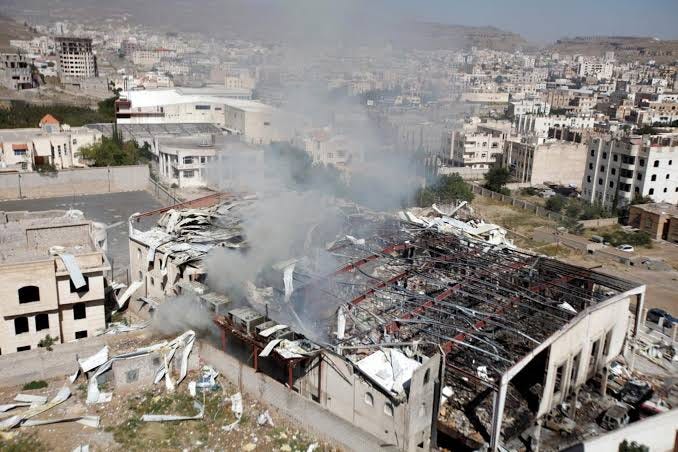
On October 8, 2016, aircraft from the Saudi-led coalition struck the hall while a funeral was under way, and then, as rescuers began moving toward the wreckage, struck it again. About 140 people were killed and hundreds more were wounded. Human Rights Watch described the attack as an apparent war crime, and investigators identified, among the remains, pieces of an American-made guided bomb. The coalition acknowledged the strike and attributed it to faulty intelligence.
Washington reviewed its support, suspended a single munitions sale, and kept the relationship intact. The United States had joined the war in March 2015, when it authorized intelligence and logistical assistance to the Gulf coalition; over time, that assistance came to include aerial refueling, training, military advice, weapons transfers, targeting help, and a joint planning cell. American pilots never flew the coalition’s bombing runs. American power kept those runs in the air all the same.
The dead were entered into reports, the bomb into evidence, and the alliance went on as before.
By the end of 2021, the United Nations Development Programme estimated that the war in Yemen had caused 377,000 deaths. Most of them came from hunger, disease, unsafe water, and the collapse of the systems that keep civilians alive, rather than from combat itself. The figure became the last comprehensive UN mortality estimate to be widely cited, and it was repeated for years while the forces that produced it kept running.
Yemen never vanished from journalism entirely. Yemeni reporters covered the war, human-rights investigators catalogued it, researchers traced bomb fragments to their manufacturers, and members of Congress forced votes on American involvement. The evidence was there. What never arrived was a consequence proportionate to it.
Newsroom fatigue explains only part of how Yemen slipped from sustained public attention. Saudi Arabia and the United Arab Emirates sat at the center of a web of relationships that distributed arms contracts, investment, jobs, consulting fees, campaign money, access to experts, diplomatic privilege, and financial rescue among the very institutions expected to scrutinize them. Nobody in a royal palace had to telephone an assignment desk. The incentives had done that work in advance.
No single censor erased the war. It was eased out of view by a political economy in which nearly every party had something to lose: governments their strategic relationships, weapons companies their contracts, lobbyists their retainers, policy institutes their donors, Pakistan its external financing, and the Gulf monarchies the embarrassment of revealing how much of their military power they had rented from abroad. This is how a documented atrocity settles into background noise.
The War Washington Enabled
Operation Decisive Storm began on March 26, 2015. By then the Houthi movement, together with forces loyal to the former president Ali Abdullah Saleh, had seized Sana’a, driven the internationally recognized government out of the capital, and pushed south. Riyadh presented its intervention as an emergency measure to restore President Abdrabbuh Mansur Hadi and to keep an Iranian-aligned force from dominating the Arabian Peninsula.
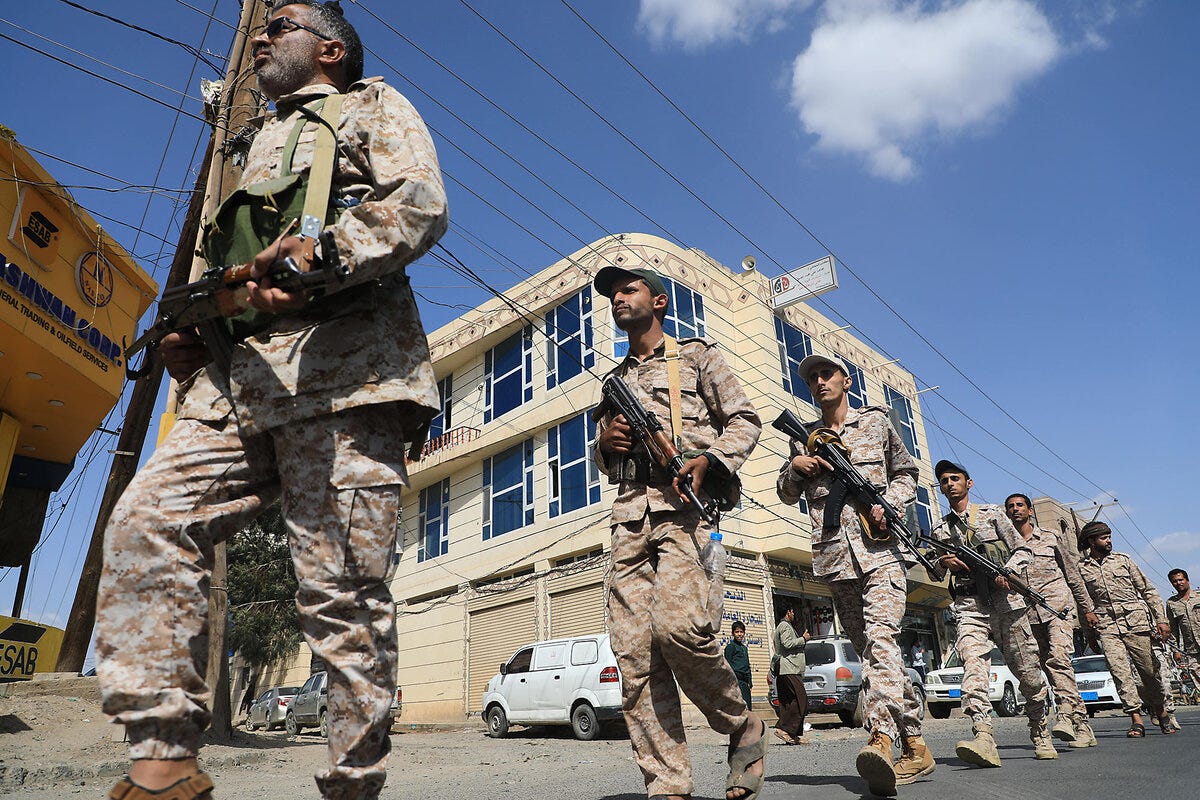
The Houthis were neither imaginary adversaries nor innocent bystanders. They took state institutions by force and built a coercive apparatus of government; they fired missiles and drones across international borders, recruited children, detained opponents, obstructed aid, and committed abuses against civilians. The UN Group of Eminent Experts documented grave violations by parties on every side, including arbitrary detention, torture, enforced disappearance, indiscriminate attacks, restrictions on humanitarian access, and the use of children in hostilities.
None of those crimes made it lawful for the coalition to attack civilians, and none excused collective punishment. One perpetrator’s guilt has never acquitted another.
The intervention was sold as a short campaign, an advanced military coalition against an irregular armed movement. It turned into a lesson in the limits of imported firepower. Saudi Arabia and the U.A.E. had modern aircraft, precision munitions, surveillance systems, and vast procurement budgets, and they remained dependent on foreign suppliers for sustainment, training, spare parts, technical expertise, and replacement weapons.
That dependence matters because an aircraft sale is never a single transaction. A modern strike fighter is a continuing political relationship encased in metal. It requires parts, software, maintenance, weapons integration, trained crews, ground support, and periodic upgrades, and the supplier remains inside the operational life of the plane long after the signing ceremony has been photographed.
From 2015 to 2019, Saudi Arabia was the world’s largest importer of major arms, accounting for 12 percent of global imports; its arms imports had risen 130 percent over the preceding five years. The United States supplied 73 percent of the kingdom’s major arms imports, and Saudi purchases absorbed 25 percent of all American arms exports in that period. The State Department later described Saudi Arabia as its largest Foreign Military Sales customer, with more than $100 billion in active cases.
Numbers on that scale build constituencies at home. A weapons program becomes factories and subcontractors, engineering teams and congressional districts, export licenses, lobbying budgets, and projected earnings. Its human consequences land abroad; its political rewards stay behind.
In 2024 alone, according to OpenSecrets, the American defense sector reported about $149 million in federal lobbying; RTX, the company formerly known as Raytheon, had spent $11.4 million on its own the year before. By 2023, more than 500 former government officials were lobbying for defense contractors, and OpenSecrets estimates that the sector has hired more than 2,700 lobbyists through the revolving door since 2001.
The dead of Yemen had no comparable lobby.
In February 2021, President Joe Biden announced that the United States would end its support for “offensive operations” in Yemen while continuing to help Saudi Arabia defend its territory. The phrase offered moral clarity without describing the machinery. Spare parts kept the aircraft flying, maintenance preserved the fleet, air defenses protected the bases, intelligence shaped the picture of the threat, and ongoing military cooperation sustained the relationship from which the campaign drew its strength.
Protecting Saudi cities from Houthi missiles and drones was a legitimate security function. Washington never built a convincing wall between that function and the wider infrastructure of Saudi coercive power. On paper the categories were clean; in operation they leaked, which was rather the point of the language.
A Market, Not a Treaty
The story of the petrodollar is usually reduced to a document that does not exist.
A viral claim holds that Washington and Riyadh signed, in June 1974, a legally binding fifty-year agreement requiring Saudi oil to be sold exclusively in dollars, and that the pact expired in June 2024. Nobody has produced such a treaty. The public agreement created the U.S.-Saudi Arabian Joint Commission on Economic Cooperation; separate arrangements encouraged Saudi oil earnings to flow into American financial institutions and government securities.
Disposing of the fictional treaty leaves the real system standing.
The oil shock of 1973 quadrupled prices, handed enormous surpluses to oil exporters, and presented Western governments with two linked problems: how to pay for expensive energy, and how to keep those surpluses from destabilizing the international monetary system. Treasury Secretary William Simon pressed oil-producing states to park their excess revenue in American bank deposits and dollar assets, an effort the Treasury Department’s official history credits to him.
A 1979 U.S. government review described the bilateral commission as a means of strengthening political ties, promoting American exports, assisting Saudi development, and recycling petrodollars. Saudi revenue paid for imports, bank deposits, securities, investments, and a widening security partnership. The arrangement was at once institutional, commercial, and strategic, and it required no magical clause.
Because oil was priced mainly in dollars, global demand for dollar liquidity rose, and Saudi accumulation of dollar revenue steered capital toward American markets. The kingdom gained access to the deepest financial system in the world and the protection of its most powerful military. American firms won contracts. Washington acquired a dependable regional partner and another source of demand for dollar assets.
The riyal’s peg to the dollar, the depth of American capital markets, the scale of American military protection, and the dollar-based plumbing of the energy trade reinforced one another. No secret switch governed the global economy. A set of incentives made leaving expensive, and that was sufficient.
Weapons purchases were one channel within that architecture. They turned oil revenue into American industrial income and tied Saudi military capability to American suppliers. Halting a bomb sale would not have brought down the dollar; it would have interrupted a lucrative part of a relationship designed to make interruption politically painful.
The old mythology misreads the mechanism from both directions. Admirers describe a neutral market; conspiracy merchants describe a hidden contract. The documented system has proved sturdier than either account. Energy, finance, security, and arms procurement formed a mutually reinforcing structure whose benefits went to states and corporations and whose costs were sent elsewhere.
The Paid Ecosystem
The coalition’s military dependence explains how the war could go on. Washington’s influence industry helps explain how political resistance to it was managed.
The Foreign Agents Registration Act does not forbid foreign governments from hiring American lobbyists, lawyers, consultants, or public-relations firms; it requires that the arrangements be disclosed. Saudi Arabia used the system on an industrial scale, retaining bipartisan firms staffed by former legislators, political operatives, congressional aides, and national-security officials. The work proceeded through registered contracts, scheduled meetings, circulated briefing papers, media outreach, and campaign networks.
Saudi registrants reported spending nearly $10 million on lobbying firms in 2016 and $27.3 million in 2017, the year the kingdom signed 45 contracts with registered firms and more than 100 individuals registered as its agents. In 2022 and 2023, according to OpenSecrets figures cited by the Quincy Institute, Saudi Arabia was among the countries, alongside China and Japan, that spent more than $100 million on FARA registrants, and it reported more political activity than any other foreign lobby. That money paid for far more than Yemen: trade, tourism, litigation, investment, reputation management, and the broader bilateral relationship. It cannot fairly be called a Yemen propaganda budget. It does show the size of the apparatus at work while Congress debated arms sales, military assistance, and the War Powers Resolution.
The narrower record on Yemen is damning enough.
Saudi lobbyists contacted congressional offices around votes intended to end American military involvement. Agents defended the coalition’s conduct, circulated material stressing Iran’s support for the Houthis, and cast any restriction on arms or assistance as a threat to American partners. A 2018 report by the Center for International Policy’s Foreign Influence Transparency Initiative counted more than 2,500 contacts by registered Saudi agents with Congress, the White House, the press, and think tanks in 2017 alone, along with $390,496 in campaign contributions from those agents to members of Congress whom they or their colleagues had lobbied. On a dozen occasions, a member’s campaign received money on the same day his or her office was contacted. One lobbyist, pressing Senate offices on a Saudi arms sale, spoke with the legislative director for Senator Tim Scott, of South Carolina, on May 16, 2017, and reported a $2,000 contribution to the senator’s political action committee that same day.
When the Senate voted in 2018 on a resolution to end American support for the war, 30 of the 37 senators who voted against it had received contributions from firms registered to represent Saudi Arabia, at least $226,182 over two years. None of this proves that any legislator sold a vote, and the contributions were legal. They do document a setting in which paid access, political fundraising, and foreign-policy advocacy ran through the same people on the same days.
Former officials lent the enterprise their authority. The McKeon Group was founded by Howard (Buck) McKeon, the former chairman of the House Armed Services Committee. Hogan Lovells, on a contract worth $175,000 a month, deployed the former senator Norm Coleman, who also sat atop one of the Republican Party’s largest fundraising operations, an organization that raised and spent more than $165 million in the 2020 election cycle. In 2021 and 2022, Coleman sent more than 1,000 emails to House and Senate staff on the kingdom’s behalf. In one, addressed to some 30 Republican aides, many of whose bosses he had helped elect, he asked that their members publicly welcome a Saudi ceasefire initiative and condemn the Houthis for obstructing the political process.
Coleman did not arrive as a crude propagandist. He came with the standing of a man who had written laws, cast votes, known the officials, and helped finance their campaigns, and he spoke the dialect in which Washington confers seriousness.
Saudi influence operations reached for public opinion as well. FARA records documented a campaign that recruited American military veterans to lobby against legislation exposing Saudi Arabia to legal claims connected to the September 11 attacks; some participants said they had not been told that Saudi interests were behind it. The episode had nothing to do with Yemen, but it displayed the method: find credible messengers, obscure the patron, manufacture the appearance of independent civic pressure, and direct the result toward legislators and news outlets.
Saudi representatives and their firms courted the press as assiduously as they courted Congress. Lobbyists pitched interviews, arranged briefings, distributed prepared arguments, and promoted a framing in which Yemen appeared chiefly as a theatre of Iranian expansion. Iran’s role was real. The framing left out the decisions made in Riyadh, Abu Dhabi, London, and Washington.
Total control of information was beyond any lobbyist’s reach, and nobody attempted it. The campaign aimed at saturation, so that every critical fact met a funded counter-narrative, every congressional restriction carried a strategic price, and any television producer hunting for an expert could find one fluent in the vocabulary of alliance management. In Washington, access of that kind tends to harden into policy.
The Experts in the Room
Washington’s think tanks occupy a peculiar position. They produce research, train future officials and employ former ones, brief current officials, supply witnesses to Congress, and populate television panels with speakers introduced as independent experts. Foreign money enters institutions whose authority depends on the distance between analysis and patronage.
Gulf governments and state-linked entities became major donors to that world. Investigations found at least $174 million in disclosed foreign-government funding to leading Washington think tanks over a five-year period, and the true figure was likely higher, because disclosure remained incomplete. The Atlantic Council, the Middle East Institute, and the Center for Strategic and International Studies were among the recipients of Gulf-linked support. Nobody has shown that every scholar altered a conclusion. The trouble lay in inconsistent donor transparency at institutions that helped set the bounds of serious debate.
Money need not dictate the last sentence of a report to shape an agenda. It can determine which program grows, which conference returns each year, which official receives a prestigious platform, which researcher is hired, and which question earns three years of institutional attention.
Its influence shows up in language before it shows up in policy. A blockade becomes maritime interdiction; the destruction of infrastructure becomes collateral damage; bombing on behalf of a deposed government becomes the restoration of legitimacy; servicing the aircraft becomes defensive assistance. Each phrase may hold a technical truth. Taken together, they take the body out of the sentence.
Journalists work inside the same economy of expertise. A producer booking a segment on deadline calls whichever former official or think-tank fellow is available. A correspondent who needs access depends on governments, embassies, militaries, and official briefings. Foreign desks have watched their budgets shrink, while Gulf capitals supply conferences, interviews, investor narratives, tourism campaigns, and an unbroken stream of modernization stories.
Nothing in the record supports accusing every journalist of corruption. The stronger charge is structural. Covering Yemen required expensive reporting from a dangerous country with little access. Riyadh and Abu Dhabi offered polished spokespeople, English-language briefings, powerful investors, well-placed sources, and institutions already woven into Western professional life. Yemen had rubble to show; the Gulf had distribution.
Abolishing the Investigators
Public relations protects a reputation. Diplomatic pressure can go further and eliminate the forum in which responsibility is recorded.
In October 2021, the UN Human Rights Council declined to renew the Group of Eminent International and Regional Experts on Yemen, the only independent international body mandated to examine violations by every party to the conflict. Its final report described Yemen as “a nation abandoned” and documented abuses by the Houthis, the coalition, the internationally recognized government, and affiliated armed groups.
The vote had a context. Diplomats described a Saudi campaign of pressure and inducements, and reporting alleged that Indonesia had been warned its citizens might face obstacles on the pilgrimage to Mecca if it supported renewal. Indonesia denied that Saudi Arabia had pressured it, so the allegation cannot be treated as established. The outcome is not in dispute. The mandate ended, and no stronger body took its place.
Seen in sequence, the steps have a certain bureaucratic elegance. The weapons were categorized, the assistance redefined, proportionality debated by experts, and finally the investigators were dismissed, at which point impunity acquired the dignity of procedure.
Pakistan’s Shrinking Choice
In April 2015, Saudi Arabia expected Pakistan to join the campaign, and the expectation had history behind it. Pakistani personnel had trained Saudi forces for decades, and Pakistani troops had served in the kingdom. Riyadh had carried Islamabad through sanctions, economic crises, and energy shortages. Saudi leaders had good reason to believe that when the kingdom asked, Pakistan would send military weight.
Parliament refused. After five days of debate, a joint session unanimously adopted a resolution calling on Pakistan to remain neutral while pledging to defend Saudi Arabia’s territorial integrity and the holy sites if they were threatened. The resolution endorsed diplomacy and drew a careful line between defending Saudi Arabia and fighting a war inside Yemen. Pakistan would protect the kingdom; it would not invade its neighbor.
The U.A.E.’s minister of state for foreign affairs, Anwar Gargash, responded with a public warning that Pakistan could pay a “heavy price” for its “ambiguous stand.” The threat was blunt, and the pressure behind it was financial.
Pakistan’s refusal made sense at home. Its military was fighting the Pakistani Taliban and allied groups in Operation Zarb-e-Azb. The country lived with permanent tension on its eastern border with India and insecurity along the Afghan frontier. A large Shia population made participation in a war marketed as a Sunni-Shia contest combustible. And Pakistan remembered the Afghan jihad of the nineteen-eighties, when American and Saudi sponsorship left behind weapons, militant networks, refugees, sectarian violence, and a security order that outlived its patrons.
The 2015 vote did not end the Saudi relationship. It marked a boundary Pakistan still believed it could draw.
That boundary grew harder to hold as Pakistan’s external accounts deteriorated. Saudi Arabia and the U.A.E. were more than friendly states. They employed large numbers of Pakistani workers, generated much of the country’s remittance income, lent in emergencies, supplied oil, and placed deposits to shore up the State Bank of Pakistan’s reserves.
In fiscal year 2025, Pakistan received a record $38.3 billion in worker remittances, about $9.34 billion of it from Saudi Arabia and about $7.83 billion from the U.A.E. That money belonged to workers and their families, not to the Saudi government, but its geographic concentration created exposure all the same; a change in Gulf labor policy could alter one of Pakistan’s largest sources of foreign exchange.
The official deposits gave the Gulf more direct influence. Saudi Arabia placed $3 billion with the State Bank in 2021 and rolled it over in the years that followed, and the central bank itself said the deposit supported foreign reserves. Pakistan’s IMF arrangements then tied domestic stabilization to assurances of external financing. In 2023, after the IMF required Pakistan to secure commitments to close its financing gap, Saudi Arabia pledged $2 billion and the U.A.E. $1 billion. IMF program documents anticipated $3.7 billion in additional financing from the two countries and a further $10 billion in rollovers from bilateral partners.
None of these institutions was acting in concert, but their conditions converged. The IMF wanted a fully financed program, Pakistan needed reserves, and Saudi Arabia and the U.A.E. had liquidity, with the result that Gulf capitals came to hold influence over the timing and credibility of Pakistan’s stabilization.
Riyadh had already shown that support could be withdrawn after a political quarrel. In August 2020, after Foreign Minister Shah Mahmood Qureshi criticized the Saudi-led Organisation of Islamic Cooperation for its inaction on Kashmir, Saudi Arabia recalled $1 billion of a $3 billion loan and let a deferred oil facility lapse. China provided replacement financing.
The episode does not prove a decade-long Saudi campaign to punish the 2015 vote on Yemen. It proves that the instrument existed, that it had been used, and that Islamabad understood it.
A financially exposed state does not need a threat before every decision. Its officials remember the last repayment demand. They know which deposit is due for renewal, which ally must send an assurance to the IMF, and which labor market sends billions of dollars to Pakistani households. Dependence keeps its own minutes.
On September 17, 2025, Prime Minister Shehbaz Sharif and Crown Prince Mohammed bin Salman signed a Strategic Mutual Defense Agreement declaring that aggression against either country would be treated as aggression against both. On August 7, 2026, Pakistan, Saudi Arabia, and Turkey widened the formula in the Makkah Joint Defence Agreement, under which an armed attack on one signatory would be regarded as an attack on all three.
The published statements specified no troop numbers, nuclear commitments, or force packages, and the bilateral text has never been released. A government source privy to it told Reuters that it allows for as many as 80,000 Pakistani troops to help secure Saudi borders; no published document confirms the figure. What is documented is the deployment that began in early April 2026, during the war with Iran: about 8,000 troops, a squadron of some 16 JF-17 fighters, two drone squadrons, and a Chinese-made HQ-9 air-defense system, operated by Pakistanis and paid for by Saudi Arabia. Officially, the personnel held training and advisory roles. The composition of the force suggested more.
The institutional direction is plain. In 2015, Parliament distinguished between defending Saudi territory and joining Riyadh’s regional campaigns. By 2026, Pakistan had entered a formal collective-defense arrangement with Saudi Arabia and Turkey, set up joint political and military mechanisms, and committed to deeper cooperation in exercises, defense production, logistics, and technology.
Debt alone did not write those treaties. Shared strategic interests, a regional war, long military ties, and distrust of the existing security order all played a part, and Pakistan secured Saudi and Turkish commitments to its own defense in return.
The first real test came from Yemen. On September 8, 2026, a month after the signing in Mecca, the Houthis fired a heavy barrage of drones and missiles at Saudi military and energy sites. Two days later, Pakistan’s foreign ministry said that no military response under the agreement was under discussion and that Pakistan would act “when time comes.” Islamabad condemned the attacks and, according to Reuters, warned Tehran to rein in its Yemeni allies. Turkey, too, confined itself to statements. The line Parliament drew in 2015, between defending the kingdom and fighting in Yemen, has so far held, though it now runs through a treaty whose central clause points the other way. On paper, the relationship is reciprocal. Between unequal balance sheets, reciprocity is seldom equal in practice, and the restraint Islamabad showed this autumn was exercised by a government whose reserves rest on the same capital it declined to fight for.
The Outsourced Battlefield
Pakistan’s refusal in 2015 forced the coalition to look elsewhere for the manpower a long ground war would demand. Saudi Arabia and the U.A.E. had advanced aircraft and great wealth, and neither wished to bear the political consequences of sustained mass casualties among its own citizens. They chose to transfer the risk.
Sudan sent thousands of fighters. Returnees and Sudanese legislators told reporters that as many as 14,000 Sudanese personnel had served in Yemen at one time. Fighters described units that included boys between 14 and 17, recruited from impoverished communities in Darfur with salaries and the promise of a payment at the end of their service. The Saudi-led coalition denied recruiting children.
The allegations were serious enough that State Department experts reportedly recommended placing Saudi Arabia on an American list related to the recruitment of child soldiers. Secretary of State Mike Pompeo overruled the recommendation.
The U.A.E. assembled another kind of outsourced force. In November 2015, the New York Times reported that the Emiratis had secretly sent about 450 Latin American troops, most of them Colombian, to Yemen, the first combat deployment of a foreign force the U.A.E. had spent five years assembling in the desert. Those sent into Yemen were offered an additional $1,000 a week.
American veterans entered the war through private contracting. A BBC investigation in 2024 found that the U.A.E. hired former American military personnel through Spear Operations Group to carry out assassinations in southern Yemen, and that Spear operatives trained Emirati-backed units in the same techniques. The human-rights organization Reprieve examined 160 killings in Yemen between 2015 and 2018 and found that only 23 of the victims had links to terrorism. The U.A.E. has denied targeting anyone without such links.
In March 2026, a federal court in San Diego unsealed a lawsuit brought by the Yemeni parliamentarian Anssaf Ali Mayo, a prominent figure in the Islah party, against Spear’s founder, Abraham Golan, and two of its former operatives. It alleges that on December 29, 2015, Spear’s team detonated an explosive device at his party’s headquarters in Aden, which he had left minutes earlier, and that the U.A.E. paid the company $1.5 million a month, plus bonuses for successful killings. No court has ruled on the claims. Golan told BuzzFeed News in 2018 that he had run a targeted-assassination program in Yemen sanctioned by the U.A.E., and a former Spear operative later told the BBC that Mayo’s name had been on the list.
The division of labor was efficient. Western states provided aircraft, weapons, training, intelligence, and diplomatic cover. The Gulf monarchies provided money and political direction. Sudanese recruits, Latin American contractors, Yemeni militias, and private operatives absorbed the risk on the battlefield, and Yemeni civilians absorbed the rest.
Outsourcing did more than spare Saudi and Emirati lives. It separated the political decision from its physical consequences. The official who authorized an operation, the company that serviced the aircraft, the lobbyist who defended the alliance, the contractor who pulled the trigger, and the family searching the rubble could live in different countries under different legal systems. Responsibility dispersed across those borders, while power stayed where it had always been.
The Peacemaker Rebrand
Eventually, Saudi Arabia changed how it presented the war. Years of bombing had failed to defeat the Houthis, who emerged with a larger arsenal of missiles and drones, control of the northern population centers, and the ability to threaten Saudi infrastructure and shipping in the Red Sea. Riyadh opened direct talks and recast itself as a mediator seeking a way out.
A state may seek peace after waging war, and diplomacy that stops the killing deserves encouragement. The difficulty begins when mediation is used to write over responsibility for the conditions being mediated.
The coalition had not restored a coherent Yemeni state. Saudi Arabia and the U.A.E. had built rival armed networks within the anti-Houthi camp. Riyadh backed the internationally recognized government and its allied forces; Abu Dhabi armed and trained the separatist Southern Transitional Council, which sought an independent south and control of strategic ports and territory.
The contradiction exploded in December 2025, when the S.T.C. seized Hadhramaut and Al Mahra, provinces that run along the Saudi border. Riyadh called the advance a threat to its national security. At the end of the month, coalition aircraft struck the port of Mukalla, hitting what the coalition described as an Emirati weapons shipment bound for the separatists; the U.A.E. said the cargo was vehicles for its own troops. The head of Yemen’s presidential council cancelled the government’s defense pact with Abu Dhabi, and within days the U.A.E. announced that it was withdrawing its remaining forces. Government troops, backed by Saudi airstrikes, retook Mukalla in early January 2026. On January 7, the S.T.C.’s leader, Aidarous al-Zubaidi, failed to board a flight to talks in Riyadh. The coalition said that he had fled to Abu Dhabi by way of Somaliland; the council insisted that he was still in Aden. Some of its officials later declared the council dissolved, a declaration the S.T.C. denied spoke for the organization.
The episode dragged the Saudi-Emirati rivalry into public view. Two states that had entered Yemen as a single coalition had spent years cultivating competing clients, and when those clients turned on each other the architecture of the intervention became visible.
Then the war returned in force. In early September 2026, the Houthis opened some of the heaviest fighting since the 2022 truce, seized stretches of the government-held Red Sea coast with unexpected speed, pushed into Mocha, and tightened their hold on the approaches to the Bab el-Mandeb. On September 8, they turned their missiles and drones on Saudi military and energy sites. By early October, security sources were reporting that the Houthis had cut the last road linking Taiz to Aden, nearly 200,000 people had been displaced, and the government, claiming to have retaken Mocha, had announced a campaign to recover all Houthi territory. The UN’s humanitarian plan for the year had already counted more than 22 million people in need of assistance, 18.3 million facing acute food insecurity, and more than 2.2 million children under five acutely malnourished, more than half a million of them severely. In the areas it could still monitor, the World Food Programme found that nearly three in four households could not meet their basic food needs.
Ten years of intervention did not produce the promised state. They produced overlapping authorities, rival currencies and institutions, armed patronage networks, a stronger Houthi movement, and a population living with the accumulated decisions of local rulers and foreign sponsors. The rebranding, meanwhile, held.
The Price of Silence
“Media silence” misdescribes what happened. Yemen received courageous reporting and painstaking investigation. The funeral hall was documented, and so was the school bus. The weapons were photographed, the lobbying contacts disclosed, the arms transfers counted, and the findings of the UN investigators published. The scandal lay in the repeated failure of those facts to produce consequences equal to their gravity.
At every stage, the political economy around Yemen rewarded forgetting. Oil revenue entered dollar markets, and arms purchases became American earnings. Defense companies lobbied the government that approved their exports. Saudi and Emirati agents cultivated Congress and the press. Gulf money entered the institutions that supplied authoritative experts. The UN investigators lost their mandate. Financially exposed states learned what it cost to challenge their creditors, and the risks of the battlefield passed to poorer foreign troops and private contractors.
Each transaction could be defended on its own terms. Treasury investment was ordinary finance; arms sales supported an ally; lobbying was legal and disclosed; think-tank donations funded research; IMF assurances closed a financing gap; Pakistani defense agreements formalized old ties; foreign recruits signed contracts; diplomacy sought peace. The atrocity lived in the connections between them.
No single document governed the whole system, and no central office had to coordinate its beneficiaries. The incentives aligned without instruction. Washington received capital and arms orders. Riyadh received military capability and diplomatic protection. Abu Dhabi received local proxies and deniable force. K Street received retainers, and policy institutes received donors. Pakistan received deposits, remittances, oil facilities, and another reprieve before its next external-payments crisis. Yemen received the bill.
The machinery can be interrupted. Arms transfers can be conditioned on accountability for end use and on independent investigations of civilian harm. Military maintenance can be brought under congressional oversight instead of being treated as neutral servicing. Think tanks can disclose foreign donors alongside every relevant report, testimony, and media appearance. FARA records can be made searchable by ordinary citizens as well as specialists. UN investigations can be funded and renewed without deference to the states under examination. Pakistan’s Parliament can demand public treaty texts, limits on deployment, and votes before any foreign combat commitment.
None of these demands is radical. They are the minimum procedures a public owes itself once its authority has become entangled with private money and foreign power.
Nobody had to order the world to forget Yemen; enough powerful institutions were paid to remember it differently. The fragment from the funeral hall in Sana’a survived the blast, and so did the contract, and so did the alliance. The people killed that day were folded into a mortality estimate of 377,000, a number the world went on repeating long after it had stopped asking anyone to account for it.