Pezeshkian Said Sorry
The IRGC Hit Al Dhafra. How Iran's wartime apology became a targeting doctrine
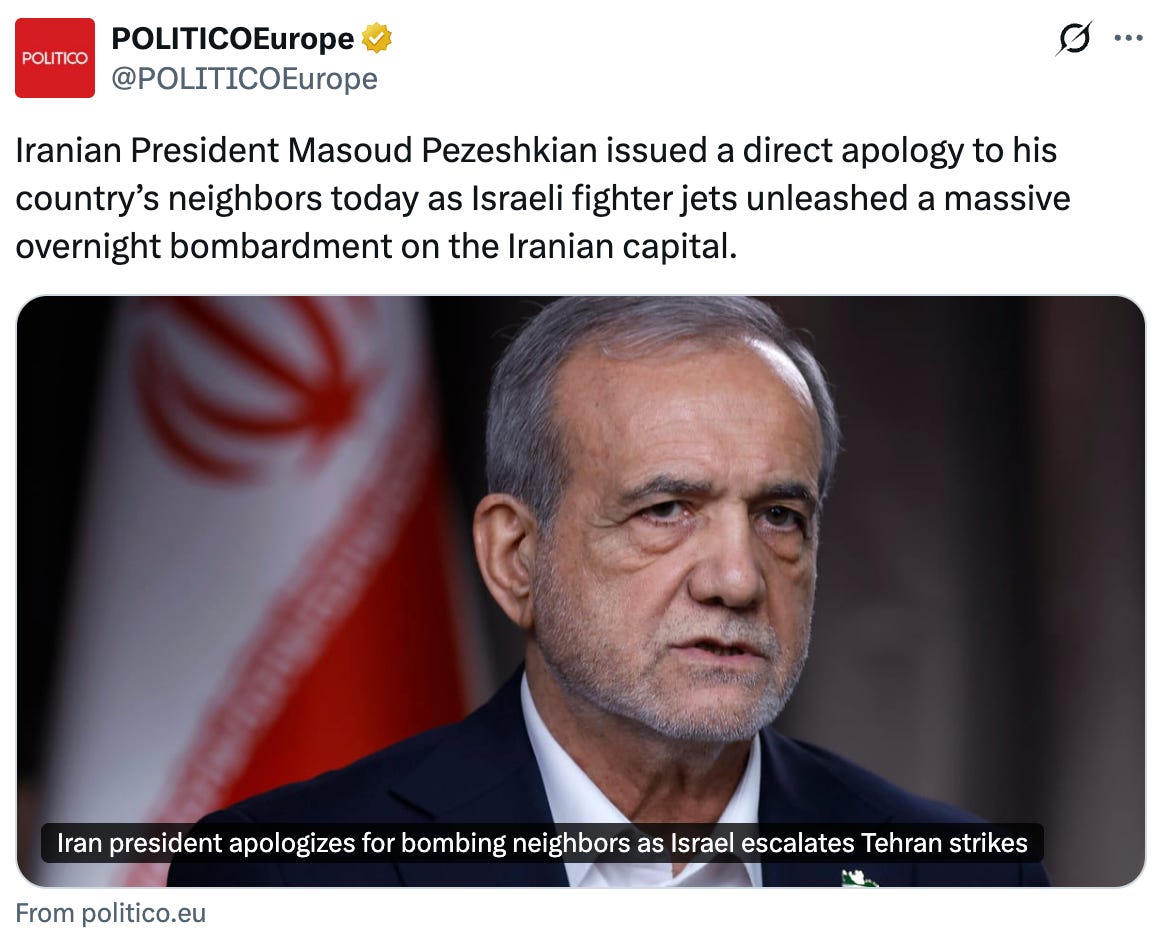
As Israeli jets completed another wave of strikes on Tehran, flying from airbases inside Israel where the F-15Is and F-16Is of the Israeli Air Force have run sustained combat missions since February 28, Iranian President Masoud Pezeshkian did something unexpected. He apologized. Not to Washington. Not to Tel Aviv. To his neighbors.
The statement, delivered via state television on Saturday, one week into the war, offered personal regret to surrounding states for strikes Iranian forces had conducted against them. Its language was conciliatory. Its targeting was not.
The same day, Iran’s armed forces spokesman, General Abolfazl Shekarchi, clarified who Iran had and had not struck. Tehran, he said, had “not hit countries that did not provide space for America to invade our country.” Hours after Pezeshkian’s apology aired, the IRGC’s naval drone unit struck Al Dhafra Air Base, south of Abu Dhabi, the facility hosting US Fifth Air Force assets in the UAE.
Pezeshkian’s apology separates the GCC nations from the American military infrastructure those nations have agreed to host. It addresses neighbors, not regimes. It expresses remorse toward peoples, not toward the basing agreements signed behind closed doors. The IRGC action immediately after confirms the distinction is not rhetorical. The apology covers the neighborhood. It does not cover Al Dhafra, Al Udeid, the Fifth Fleet compound in Manama, Prince Sultan Air Base outside Riyadh, or Camp Arifjan in Kuwait, each of which has been struck by Iranian missiles and drones since the war began.
The targets are not random GCC assets. They are US military infrastructure embedded in GCC territory: the largest American air base in the Middle East at Al Udeid in Qatar, struck by ballistic missile on March 4; the Fifth Fleet headquarters in Bahrain, hit by a Shahed-136 drone; Prince Sultan Air Base in Saudi Arabia, where air defenses intercepted three Iranian ballistic missiles in a single exchange. These are the nodes of the command and logistics architecture that CENTCOM has used to sustain over 3,000 strikes on Iran in the first week of the war.
The US strikes on Iran have come from carriers: the USS Abraham Lincoln in the North Arabian Sea, the USS Gerald R. Ford in the Eastern Mediterranean, and from what CENTCOM describes as “planes based around the Middle East.” The Israeli strikes have come from Israel’s own airbases. The GCC states did not launch the war. But their territory, their airspace, and their port infrastructure are woven into the operational fabric that makes the war executable.
Pezeshkian’s apology puts that on the record. GCC populations watching are told Iran does not hold them responsible. GCC governments are told that the moment an attack on Iran originates from their soil, the insulation ends. The interim leadership council that approved the policy stated this directly: neighboring states will not be targeted unless an attack against Iran originates from their territory. The apology and the doctrine arrived in the same statement.
Pezeshkian attributed earlier strikes on neighbors to “fire at will” decisions made by IRGC commanders operating without central direction after Khamenei’s assassination and the deaths of senior military leadership in the opening hours of the war. It is the version of events most useful to a GCC government that wants to reduce its exposure without publicly confronting Washington, and it gives Gulf states the face-saving exit that a patron relationship with the United States no longer can.
Trump read the apology as surrender and said so on Truth Social within hours. Pezeshkian said in the same statement that US demands for unconditional surrender were “a dream they should take to their grave.” The apology was a recalibration of targeting doctrine, one that narrows the list of Iran’s enemies at the exact moment Iran most needs to narrow it.
The IRGC hit Al Dhafra the same afternoon. The apology was for the UAE. Al Dhafra is American. Iran had already decided which was which.
Doctrine.