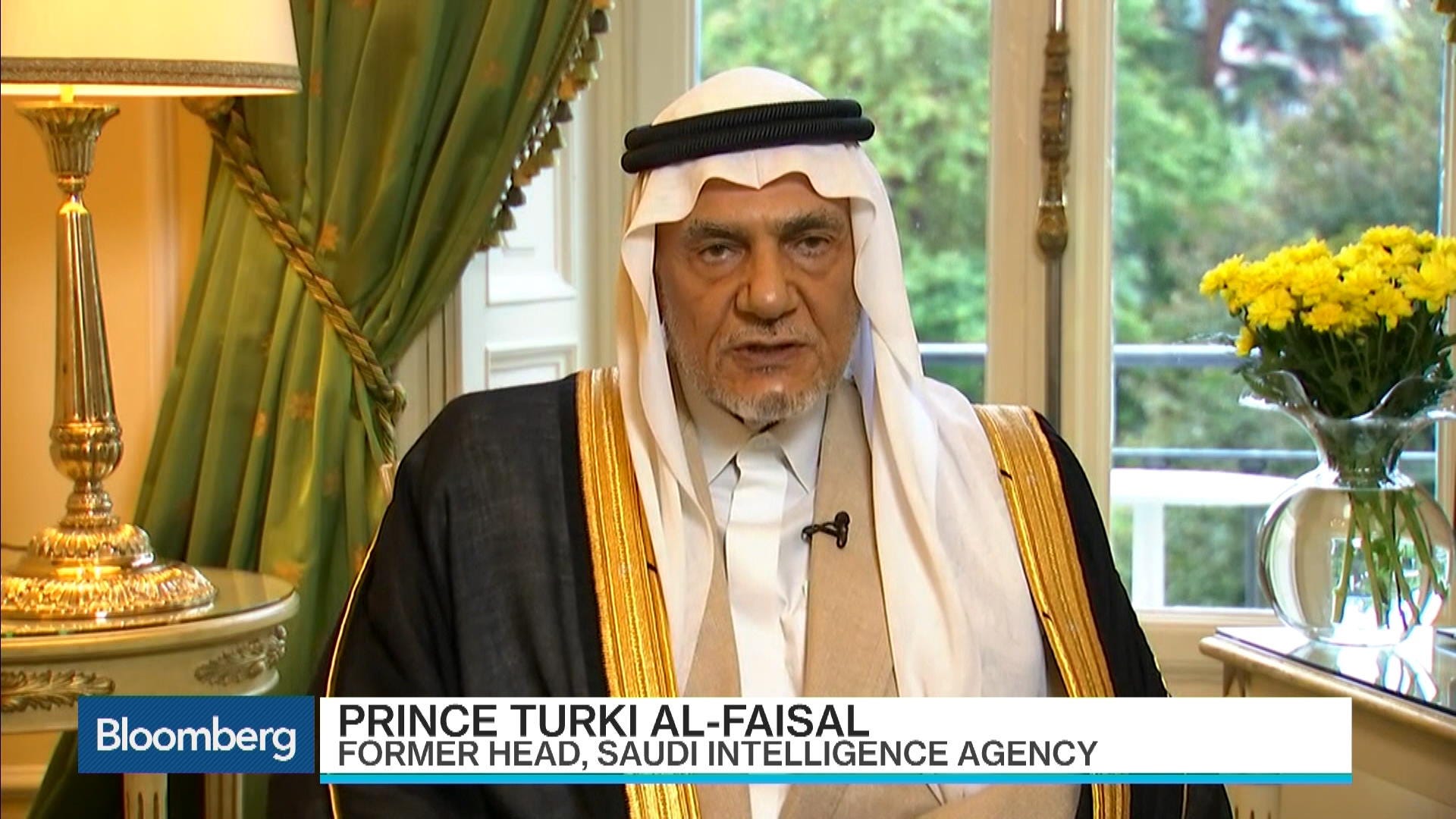
Prince Turki al-Faisal's Op-Ed
When the former head of Saudi intelligence documents a de-escalation channel that bypassed the United States entirely, and Washington says nothing, the silence is the answer.
The phrase arrives in the second paragraph, without qualification: “the US-Israeli war on Iran.” Not a conflict. Not a military operation. Not Washington’s preferred formulation, which has spent seventy days carefully separating American strategic objectives from Israeli political ones. The man who wrote it ran Saudi intelligence for twenty-four years, served as ambassador in London and Washington, and spent his career reading exactly this kind of language in classified traffic from foreign capitals. He is seventy-nine years old and a son of King Faisal. He wrote those four words knowing every implication, and he published them anyway.
Prince Turki al-Faisal’s piece in Asharq Al-Awsat on May 8, 2026 has been processed by most of the Western press as a defense of Mohammed bin Salman and a rebuke of Israel. Both readings are correct. Neither reading is sufficient. What Turki published is a transmission, and the discipline required to understand it is the same discipline required to read any intelligence communication: identify the sender, identify the channel, identify each recipient, and then read what is addressed to each of them separately. The piece has four distinct destinations. Every sentence is load-bearing. None of it was written for the reader who thinks it was written for them.
Asharq Al-Awsat was founded in London in 1978 and has been controlled since 2003 by entities linked to the Saudi royal family through the Saudi Research and Media Group. It is not a state organ in the crude sense of a ministry bulletin. It is something more precisely calibrated: an outlet that carries the weight of official Saudi thinking while maintaining enough editorial distance from the palace to function as a plausible-deniability channel. When Riyadh needs a position to exist in the public record without a press conference, without an attribution to the foreign ministry, without a spokesperson who can be questioned and contradicted, this is where it goes.
Turki al-Faisal is not simply a prominent person who chose a prominent platform. He is himself a platform. As director of the General Intelligence Directorate from 1977 until ten days before September 11, 2001, he managed Saudi Arabia’s covert relationships with the CIA, with Pakistani ISI, with Palestinian factions across the ideological spectrum, and with the Afghan mujahideen during the Soviet war and its bloody aftermath. He was Riyadh’s back-channel to everything that could not be discussed at the level of states and foreign ministries. The architecture of covert Saudi influence during the Cold War’s last decades ran substantially through his office. He then served as ambassador to the Court of St James’s from 2002 to 2005 and to Washington from 2005 to 2006, accumulating in those years personal relationships with every significant figure in the American national security apparatus and a granular understanding of how Washington parses signals from the Gulf.
He left the GID ten days before September 11. That timing, never fully explained, has followed him through two decades of public life and given his every public statement a weight that transcends his formal post-retirement status. When Turki al-Faisal speaks, people in intelligence services on four continents listen, because he is one of the last figures alive who has sat at the centre of decisions that shaped the modern Middle East and who still speaks publicly. He published seventy days into the war. That precision is not incidental. It is far enough from the opening shock to allow careful positioning, and close enough to the active conflict that the message still carries operational weight.
“The US-Israeli war on Iran.” Under Turki’s byline, in a Saudi outlet of record, that phrase is now a formal Saudi diplomatic characterization of the conflict, entered into the public record by the most credentialed non-governmental voice Saudi Arabia possesses.
Washington is trapped and has been since the piece published. To rebut Turki’s framing requires the United States to publicly draw a line between its own objectives and Israel’s, which in the context of a joint military operation is either politically impossible or an open confession of alliance fractures that both governments have spent months insisting do not exist. To stay silent means accepting, without challenge, that the former director of Saudi intelligence has characterized the United States as a co-aggressor in a war against a Muslim-majority nation, in the most read Arabic newspaper in the world, and that Washington had nothing to say about it. Washington chose silence. That silence is now part of the record, and it is doing work.
The second layer is more corrosive, and the Western press has declined to name what it actually means. Turki writes that Israel had a deliberate plan to ignite a Saudi-Iran war. That the plan would have sent thousands of Saudi sons and daughters to die in a battle the Kingdom had no business fighting. If that accusation is taken as a formal Saudi diplomatic position, Washington faces a specific and ugly accounting: either the United States knew about Israel’s effort to widen the war to include Saudi Arabia and permitted it, making Washington a co-conspirator in a scheme to sacrifice Arab lives for Israeli regional dominance, or Washington did not know, meaning Israel ran an unauthorized operation inside a war Washington co-launched, using American cover for an objective America had not sanctioned. One reading makes Washington complicit in a plan to use Saudi Arabia as expendable. The other makes Washington a fool whose war was hijacked by its junior partner. Turki did not specify which reading he holds. He placed the question where it cannot be extracted, and Washington’s silence is functioning as a confession to one of the two options, without specifying which.
There is a third dimension in this section that has received almost no attention: what Turki’s vocabulary does to the Abraham Accords architecture. Washington’s grand Middle East strategy since 2020 has rested on a single load-bearing premise, which is that Saudi Arabia will eventually normalize relations with Israel, and that this normalization will resolve the Arab-Israeli conflict as a political category, consolidate a US-Israel-Gulf alliance against Iran, and ratify two decades of American diplomatic investment. Saudi Arabia was the prize. The UAE, Bahrain, Sudan, and Morocco signed. Saudi Arabia’s accession was the endgame. Read Turki’s piece and ask whether a treaty with Israel is imminent. He writes that Israel tried to destroy Saudi Arabia. He writes that “Israel would have imposed its will on the region” had Saudi Arabia been drawn into the war. He writes of a battle in which the Kingdom had no stake. That is not the vocabulary of a nation moving toward partnership with Israel. That is the vocabulary of a nation that has just watched a neighbor attempt to use it as cannon fodder, and is writing down what it saw.
Between February 28 and May 8, Iranian strikes landed on Gulf infrastructure. Saudi Arabia absorbed them without military response, a restraint maintained under pressure from internal factions who read silence as submission and argued, with some logic behind them, that deterrence theory does not reward a state that absorbs attacks without reply.
The Abqaiq and Ras Tanura facilities that Turki names are not peripheral targets. Abqaiq is the largest crude oil processing and stabilization plant in the world, handling roughly seven percent of global daily supply. A sustained successful strike there would not just damage Saudi Arabia. It would convulse the global oil market in ways that no country on earth, including Iran, would benefit from. That Tehran struck at these facilities and Saudi Arabia still chose not to retaliate is a specific and calibrated act of strategic discipline. Turki is entering that act into the diplomatic ledger.
The claim he is filing with Tehran is precise: Saudi Arabia held its fire. Saudi Arabia is owed. In whatever negotiation follows, whether that concerns the terms of Gulf security architecture after the war, the management of the Houthi endgame in Yemen, OPEC+ quota flexibility as Iran eventually attempts to restore its oil export capacity, or the long-unresolved question of Shia communities in Saudi Arabia’s Eastern Province and Bahrain, Riyadh is arriving at the table with documented restraint in hand. Turki does not threaten. He does not name the specific debt he is collecting. He places the receipt where Tehran’s diplomats will find it, and leaves the terms of repayment deliberately open.
The literary flourish at the end of Turki’s piece, dismissed as decorative by most English-language coverage, is the most specifically targeted section in the entire transmission. He quotes the late Saudi poet Prince Badr bin Abdul Mohsen and dismisses his critics as “dogs” barking while MBS’s wisdom held. That is not rhetoric aimed at foreign audiences. It is aimed at a specific, unnamed, and identifiable faction inside the Saudi establishment.
The internal debate during the war’s worst weeks ran between two positions that both had genuine arguments behind them. The restraint faction, which won, held that absorbing the strikes was necessary to preserve Saudi infrastructure, avoid a war of attrition against a country that could not destroy the Kingdom but could make it bleed, and emerge from the conflict with leverage intact. The hawks argued that absorbing Iranian strikes without response was catastrophic for deterrence, for Saudi Arabia’s credibility as a regional power, and for the honor logic that underpins Gulf political culture in ways that Western analysts consistently underestimate.
What neither argument in the hawks’ camp appears to have fully processed was the specific scenario Israel needed from them. The operational logic, as Turki describes it, required Saudi Arabia to retaliate. An Iranian strike on Abqaiq, a Saudi strike on Iranian territory in response, Iranian escalation against the Saudi coast and the Gulf desalination infrastructure, and Saudi Arabia is no longer a stable custodian of the world’s largest oil reserves. It is a war theater. Israel neutralizes its primary adversary and its primary regional competitor simultaneously, at the cost of a war fought entirely by other people. The hawks who argued for retaliation were, regardless of their intent, arguing for the execution of Israel’s plan. Turki is saying that publicly, under his name, and the men he is talking to know exactly who they are.
The poet’s quote is not closure. It is a warning. It tells the hawks inside the Saudi establishment that the official narrative is set, that MBS carried the decision, that history will record the choice as wisdom, and that anyone who attempts to revisit the argument in the post-war political environment will be positioned as a man who wanted to burn Saudi Arabia down to satisfy his own instincts. The piece locks the internal record before the war ends and the revisionist accounts begin.
One sentence in Turki’s piece has been almost entirely ignored in Western and Gulf coverage. He credits Saudi Arabia and Pakistan, together, with “extinguishing the fire of fighting” and giving “advocates of peace hope.” That is not a diplomatic pleasantry. He is saying that Pakistan was an active participant in whatever back-channel operated during the worst weeks of the conflict, and that the channel mattered enough to be named in a document intended for four sophisticated audiences simultaneously.
To understand why Pakistan and not any other actor, the history needs to be briefly excavated. Islamabad’s relationship with both Riyadh and Tehran is not simply geographic or religious. It is structural and specific. The Kingdom financed Pakistani military budgets, underwrote IMF bailouts through bilateral deposits when the international community would not move fast enough, and employs roughly two and a half million Pakistani workers whose remittances are material to Pakistan’s foreign exchange position. The Saudi-Pakistani security relationship runs directly between the two intelligence services, built during the Afghan jihad of the 1980s when the ISI was the primary ground operator for a joint CIA-Saudi covert operation against the Soviet Union. Turki al-Faisal was the Saudi intelligence chief running that operation. He knows the ISI’s capabilities and its leadership’s judgment from thirty years of shared operational history.
The Iran dimension is different but equally structural. Pakistan shares a 909-kilometer border with Iran. It has a Shia Muslim population of between thirty and forty million people, making sectarian escalation between Riyadh and Tehran an existential domestic political problem for any Pakistani government. It spent three decades absorbing the consequences of Saudi-Iranian proxy competition across Punjab and Karachi in the 1980s and 1990s, in a wave of targeted killings and sectarian bombings that Pakistani institutions have never fully reckoned with. Islamabad cannot afford to be deployed as a Saudi instrument against Tehran. It also cannot afford to openly defy Riyadh. That bind, which Pakistani governments have navigated with varying levels of skill for forty years, is precisely what makes Pakistan useful as a mediator. It has no clean side to be on, which means Tehran can receive its communications without dismissing them as Saudi proxies, and Riyadh can trust that Islamabad will not sacrifice Saudi interests to curry favor with Iran.
There is one more dimension that no coverage has touched. Pakistan is the only nuclear-armed Muslim-majority state in the world, and its nuclear program was financed in substantial part by Saudi money during the Bhutto and Zia eras. Whatever one makes of the specific terms of that arrangement, it gave Saudi Arabia a specific form of leverage with Pakistan and gave Pakistan a specific form of obligation to Riyadh that has structured the relationship ever since. When Islamabad picks up the phone to mediate between Riyadh and Tehran, it is not a neutral broker. It is the keeper of a nuclear deterrent that Saudi money helped build, calling on debts that run in multiple directions simultaneously.
What Turki is telling us is that the de-escalation architecture that apparently mattered ran entirely outside American mediation. The United States, which has spent fifty years billing itself as the indispensable broker for Gulf security and charging accordingly in basing rights, arms contracts, and geopolitical deference, was not in the room. The channel ran Riyadh to Islamabad to Tehran. Washington found out by reading the newspaper. What that back-channel carried, who authorized each step of it, and what specific commitments it produced, nobody has reported. That story exists in the records of three intelligence services and has not been told.
Turki does not call for a ceasefire. He does not express sympathy for Iranian civilian casualties. He does not criticize the United States by name. He does not demand Israeli accountability through any institutional mechanism. He does not invoke international law, the United Nations, or any framework of collective security. He does not call for an investigation into the Israeli proxy-trap operation he has just publicly attributed. The list of what he does not say defines the precise boundaries of what Saudi Arabia will and will not commit to at this stage, and every item on it is a calculation made by someone who spent his career deciding what to say and what to withhold.
The sentence carrying the most structural weight is the one that has attracted the least attention: “a battle in which we had no stake.”
Taken as a formal Saudi diplomatic position, that sentence is a public liquidation of fifty years of American strategic architecture in the Gulf. The arrangement functioned as follows. Saudi Arabia bought American weapons at a scale that made it the largest single purchaser of US arms for most of the last two decades: F-15SA fighter jets, THAAD missile defense batteries, Patriot systems, tens of billions in ordnance and maintenance contracts. Saudi Arabia hosted American military infrastructure, from the Fifth Fleet headquarters in Bahrain to pre-positioned equipment at Prince Sultan Air Base. Saudi Arabia priced its oil in dollars, which sustained the petrodollar system that has underwritten American monetary dominance since the Nixon administration ended Bretton Woods. Saudi Arabia funded American political infrastructure through decades of lobbying, think-tank financing, and investment relationships that made Riyadh one of the best-connected foreign capitals in Washington.
In return, Washington guaranteed Saudi security against Iran. The Carter Doctrine of 1980 formalized the commitment, promising American military force against any external threat to Gulf oil supplies, which in practice meant against Iran. Every subsequent administration ratified the arrangement and deepened it. The security guarantee justified the basing rights. The basing rights justified the arms sales. The arms sales justified the diplomatic protection at the United Nations. The entire architecture held together because both parties shared a stated interest in containing Iranian power in the Gulf.
The customer paid. For fifty years, the customer paid. And when the test came, when Iranian strikes landed on Saudi infrastructure during a war that Washington co-launched, Saudi Arabia had to manage the fallout through a Pakistani back-channel because the protection the customer had been paying for was not available in the form that mattered. Turki is the former director of the intelligence service of the country that wrote those checks. He wrote “a battle in which we had no stake” knowing the full history of what the Kingdom purchased and what it received. That is not a throwaway phrase in a defensive op-ed. It is a contract dispute filed in public.
Saudi Arabia absorbed the war without fighting it. The restraint is documented now, entered into the record by Turki’s own hand, carried simultaneously to Washington, Tehran, the internal hawks, and an international readership that has not yet absorbed what it was told. Saudi Arabia demonstrated that it can hold its fire under provocation, manage its own diplomatic channels without American mediation, and enter the post-war order with leverage intact and infrastructure undamaged.
What Turki’s piece cannot answer, and may be specifically designed to leave open, is what Saudi Arabia intends to build with that position. The post-war Gulf security architecture will need to be renegotiated. The normalization project with Israel is damaged beyond its previous form. The American basing arrangement will face questions it has not faced since the 1970s. The China-mediated Saudi-Iranian rapprochement of 2023 did not collapse under the pressure of the war. Pakistan has demonstrated value as a communication channel that Washington cannot replicate. All of these are live variables, and Turki addressed none of them directly.


