Real Estate Agents Bring Us Closer To A World War
Iran-USA conditional ceasefire still in effect, but will it hold?
When Washington and Tehran met in Islamabad for the first time since 1979, the United States sent a vice president who had built his career opposing foreign wars, a son-in-law with Saudi money in his fund, Netanyahu on speed dial, and a property developer who could not read a nuclear diagram. Iran sent seventy-one people, photographs of dead children, and forty-six years of broken American promises.
The blood-stained school bags were in the front row of the plane.
Mohammad Bagher Ghalibaf placed them there himself, before the flight left Tehran on the evening of Friday, April 11. Children’s shoes were arranged beside them, and photographs: girls and boys between seven and twelve who had been at their desks at the Shajareh Tayyebeh primary school in the southern Iranian city of Minab on the morning of February 28 when the missiles arrived. The Iranian government counted 168 dead. Ghalibaf sat across from the shoes and the photographs and posted an image before takeoff: “My companions on this flight. #Minab168.” The seventy-one-member delegation he was leading to the first direct engagement between American and Iranian officials since the 1979 Islamic Revolution adopted the name without deliberation. It appeared on no official agenda. No American briefer, before or after Islamabad, acknowledged it.
He was flying to negotiate with the government whose weapons, by the conclusions of Amnesty International, Human Rights Watch, and two separate internal US military investigations, had most likely killed those children.
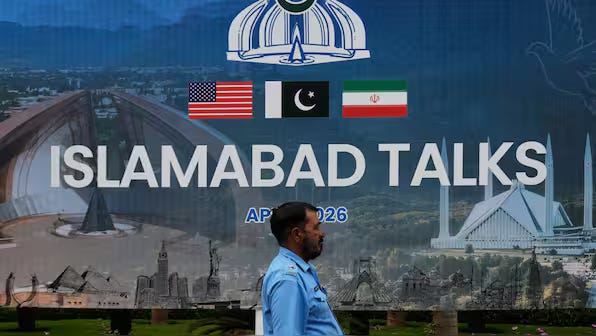
The Serena Hotel was surrounded by Pakistani rangers. A billboard near the entrance announced the talks in block letters. The Red Zone was sealed. Islamabad had been preparing for days, the city’s normally quiet streets absorbed into a security perimeter that turned its own centre into a temporary state. A nineteen-year-old student named Khizra Zaheer, standing in a parking lot near the venue, said to a reporter that she was “a bit surprised.” “When did Pakistan get so influential?” she asked. It was the right question and the wrong person to put it to. It should have been addressed to the American delegation, whose lead envoy had spent the previous six weeks presiding over a war that elevated Islamabad, briefly and improbably, to the position of the world’s most consequential city.
The Iranians arrived before the Americans. They came in black, all seventy-one of them, in mourning for Ayatollah Ali Khamenei, killed in the joint US-Israeli strikes of February 28, and for the officials, soldiers, and students who came after. Before a single American had disembarked, before the first Pakistani mediator had moved between rooms, Iran had communicated its position in the only language that needed no interpretation: we remember everything, and we have brought the record.
Mohammad Bagher Ghalibaf is not a diplomat. He commanded the IRGC Aerospace Force from 1997 to 2000, during which Iran built its first operational drone programme. In July 1999, when student protesters filled the streets of Tehran and President Mohammad Khatami hesitated, Ghalibaf was one of twenty-four IRGC commanders who signed a letter warning the civilian president that if his government did not restore order, the military would. The letter is a precise document about what the IRGC is: an institution that treats elected authority as provisional, and adjusts it when conditions demand. Ghalibaf was not the most senior signatory. He signed anyway.
He ran for president in 2005, 2013, and 2017, losing each time. He withdrew before the 2024 runoff. That record, three formal losses at the ballot alongside continued institutional survival inside the IRGC command structure, describes a specific Iranian political geography: the military outlasts elections, and a man with the right position does not need the presidency. He arrived in Islamabad as parliamentary speaker, the formal authority that allowed him to lead a sovereign delegation without deferring to the Foreign Ministry’s diplomatic conventions. The choice to elevate Ghalibaf and subordinate Araghchi was the IRGC announcing, in the only language institutions speak, that it controlled this negotiation.
Abbas Araghchi was there, too. He negotiated the JCPOA in 2015, built its technical architecture clause by clause, and arrived in Islamabad as foreign minister, the most experienced nuclear negotiator in any room the talks would occupy. He was not leading the delegation. He communicated with his German counterpart, posted that Iran entered the negotiations in “complete distrust,” and watched the soldier lead. The diplomat who built the last nuclear deal had been made a witness to the next failed one.
Araghchi had tried to prevent the war. On February 25, he called the possibility of a deal “within reach.” On February 26, he submitted a seven-page proposal through Oman’s foreign minister Badr Al-Busaidi, who had spent months carrying messages between the American and Iranian delegations at a residence in Geneva. Al-Busaidi called the session “significant progress” and announced that technical teams would meet in Vienna the following week. Araghchi said the two sides had identified “the main elements of a possible agreement.” Two days later, before those teams could board their planes to Vienna, the United States and Israel launched the strikes.
In the weeks that followed, Araghchi found the language for what had happened in the professional vocabulary of the men across the table from him. “When complex nuclear negotiations are treated like a real estate transaction,” he wrote, “and when big lies cloud realities, unrealistic expectations can never be met. The outcome? Bombing the negotiation table out of spite.”
Steve Witkoff is the founder of the Witkoff Group, a Manhattan property development company. His four-decade friendship with Trump began on a golf course. He co-founded World Liberty Financial, a cryptocurrency venture, with Trump’s sons; a UAE-backed firm subsequently invested two billion dollars in the venture. He led the American side in Geneva. In March, the Arms Control Association published a formal analysis grounded in recordings and transcripts from two of his post-strike press briefings. Its conclusion: Witkoff “did not have sufficient technical expertise or diplomatic experience to engage in effective diplomacy.” The analysis documented the specific error that most likely mattered. Witkoff had told reporters that the Tehran Research Reactor, a sixty-year-old facility for producing medical isotopes built and supplied by the United States in 1967 and operating under continuous IAEA monitoring, was a covert weapons stockpiling operation. Elena Sokova, executive director of the Vienna Centre for Disarmament and Non-Proliferation, called those characterisations “confusing and misleading,” riddled with technical errors, and noted that research reactors are structurally incapable of uranium enrichment for any purpose. Witkoff presented this assessment to Trump as his account of the Geneva talks. Trump told reporters he was “not happy” with Iran’s approach to negotiations. The following day, the bombs fell.
Neither Witkoff nor Jared Kushner had brought nuclear technical experts to Geneva, per the account of a senior Middle East diplomat with direct knowledge of the room. The meeting that preceded a war was conducted without anyone on the American side qualified to evaluate the seven-page proposal that Araghchi had submitted through the Omani mediator.
Kushner is the president’s son-in-law. His fund, Affinity Partners, collected $157 million in management fees from foreign governments by March 2026, including $87 million from the Saudi government. While Kushner was meeting Iranian officials in Geneva in February, Affinity was in discussions with Saudi Arabia’s Public Investment Fund about a capital raise of at least five billion dollars. A congressional investigation launched in March demanded records of every foreign government meeting he had attended since January 2025. The investigation was active when he stepped off the plane in Islamabad. A Gulf diplomat, speaking to MSNBC before the talks, said US intermediaries had been “acting in Israeli interests to pressure the United States into a military confrontation.” Kushner has maintained a decades-long friendship with Benjamin Netanyahu, designed the 2020 Abraham Accords without consulting the Palestinians, and told a senior diplomat, when asked about the history of prior nuclear negotiations, that there was nothing in it worth learning.
Senator Mark Kelly, a combat pilot and former Navy captain, said it at a convention in New York on the morning the Islamabad talks began: “You can’t send two real estate developers to negotiate a peace with another region.” Republican Senator Thom Tillis called the arrangement something that “doesn’t make any sense.” The criticism came from both parties. The delegation’s composition did not change.
At the airport, before entering a single meeting room, Ghalibaf stated Iran’s terms in language so exact it barely sounded like a statement: “We have good intentions. We do not trust.” Then he named the ground of that mistrust. “Twice within less than a year, in the middle of negotiations, despite the goodwill of the Iranian side, they attacked us and committed multiple war crimes.” The first was the June 2025 Twelve-Day War, launched while Oman was mediating. The second was the February 28 strikes, launched 36 hours after Araghchi’s seven-page proposal was in the Omani mediator’s hands.
Iran’s ten-point negotiating framework, delivered via Pakistan before the talks began, was the written form of that statement. A halt to Israeli strikes on Lebanon as a precondition for any permanent agreement. The release of approximately seven billion dollars in frozen assets across multiple jurisdictions. Formal guarantees around Iran’s remaining nuclear infrastructure and the right to civilian enrichment. A protocol for reopening the Strait of Hormuz under Iranian coordination. War reparations from the United States. A ceasefire architecture covering the entire regional theatre: Lebanon, Gaza, and the Gulf.
American officials called this maximalism. Each of those points corresponded to a specific prior sequence: a commitment made and violated, a clause acknowledged and then reinterpreted, a process advancing and then bombed. The frozen assets had been agreed under the JCPOA and blocked when Trump withdrew in 2018. The civilian enrichment right had been acknowledged in principle in Geneva and then cited by Witkoff as evidence of weapons intent. Lebanon’s inclusion in the ceasefire had been confirmed in Pakistan’s prime minister’s public announcement and denied by Netanyahu within hours. Every line on Iran’s list was a documented debt, submitted in writing, in a room with Pakistani witnesses, to create a record that would survive whatever came next.
Iran’s First Vice President Mohammad Reza Aref named the question directly from Tehran as the delegations assembled: a deal was possible if Washington prioritised “America First” interests rather than “Israel First” ones. Who, at the table in Islamabad, actually controlled the American position? Vance, who admitted speaking with Trump “half a dozen times, a dozen times” across the twenty-one hours? Or Netanyahu, who announced publicly, while the talks were underway, that Israel’s campaign against Iran “is not over” and that he intended to disarm Hezbollah on his own schedule?
The ceasefire was already damaged before the delegations arrived. When the two-week truce was announced on April 7 and confirmed by Iran on April 8, Pakistan’s prime minister had explicitly included Lebanon in its scope. Netanyahu’s office denied it within hours. On April 9, the Wednesday the ceasefire formally took hold, Israel launched what Lebanon’s health ministry called the deadliest single day of strikes since September 2024: at least three hundred and fifty-seven people killed, residential neighbourhoods struck without warning. Araghchi posted publicly: “The US must choose, ceasefire or continued war via Israel. It cannot have both.” Iran closed the Strait of Hormuz. The IRGC joint command said it had its “fingers on the trigger.”
Before boarding his plane, Ghalibaf had posted his preconditions: Lebanon, the frozen assets. Vance could deliver neither. One required Netanyahu’s compliance. The other involved funds across multiple legal jurisdictions. Ghalibaf inserted those conditions knowing they could not be met. A delegation that builds exit conditions it cannot satisfy has already decided what the talks are for.
The talks at the Serena Hotel ran for twenty-one hours. They began with Pakistani mediators moving between separate rooms, shifted to direct engagement, and then retreated to written exchanges: proposals submitted, reviewed by expert teams, answered in writing. When a negotiation moves from conversation to paper, it means the conversation has stopped producing forward motion and both sides need the documentary record more than the dialogue.
During the talks, Trump posted on Truth Social that Iran was doing “a very poor job, dishonorable some would say, of allowing oil to go through the Strait of Hormuz.” Two US Navy guided-missile destroyers transited the strait, the first American warships to do so since February 28. Trump separately announced that all twenty-eight Iranian mine-laying boats were “lying at the bottom of the sea” and that Washington was clearing the strait “as a favor to Countries all over the World, including China, Japan, South Korea, France, Germany, and many others.” The announcements were made while Araghchi and Ghalibaf were in the building.
When the talks ended, Vance stood before reporters outside the hotel: “The bad news is that we have not reached an agreement. And I think that’s bad news for Iran much more than it’s bad news for the United States of America.” He said Iran had “chosen not to accept our terms.” He said Iran’s nuclear programme had been “destroyed” but Washington still needed a “fundamental commitment” from Tehran not to rebuild it. Then he said he was leaving Iran a “final and best offer.”
It is the terminal move in a real estate negotiation. You use it when you have decided the other party will accept your last number or lose the deal.
Ghalibaf posted within the hour: “My colleagues raised forward-looking initiatives, but the opposing side ultimately failed to gain the trust of the Iranian delegation.” Tasnim attributed the collapse to US “overreach and ambitions.” The Foreign Ministry called Washington’s demands “excessive and unlawful.” Fars, citing a source close to the negotiating team, said Tehran had “no plan for a next round of negotiations” and was “in no hurry.”
Vance waved from the top of the stairs. He boarded Air Force Two. He left.
Iran’s former Vice President Ataollah Mohajerani said to Fars, without softening: “The US proposed negotiations, arranged a mediator, agreed to Iran’s conditions, and then sought at the negotiating table what it had failed to gain on the battlefield.”
He was describing a sequence the record fully supports. Twice in less than a year, the United States had used negotiations with Iran as the staging ground for military escalation: the June 2025 Twelve-Day War launched while Oman was mediating, and the February 28 strikes launched 36 hours after a seven-page proposal was in the mediator’s hands. The Omani foreign minister, who had built what he called “significant progress” across three rounds in Geneva, found himself in Washington the day before the February strikes, still relaying the message that the talks were going well. It is not known what he was told and when.
Ghalibaf had built the Islamabad preconditions to account for exactly this. He came with conditions that could not be satisfied, sat in a room for twenty-one hours, submitted written proposals before Pakistani witnesses, and named every broken promise by its category. The delegation named itself after the dead. It brought the dead’s belongings on the plane. Every document Iran submitted was a debt notice addressed to a creditor who had already chosen the battlefield over the table.
A conditional ceasefire expiring April 22 leaves Washington with no framework, no extension mechanism, and a president who publicly threatened civilizational annihilation if the deal fails, now holding what his vice president called a final and best offer that the other side has declined to accept. The delegation that boarded Air Force Two without an agreement was the one that needed one.
The Strait of Hormuz remains under operationally contested terms. Iran says coordination with its armed forces is required for safe passage. Washington says it has cleared the strait and Iran’s authority over it has ended. Two American destroyers are now inside it. Who controls the waterway through which forty percent of the world’s seaborne oil flows was not resolved at the Serena Hotel. It was deferred.
Iran has no functioning air force, according to Trump. It has mines. It has the Strait, in the sense that it retains the capacity to make transiting it lethal. And it has the record: seventy-one people who arrived in black, named themselves after children, and sat across a table for twenty-one hours building the documentary foundation that Washington will have to refute the next time it asks the world to believe the negotiations were genuine and the strikes were a last resort.
What comes after April 22 is the question Islamabad did not answer.
The photographs are on their way back to Tehran.


