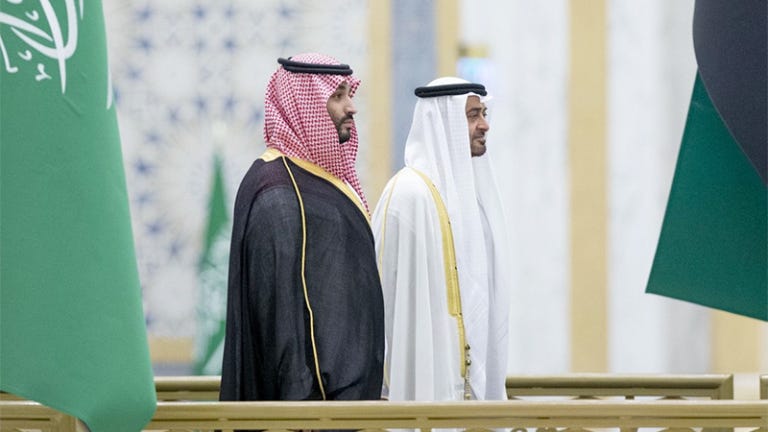
Rift in the Gulf: Saudi Arabia Confronts the UAE’s Regional Recklessness
How Riyadh’s decisive action in Yemen exposes the limits of Abu Dhabi’s proxy strategy and America’s sidelined role in a fracturing alliance
The once-formidable alliance between Saudi Arabia and the United Arab Emirates has ruptured into open confrontation, with Riyadh launching an unprecedented campaign against Abu Dhabi’s regional ambitions. What began as quiet diplomatic tensions exploded into military action in late December 2025, when Saudi forces conducted airstrikes against UAE-backed separatist forces in Yemen, marking a dramatic escalation between two nations that once stood shoulder-to-shoulder against common threats. The United States, despite its deep strategic ties to both countries, has remained conspicuously passive, leaving the conflict to unfold with minimal American intervention.
At its core, this rupture represents a collision between competing visions for regional order. One vision prioritizes state sovereignty and territorial integrity. The other tolerates fragmentation and non-state actors as instruments of influence. This philosophical divide mirrors an observation offered a decade ago at a panel in Riyadh: the world is no longer divided between East and West, but between order and disorder. That framing captures the essence of what is unfolding today between Riyadh and Abu Dhabi.
Historical Foundations: From British Protection to Saudi Patronage
The current confrontation marks a dramatic reversal of a relationship built on Saudi patronage and genuine goodwill. Historically, Saudi Arabia took pride in being the only Gulf Cooperation Council country never occupied by foreign powers and consistently challenged British dominance in the Middle East. Before its formation, the UAE existed as the Trucial States under British protection, with London controlling defense and foreign affairs while local rulers governed internally. Riyadh consistently encouraged independence and self-rule across the Arab world, as it had done from the Levant to North Africa.
When Britain decided to end its presence in the Gulf, Saudi Arabia played a central role in supporting the newly formed UAE. King Faisal was among the first leaders to recognize the UAE and provided substantial political and financial backing in the early 1970s. This was not mere diplomatic courtesy but active mentorship of a fledgling state by the region’s established power.
As the UAE developed rapidly in subsequent decades, Saudis viewed its progress with genuine pride. Dubai’s economic transformation in the 1990s and 2000s offered a successful non-oil development model that many Saudis celebrated as a modern Arab success story. The enthusiasm was authentic. Dubai represented what Arab ingenuity and ambition could achieve when given stable governance and strategic vision.
Saudi Arabia positioned itself as the GCC’s strategic depth and security backbone. This role manifested clearly during the 1991 liberation of Kuwait, when Saudi territory served as the staging ground for coalition forces. It appeared again in 2011 when Gulf Shield forces rapidly deployed to Bahrain to protect the island kingdom from Iranian-backed destabilization. Throughout these crises, Saudi Arabia acted as the guarantor of Gulf security, a role smaller states acknowledged and appreciated.
Early Warning Signs: The 2008 Iran Incident
This protective posture extended naturally to the UAE’s territorial disputes. When Iran began provoking the Emirates militarily over three disputed islands in the Gulf, Saudi Foreign Minister Prince Saud Al Faisal issued a forceful statement on September 9, 2008, affirming Saudi determination to support Emirati sovereignty and territorial integrity. The declaration carried weight. It signaled that any Iranian aggression against UAE territory would be treated as aggression against the broader Gulf Arab family, with Saudi Arabia prepared to respond.
Less than two months later, on October 30, 2008, Abu Dhabi surprised Riyadh by dispatching its foreign minister to Tehran to sign a comprehensive cooperation agreement. The timing stunned observers in Riyadh, Washington, and other Gulf capitals. It appeared to undermine the Saudi position and signal to Tehran that the UAE valued bilateral relations more than Gulf Arab solidarity. While Saudi Arabia did not object publicly, the episode raised serious concerns about Abu Dhabi’s strategic orientation and reliability as a partner.
Those concerns deepened over subsequent years. The UAE steadily expanded economic ties with Iran, ultimately becoming Tehran’s second-largest trading partner despite international sanctions and Gulf Arab suspicions about Iranian regional behavior. U.S. Treasury Department sanctions repeatedly highlighted UAE-based networks facilitating Iranian money laundering, sanctions evasion, and terror financing. The most recent Treasury action came on January 16, 2026, underscoring the persistence of this problem.
For Saudi Arabia, the contradiction was stark. Abu Dhabi publicly aligned with Gulf efforts to contain Iranian influence while privately maintaining the commercial and financial networks that sustained Tehran’s economy and enabled its regional activities. The UAE positioned itself as both barrier and bridge to Iran, a duality that served Emirati interests but complicated broader Gulf security strategy.
The Yemen Coalition: When Unity Gave Way to Betrayal
The 2015 Yemen intervention marked both the high point of Saudi-UAE cooperation and the beginning of its unraveling. When Iranian-backed Houthi forces seized Yemen’s capital Sanaa in 2014 and threatened to overrun the entire country, Saudi Arabia assembled an Islamic coalition to restore the internationally recognized government and counter what Riyadh viewed as brazen Iranian expansion into the Arabian Peninsula. The UAE appeared fully committed to this mission, deploying thousands of troops and advanced military assets.
Riyadh rewarded this partnership generously. A bilateral strategic council was established to coordinate policies across multiple domains. Abu Dhabi was integrated deeply into Saudi Vision 2030 economic projects, with Emirati investors and developers granted privileged access to mega-initiatives transforming the Kingdom. The two nations projected an image of inseparability, with Crown Prince Mohammed bin Salman and Crown Prince Mohammed bin Zayed frequently appearing together at summits and state visits.
The trust was not reciprocated. Saudi officials gradually concluded that the UAE was exploiting joint strategic mechanisms to gather intelligence on Saudi economic plans, then pursuing parallel and competing deals independently. Projects that were supposed to involve UAE partnership mysteriously saw Emirati investors withdrawing or demanding terms that Saudi planners viewed as exploitative. Riyadh concluded that Abu Dhabi was not an economically reliable partner and began scaling back cooperation.
The decisive break came in Yemen itself. What Saudi Arabia had assumed was shared commitment to Yemeni unity proved to be profoundly different strategic objectives. While the Saudi-led coalition focused on defeating the Houthis and restoring Yemen’s territorial integrity, the UAE increasingly directed resources toward the Southern Transitional Council, a separatist movement seeking autonomous control over southern Yemen. The STC’s territorial ambitions centered on strategic assets: the port of Aden, oil infrastructure in Shabwa and Hadramawt, and areas near the Bab al-Mandab Strait, through which approximately 20 percent of global maritime trade passes.
By 2020, the scale of UAE subversion became undeniable. Abu Dhabi had effectively split Yemen’s national army, turning former allies against each other. Yemeni military units that had fought together against the Houthis now faced off against each other in southern Yemen, with UAE-backed forces seizing territory from government control. The STC was not merely a political movement advocating southern interests within a unified Yemen. It was an armed separatist force pursuing fragmentation, backed by Emirati weapons, financing, and direct military support.
The contradiction in Abu Dhabi’s approach became even starker when examined against its stated counterterrorism objectives. In 2018, an Associated Press investigation exposed what it termed a farce in UAE counterterrorism efforts. The investigation documented how Emirati-backed forces in Yemen actively recruited, financed, and empowered some of the most dangerous al-Qaeda operatives in the Arabian Peninsula. These arrangements were transactional: al-Qaeda figures received money, weapons, and territorial control in exchange for loyalty to UAE-backed commanders and cooperation against shared enemies. The arrangements directly undermined the coalition’s proclaimed mission of combating extremism.
The STC leadership itself raised profound alarm in Riyadh. Among the figures Abu Dhabi elevated and empowered were individuals with troubling backgrounds. Hani bin Buraik, who became STC vice president, was a former al-Qaeda affiliate. Aidarous al-Zubaidi, the STC leader, had according to intelligence assessments received training from Hezbollah two decades earlier. Both men were granted UAE citizenship and treated not as political statesmen who might negotiate southern grievances within Yemen’s political framework, but as militia leaders whose value lay in their ability to mobilize armed force.
Iranian statements added another disturbing dimension. Ali Larijani, then Iran’s parliamentary speaker, reportedly told Yemeni separatist figures in 2015 that Tehran did not mind two Yemens: a Shiite one in the north and a friendly one in the south. This statement, considered alongside Abu Dhabi’s actions on the ground, raised serious questions about whether Emirati and Iranian objectives in Yemen were converging despite their adversarial postures elsewhere. For Saudi Arabia, the possibility that UAE policy was objectively advancing Iranian strategic goals, regardless of intent, was deeply troubling.
Abraham Accords and the Illusion of Immunity
When the UAE joined the Abraham Accords and normalized relations with Israel in September 2020, Saudi Arabia did not object publicly. The Kingdom maintained its position that normalization was a sovereign decision for each Arab state. However, the manner in which senior Emirati officials framed the move raised eyebrows in Riyadh. Minister of State Anwar Gargash and other Emirati voices explicitly presented normalization as a tool to increase the UAE’s regional competitiveness. Some went further, suggesting the Israeli partnership formed the foundation of a new regional coalition designed to challenge existing alignments.
The implication was clear: Abu Dhabi believed that alignment with Israel would provide diplomatic immunity and strategic cover for increasingly aggressive support of non-state actors across the region. If regional or international criticism emerged over UAE actions in Yemen, Sudan, Libya, or elsewhere, Israeli and American backing would shield Abu Dhabi from consequences. This calculation proved to be a profound miscalculation. It underestimated Saudi tolerance for challenges to regional order and overestimated the extent to which external partnerships could substitute for Gulf Arab solidarity.
Despite mounting evidence of Emirati subversion in Yemen, Saudi Arabia repeatedly exercised restraint. Saudi diplomats worked behind the scenes to preserve some semblance of unity, persuading Yemen’s internationally recognized government to integrate STC figures into the cabinet in 2020. The hope was that institutional inclusion would moderate separatist ambitions and provide a path toward political resolution. Instead, Abu Dhabi used this arrangement to further entrench militia structures while blocking meaningful power-sharing. Southern Yemen was treated as a geopolitical chessboard rather than sovereign territory requiring restoration to government authority.
Sudan and the Reputational Crisis
The UAE’s regional intervention strategy followed a consistent pattern across multiple theaters, but nowhere were the consequences more devastating than in Sudan. When civil war erupted between Sudan’s Armed Forces and the paramilitary Rapid Support Forces in April 2023, the UAE threw its support behind the RSF despite mounting evidence of mass atrocities. Throughout 2024 and 2025, international investigators documented UAE arms shipments and financial support that enabled RSF forces not merely to resist government offensives but to commit what many observers characterized as genocide.
The RSF’s conduct during Sudan’s civil war triggered widespread international condemnation. Systematic killings of civilians, mass sexual violence deployed as a weapon of war, and forced displacement of entire communities were documented by United Nations investigators, human rights organizations, and journalists. The evidence linking UAE support to these atrocities became overwhelming. Arms transfers continued even as the scale of RSF crimes became undeniable.
Abu Dhabi faced one of the gravest reputational crises in its history when the RSF connection peaked in international attention on October 26, 2025. Global outrage focused directly on Emirati policy. Within weeks, Abu Dhabi took unusual domestic measures. On November 11, 2025, the UAE announced its first-ever nationwide federal military training exercises across all seven emirates. The exercises were unprecedented in scope and accompanied by official warnings to citizens and residents against taking photographs. Many observers interpreted this show of force as a message directed inward, signaling who ultimately holds power in the federation and that internal dissent over Abu Dhabi’s foreign policy would not be tolerated.
Shortly thereafter, on November 29, the Abu Dhabi government announced large-scale loan forgiveness for Emirati citizens. The combination of military exercises and financial largesse represented a classic application of what some analysts termed sword-and-gold tactics: coercion paired with patronage to maintain domestic stability amid controversial policies.
The discomfort extended beyond Abu Dhabi. Many within the UAE federation, particularly in Dubai and the northern emirates, grew uneasy with the trajectory of Abu Dhabi’s regional adventures. The other six emirates do not rely on oil revenues the way Abu Dhabi does. They depend heavily on their reputations as hubs of tourism, business, finance, and international commerce. Abu Dhabi’s association with militia groups committing atrocities in Sudan and Yemen risked damaging the reputation of all seven emirates, threatening economic interests that sustain millions of residents and expatriates.
The Pattern of Fragmentation Across Multiple Theaters
Saudi strategic assessments increasingly viewed Emirati interventions as following a deliberate pattern rather than isolated tactical decisions. The pattern was consistent: support non-state actors and separatist movements that fragment weak states while securing strategic assets for UAE influence. This approach manifested across the Red Sea basin and Horn of Africa with striking similarity.
In Somalia, UAE support for Somaliland separatists accelerated after the breakaway region granted Abu Dhabi access to the strategic port of Berbera. When Israel recently extended diplomatic recognition to Somaliland, it marked the first major international legitimization of the unrecognized entity. The Israeli move, coming after years of UAE cultivation of Somaliland ties, raised Saudi concerns about external powers validating secessionist movements that control strategic Red Sea access points.
In Syria, Emirati outreach to Druze communities and other minority groups raised alarms about efforts to encourage autonomous governance structures that could fragment Syrian state authority. While Syria remained under Assad’s control, UAE engagement appeared designed to cultivate alternative power centers that might prove useful in future scenarios.
From Riyadh’s perspective, these interventions constituted what analysts termed structural reconfiguration of the regional order rather than tactical maneuvers. The UAE was not simply pursuing influence within existing states. It was actively reshaping borders, political realities, and governance structures in ways that might prove impossible to reverse. Fragmented political entities with competing external loyalties were replacing weakened but internationally recognized states.
For Saudi Arabia, this approach posed existential concerns. Yemen’s territorial integrity, however imperfect under the best circumstances, was vastly preferable to a patchwork of externally-aligned militias controlling strategic territory along Saudi Arabia’s vulnerable southern frontier. The concern extended beyond immediate border security. Fragmentation along the Red Sea basin threatened maritime routes carrying global trade while creating ungoverned spaces that extremist organizations could exploit. Al-Qaeda in the Arabian Peninsula and Islamic State affiliates had historically thrived in Yemen’s chaos. A permanently fractured Yemen would offer these groups indefinite sanctuary.
The Breaking Point: Escalation During the GCC Summit
Abu Dhabi entered a state of political paranoia in late 2025. Senior circles in the Emirati leadership became convinced that Crown Prince Mohammed bin Salman had personally lobbied Washington to impose sanctions on the UAE over its support for the RSF in Sudan. This belief was entirely false. No such lobbying occurred. Nevertheless, this mistaken conviction heavily influenced Abu Dhabi’s subsequent behavior and contributed to a series of reckless decisions.
The biggest misstep came when Abu Dhabi directed the STC to attempt further territorial seizures during a GCC summit in Bahrain in late December 2025. STC forces launched operations to seize additional areas in Yemen’s Hadramawt region, one of the country’s largest and most economically significant provinces. The operations resulted in documented civilian casualties, forced displacement of populations, and destruction of civilian infrastructure. Yemeni officials and residents reported widespread intimidation campaigns designed to cement STC control over newly occupied areas.
Saudi Arabia responded with an ultimatum. Riyadh issued a 72-hour deadline for STC forces to withdraw from newly seized territories and return to positions they had held before the offensive. Multiple STC defectors later confirmed that Abu Dhabi instructed Aidarous al-Zubaidi, the STC leader, not to comply with the Saudi demand. The decision to defy Riyadh’s ultimatum represented a fundamental miscalculation of Saudi resolve and capabilities.
Saudi Arabia acted decisively. On December 30, 2025, Saudi air forces conducted strikes destroying a shipment of Emirati weapons at the port of Mukalla. The weapons included advanced tanks and armored vehicles intended for STC militia forces. Additional Saudi strikes followed on January 2, 2026, targeting military positions and equipment. Within five days, Saudi-backed Yemeni government forces had dismantled STC military control structures that Abu Dhabi had spent a decade constructing. The speed and thoroughness of the collapse stunned observers.
The UAE announced withdrawal of its military forces from Yemen on January 1, 2026. Saudi Arabia pledged $500 million for Yemen development projects, signaling commitment to reconstruction and stabilization. Simultaneously, Saudi-controlled media outlets began systematically documenting Emirati actions in Yemen, Sudan, and other regional theaters. This coverage had been conspicuously absent during the years when Riyadh provided diplomatic cover for Abu Dhabi in regional and international forums.
Saudi Media Offensive: Al Ekhbariya Leads the Charge
Saudi state television channel Al Ekhbariya emerged as a key platform for Riyadh’s public campaign against UAE Yemen policy. On New Year’s Eve 2025, the channel aired a half-hour documentary declaring that the Saudi-led coalition had closed the chapter on the UAE’s role in Yemen. The program detailed Emirati support for separatist forces and accused Abu Dhabi of undermining coalition objectives.
On January 9, 2026, Al Ekhbariya broadcast a statement from an STC delegation member in Riyadh announcing that the separatist group had disbanded and pledged loyalty to Yemen’s internationally recognized government. STC leadership in Abu Dhabi immediately denied the claim as absurd fabrication, but the broadcast highlighted real fractures within the movement. The STC reported losing contact with its Riyadh delegation as Saudi pressure mounted, suggesting that some separatist figures were defecting or negotiating separate arrangements.
This media offensive represented a strategic shift for Saudi Arabia. For years, Riyadh had shielded Abu Dhabi from criticism in Arab and international media, using its influence to suppress coverage of controversial Emirati actions. Lifting this protective cover exposed the UAE to sustained criticism from media outlets and governments across the Arab and Muslim world that had previously remained silent out of deference to perceived GCC unity. The coverage was withering. Saudi and other Arab commentators accused the UAE of supporting secession, financing militias that cooperated with al-Qaeda, and pursuing policies that objectively served Iranian strategic interests in fragmenting Arab states.
Saudi and Emirati writers clashed online, with social media becoming a battleground for competing narratives. The intensity of the exchanges reflected genuine anger on both sides. Saudi commentators expressed betrayal at what they characterized as Emirati backstabbing after years of support and protection. Emirati voices accused Saudi Arabia of heavy-handed interference and failure to respect UAE sovereignty in conducting its own foreign policy.
American Passivity and the Limits of Mediation
The United States found itself in an uncomfortable position. Both Saudi Arabia and the UAE are major American security partners, hosting U.S. military bases, purchasing billions of dollars in American weapons systems, and cooperating on counterterrorism and Iran policy. When confrontation erupted between them, Washington faced pressure to mediate.
The Trump administration, inaugurated in January 2025, had been aggressively courted by both Gulf leaders. Crown Prince Mohammed bin Salman visited Washington shortly after inauguration, announcing major investments in American infrastructure and manufacturing. The UAE followed with an extraordinary commitment: $1.4 trillion in investments over ten years. Abu Dhabi also invested $2 billion in Trump family cryptocurrency ventures, a move that generated controversy but demonstrated the extent of Emirati efforts to cultivate influence.
Despite these competing courtships, the Trump administration declined direct mediation. U.S. officials instead signaled preference for Qatari and Omani mediation efforts, effectively ceding the lead role to Gulf actors. This approach allowed Washington to maintain bilateral relationships with both Riyadh and Abu Dhabi without the political costs of choosing sides or being blamed if mediation failed.
American priorities in the dispute centered on three concerns. First, preventing Yemen’s fragmentation in ways that would expand Iranian and Houthi influence over the Red Sea and Bab al-Mandab Strait, chokepoints for global maritime trade and energy shipments. Second, avoiding escalation that could disrupt oil markets or trigger broader regional instability. Third, preserving cooperation on Iran policy, particularly as tensions between Washington and Tehran remained high over Iran’s nuclear program and regional activities.
The Trump administration proceeded with major arms packages to Saudi Arabia, including long-delayed F-35 fighter jet deliveries, expanded missile defense systems, and civil nuclear cooperation agreements. None of these arrangements were conditioned on Saudi restraint toward the UAE or progress in resolving the Yemen dispute. The message was clear: bilateral U.S.-Saudi relations would continue regardless of Saudi-UAE tensions.
This passivity reflected both strategic calculation and genuine complexity. As one analyst observed, both Saudi Arabia and the UAE would continue seeking U.S. support, creating a point of tension in any future escalations involving the United States, Israel, and Iran. Washington appeared willing to accept diplomatic discomfort rather than expend political capital adjudicating between allies whose regional visions had become fundamentally incompatible.
Gulf states influenced American policy in other ways. When tensions between the United States and Iran escalated in mid-January 2026 over potential military strikes, Saudi Arabia, Qatar, and Oman jointly urged Washington against military action. Riyadh reportedly assured Tehran that Saudi territory and airspace would not be used for any American or Israeli strikes against Iran. This outreach demonstrated Saudi prioritization of regional stability over reflexive alignment with U.S. military operations, a shift from earlier decades when the Kingdom routinely facilitated American power projection.
Economic Competition and Vision 2030
Beyond security disputes, the Saudi-UAE rupture reflected intensifying economic rivalry. Saudi Arabia’s Vision 2030 development agenda under Crown Prince Mohammed bin Salman prioritized economic transformation and diversification away from oil dependence. The strategy required creating stable, predictable business environments attractive to foreign investors: a de-risking approach that depended fundamentally on territorial integrity and functional state institutions.
This vision manifested in direct challenges to UAE economic dominance. In 2021, Saudi Arabia mandated that companies seeking government contracts establish regional headquarters in the Kingdom by 2024. The requirement directly targeted Dubai’s status as the Gulf’s premier business hub, forcing multinational corporations to choose between Saudi market access and operational convenience. Many companies reluctantly relocated, draining Dubai of some corporate presence.
The launch of Riyadh Air as a new national carrier represented another challenge to Emirates and Etihad airlines. Massive Saudi investments in tourism infrastructure, from Red Sea resort developments to entertainment districts in Riyadh and Jeddah, encroached on markets where the UAE had long enjoyed competitive advantages. Saudi Arabia was not merely diversifying its own economy but actively competing to capture market share the UAE had cultivated over decades.
Saudi observers framed this competition in explicitly hierarchical terms. Analyst Ali Shihabi articulated what many in Riyadh believed: as smaller states acquire substantial wealth, they often operate under the illusion that they are equal with the Kingdom rather than beneficiaries of a system ultimately anchored by Saudi Arabia. From this perspective, UAE refusal to accept Saudi primacy in Gulf security architecture represented not merely economic competition but a challenge to the fundamental ordering principle that had governed GCC relations since the 1980s.
The UAE saw matters differently. Abu Dhabi had transformed from a backwater of fishing villages and pearl divers into a global commercial and financial hub through vision, investment, and risk-taking that Saudi Arabia had been unwilling or unable to replicate for decades. Emirati officials resented what they viewed as Saudi attempts to leverage geographic size and oil wealth to reclaim dominance that Riyadh had failed to earn through performance.
Regional Implications: The Costs of Fragmentation
The consequences of the Saudi-UAE rupture extend far beyond bilateral relations. Gulf Cooperation Council unity, already strained by the 2017-2021 Qatar blockade, faces renewed pressure as member states navigate between Riyadh and Abu Dhabi. Smaller states like Kuwait, Oman, Bahrain, and Qatar must carefully calibrate their positions to avoid being forced into choosing sides between two powerful neighbors.
Analysts predict increased economic competition between Saudi Arabia and the UAE, with both nations using financial inducements and market access to build rival coalitions. Diplomatic campaigns targeting Washington will intensify, with each capital seeking to position itself as America’s indispensable Gulf partner. Both nations possess significant financial leverage that could be deployed in future escalations, though the Qatar blockade demonstrated that economic coercion has limits when targets refuse to capitulate.
Security implications are profound. The Houthis, previously the common enemy that united Saudi and Emirati military efforts, now observe their former adversaries attacking each other. This provides the Houthis breathing room to consolidate control over northern Yemen and potentially resume attacks on Saudi territory or Red Sea shipping. Al-Qaeda in the Arabian Peninsula and Islamic State affiliates may exploit the chaos as their primary antagonists fracture, finding new opportunities for recruitment, fundraising, and operations.
Red Sea maritime security faces additional uncertainty if Saudi-UAE coordination collapses entirely. Both nations have invested heavily in protecting shipping lanes from Houthi missile and drone attacks. A breakdown in intelligence sharing and joint operations could leave commercial vessels more vulnerable at a time when global supply chains remain fragile.
Perhaps most significantly, the rupture validates fragmentation as a viable regional strategy. If the UAE faces minimal lasting consequences for supporting separatist movements and non-state militias across multiple theaters, other regional actors may conclude that similar approaches serve their interests. The normalization of state fragmentation as a tool of regional competition would fundamentally alter the Middle Eastern order that has existed since decolonization.
Iran has already demonstrated comfort with Yemen’s potential partition. The alignment between Iranian strategic interests and Emirati actions on the ground, whatever Abu Dhabi’s intentions, has not gone unnoticed in Riyadh. Saudi officials increasingly view UAE interventions as objectively advancing Tehran’s goal of fragmenting Arab states, creating weak statelets vulnerable to external manipulation rather than strong states capable of resisting Iranian pressure.
Order Versus Disorder: The Fundamental Divide
The Saudi-UAE confrontation ultimately represents competing philosophies for how the region should be governed. Saudi Arabia under Crown Prince Mohammed bin Salman has prioritized strengthening state institutions, restoring territorial integrity where it has collapsed, and creating predictable environments conducive to economic development and foreign investment. This order-centric approach views fragmentation as an existential threat not merely to individual states but to the entire regional system.
The UAE approach, by contrast, has demonstrated tolerance for non-state actors, separatist movements, and alternative governance structures when these serve Emirati strategic interests. Abu Dhabi appears to believe that influence over fragmented entities controlling strategic assets like ports, energy infrastructure, and trade routes serves UAE interests better than supporting the restoration of strong central governments that might resist Emirati influence.
Riyadh’s decisive military action in Yemen signaled determination to enforce limits on disorder. The speed with which Saudi-backed forces collapsed STC military positions, reversing a decade of Emirati investment in merely five days, suggests Riyadh possesses both intelligence penetration and operational capabilities that Abu Dhabi appears to have underestimated. The demonstration was as much about signaling as immediate military objectives: what Saudi Arabia accomplished in five days in Yemen can be replicated elsewhere if necessary.
Yet Saudi Arabia has calibrated its response carefully. There has been no diplomatic rupture, no economic boycott, no border closures, and no air embargo of the type imposed on Qatar from 2017 to 2021. Commercial flights continue between Saudi and Emirati cities. Trade continues, though likely at reduced volumes. Saudi Arabia has simply removed the protective diplomatic cover it long provided Abu Dhabi in regional and international forums.
This lifting of cover has exposed the UAE to criticism from Arab and Muslim-majority nations that previously remained silent out of deference to perceived GCC unity. Media outlets in Egypt, Jordan, Iraq, and North Africa that rarely criticized the UAE have begun publishing pointed commentary about Emirati policies. Some governments have issued subtle but pointed statements questioning UAE actions in Sudan, Yemen, and Somalia. For Abu Dhabi, the realization appears to be setting in that Saudi protection was more valuable than Emirati leaders had appreciated.
The measured nature of Saudi escalation suggests that Riyadh’s strategy aims to restore boundaries and enforce limits rather than permanently sever ties. Saudi Arabia is creating space for course correction if Abu Dhabi adjusts its regional approach and demonstrates willingness to accept Saudi primacy in Gulf security matters. Whether the UAE leadership will make such adjustments remains uncertain.
The United States, meanwhile, has effectively ceded regional leadership on this dispute to Gulf actors themselves. Washington continues prioritizing bilateral relationships with both Riyadh and Abu Dhabi over conflict resolution between them. This passivity may ultimately prove costly if the rift deepens into permanent realignment, forcing the United States to choose between partners whose visions for regional order have become irreconcilable.
For now, the conflict proceeds along trajectories determined primarily in Riyadh and Abu Dhabi, with American influence relegated to the margins of a dispute that is reshaping the Gulf’s political geography and potentially the broader Middle Eastern order. The world watches to see whether order or disorder will prevail in a region that has known far too much of the latter.


