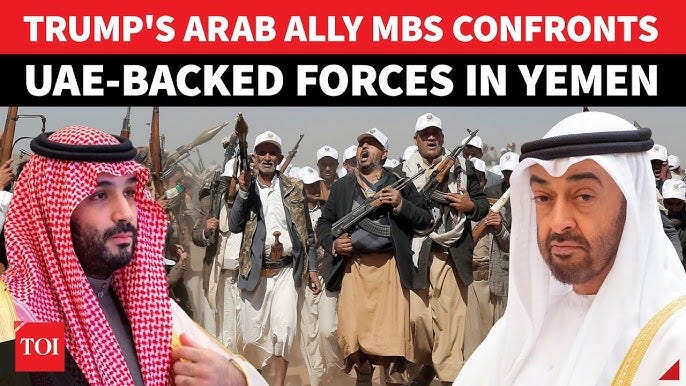
Riyadh’s Red Line in Yemen: How the Saudi–Emirati Rift Reopened a War
Why Saudi Arabia and the Yemeni government see the UAE’s southern offensive as a fight over Yemen’s unity, vital trade routes and the future of political Islam.
Yemen has once again been thrust toward full-scale war, as old front lines harden and new rifts open within what was supposed to be a unified anti-Houthi camp. From the Saudi and Yemeni government perspective, the latest escalation is not simply another flare-up in a long, grinding conflict, but a decisive struggle over Yemen’s unity, the integrity of its institutions and the security of Saudi Arabia’s own southern flank. In their view, what is currently unfolding in the south and east of Yemen is the culmination of a dangerous trajectory that transforms what began as a joint intervention to restore the legitimate government into a fragmented battleground of overlapping agendas, where external sponsorship of local militias now threatens to tear the country apart.
At the heart of this renewed crisis lies the rapid and sweeping advance of the Southern Transitional Council, or STC, a separatist movement long backed by the United Arab Emirates. For years, the STC positioned itself as the voice of southern grievances and the heir to the brief period when South Yemen existed as an independent state before unification in 1990. Its fighters were integrated into the anti-Houthi war effort and received training, arms and political support from Abu Dhabi. That uneasy accommodation now appears to have shattered. In early December 2025, STC-aligned forces launched a broad offensive not just in their traditional strongholds around Aden, but across key parts of eastern Yemen, including Hadramawt and Mahrah, two provinces that are both strategically located and rich in natural resources.
From the vantage point of Riyadh and the internationally recognized Yemeni government, this push is nothing short of an attempted coup against the state. They see not a defensive move to protect southern communities, but a carefully orchestrated military campaign designed to displace state institutions, seize vital infrastructure and redraw Yemen’s internal map. The seizure of bases, energy facilities and government buildings in areas that had stayed under the authority of the Presidential Leadership Council, the body formed with Saudi sponsorship to unify anti-Houthi factions, has been particularly alarming to officials in Riyadh. To them, it looks calculated to sideline the council, weaken the national army and replace the idea of one Yemeni state with a de facto partition backed by a foreign power.
The Presidential Leadership Council, led by Rashad al-Alimi and viewed in Riyadh as the legitimate custodian of Yemeni sovereignty, has reacted with a mix of urgency and alarm. It has declared a state of emergency, cancelled its defence and security arrangements with the UAE and demanded that Emirati forces leave Yemen within twenty-four hours. These steps mark a dramatic shift from the period when the UAE was seen as a crucial partner in stabilizing southern Yemen and combating extremist groups. Now, in the language of the Yemeni presidency, Emirati actions are described as hostile to the state and in violation of earlier understandings that foreign support should flow through, not around, national institutions.
These political declarations have been reinforced by hard power. Saudi Arabia has moved quickly to align itself with the Yemeni government’s position, publicly backing the call for an Emirati withdrawal and issuing its own stark warning that recent developments pose a direct threat to Saudi national security. For a kingdom that has, for years, tried to keep disagreements with fellow Gulf states away from the public stage, the bluntness of this message is striking. Officials close to the Saudi leadership now speak openly of red lines being crossed in Yemen, where arming and funding militias outside the chain of command of the internationally recognized government is regarded as an intolerable risk to stability in the borderlands and to the security of Saudi cities and infrastructure further north.
The most visible and controversial military manifestation of this shift has been the airstrikes carried out by the Saudi-led coalition on Mukalla, an important southern port on the Arabian Sea. Coalition spokesmen say the targets were vessels, warehouses and infrastructure involved in an unauthorized shipment of weapons arriving from the UAE and destined for STC-aligned units. From their perspective, this was not a symbolic gesture, but a necessary operation to stop the flow of arms that could embolden separatist forces, deepen the fragmentation of the security landscape and undermine any prospect of re-establishing the authority of the central government. For Saudi decision-makers, allowing such shipments to pass uncontested would mean conceding that another state can unilaterally create and sustain a parallel army on Yemeni soil.
The accusation that the UAE has been using the STC and other allied formations to carve out an autonomous sphere of influence in southern Yemen is not new, but the current crisis has given it a new intensity and urgency. In the Saudi and Yemeni government narrative, what is happening is not merely tactical manoeuvring over who controls which district or port. It is a strategic contest over the future political shape of Yemen. Riyadh and its Yemeni allies argue that the Emirati-backed expansion of separatist forces is aimed at locking in control of key ports, oil fields and transit routes before any comprehensive political settlement with the Houthis can be reached. If that happens, they fear, Yemen would be pushed down a one-way path toward permanent division, with a northern state dominated by the Houthis and a southern entity under the sway of Abu Dhabi’s partners.
This vision is seen as fundamentally at odds with Saudi Arabia’s own long-term goals in Yemen. After years of costly intervention, missile and drone attacks on its territory and mounting international scrutiny, Riyadh has invested considerable political capital in pursuing a negotiated understanding with the Houthis. That approach is rooted in two core aims: ending cross-border attacks that threaten Saudi cities and economic projects, and ensuring that the kingdom no longer faces an unstable, ungoverned or hostile territory on its southern frontier. An eventual settlement was supposed to be built around a unified Yemeni state, with the Presidential Leadership Council serving as the framework through which power-sharing and security arrangements would be negotiated.
The latest escalation threatens this entire strategy. From the Saudi perspective, as the STC pushes deeper into eastern Yemen, the logic of compromise with the Houthis becomes harder to sustain. Instead of moving toward a single negotiating table where the main Yemeni actors could work out an internal arrangement, there is now the prospect of multiple de facto authorities, each with its own external backer, security forces and economic fiefdoms. In such a scenario, the Houthis are effectively rewarded for sitting back and watching their opponents fall out, while anti-Houthi forces turn their guns on each other. The message to Riyadh is clear: unless the fragmentation is halted, the kingdom’s efforts to de-escalate with the Houthis will be overshadowed by a new, multi-sided conflict in the south and east.
For Yemenis aligned with the government, the stakes are even more existential. Yemen’s unity has long been fragile, but for many in the political and military leadership associated with the internationally recognized state, the idea of one Yemen remains the anchor that gives meaning to their struggle and sacrifice. They see the current separatist offensive as a direct assault on that principle. In their eyes, what is happening in Hadramawt, Mahrah and other areas is not the expression of legitimate local aspirations to self-rule, but a forced reordering backed by foreign money and firepower. The fear is that if this approach succeeds, it will embolden other local actors, tribes, militias, regional councils, to pursue their own mini-states, accelerating the centrifugal forces already tearing at the fabric of the country.
The consequences of such a slide would go beyond the political. Yemen’s already battered economy would face further disintegration, with customs revenues, oil exports and port fees captured by competing authorities rather than pooled in a national budget. Public services, which are already weak or non-existent in many areas, would become hostage to local strongmen rather than subject to any coherent national policy. Security would become even more fragmented, increasing the space for extremist groups, criminal networks and smuggling operations to exploit the chaos. For Saudi Arabia, which shares a long and porous border with Yemen and has already experienced the spillover from previous phases of the war, this is not an abstract concern but a direct security challenge.
Behind the military confrontation lies a deeper set of strategic motivations that help explain why the UAE has pursued this path. From the Saudi and Yemeni government perspective, the Emirati campaign in southern Yemen serves three interconnected objectives that have little to do with the stated goal of combating the Houthis and everything to do with Abu Dhabi’s own regional ambitions.
The first and most tangible is control over trade routes and logistics infrastructure. For more than a decade, the UAE has pursued a string of ports strategy across the Red Sea and Horn of Africa, positioning itself as the dominant commercial gateway between East Africa, South Asia and the global economy. Yemen, strategically located along the Gulf of Aden at the intersection of the Arabian and Red Seas, is central to this vision. The UAE’s port operator DP World has sought agreements to manage and operate ports across the region, from Djibouti to Berbera in Somaliland to Aden itself. When some of those arrangements fell through, including the cancellation of a joint venture to manage Aden’s port after the 2012 transition and the Djiboutian government’s seizure of the Doraleh Container Terminal in 2018, the UAE doubled down on Yemen, where international competition was less intense.
Through its proxies, the UAE now controls or heavily influences ports and coastal infrastructure in the governorates of Aden, Hadramawt, Shabwa and Ta’iz, as well as the archipelago of Socotra and the strategic island of Mayun, also known as Perim, which sits in the narrow Bab al-Mandab strait. This network of facilities gives Abu Dhabi the ability to monitor, tax and control shipping flows through a chokepoint where roughly thirty percent of the world’s oil transits. Emirati leaders have invested heavily in the construction and renovation of local ports and military bases, consolidating their hold over these assets even as the broader war continues. From the Yemeni government’s perspective, this is economic colonialism dressed up as counterterrorism, a bid to lock Yemen into a UAE-dominated logistics system that bypasses national sovereignty and siphons revenues that should belong to the state.
A continued fragmentation of Yemen serves this interest perfectly. As long as Yemen remains divided, the UAE faces minimal challenges to its authority over southern ports and energy facilities, giving it a strong edge in shaping the outlook for maritime trade in the region. Emirati control of ports and energy facilities through local proxies greatly increases its bargaining position in any postconflict scenario. Moreover, while Yemen remains disunited, instability in southern Yemen and concerns over the security of Yemeni ports could mean more traffic redirected to the UAE’s Jebel Ali Port, further enhancing its status as a global logistics hub. For the Saudi-backed government, this is an unacceptable outcome that subordinates Yemen’s national interest to Emirati commercial gain.
The second pillar of UAE strategy in Yemen is the containment and destruction of political Islam, particularly the Muslim Brotherhood and its local affiliate, the Islah party. The UAE designated the Muslim Brotherhood as a terrorist organization in March 2014, reflecting a broader regional campaign against Islamist movements that Abu Dhabi views as existential threats to its model of governance. In Yemen, this translated into a sustained effort to weaken, isolate and in some cases eliminate Islah’s influence on the ground.
Islah, formally known as the Yemeni Congregation for Reform, has been a major political and military force in Yemen since its founding in 1990. It played a key role in the 2011 Arab Spring uprisings and was the first party to support Saudi Arabia’s intervention in Yemen in March 2015, providing crucial fighters and political legitimacy to the anti-Houthi coalition. Yet from the UAE’s perspective, Islah’s ties to the Muslim Brotherhood make it an unacceptable partner, regardless of its utility in fighting the Houthis. The April 2016 appointment of Ali Mohsen al-Ahmar, a senior military figure widely perceived to be pro-Muslim Brotherhood, as vice president of Yemen prompted the UAE to fundamentally reassess its strategy.
Rather than continue to support a government in which Islah held significant sway, Abu Dhabi chose to build a counterweight. The creation of the Southern Transitional Council in May 2017 was the most visible expression of this shift. The STC was designed not only to advance southern secessionist ambitions, but to serve as a vehicle for containing Islah’s influence in the south. UAE-backed forces engaged in repeated clashes with Islah-aligned units, culminating in the STC’s decisive victory over Islah in Shabwa in August 2022 and the more recent offensive to capture the Islah stronghold of Seiyun in Hadramawt. According to reports, the UAE even contracted a group of American mercenaries to carry out a series of assassinations of Islah members in Yemen between 2015 and 2016, with between twenty-five and thirty members reportedly killed.
From the Saudi and Yemeni government standpoint, this campaign against Islah is not only morally indefensible but strategically catastrophic. Islah remains the second-largest political party in Yemen and commands substantial military forces that are essential to any meaningful fight against the Houthis. By turning its proxies against Islah, the UAE has effectively opened a second front within the anti-Houthi coalition, dividing its resources, weakening its coherence and handing the Houthis a strategic windfall. A divided Yemen gives the UAE more latitude to weaken Islah territorially and reduces the legitimacy of the internationally recognized government of which Islah is a part. For Saudi Arabia, which has had to navigate its own complicated relationship with Islah, balancing its own hostility to the Muslim Brotherhood with the practical need for Islah’s military muscle, the UAE’s unilateral campaign represents a betrayal of coalition unity and a direct threat to the prospect of ever defeating the Houthis.
The third strategic driver of UAE policy is the establishment of a network of military bases and surveillance facilities that extends Emirati power projection deep into the Red Sea and Gulf of Aden. Satellite imagery and investigative reporting have revealed that the UAE has constructed or expanded military infrastructure on a series of strategically located islands and coastal sites. These include Mayun Island in the Bab al-Mandab strait, where an airstrip extending approximately 1.85 kilometers has been built, capable of hosting medium-sized aircraft or large drones and manned reconnaissance aircraft. The island’s position allows whoever controls it to project power into the strait and easily launch air strikes into mainland Yemen, as well as to monitor and potentially interdict shipping traffic.
On the larger island of Socotra and its smaller companions Abd al-Kuri and Samhah, the UAE has established military bases and maritime surveillance centers. Abd al-Kuri, lying on the shipping lane from the Indian Ocean to the Bab al-Mandab, serves as an early observation point for vessels coming from the southeast and has been transformed into a strategic military facility. Samhah saw the completion of an airstrip in April 2025, alongside road paving and the establishment of essential support facilities. On the main island of Socotra, the UAE deployed several maritime surveillance centers, including sites overlooking the Arabian Sea, Gulf of Aden and the Horn of Africa.
Most recently, satellite imagery shows construction of a new 2,000-meter airstrip on Zuqar Island in the Red Sea, likely carried out by Emirati-linked firms. The facility appears designed to monitor smuggling and shipping routes near the Bab al-Mandeb Strait and potentially serve as a forward staging point for raids against Houthi maritime assets. Collectively, these installations form a ring of UAE-controlled or UAE-influenced sites that encircle the strategic waterways connecting the Red Sea to the Indian Ocean. For the Yemeni government and its Saudi backers, this network is not a temporary expeditionary presence but a bid for permanent strategic control, transforming Yemeni territory into a forward operating base for Emirati regional ambitions.
The economic and regional reverberations of the Saudi-Emirati rift over Yemen are already being felt. Financial markets in the Gulf, usually responsive to geopolitical tremors, have shown signs of stress as investors factor in the risk of a prolonged dispute between two major energy producers whose partnership has been a stabilizing force within OPEC and in broader regional diplomacy. Shipping companies and security analysts, meanwhile, are once again paying close attention to the coastlines of the Red Sea and the Gulf of Aden. A fragmented Yemen with multiple armed actors vying for control of ports and coastal towns raises the specter of renewed threats to international shipping, whether from piracy, militant groups or the use of coastal territory to launch attacks or exert pressure during regional disputes.
The Houthi campaign against Red Sea shipping, which has been ongoing since November 2023 in response to the Gaza war, has already caused massive disruptions to global trade. Over 190 attacks by October 2024 led to a ninety percent decrease in container shipping through the Red Sea and forced most major shipping lines to reroute around the Cape of Good Hope, adding eleven thousand nautical miles, ten days of travel and one million dollars in fuel costs to each voyage. Freight rates and insurance premiums have surged, and the knock-on effects on supply chains, inflation and regional economies have been severe. The prospect that southern Yemen could become an additional source of instability, with competing factions potentially interdicting or taxing ships, only compounds these fears.
Diplomatically, the new reality has been captured in what many regional observers describe as an unprecedented Saudi ultimatum to the UAE. The message, as relayed through statements and briefings, is stark: halt support for separatist forces, pull back Emirati troops and respect the authority of the Yemeni government, or face open and sustained opposition from Riyadh and its allies. The idea that two leading Gulf states, long presented as close partners with a shared outlook on regional security, could find themselves on opposite sides of a confrontation in Yemen would have seemed far-fetched a decade ago. Yet that is the scenario many now contemplate, as Saudi and Emirati policies diverge not only in Yemen but in their wider strategic priorities and threat assessments.
From a Saudi-aligned standpoint, the objective is still not to provoke a direct clash with the UAE, but to reshape the balance of incentives so that Abu Dhabi recalibrates its approach. By backing the Yemeni government’s decisions, mounting operations that signal resolve and making clear that Yemen’s unity is a non-negotiable principle, Saudi leaders hope to force a pause and, eventually, a rethinking of separatist ambitions. At the same time, they are moving to tighten their grip over the anti-Houthi military coalition, working to bring disparate units under a more coherent structure, strengthen the national army where possible and ensure that future security assistance does not bypass the state.
For the Yemeni government, the path ahead is fraught. It must try to reassert its presence in regions where its influence has eroded, fend off separatist advances, and maintain basic governance in areas still under its control. All of this must be done while the Houthis remain entrenched in the north and center of the country, retaining their own arsenal and holding the capital. The leadership in Aden and elsewhere is acutely aware that it cannot afford to fight everyone at once. Its strategy, as articulated in its own statements, is therefore to prioritize the consolidation of state authority in the south and east, restore some semblance of centralized control over ports and revenue streams, and only then resume a serious push for a broader national settlement.
Within this narrative, the confrontation with the UAE’s local allies is framed not as a distraction from the conflict with the Houthis, but as a necessary step to prevent the disintegration of the state that ultimately must negotiate with them. If Yemen breaks into competing entities now, the government argues, any future talks with the Houthis will become meaningless, because there will be no single partner capable of implementing an agreement across the country’s territory. Instead, the conflict would simply mutate into a patchwork of local wars, each with its own patrons and dynamics, ensuring that Yemen remains trapped in violence for years to come.
The seizure of Hadramawt is particularly significant in this regard. The governorate holds approximately eighty percent of Yemen’s modest oil reserves, and its control gives the STC decisive leverage over the country’s financial future. By taking over PetroMasila, Yemen’s largest oil company, the STC positions itself as gatekeeper of national revenue streams at a time when oil exports have been almost entirely shut down since October 2022 due to Houthi blockades and attacks. Before the war, oil revenues accounted for seventy to seventy-five percent of government income and nearly ninety to ninety-five percent of Yemen’s total exports. The cessation of these exports has cost the Yemeni government an estimated 7.5 billion dollars since late 2022, collapsing the national currency, disrupting the payment of salaries and gutting basic services. For the STC to now control the physical infrastructure and territory where this oil is produced means it can, in theory, dictate terms to both the government and the Houthis in any future political settlement.
Underlying this Saudi-Yemeni view is a broader anxiety about the trajectory of regional politics. As the Gulf states diversify their economies, seek new security partnerships and reposition themselves in relation to global powers, Yemen has become both a test and a symbol. For Saudi Arabia, a stable, unified neighbor is essential to the success of its own ambitious domestic transformation plans. Vision-driven mega-projects, tourism, logistics and investment zones all hinge on the perception of a secure and predictable environment. A Yemen torn into competing enclaves, exposed to militant groups and foreign interference, sits uneasily with that vision. The current crisis is therefore seen not only as a humanitarian and political tragedy for Yemen, but also as a direct challenge to the kingdom’s long-term strategy for its own future.
As the confrontation deepens, the space for quiet compromise narrows. The blunt language used by Saudi and Yemeni officials about Emirati actions suggests that previous attempts to manage disagreements behind closed doors have run their course. Yet, even now, there remains an awareness in Riyadh that a complete rupture with Abu Dhabi would carry its own costs, potentially undermining Gulf cohesion at a time when the region faces multiple external pressures. Navigating this dilemma, asserting non-negotiable interests in Yemen while preserving some framework for cooperation with the UAE, is likely to be one of the kingdom’s most delicate diplomatic tasks in the months ahead.
For Yemenis living through these events, the geopolitical calculations of powerful neighbors can feel both distant and painfully immediate. Each shift in alliances and each new front opened translates into changes on the ground: disrupted trade, shifting checkpoints, new commanders issuing orders, and fresh uncertainties about who guarantees security in any given town or village. From the perspective aligned with the Saudi-Yemeni government, the hope is that by drawing a firm line now, insisting on Yemen’s unity, pushing back against separatist militarization and re-asserting the primacy of the state, they can still steer the country away from irreversible fragmentation. Whether that hope can withstand the pressures of war, competing interests and the deep scars of a decade of conflict remains the central question hanging over Yemen’s future.
At the same time, the Yemeni government and its Saudi backers recognize that they are racing against time. The STC has already declared its readiness to announce independence at any moment, with its leader Aidarous al-Zubaidi stating publicly that southerners already control their land, that the army and police are in place, and that only formal recognition is needed. He has framed independence not just as a local aspiration but as part of a wider regional stability framework, drawing parallels to a two-state solution for Yemen mirroring the Israeli-Palestinian context. For the government in Aden and its Saudi allies, such rhetoric is inflammatory and dangerous, threatening to harden positions and make reconciliation impossible.
The irony, from the Saudi-Yemeni perspective, is that the UAE’s campaign is ultimately self-defeating. By fracturing the anti-Houthi coalition, Abu Dhabi has ensured that no side can achieve a decisive victory. The Houthis, who still control Sanaa and vast swaths of northern Yemen, are effectively insulated from pressure as their enemies fight one another. Iran, the Houthis’ main external backer, continues to smuggle arms and components into Yemen despite repeated interdictions by Western navies. Between 2015 and 2024, the United States and its partners intercepted at least twenty Iranian smuggling vessels carrying ballistic, cruise and surface-to-air missile components, anti-tank guided missiles, unmanned aerial vehicles and other illicit weapons destined for the Houthis. Yet the flow has never stopped, and the Houthis have used these capabilities to devastating effect, launching hundreds of attacks on Saudi territory, threatening international shipping in the Red Sea and maintaining their grip on Yemen’s most populous regions.
By opening a southern front against Islah and the government, the UAE has made it virtually impossible for the coalition to mount a credible offensive against the Houthis. Instead, the war has metastasized into a multi-sided contest in which every faction is weaker than it would be in a united front, and the only beneficiaries are the Houthis and their Iranian sponsors. From the Saudi and Yemeni government viewpoint, this outcome was both predictable and avoidable, the result of Abu Dhabi prioritizing narrow ideological and commercial interests over the collective goal of restoring stability to Yemen.
The prisoner exchange agreement reached in late December 2025, involving nearly three thousand prisoners including seven Saudis, offers a glimpse of the parallel diplomatic track that Saudi Arabia has been pursuing with the Houthis even as the southern crisis escalates. The deal, brokered by Oman and facilitated by the United Nations and the International Committee of the Red Cross, is the largest such exchange in a decade and is seen as a confidence-building measure that could pave the way for broader negotiations. For Riyadh, maintaining this channel with the Houthis is critical, both to secure the release of Saudi nationals and to keep alive the possibility of a comprehensive settlement that ends cross-border attacks and allows Yemen to stabilize under a unified government.
Yet the STC’s offensive threatens to derail this entire process. If the south descends into open conflict between the government and separatist forces, the Houthis have little incentive to make concessions at the negotiating table. They can simply wait for their opponents to exhaust themselves, then impose terms from a position of strength. This is precisely the scenario that Saudi Arabia and the Yemeni government have been trying to avoid, and it is why they view the UAE’s actions as not just unhelpful but actively hostile to the peace process.
For all these reasons, the confrontation unfolding in Yemen today is seen by the Saudi and Yemeni government as a defining moment. It is a test of whether the principle of state sovereignty and territorial integrity can be upheld in the face of external interference and proxy warfare. It is a test of whether the anti-Houthi coalition can rediscover a sense of common purpose, or whether it will fragment irreversibly into rival camps. And it is a test of whether Saudi Arabia, after years of costly engagement in Yemen, can still shape outcomes on its southern border, or whether it will be forced to accept a fragmented, unstable neighbor dominated by competing foreign influences.
From the perspective of those aligned with the Saudi-Yemeni government, the stakes could not be higher. Yemen’s fate will determine not only the future of its own people, but the broader trajectory of the Gulf region, the security of critical maritime chokepoints, and the credibility of international norms around sovereignty and non-interference. By standing firm against the UAE’s separatist project, defending the unity of the Yemeni state and insisting that foreign actors respect the authority of the internationally recognized government, Riyadh and its Yemeni allies believe they are fighting not just for Yemen, but for a vision of regional order in which states, not militias and their external sponsors, are the primary actors. Whether they can prevail in this struggle, in the face of Emirati determination, Houthi resilience and the sheer complexity of Yemen’s internal divisions, remains the defining question of the conflict as it enters its second decade.


