The village of Bambali sits in Senegal’s Sedhiou province, a place where poverty is not an idea but a daily arrangement of distance, weather, illness, and waiting. For the first forty years of its life as a post-independence Senegalese settlement, it had no hospital, no secondary school, no post office, no gas station, and no 4G connection. When a man fell ill, his family tried what they had. They used traditional remedies. They asked neighbors. If the illness stayed, they carried him toward another village and hoped the road was kinder than the disease.
In 1999, the imam of Bambali developed a stomach ache that nobody nearby could treat. He died. His seven-year-old son, Sadio Mane, watched this happen and did not forget it.
That is where this story begins. Not at Anfield. Not in the tunnel before a Champions League final. Not in the transfer window when Bayern Munich paid Liverpool EUR32 million for one of the Premier League’s most dangerous forwards. It begins in a village that could not save one man from a stomach ache, and in the child who learned, before he had language for it, that the absence of a building can become a death sentence.
The football world has spent years admiring Mane’s acceleration, his timing, his left foot, his appetite for the hard run. The infrastructure he has built with his earnings in a remote corner of southern Senegal receives a smaller kind of attention, and even that attention often turns him into a neat moral story: humble athlete gives back. The phrase is too small for what happened in Bambali.
What Mane has done there is closer to a private public works program. He has helped build health, education, transport, and communications infrastructure in a village of roughly two thousand people. He has funded direct monthly support for families. He has done, with football wages, the kind of basic state-building that usually arrives late, if it arrives at all.
The cracked phone photograph went viral in 2019. Here was one of the highest-paid footballers in England carrying a smartphone with a shattered screen. It was treated as a charming oddity, a little proof of humility in an industry that loves excess almost as much as it loves goals.
When asked about it, Mane’s answer was plain. He said he could buy thousands of phones, Ferraris, private jets, diamond watches, anything people imagine when they imagine wealth. Then he asked what good it would do him. He had seen poverty keep children out of school. He had played without shoes. He had known hunger. Now he had enough, and he wanted to share it with his people instead of showing it off.
The quote traveled widely, especially in West Africa. In England, it mostly became another cracked-phone anecdote. But the phone was never the story. The story was what he was doing while everyone else was looking at the screen.
That matters in a place where academic promise can still be defeated by transport costs, family pressure, and the blunt arithmetic of poverty. A scholarship is not only a reward. In a village like Bambali, it is a signal that study can carry weight in the household economy.
Three hundred Liverpool shirts were also distributed to residents so the village could watch its son play in Istanbul. It is a small detail, almost tender in the middle of the bigger numbers. The shirts did not build a future. They built a shared moment. Sometimes a village needs that too.
In 2021, Mane donated about USD693,000, often reported as GBP500,000, toward the construction of Bambali’s first hospital. After the donation, he asked to meet Senegalese President Macky Sall and pressed the government to staff the facility with trained medical workers. That detail matters. A building without doctors is only a monument. Mane seemed to understand that the check was not the end of the work.
The hospital now serves dozens of surrounding villages. It includes a maternity ward, an emergency unit, a dental clinic, and consultation rooms. At the entrance, a plaque names Mane as the man who funded and inaugurated it. He was photographed around the ceremony in his mother’s courtyard, eating a mango he had picked up from the ground. It is the kind of image publicists would ruin if they tried to stage it.
The less familiar part of the story is the monthly support. Mane has reportedly provided about EUR70 a month to families in Bambali and the surrounding area, roughly in line with the Senegalese minimum wage. The scale is easy to miss if you say it quickly. This is not a holiday donation. It is recurring support, month after month, in a place where small, dependable money can change the shape of a household.
It also sits alongside the other work: the hospital, the school, the laptops, the student grants, the post office, the gas station, the stadium for youth development, and improved cellular connectivity. This is why the usual vocabulary fails. Charity sounds too occasional. Philanthropy sounds too distant. What Mane has built is more intimate and more practical than either word suggests.
There is also a specific restraint in the way he has done it. Modern athlete philanthropy often moves through foundations, galas, launch videos, branded check presentations, and a familiar rhythm of announcement. Mane’s work in Bambali was documented for years before it became a major international story because he did not seem especially interested in making it one. When he has spoken about it, he has tended to speak briefly. He does not sound like a man selling virtue. He sounds like someone describing a repair.
The argument for football’s social value is usually made in two voices. The first is inspirational: sport builds character, teaches resilience, crosses borders, unites nations. The second is developmental: football can be used for public health, gender equity, youth engagement, and community cohesion. Both are true enough. Both can also become a little too smooth.
Football generates enormous wealth for a very small number of people. Much of that wealth flows through clubs, broadcasters, agents, sponsors, owners, and cities far from the places where the game is most deeply loved. Mane sits at a strange and revealing intersection. He is from one of those places. He earned the money at the top of the game. Then he used it to close specific gaps in the place that produced him.
The research on sport and community development is not merely sentimental. Studies have connected structured sports participation with mental health benefits, social cohesion, identity, and belonging. Football-based programs have also been used in community settings to address isolation, rebuild social skills, and reach young people who would otherwise sit outside formal institutions.
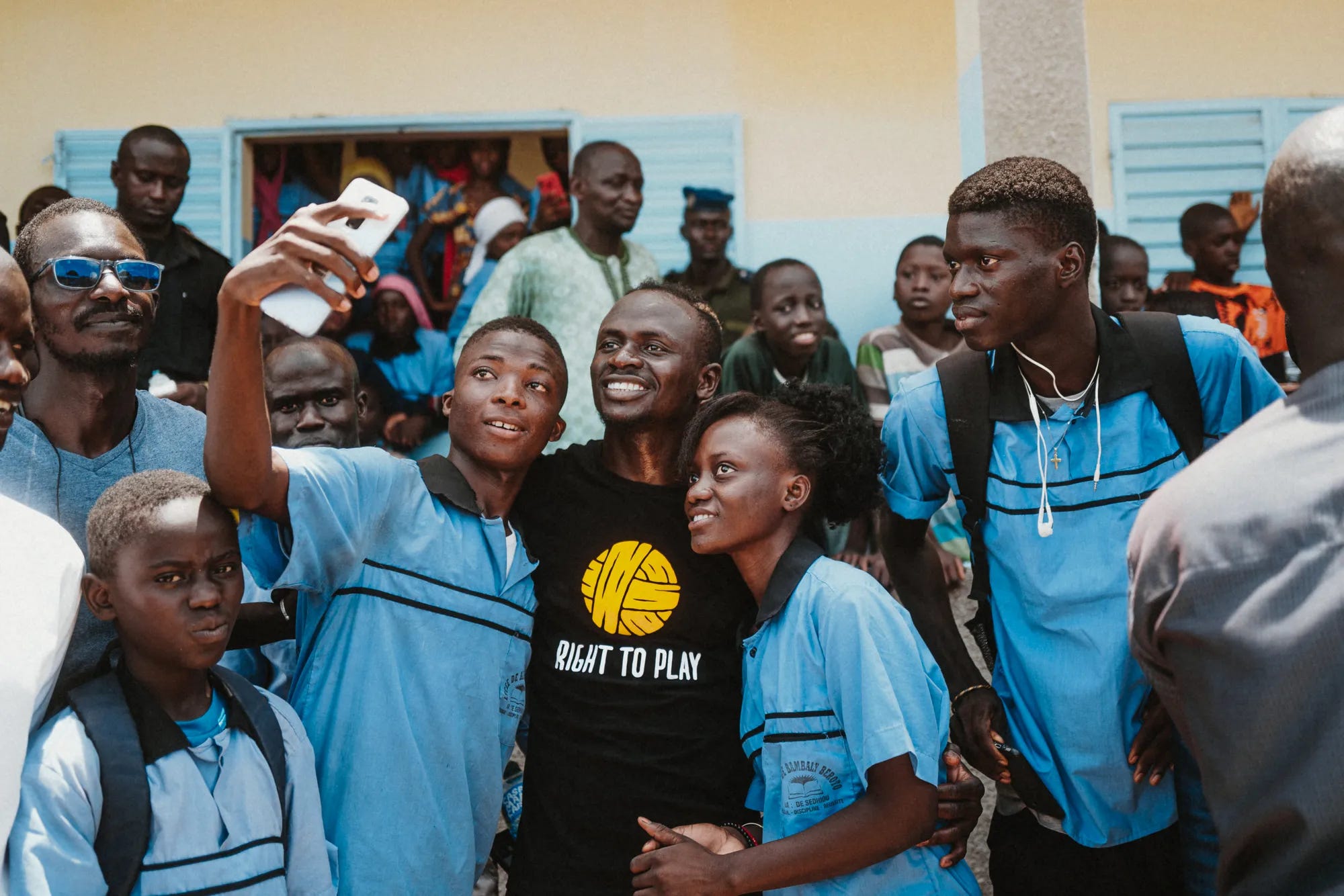
Mane’s work with Right to Play fits into that broader frame. As a global ambassador, he has supported sport-based education programs focused in part on gender equity in Senegal. The geography is important. These are not abstract campaigns aimed at glossy donor rooms. They reach into the southern provinces where Bambali sits, into places that have often been left waiting for national systems to arrive.
There are comparisons, of course. Didier Drogba funded a hospital in Ivory Coast and used his public stature during the Ivorian civil war in ways that entered political history. Other athletes have built schools, clinics, and foundations. The critique of this model is also fair: a community whose hospital depends on one footballer is a community still exposed to the fragility of individual fortune.
Mane seems to have understood at least part of that risk. His decision to involve the Senegalese government in staffing the hospital was not glamorous, but it was serious. It recognized that infrastructure cannot live forever on gratitude. At some point, a state has to do what a state is for.
Sadio Mane was born in 1992 into a family that did not want him to become a footballer. His father, the village imam, held religious and moral authority in a Muslim community. His extended family wanted him in school. The elders wanted him near the mosque. Football, to them, was not a serious occupation for a boy whose life still had other possible paths.
At fourteen, Mane took money from his family to pay for transport to a regional trial. When they found out, they stopped speaking to him for a time. He made the trial anyway. He got into an academy. Eventually he reached Metz in France, still a teenager, without French, without polish, without the soft landing that people often imagine when they see a player fully formed on television.
At one early trial, he wore boots that were torn open. City kids laughed. Mane said nothing and played. That detail has followed him because it feels almost too literary, but it also sounds like the simplest possible version of him: no speech, no performance, just the work.
The question of how his biography shapes his giving is not incidental. Athletes from comfortable backgrounds can be generous, and many are. But people who grow up inside scarcity know the exact price of absence. The hospital is not a cause to Mane. It is the shape of an old wound. His father died because there was nowhere close enough to treat him.
The school is not a gesture either. Mane’s own education was interrupted by the chase for football, by family pressure, by the poverty of choices available to him. A secondary school in Bambali means a child does not have to leave quite so early, or choose quite so brutally, between the classroom and the family’s survival.
The monthly stipend works the same way. It is not symbolic. It is not a headline number designed to impress outsiders. It is the kind of money that can buy rice, pay for transport, keep a child in class, or soften the panic when illness enters a house.
Mane lives, by the standards of elite European football, with unusual restraint. There is no famous fleet of supercars, no yacht myth, no public theater of luxury. The cracked phone was not a pose. It was a clue. His private calculation had already been made: he knew what hunger was, and he knew what a school cost, and he knew the difference between owning ten Ferraris and building one hospital.
There is a line often associated with him: the hands that help are better than the lips that pray. It reads differently when the person saying it has built the place where women give birth, where children are treated, where a father with a stomach ache might have had a chance.
The transfer economy in European football has become so abstract that it often feels detached from ordinary life. Fees rise, wages swell, agents circle, and the numbers begin to sound like weather. Bayern Munich paid Liverpool EUR32 million for Mane in the summer of 2022. In football finance, that was a normal elite transaction.
In Bambali, the meaning of the money was different. It became a school, a hospital, a post office, a gas station, a stadium, laptops, student grants, family stipends, and phone service. It became the practical grammar of a modern village.
The documented investment is commonly estimated at more than GBP1 million, and that figure may be conservative once the monthly support is counted across years. The exact number matters less than the pattern. Mane did not simply donate after he became rich. He kept returning to the same place with the same question: what is missing, and what would it take to build it?
This is what football did. It took a boy who ran away from home with bus fare he was not supposed to take, who wore torn boots to a trial and stayed quiet when he was laughed at, who watched his father die at seven because there was no hospital nearby, and it gave him a salary large enough to build the hospital himself.
The game’s critics are not wrong about what football has become at its commercial summit. It is a speculation engine. It serves investors, agents, broadcasters, and ownership classes in a small number of powerful cities. It has colonized calendars and attention spans across the world without returning much to many of the communities that make the sport feel sacred in the first place.
But Mane moved through that system and bent part of it back toward home. He did not put the money back into football’s vanity loop. He put it into the ground where his father is buried.
One question remains. What happens to Bambali’s hospital when Mane’s playing career ends and the largest checks stop? The Senegalese government was asked to take responsibility for staffing it. Whether that support endures is the test that comes after the beautiful part of the story.
The plaque at the entrance to Bambali’s hospital names one man. The future will tell us whether a name is enough.


