Salt and Consequence
The Underground Oil Reserve That Cannot Save the War America Started
The war that closed the Strait had begun twelve days earlier, on February 28, when United States and Israeli forces launched coordinated strikes against Iranian military infrastructure under the operational designation “Epic Fury.” Iran’s response was geologically immediate: within seventy-two hours, a combination of naval mines and drone swarms had reduced tanker traffic through the Hormuz to less than ten percent of pre-conflict levels. Brent crude touched $120 per barrel before retreating to $92 on the IEA announcement. As of mid-May, roughly 1,500 vessels laden with oil, gas, fertilizers, and petroleum products remain trapped in the Persian Gulf, according to the Columbia Center on Global Energy Policy. The IEA’s own March release statement described it as “the largest supply disruption in the history of the global oil market.” Washington produced that disruption, then reached for the instrument it had spent four years degrading to manage it.
The United States Strategic Petroleum Reserve entered the Iran conflict depleted, physically damaged, operating below its authorized extraction ceiling, and incapable of being refilled while the war it was meant to cover continues driving oil prices to levels that make purchasing impossible. Four thousand miles east, China entered the same conflict having spent 2025 adding an average of 1.1 million barrels per day to storage reserves that by December had reached nearly 1.4 billion barrels, held in above-ground tank farms that require no brine injection, no geomechanical cycle management, and no fresh water to extract. The difference between those two storage architectures is the story of how differently Washington and Beijing read the last decade.
The Physics the Press Releases Skip
The Strategic Petroleum Reserve is four sites along the Gulf Coast: Bryan Mound and Big Hill in Texas, Bayou Choctaw and West Hackberry in Louisiana. They contain sixty operational salt caverns. The DOE’s authorized storage capacity is 714 million barrels. As of April 10, 2026, the reserve holds 409 million barrels. The 305-million-barrel gap is not empty space waiting to be filled. It is the accumulated physical record of every political calculation made against the reserve since 1985.
Oil stored in salt caverns does not sit passively in rock waiting to be tapped. It floats above a brine layer at the base of a cavern created by dissolving salt with injected fresh water, a process called solution mining. Extraction reverses the sequence: fresh water is injected at the cavern’s base, displacing brine and pushing the oil column upward through production wells into surface infrastructure, then into pipelines and marine loading terminals serving the Gulf of Mexico. The extraction rate is constrained not by the volume of oil present but by the combined capacity of the water injection system, the production wells, the surface transfer network, and the marine terminal loading arms. All of these are aging. None were designed for simultaneous, system-wide emergency drawdown.
Bryan Mound, the largest of the four sites, sits on a 500-acre complex southwest of Freeport, Texas. Its nineteen operational caverns hold approximately 245 million barrels, marginally below their design capacity. A media tour conducted by the DOE in late 2024 made clear the extraction sequence: water injected into cavern bases pushes oil up to the surface, where it moves through crude oil transfer systems to marine terminals and pipelines serving the Gulf. The DOE, in that same period, was already pushing Congress for dedicated marine terminals on the grounds that existing terminal capacity shared with commercial operations creates a bottleneck whenever emergency volumes compete with standard commercial loading schedules. The request was a technical admission that the theoretical extraction ceiling and the practical delivery rate are not the same number.
Sandia National Laboratories, which has conducted geomechanical assessments of the SPR caverns since the 1990s, mapped the structural consequence of repeated extraction cycles years before the current crisis. Each cavern was engineered for approximately five full drawdown cycles over its operational life. When fresh water is injected during extraction, it does not remove oil cleanly and stop. It dissolves salt from the cavern walls, permanently enlarging the cavity and altering its pressure envelope. Sandia’s models found that caverns vary dramatically in their remaining viable cycles: some retain three to five, others have been reduced to one, and several have been flagged as having zero remaining draws without risking permanent structural failure. The brine displaced during each drawdown must also be managed. It cannot simply be discharged; it requires disposal infrastructure, and the brine systems at all four sites are among the components the DOE has flagged as exceeding serviceable life. The physical consequence the Sandia scientists summarized without softening: “Geology takes over. Engineering doesn’t matter.”
The DOE’s own Long-Term Strategic Review, submitted to Congress in August 2016, had already identified what the geology was recording. Seventy percent of SPR equipment infrastructure was exceeding its serviceable life across all four sites. The report listed the specific systems: crude oil transfer lines, raw water supply infrastructure, brine disposal networks, power distribution, and physical security. Most of it dated from construction between 1975 and 1991. The review called for modernization investment and noted that failure to act would “begin to fundamentally compromise the Reserve’s capabilities.” Congress filed the report. Neither the Obama administration in its final months, nor the first Trump administration, nor the Biden administration appropriated the capital the review identified as necessary.
How the Reserve Was Spent Before the War
The SPR has been drawn down six times in its history for emergency purposes. What degraded it was not emergencies. It was Congress.
Between fiscal years 2015 and 2022, Congress mandated seventeen separate SPR sales totaling more than 220 million barrels, used as budgetary offsets to fund unrelated spending across multiple appropriations bills. These were not emergency releases triggered by supply crises. They were legislatively directed asset sales, with SPR oil auctioned to generate cash that appeared as revenue on Congressional budget tables while the physical reserve shrank. The National Taxpayers Union Foundation documented $18.3 billion in budgetary offsets generated through SPR sales recorded through that period. The reserve Congress had funded in 1975 as an insurance policy against exactly the kind of supply shock now unfolding was being liquidated incrementally to balance spreadsheets, one appropriations cycle at a time.
The Biden drawdown of 2022 landed on infrastructure already weakened by two decades of politically directed, small-volume extractions that the DOE’s own 2010 study had identified as creating a dangerous mismatch between design intent and actual use. The caverns were designed for five large drawdown cycles spaced over a long operational life. What they received instead was repeated small withdrawals, each requiring depressurization and water injection and brine displacement, each cycle enlarging the cavern walls and consuming a fraction of the structural tolerance that had been allocated for full emergency draws. By the time Biden ordered the largest release in the reserve’s history, the caverns had already absorbed decades of stress the engineers had not designed for.
The 2022 release ran from March through October: 180 million barrels at approximately one million barrels per day over 180 days. The stated justification was the energy price spike following Russia’s invasion of Ukraine. Gasoline prices reached $5.01 per gallon nationally in June 2022, the highest ever recorded in the United States, after the drawdown had been underway for three months. The release did not contain the spike. It overlapped with it, and prices continued rising before finally declining in the second half of the year. What the drawdown produced that was concrete and lasting was physical damage to equipment. Energy Secretary Chris Wright testified before the House Energy and Commerce Subcommittee in 2025 that the rapid Biden drawdown had caused structural damage to SPR storage and injection facilities requiring more than $100 million in repairs. The DOE’s October 2025 crude oil purchase solicitation put the figure at “nearly $280 million in costs” and described “unprecedented wear and tear on storage and injection facilities.” Pumps were damaged. Pipeline systems were stressed beyond what incremental maintenance had prepared them for.
The Trump administration that took office in January 2025 inherited a reserve at roughly 350 million barrels, the lowest level since 1983. Energy Secretary Wright estimated refilling to authorized capacity at $20 billion and a six-year timeline. Throughout 2025, the DOE purchased oil incrementally, one to two million barrels per month, raising the total by approximately 18 million barrels over the year to 413 million barrels by December. The purchases were economically rational: WTI crude was trading near $62 per barrel, below the $70 threshold Wright had cited as a purchase target. Then Operation Epic Fury began on February 28. Oil prices crossed $90 in the first week of March and have not returned to purchase range. The SPR cannot be refilled while prices remain elevated. Prices remain elevated because of the war. The instrument Washington needs to manage the war’s energy consequences cannot be rebuilt until the war ends, and the war shows no sign of ending.
The Ceiling That Isn’t
The official SPR maximum drawdown rate of 4.4 million barrels per day is the figure American officials cite when asked whether reserves are adequate. It deserves scrutiny. The DOE’s own FY 2026 budget submission states that “actual drawdown rate is highly dependent on cavern and site fill level,” a qualification that transforms the 4.4 million barrel ceiling from a reliable operational number into a theoretical maximum achievable only under conditions that do not currently exist. At 409 million barrels and with damaged infrastructure across four sites, the practical sustained drawdown rate is lower than 4.4 million barrels per day, by how much the DOE has not publicly specified.
At even the stated ceiling, the Hormuz disruption cannot be bridged. The closure is suppressing roughly twenty million barrels per day of normal global transit. The SPR at maximum drawdown replaces less than a quarter of that volume before accounting for the pipeline and terminal constraints that govern how quickly released oil reaches refiners. The DOE’s push for dedicated marine terminals, a request the agency has made repeatedly over the past decade without receiving the funding, reflects a system-level recognition that SPR release volumes compete with commercial loading schedules at shared terminal infrastructure. A barrel authorized for release from Bayou Choctaw, Louisiana, does not reach a refinery in Rotterdam without moving sequentially through crude transfer lines, shared terminal loading arms, tankers, and refinery intake systems. Each step has its own rate constraint. In a market where tanker availability is itself compressed by the Hormuz blockade, the logistics between authorization and delivery create a gap that the release numbers announced in Paris cannot close.
There is a further irony the IEA press materials did not address. The United States, having become a net oil exporter in 2019, is formally exempt from the IEA’s ninety-day emergency reserve requirement. The obligation that drives most IEA members to maintain strategic stocks proportional to their import dependency does not bind Washington. The country that built the SPR, that used it as the template for the global emergency reserve architecture, is the only major economy in the IEA that has legally outgrown the requirement to maintain it at any specific level. The political consequence of that exemption played out predictably: without a binding floor, the reserve became available for use as a fiscal instrument, a gasoline price management tool, and a midterm election hedge, purposes it was never engineered for and that left it structurally compromised before the war it was actually needed for arrived.
What China Built While Washington Drew Down
China is not a member of the International Energy Agency. It contributed no barrels to the March 11 coordinated release. It was not asked to. Beijing entered the Iran conflict with nearly 1.4 billion barrels of crude in strategic inventories, according to the EIA’s April 2026 assessment, nearly three and a half times the current U.S. SPR. That figure is the product of a storage doctrine Beijing began designing in 2001, accelerated sharply after Russia’s 2022 Ukraine invasion demonstrated the geopolitical leverage built into energy dependency, and then drove to industrial scale throughout 2025 at a rate of 1.1 million barrels per day of net accumulation. China’s total storage capacity, according to Energy Aspects, reached 2 billion barrels by late 2024, with OilX data indicating existing caverns and tanks operating at roughly fifty percent fill, leaving substantial room for continued accumulation before physical limits are approached.
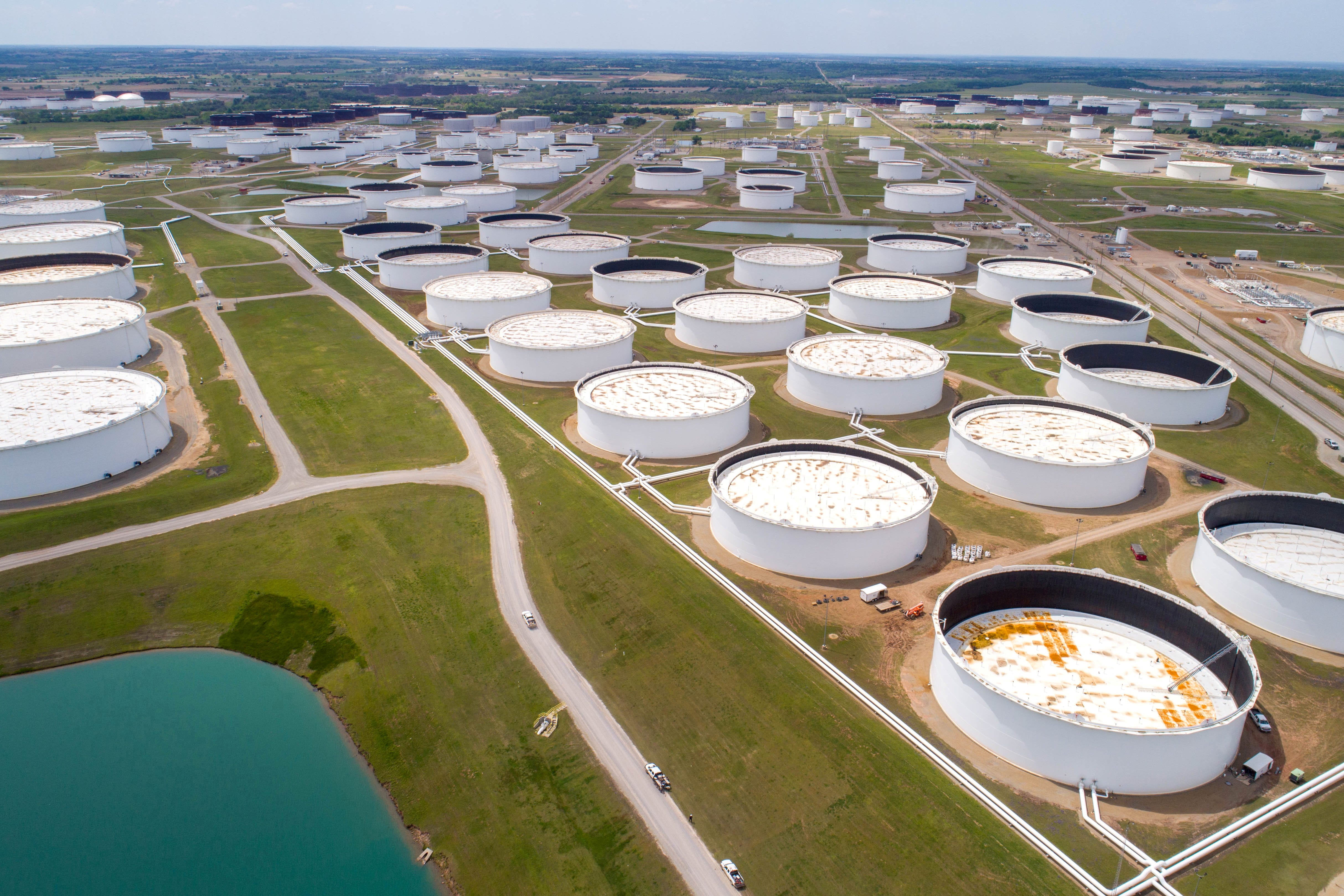
China’s Phase One strategic reserve sites, established between 2004 and 2008, are above-ground concrete and steel tank farms: Zhenhai in Ningbo, Zhoushan in Zhejiang, Dalian in Liaoning, Huangdao in Qingdao. They were built as industrial petroleum terminals, which is what they are, with direct deep-water port access for supertanker offloading and pipeline connections to proximate refinery complexes. Phase Two and Phase Three expansions extended the network to Tianjin, Zhanjiang in Guangdong, Huizhou, Dushanzi in Xinjiang, and Lanzhou in Gansu, the inland northwest sites providing strategic distribution redundancy away from the coastal concentration vulnerable to naval interdiction. Sinopec and CNOOC are completing eleven additional facilities with combined new capacity of 169 million barrels, of which 37 million barrels was already operational by late 2025, according to Reuters research.
Above-ground tank storage requires no brine management. Fresh water injection is not part of the extraction sequence. The geomechanical constraints of solution-mined caverns, the salt dissolution that permanently enlarges cavern walls with each draw, the depressurization damage that accelerates structural decay during maintenance, none of it applies. A tank farm draws down by opening valves. Throughput is governed by terminal loading rates and pipeline capacity, both of which are engineered to the scale of the facility and can be expanded with standard capital investment. China’s 2021 Dalian release, the country’s first public reserve auction, released 7.38 million barrels of Qatar Marine, Forties, Oman, Murban, and Upper Zakum crude into a refinery bidding process. The S&P Global analysis of that release identified logistical friction in the other direction: refineries in southern and central China found the cost of moving Dalian crude overland or coastwise to their plants made the auction less competitive for them than for Dalian-area refineries with direct pipeline connections. The Chinese system has its own distribution geometry. But the friction it encounters is commercial logistics, not geology eating the walls of its storage chambers.
A 2025 domestic energy law formalized unified state oversight of both dedicated SPR sites and commercial stockpiles maintained by CNPC, Sinopec, and CNOOC. Kpler estimated China’s total national and commercial onshore stocks at approximately 799 million barrels in early September 2025. Vortexa placed state-company controlled stockpiles, including refinery stocks, at 735 million barrels in the same period. Kayrros reported 401 million barrels in above-ground SPR facilities alone as of March 31, 2025, excluding the 130 million barrels in underground facilities. Across all three firms and methodologies, the picture entering the Iran conflict was consistent: China’s combined strategic and commercial reserves exceeded anything the thirty-two IEA member states could collectively mobilize, with Beijing holding full sovereign discretion over release timing and whether to release at all.
The Discount That Washington Built for Beijing
The accumulation China completed in 2025 was partly funded by the sanctions architecture Washington spent a decade constructing. Russia, Iran, and Venezuela, all of them under American sanctions regimes that restricted their access to Western buyers, sold crude to China at discounts ranging from $5 to $15 per barrel below benchmark prices throughout 2024 and 2025. China’s oil import costs were structurally below market rates on a substantial portion of its purchases precisely because Washington had reduced the number of willing buyers for those barrels. The Oxford Institute for Energy Studies, in a February 2026 paper written three weeks before the Iran war began, identified the convergence of factors behind China’s 2025 accumulation surge: relatively low benchmark oil prices in the $60-70 range, rising geopolitical risk that increased the strategic value of reserves, the new domestic energy law mandating commercial reserve holdings, and the availability of sanctioned crude at discount. The war that began on February 28 arrived with China having converted Washington’s sanctions policy into approximately 1.4 billion barrels of strategic buffer.
Iran accounted for roughly thirteen percent of Chinese crude imports in 2025. Venezuela supplied around four percent more. Both supply lines are now degraded by the conflict. Oil above $90 per barrel represents a genuine terms-of-trade cost on every barrel China must now source from higher-priced alternatives. China’s electricity consumption exceeded double that of the United States in 2025, the scale of an industrial economy that uses oil not only for transport but for the petrochemical base underpinning its manufacturing output. The disruption is real. The Center on Global Energy Policy estimates China holds the equivalent of 104 days of net crude coverage across its reserves. At that rate of buffer, Beijing can sustain refinery throughput through a multi-month Hormuz closure without a supply crisis, drawing down reserves while sourcing replacement volumes from Russia and Brazil at elevated but manageable prices, and waiting. The IEA’s 400 million barrel release covers four days of global consumption, at extraction rates the member states’ combined aging infrastructure may not sustain simultaneously, drawn from reserves that the United States portion entered at 57 percent of authorized capacity with documented pump and cavern damage. It addresses weeks. China is positioned for months.
What Paris Left Open
The IEA’s March 11 announcement achieved what it could. It coordinated political will across thirty-two governments in the middle of a live military conflict, produced a credible volume commitment, and helped drive Brent crude back below $100 per barrel from its $120 peak. The price ceiling it created protected European and Japanese consumers from the kind of immediate shock that converts energy inflation into recession in a single quarter. None of that is trivial.
What it could not do was address the structural conditions the crisis exposed. The IEA acknowledged as much in its own March 12 Oil Market Report, describing the release as “a stop-gap measure” whose ultimate impact depends “crucially on the duration of disruptions to shipping through the Strait of Hormuz.” Duration is the one variable that the reserves cannot control, and the one variable determined entirely by the military situation Washington created. The disruption the IEA reserve system was designed for is a short one, measured in weeks, the type produced by a hurricane, a refinery fire, a temporary geopolitical standoff. The Iran war is now in its eighty-third day. Roughly 1,500 vessels remain trapped in the Persian Gulf. The Strait has not reopened.
The SPR that Washington is drawing on entered this conflict carrying decades of deferred maintenance, the structural damage of the largest emergency release in its history conducted two years prior on infrastructure already past its engineered lifespan, a refilling program frozen by the price effects of the war it was supposed to cover, and an extraction architecture whose real-world throughput the DOE itself conditions on cavern fill levels and surface system integrity. Congress used the reserve as a fiscal instrument for two decades. The Biden administration used it as a gasoline price management tool. No administration funded the 2016 infrastructure review. The war arrived before the repair bill was paid.
China spent the same period building 1.4 billion barrels of above-ground storage, funded partly by the discounted sanctioned crude Washington’s own policy made available to Beijing, governed by a unified state oversight architecture that treats strategic and commercial reserves as a single deployable instrument, and maintained in facilities that do not dissolve when you open the valve.
The United States holds approximately 409 million barrels in caverns that geology is steadily reclaiming. Whether those barrels can be extracted at the rate and duration the current crisis demands remains a question the DOE’s own budget documents do not answer with confidence.