Saudi Arabia Is Building the Logistics Architecture the Iran War Exposed It Didn’t Have
King Khalid authorized the Petroline in 1979, the year the Iranian Revolution ended the era of unchallenged Gulf transit. Construction of the 1,200-kilometre East-West Crude Oil Pipeline began in 1981 at a cost of approximately $2.5 billion, running two parallel steel arteries across the Arabian Peninsula from the Abqaiq processing complex in the Eastern Province to the Red Sea export terminal at Yanbu. It was built, from the first survey team, as a bypass. The original nameplate capacity was 3.2 million barrels per day. Saudi engineers expanded it to 5 million in 1992, after the Gulf War concentrated minds about chokepoint risk, then converted a parallel natural gas liquids line to crude service in 2019 following Houthi drone strikes on Abqaiq, raising the theoretical maximum to 7 million barrels per day. In the forty-five years between commissioning and the spring of 2026, that 7-million-barrel ceiling had never been operationalized at sustained throughput. It took the closure of the Strait of Hormuz to make the pipeline run at its own design.
On March 10, Aramco chief executive Amin Nasser confirmed the Petroline would hit 7 million barrels per day within days. Yanbu, which had processed fewer than 800,000 barrels daily in February, tripled its throughput in barely a week. Between March 15 and 21 alone, approximately 22.9 million barrels were loaded at the terminal, a 20 percent week-over-week increase. Five supertankers loaded with roughly 10 million barrels had already departed westward. Saudi Arabia was not rerouting its oil exports. It was activating infrastructure it had spent four decades building for exactly this scenario.
On May 21, Bloomberg reported that the Public Investment Fund was considering consolidating its ports, rail, and shipping assets into a single national logistics entity, one that could potentially list on international capital markets. The PIF declined to comment. The deliberations, people familiar with them said, had started before the war, though talks gained urgency as the Strait of Hormuz remained shuttered. That framing is accurate as far as it goes. What it does not capture is that the physical infrastructure for a consolidated Saudi logistics corridor has been under construction, in overlapping phases, since 1981. The Hormuz closure did not create the strategy. It finally gave it an audience.
The PIF holds approximately 22.55 percent of Bahri, the National Shipping Company of Saudi Arabia, established by Royal Decree in January 1978. Saudi Aramco’s development arm holds another 20 percent; the remainder is publicly listed on the Tadawul. Bahri is not a minor position. Its fleet of over 100 vessels, including more than 50 Very Large Crude Carriers, gives it more VLCC tonnage than most sovereign shipping programs on earth. Its 2024 revenues reached 9.48 billion riyals. It serves 150 ports worldwide and, at the moment the Strait closed, provisionally chartered at least five additional supertankers as freight rates broke $200,000 per day for the first time since 2020, and then kept climbing. By March 3, the benchmark rate for a VLCC on the Middle East-to-China route hit an all-time record of $423,736 per day, up 94 percent from the prior Friday, according to Baltic Exchange data. Bahri, in other words, was the entity best positioned to profit from the disruption its sovereign owner had spent 45 years preparing for. The money flowing through Bahri’s fixture books during March 2026 was the market’s involuntary validation of Saudi infrastructure strategy.
Alongside Bahri sits Saudi Global Ports, a joint venture between the PIF and PSA International, the Singaporean port operator, managing the second container terminal at King Abdulaziz Port in Dammam. The terminal connects to the existing Dammam-Riyadh rail corridor and the highway network running toward the capital. Under normal conditions, it handles cargo flowing from Asia through the Arabian Gulf into the Saudi interior. Since late February, with Western-linked commercial shipping having withdrawn from Hormuz following the IRGC’s warning that any vessel attempting transit would be targeted, it is semi-paralyzed, cut off from its natural inbound flow by the same closure that has made Bahri’s tankers worth $423,000 a day.
This is the structural contradiction the Bloomberg story is actually describing, even if that framing does not appear in its text: the PIF holds a fleet benefiting enormously from the Hormuz closure and a container port crippled by it, with no institutional mechanism connecting the two. Bahri moves oil. Saudi Global Ports moves containers. The $7 billion Saudi Landbridge, a 950-kilometre rail corridor connecting Jeddah on the Red Sea to Riyadh and onward to Dammam on the Gulf coast, is under construction, with partial operations targeted for the late 2020s. Nobody holds an integrated command over the corridor from tanker berth to railhead. That gap is what the consolidation is designed to close.
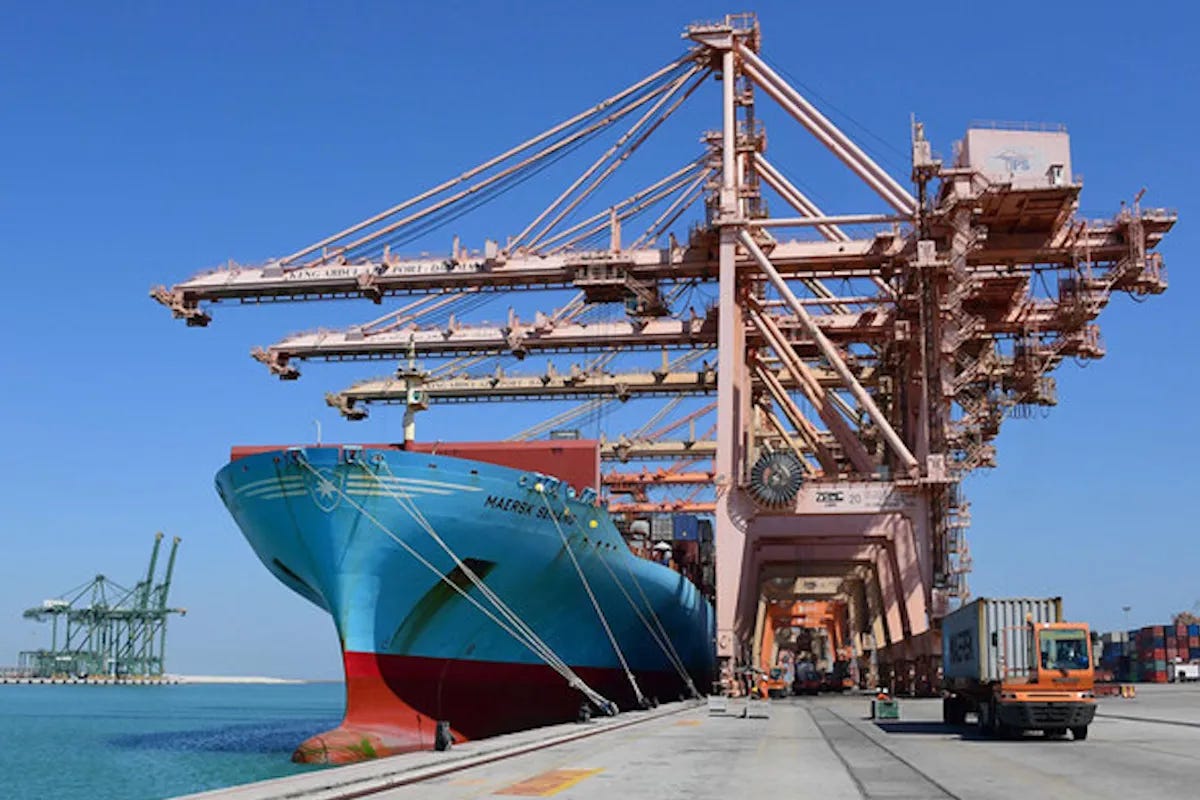
The port of Yanbu on the Red Sea coast is Saudi Arabia’s second-largest settlement and its largest port by area: 6.8 square kilometres, 34 berths, 10 terminals, rated capacity of 210 million tonnes of cargo annually. The Petroline arrives at its export terminal. The SAMREF refinery, processing 400,000 barrels per day in a joint venture between Aramco and ExxonMobil’s Mobil Yanbu Refining subsidiary, sits adjacent. The YASREF refinery, a 430,000 barrel-per-day facility jointly owned by Aramco at 62.5 percent and China’s Sinopec at 37.5 percent, lies approximately 10 kilometres away. Yanbu is not a port that acquired industrial weight by accident. It was built to be the western terminus of Saudi Arabia’s energy export architecture, the loading dock for a bypass system premised on the permanent unreliability of the Gulf.
The same logic, applied to container freight, produced the Landbridge. At $7 billion in total investment, the project connects Jeddah’s port with Riyadh, extends to Dammam on the Gulf, adds a 115-kilometre spur to the industrial city of Jubail, and includes a 172-kilometre extension from King Abdullah Port to Yanbu Industrial City. Seven logistics centres are planned along the Yanbu-to-Riyadh stretch alone. Once operational, a container train would cross the kingdom in under 10 hours, cutting the transit time from Gulf intake to Red Sea export from days by ship to hours by rail. The Landbridge is designed to carry 35 to 40 freight trains per day and over 50 million tonnes of freight per year.
The Landbridge is not yet operational. That matters for understanding why the PIF’s consolidation discussions are happening now. The physical infrastructure exists, some of it, and some of it is under construction. The institutional architecture, the single entity with a unified balance sheet that can deploy Bahri’s fleet, manage Saudi Global Ports’ terminals, coordinate with Yanbu’s loading operations, and eventually direct freight movements across the Landbridge, has never been assembled. The war activated the existing pipeline infrastructure at full capacity for the first time in its history. It exposed the absence of the institutional layer above it.
Saudi Arabia’s port authority responded to the Hormuz closure by adding five new maritime shipping services via the Red Sea in March 2026, citing supply chain continuity. A port authority adding shipping lines is not a unified entity directing freight across a multimodal corridor, and the gap between the two is precisely the argument the PIF is making to itself.
While Yanbu was loading supertankers at a wartime pace, Egypt and Saudi Arabia were building something quieter: a logistics corridor connecting Egypt’s Mediterranean port of Damietta on the Adriatic-facing northern coast to the Red Sea port of Safaga, and from there to Saudi Arabia’s Red Sea gateways. Hundreds of tonnes of refrigerated and dry cargo began flowing from Italy’s Trieste port through Damietta and Safaga into Gulf markets, bypassing the Hormuz corridor entirely.
The corridor’s permanence does not depend on the war continuing. Europe-to-Gulf freight moving through Damietta-Safaga reduces transit time and cost against the Cape of Good Hope route, which most major carriers had reverted to after the Hormuz closure made the Red Sea approach impractical from the eastern end. When Hormuz reopens, the Cape diversion ends. When the Red Sea normalizes, Bab el-Mandeb risk recedes. The Damietta-Safaga corridor remains viable on commercial grounds. Maritime transport analysts cited in reporting by The New Arab expect Gulf countries to become structurally dependent on this corridor for European trade regardless of the strait’s status, because the economic case survives the security case that created it.
A consolidated Saudi logistics entity with terminal positions, fleet assets, and rail connectivity would own the receiving end of that corridor. The Egypt-Saudi route arrives at Red Sea ports. A unified Saudi vehicle with Bahri’s fleet, Jeddah’s terminals, and the eventual Landbridge rail connection would be positioned as the corridor’s Gulf hub, directing freight from Red Sea arrival through Riyadh and on to the Gulf coast. No existing entity holds that integrated position. DP World, which operates the upgraded South Container Terminal at Jeddah under a 30-year concession, holds a piece of the terminal infrastructure. PSA International holds a piece of the Dammam terminal. Bahri holds the fleet. None of them hold the corridor.
DP World extended its Jeddah position in 2025, when it and the Saudi Port Authority MAWANI launched the upgraded South Container Terminal, doubling capacity from 1.8 million TEU to 4 million TEU, with a trajectory toward 5 million TEU. The Jeddah Logistics Park, DP World’s adjacent warehousing facility covering 415,000 square metres with over 390,000 pallet positions, opened in phases beginning in the second quarter of 2025. Abdulla Bin Damithan, CEO and Managing Director for DP World GCC, described it as the largest integrated logistics facility in the kingdom. The investment was framed as a deepening of 25 years of Jeddah port operations.
Jebel Ali, the Dubai government’s flagship, handled 14.5 million TEU in 2023, the highest since 2018. Its operating model is predicated on the free movement of vessels through Hormuz and Bab el-Mandeb. Most hardware entering the UAE, Saudi Arabia, and surrounding markets moves through Jebel Ali into the Dubai logistics ecosystem, where JAFZA’s bonded consolidation facilities and Jebel Ali’s re-export infrastructure convert the port from a transit point into a value-capture machine. DP World did not build a logistics empire in Jeddah out of charity. It built a position in the market its home port cannot serve from its eastern side when Hormuz closes.
The Saudi-UAE logistics rivalry predates this war by a decade. Saudi Arabia’s National Transport and Logistics Strategy, finalized under Vision 2030, targets entry into the global top 10 in logistics performance alongside 300 million annual air passengers and 4.5 million tonnes of air cargo, a direct structural challenge to Emirates and Dubai’s East-West transit dominance. In 2023, Saudi Arabia required multinational companies seeking government contracts to base their regional headquarters in Riyadh rather than Dubai, a policy the UAE perceived, correctly, as an attempt to redirect the corporate tax base away from ADGM and DIFC. Riyadh Air and the multi-billion-riyal expansion of King Salman International Airport are built to compete with Dubai International for Asia-Europe-Africa transit traffic. The aviation competition and the maritime competition are structurally identical: Saudi Arabia is using sovereign capital to build the hub infrastructure that would make Dubai’s version of each unnecessary.
What the PIF’s consolidation would accomplish in that context is not adding a layer to an existing rivalry. It would be Saudi Arabia’s first genuine institutional claim to parity in the one sector where Dubai has held undisputed regional primacy since the 1980s. A unified, publicly listed Saudi logistics vehicle commanding Bahri’s fleet, the Saudi Global Ports terminals, Jeddah’s berths, and the Landbridge rail corridor would be in a direct competitive position against DP World’s global portfolio, with the additional advantage of operating inside its own sovereign territory where the concession terms are ultimately set by the same government that owns the consolidating entity.
DP World holds its Jeddah South Container Terminal on a 30-year concession. PSA International holds its Dammam joint venture through a structure designed to attract Singaporean operational expertise. The consolidation the PIF is contemplating would need to navigate both positions, buying out minority interests, restructuring joint ventures, or folding partners into a vehicle where PIF holds control and the foreign operators hold reduced stakes. That is not a hostile restructuring on its face. It could be framed as an upgrade, offering DP World and PSA equity in the enlarged entity in exchange for transitioning from concession-holder to minority shareholder in a listed national champion. The commercial logic for both is defensible. Dubai would understand the terms precisely.
One person familiar with the PIF’s deliberations told Bloomberg the enlarged logistics entity could eventually be brought to international markets through an IPO. That detail is the most consequential part of the story, and the least developed in the initial reporting.
A consolidated Saudi logistics vehicle, when it arrives at global capital markets, will go there carrying a specific and recently validated argument. The global shipping industry has spent three months repricing its Hormuz exposure. Foreign institutional investors who held stakes in Gulf logistics infrastructure learned in February 2026 that the single-chokepoint architecture of Middle Eastern supply chains is not a risk scenario to be modeled; it is a recurring operational condition. Insurance underwriters at Lloyd’s scrapped war risk cover for vessels in the Persian Gulf as of March 5. Asian manufacturers with supply chains running through Hormuz faced shipping rate increases of 461 percent on crude cargo routes in a single week, according to S&P Global Energy’s Platts assessment. The argument the Saudi IPO would make to that repriced market: a Red Sea corridor asset with rail connectivity to the Gulf interior, a fleet capable of moving crude without transiting the strait, and sovereign backing from the government whose infrastructure has survived every Gulf crisis since 1979 is not a geopolitical bet. It is the hedge.
PIF’s assets under management reached approximately $913 billion by year-end 2024, with capital deployment reaching $56.8 billion in 2024 alone. Its 2026-2030 strategy, approved by a board chaired by Crown Prince Mohammed bin Salman in April, targets logistics capacity expansion to 40 million containers and frames sector integration, rather than incremental asset acquisition, as the mechanism. The consolidation is how the fund reaches that figure. The IPO is how it locks it in.
A publicly listed national logistics entity with foreign institutional shareholders is structurally harder for any future Saudi government to dismantle than a royal decree. The crown prince understands this. He has spent a decade using financial instruments, including Aramco’s 2019 IPO, to create institutional facts on the ground that outlive any single political moment. A national logistics champion listed on international markets, with pension funds and sovereign wealth funds holding minority positions, becomes a permanent feature of the Saudi economic architecture in a way that a PIF internal portfolio restructuring does not.
The Strait of Hormuz will reopen. The physical bypasses and alternative corridors built around its closure will remain commercially viable when it does. The institutional structure the PIF is assembling above them is designed to still be there when the next crisis comes.
What nobody at the fund is saying publicly is what DP World’s equity position in the new entity would be, and whether Abdulla Bin Damithan’s largest integrated logistics facility in the kingdom ends up as a minority-held asset inside the vehicle that absorbed it.


