Section 622
Congress Is Making It Illegal for Any President to Pull Back from Israel’s Intelligence Architecture
While Washington debated Section 224’s Pentagon military merger, the Senate Intelligence Committee passed a companion provision amending the National Security Act itself to forbid any future president from reducing intelligence sharing with Israel without formal justification and congressional notification. No other country on earth holds this legal protection.
The House Armed Services Committee voted this morning to keep Section 224 in the FY2027 National Defense Authorization Act. The Khanna amendment to strip it failed on a voice vote, with only Representative Ro Khanna of California and Representative Sara Jacobs of California voting to remove it. Section 224 now advances toward the full House, toward conference with the Senate, and toward the President’s desk. The public has had nine days to register what is happening. In those nine days, almost nothing has been said publicly about Section 622.
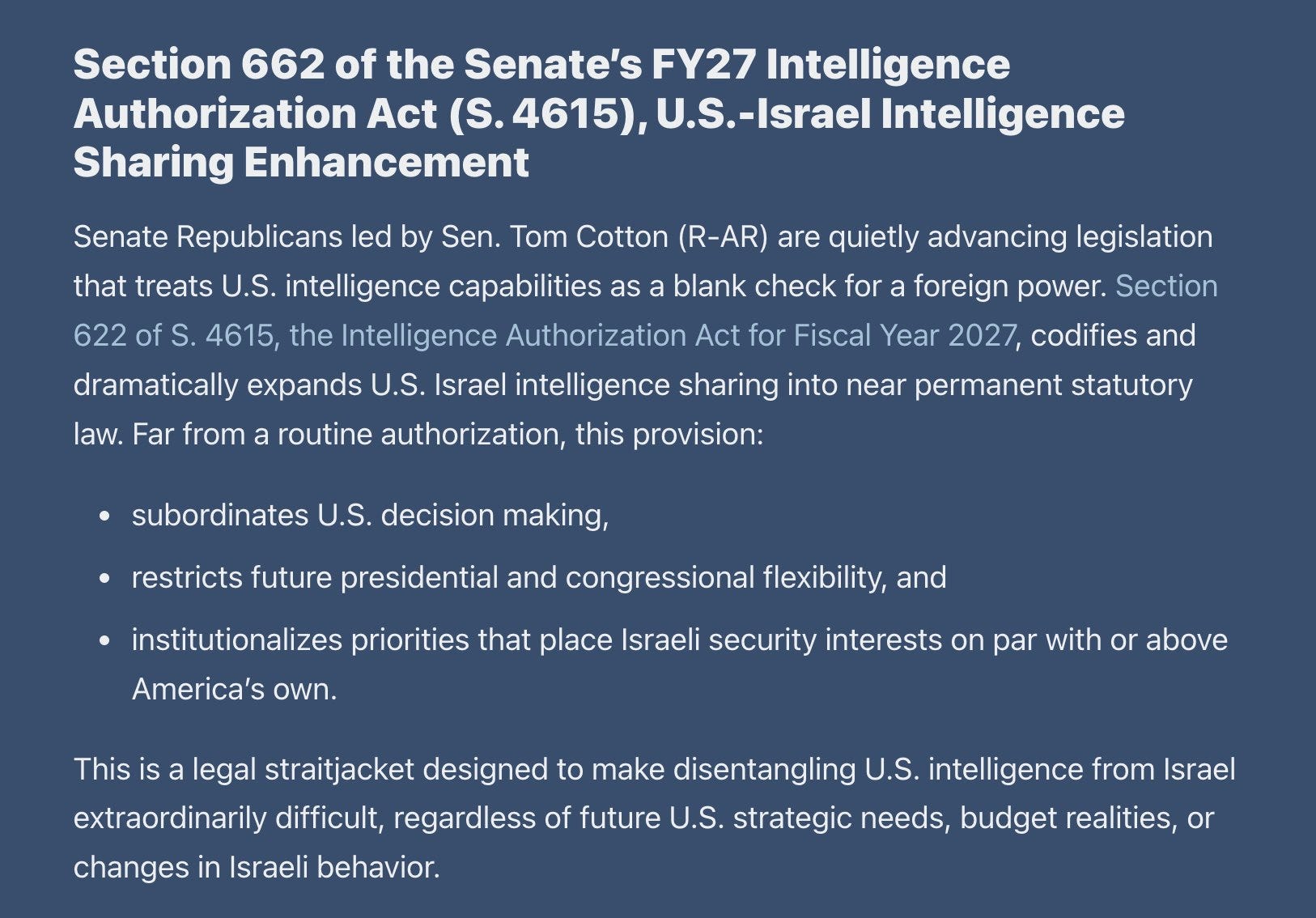
Section 622 of S. 4615, the Intelligence Authorization Act for Fiscal Year 2027, was approved by the Senate Select Committee on Intelligence on May 20, 2026, on a bipartisan vote. It is titled, in the committee’s own language, the “United States-Israel intelligence sharing enhancement.” It sits inside Title VI of the bill, between a provision on intelligence activities related to Ukraine and a provision on requirements relating to countries of significant concern. It was reported by Senator Tom Cotton of Arkansas, the committee’s chairman, and placed on the Senate calendar without a floor vote, awaiting absorption into the NDAA through the same mechanism that has carried every recent Intelligence Authorization Act into law. No press conference announced it. No floor debate addressed its implications. No member of either chamber has been asked, in a public setting, to explain what it means for the constitutional authority of every future American president over the country’s own intelligence apparatus.
What Section 622 Actually Requires
Section 622 directs the President of the United States to “expand and enhance intelligence sharing with the Government of Israel” across specified domains: cybersecurity, counterterrorism, missile and drone threats, and regional security across the Middle East. This is a statutory command, not a policy objective or a general authorization. The sitting president and every successor must actively work to expand and deepen intelligence cooperation with Israel.
The operative clause reads as follows: intelligence sharing with Israel “shall not be suspended, reduced, or otherwise materially limited except on the basis of a specific and identifiable national security concern.”
“Shall not” is mandatory. “Suspended, reduced, or otherwise materially limited” covers the full range of executive authority over intelligence sharing, including partial reductions, temporary pauses, and conditional limitations. “Except on the basis of a specific and identifiable national security concern” defines the only legal exit: a president who wants to reduce intelligence sharing with Israel must identify a specific national security justification, document it with a formal rationale, and notify the congressional intelligence committees within fifteen days of the decision. The notification must include the rationale, the nature of the limitation, and the duration. The president must also report to Congress on the progress of intelligence integration with Israel every five years.
The provision extends a similar mandate to “any Middle Eastern country allied with Israel under the Abraham Accords,” meaning the United Arab Emirates, Bahrain, Morocco, and Sudan. The default intelligence sharing obligation toward those four additional states is constrained by the same legal architecture.
No Other Country Has This
Every comparable intelligence relationship the United States maintains operates on executive authority, not statutory mandate.
The closest analogue is the Five Eyes: the intelligence sharing arrangement between the United States, the United Kingdom, Canada, Australia, and New Zealand that covers the bulk of signals intelligence collection globally. The Five Eyes, however, is governed by executive agreements between the relevant intelligence agencies, operating under classified memoranda of understanding rooted in the UKUSA Agreement of 1946, not by an act of Congress embedded in the National Security Act. A future president who decided that the Five Eyes arrangement needed to be modified would face political and diplomatic consequences, but no statutory prohibition and no mandatory notification to Congress. Even the NATO alliance, the most formally codified collective defense arrangement in American history, does not contain a statutory prohibition on reducing intelligence sharing with any member state. The intelligence relationship with America’s closest anglophone partners, and with every European ally, operates on executive discretion. The intelligence relationship with Israel, under Section 622, operates on statutory mandate.
Executive discretion can be exercised silently, quickly, and without a public justification requirement. A statutory mandate can be reduced only by clearing procedural hurdles designed, by construction, to make reduction politically costly. A president who wanted to reduce intelligence sharing with the United Kingdom could do so without notifying Congress or citing a specific national security concern. A president who wanted to do the same with Israel, after Section 622 becomes law, would be required to put in writing, in a classified submission to the intelligence committees, the specific and identifiable national security concern that justified the decision, and to do so within fifteen days. The political cost of that notification, in a Congress where the Israel lobby’s capacity to organize electoral consequences has been demonstrated at thirty-two million dollars in a single House primary, is intended to function as a near-absolute deterrent.
The Classified Architecture
Section 622 runs through the classified channel by design. The Senate Intelligence Authorization Act is, by its nature, a largely classified document. The public text available on Congress.gov is the unclassified version. The committee report accompanying the bill, containing the detailed legislative history, staff analysis, and policy rationale for specific provisions, is classified. The briefings that members of the intelligence committees received before the vote are classified. The progress reports the president will be required to submit every five years on the state of intelligence integration with Israel will be classified. Any notifications when intelligence sharing is reduced or suspended will be classified.
The structural consequence follows from this architecture: every mechanism by which a future president might exercise, trigger, challenge, or be held accountable for this mandate runs through the same classified pipeline that produced it. An American citizen who wanted to understand the current state of their government’s intelligence obligations to a foreign country would have no legal pathway to the primary record. The political cost of triggering the notification process is calibrated, by construction, to ensure that no president does.
The Biden Precedent and Why It Matters Now
In 2024, the Biden administration briefly withheld some intelligence from Israel during the military campaign in Gaza. According to Reuters reporting, officials in the US intelligence community had grown concerned about civilian casualties in Israeli operations and about whether Shin Bet, Israel’s domestic security agency, was mistreating Palestinian prisoners. Officials were specifically concerned that Israel had not provided sufficient assurances that it would abide by the law of war when using American information. Under existing US law, intelligence agencies are required to receive such assurances before sharing information with a foreign country.
Biden ultimately chose not to cut off the intelligence, concluding that the Trump administration would likely renew the partnership and that administration lawyers had determined Israel had not violated international law. But the decision to pause was made. It reflected a considered executive judgment about whether the conditions for sharing were being met, exercised under the legal framework that currently exists.
Section 622 forecloses that framework. Under the provision, any future administration that wanted to pause intelligence sharing with Israel in response to evidence of war crimes, civilian casualties, violations of the law of armed conflict, or any other concern would be required to characterize that concern as a “specific and identifiable national security concern,” document it formally, and submit the documentation to congressional intelligence committees within fifteen days. The political pressure flowing from that notification, organized by institutions that spent thirty-two million dollars in a single congressional primary to remove one Republican for insufficient support of Israeli military policy, would be immediate and designed to override the executive judgment that prompted the pause. The provision does not make a pause impossible. It makes it politically catastrophic, which in American governance is a distinction without practical meaning.
The Intelligence Security Record
The argument for mandating permanent, unrestricted intelligence sharing with any foreign partner rests on an assumption of reliable information security practices by the receiving party. The documented history of Israeli intelligence operations against the United States places that assumption under serious pressure.
Jonathan Pollard was a United States Navy intelligence analyst who, beginning in 1984, passed classified American intelligence to Israeli handlers. At his peak, he was passing approximately 800 classified documents a month. The materials included satellite imagery, signals intelligence intercepts covering Soviet weapons systems and Arab military capabilities, and intelligence assessments on Palestinian operations. Some of this intelligence was reportedly re-shared by Israel with the Soviet Union in exchange for exit visas for Soviet Jews, a claim that US counterintelligence officials have not publicly disputed. Pollard was arrested in 1985, convicted of passing classified information to a foreign government, and sentenced to life imprisonment. He was released in 2015 after decades of sustained diplomatic pressure from the Israeli government, including direct appeals by multiple Israeli prime ministers. He moved to Israel in 2020 and was received in a ceremony at Netanyahu’s residence. The Israeli government has never apologized for the operation.
The Pollard case is the most documented, but the institutional record does not stop there. Ben-Ami Kadish was a United States Army engineer who pleaded guilty in 2009 to passing classified materials to Israel between 1979 and 1985, including information on nuclear weapons, the F-15 fighter jet, and the Patriot missile defense system. He had been handled by the same Israeli intelligence officer, Yosef Yagur, who handled Pollard. He was 85 at the time of his guilty plea and received a sentence of two years probation and a fifty-thousand-dollar fine. Lawrence Franklin was a Defense Department analyst in the Office of the Secretary of Defense who pleaded guilty in 2005 to passing classified information about Iran and Middle East policy to AIPAC officials, who were in contact with the Israeli Embassy. Franklin was sentenced to ten months in prison.
Section 622 contains no exemption for cases where the receiving party is engaged in active collection operations against the United States, a condition the documented history of the relationship makes historical rather than hypothetical.
The Abraham Accords Extension and What It Means
The extension of Section 622’s mandate to “any Middle Eastern country allied with Israel under the Abraham Accords” is the provision’s least-discussed element. The Abraham Accords signatories include the United Arab Emirates, Bahrain, Morocco, and Sudan.
Sudan experienced a military coup in October 2021, and its governing junta has been engaged in a civil war since April 2023 between the Sudanese Armed Forces and the Rapid Support Forces, a conflict the UN has described as producing one of the world’s most severe ongoing humanitarian crises. Sudan’s normalization agreement with Israel was signed in 2020 but has never been formally ratified and is functionally suspended given the political collapse of the government that signed it.
The UAE presents a different and more precisely documented concern. The United States suspended the Trump-era F-35 fighter jet sale to Abu Dhabi in January 2021, citing concerns about Huawei 5G telecommunications infrastructure in UAE national networks and the intelligence security risks of operating advanced American weapons systems in proximity to Chinese telecommunications equipment. The concern that intelligence shared with the UAE could reach Chinese counterintelligence through that infrastructure was documented as a formal US government position, serious enough to halt a bilateral arms sale worth tens of billions of dollars.
Bahrain hosts the United States Navy’s Fifth Fleet. It also crushed a democratic uprising in 2011 with Saudi military assistance, maintains close financial and diplomatic ties with Iran while hosting American forces, and operates under a political system that imprisoned a prominent human rights activist in 2020 for criticizing the normalization agreement with Israel.
Section 622 would apply the same statutory constraint on a president’s authority to reduce intelligence sharing with these four states as it applies to Israel. A future administration that concluded intelligence shared with the UAE was reaching Beijing, or that intelligence shared with Sudan’s governing junta was reaching Russian-backed forces in the country’s civil war, would be required to identify a specific and identifiable national security concern, document it formally, and notify congressional intelligence committees before acting. The intelligence relationship with states whose alignment with American national security interests is conditional and context-dependent would be governed by the same statutory permanence as the provision’s central Israel mandate.
The National Security Act and What Amending It Means
Section 622 does not operate as a standalone policy directive. It amends the National Security Act, the foundational 1947 statute that created the Central Intelligence Agency, established the National Security Council, and defined the legal architecture of American intelligence. The National Security Act is structural law. It governs how the intelligence community operates across administrations, across decades, and across political transitions.
Writing Section 622 into the National Security Act means the mandate to share intelligence with Israel, and the prohibition on reducing that sharing without formal justification, becomes part of the permanent governing law of the American intelligence community, with no expiration date, no annual reauthorization requirement, and no termination clause tied to a change in administration. A future Congress wishing to remove the provision would need to pass new legislation explicitly repealing it, in a political environment where the cost of that repeal would be at least as high as the cost of triggering the notification process in the first place. Embedding the mandate in foundational statute rather than in annual authorization language is how permanence is manufactured in American law, and the architects of Section 622 understand this precisely.
The 2028 Cliff and Why the Timing Is Not Accidental
The Obama administration’s 2016 memorandum of understanding, which committed $38 billion in military assistance to Israel over ten years at $3.8 billion annually, expires at the end of fiscal year 2028, meaning September 30, 2028, approximately twenty-seven months from now. It is the legal framework governing the most consequential bilateral military aid relationship in American history, and it will require renegotiation within the current political cycle. According to Axios reporting earlier this year, Israel has already begun positioning for that renegotiation, seeking a new MOU that would shift the financial structure from direct grant aid to joint weapons production, a model that replicates the Section 224 architecture across the bilateral aid relationship itself.
The Arab Center DC identified the MOU expiration directly as a driver of the current legislative push: Israel’s most fervent supporters in Congress are trying to seize the current window to cement the relationship before the MOU expires and the political climate hardens further. A New York Times poll in May 2026 found 64 percent of Americans opposed to the Iran strikes. An Institute for Global Affairs survey found 38 percent in favor of halting weapons transfers to Israel entirely, and only 16 percent supporting their continuation without restriction. Renegotiating a new ten-year MOU in public view, with those polling numbers as the backdrop, is a political problem for the relationship’s advocates in Congress. Section 622 and Section 224 solve that problem by structural means: they convert the intelligence relationship and the military technology relationship from annually authorized and politically visible instruments into statutory mandates embedded in foundational law, operating through channels the annual appropriations process cannot easily reach, before the MOU expiration forces a public reckoning.
Section 224 Plus Section 622: The Full-Spectrum Lock
Read together, the two provisions cover the entire operational spectrum of the security relationship. Section 224 governs the military, weapons, and defense industrial dimension: research, development, testing, evaluation, integration, and co-production across AI, quantum computing, autonomous systems, directed energy, cyber, and biodefense. Section 622 governs the intelligence dimension: signals intelligence, human intelligence, analysis, targeting data, and the full range of classified information sharing between the two countries’ intelligence communities. Before these provisions, a future president who wanted to impose real conditions on Israeli military conduct had two primary tools: restricting arms transfers and reducing intelligence sharing. The Biden administration used both, imperfectly and briefly, during the Gaza campaign.
Section 224 moves the arms relationship out of the visible foreign military sales and appropriations process into Pentagon acquisition machinery. Section 622 places a statutory prohibition on reducing intelligence sharing without formal documentation and congressional notification. After both provisions become law, the tools available to a future president who needs to exercise meaningful leverage over Israeli military conduct have been reduced to diplomacy and public statements. Neither has produced documented behavioral change in the record of the relationship.
There are in total five bills and provisions advancing this legislative architecture simultaneously: Section 224 of the House NDAA, Section 622 of the Senate IAA, the War Reserve Stockpile Authority extension for Israel through January 2029, the subterranean cooperation extension through December 2029, and the counter-unmanned systems cooperation extension through the same date. Each addresses a specific dimension of the relationship. Together they are designed to convert the US-Israel security relationship from a politically negotiable arrangement into a legally mandated and institutionally embedded fact of American governance, operating across the Pentagon’s acquisition channels, the intelligence community’s classified pipelines, the pre-positioned weapons stockpiles on Israeli soil, and the joint technology programs that will govern American weapons development for the next generation.
What is being constructed does not require Israeli officials in the Situation Room or Israeli generals issuing orders to American intelligence analysts. It requires that the default of the system, the path of least resistance for every actor within it, runs permanently toward deepening rather than distance, and that every mechanism for creating distance carries a prohibitive cost, with Section 622 locking the intelligence relationship and Section 224 locking the weapons and defense industrial relationship into the same logic.
The question that neither provision asks, and that no member of either committee has been asked publicly to answer, is what the United States is supposed to do when Israel takes actions that conflict with American strategic interests or American legal obligations, and the tools for exerting pressure have been removed by statute. What recourse exists when the weapons pipeline is governed by acquisition contracts that cannot easily be cancelled and the intelligence pipeline is governed by a statutory mandate that cannot easily be suspended? What remains of the sovereign authority of the American government to manage its own foreign policy toward a state that has, in recent months, publicly defied the sitting president on Lebanon and continued military operations in Gaza under active ICJ genocide proceedings?
The Intelligence Authorization Act for FY2027 is on the Senate calendar. Its path to law runs through the NDAA. The FY2026 IAA became law as part of the FY2026 NDAA in December 2025. The FY2027 IAA will follow the same path. The markup for the FY2027 NDAA in the Senate Armed Services Committee has not yet been scheduled. When it is, Section 622 will travel with it, through classified briefings and closed-door sessions, into a conference report most members of Congress will not read, toward a presidential signature that will amend the National Security Act in ways the American public has not been told about and has not been asked to consider. By the time anyone outside the relevant classified committees understands what has passed, reversing it will cost more politically than anyone in Washington has so far been prepared to pay.
The markup has not been scheduled.