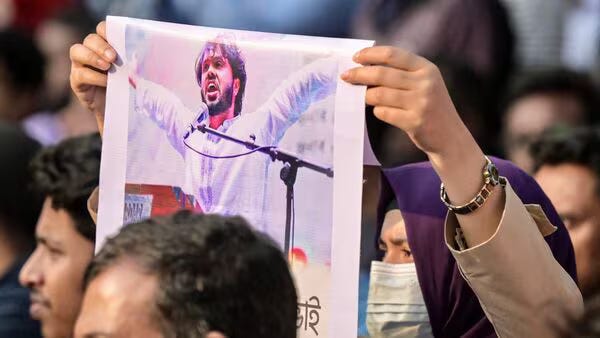
Sharif Osman Hadi’s Killing and the Night That Followed
Inside the plot, the street fury and the fragile future facing Bangladesh after a young leader’s assassination
Bangladesh is living through another long, sleepless night after the death of Sharif Osman Hadi, and the story of how the country reached this point is darker and more intricate than the first images of burning buses and angry slogans suggest. To understand what his killing has unleashed, you have to start in the days and even months before a gunman raised his pistol in a cramped Dhaka street.
A long shadow before the gunshots
On the surface, 12 December looked like a familiar day in central Dhaka. Jumma prayers had just ended, the streets around Bijoynagar and Purana Paltan were thick with worshippers, vendors and office workers heading back to their routines. Hadi, an independent hopeful for Dhaka 8 and the outspoken spokesperson of Inqilab Mancha, was moving through the area in a battery powered rickshaw. It was barely 24 hours since the election schedule had been announced.
Then, at around 2:20pm, a motorcycle pulled up behind his rickshaw. CCTV cameras in the Box Culvert area later showed two men wearing helmets, one driving, one sitting pillion. Witnesses describe a short, sharp burst of shots. Hadi collapsed in the rickshaw, his white panjabi soaked in blood. A supporter who had been livestreaming him on Facebook dropped his phone and joined others in lifting the unconscious leader onto a different rickshaw, racing towards Dhaka Medical College Hospital. In the video, Hadi’s head lolls to one side, his eyes half open, as someone screams that he has been hit in the face.
What looked like a sudden act of violence was, according to police documents and leaks to local media, the end of a carefully prepared operation. Investigators speaking off the record to Dhaka based reporters say they have pieced together a picture of men trailing Hadi for weeks: turning up at his cultural centre, attending his discussions, hovering at the back of campaign meetings, riding past his new flat in Uttara. A Prothom Alo investigation, quoting unnamed officers, describes an “organised network” that had been following him for at least two months, waiting for the right moment in public, with a crowd, the day after the election schedule, to make the maximum impact.
A youth leader with enemies
To understand why someone might invest months in killing him, you have to look at the dual life Hadi was leading in his last year: part idealistic cultural organiser, part lightning rod for a country’s grievances. He first drew national attention when he helped rescue injured protesters during the July 2024 uprising in Dhaka, turning his Inqilab Cultural Centre into a refuge and logistics hub. Photos and videos from that time show him hauling the wounded out of tear gas clouds, shouting instructions, pushing back phalanxes of riot police with nothing more than a loudspeaker and raw nerve.
From that moment, he stopped being just another activist shouting into the void. Inqilab Mancha emerged as a loose but powerful platform that rejected both of Bangladesh’s old poles, the Awami League and the BNP, accusing them of treating the country as their private fiefdom. Hadi’s speeches mixed religion, nationalism and social justice. He attacked rising prices and joblessness, denounced “foreign diktats” on policy, and spared neither the old ruling party nor the cautious technocrats of the transitional government. Indian television channels and security commentators, for their part, began labelling him a “radical” and replaying his most incendiary lines about India and the idea of a “Greater Bangladesh”.
This made him a hero to a certain slice of the young: those who saw no place for themselves in the traditional parties, who felt used as foot soldiers while the older generation cut deals. But it also made him a marked man. Business lobbies resented his attacks on “oligarchs”. Some within more established Islamist outfits saw him as an upstart crowding their space. Remnants of the Awami League and its student front, the Chhatra League, had not forgiven him for the role he played in bringing down Hasina, a point that would later appear in the police’s own investigative trail.
Quiet clues in local crime reports
While the world’s attention fixed on the flames after his death, local crime reporters had already begun to trace the outlines of the plot in the days between the shooting and the final announcement from Singapore.
The first real break came from the road. After officers collected CCTV footage from around the scene, they honed in on the motorcycle. Rapid Action Battalion units and police tracked the registration number and, within 24 hours, arrested its owner, Abdul Hannan, in Mohammadpur. The bike was seized and both man and machine were handed to Paltan police for questioning. A senior Dhaka Metropolitan Police official confirmed the arrest to reporters, but insisted it was too early to say whether Hannan had direct involvement or had simply lent the vehicle.
A few days later, reports surfaced that another court had placed Hannan on remand, while security agencies widened their focus to a man identified as Faisal Karim Masud, known as Rahul, described in one detailed report as a Chhatra League leader with ties to Awami League aligned politics. Anonymous investigators told a Dhaka daily that Faisal had been in repeated phone contact with his wife, brother in law and a close friend before and after the shooting. Those relatives were quietly taken into custody for questioning.
Another story, this one buried on an inside page of a Bangladeshi paper, mentioned raids at the India border, where two individuals were detained on separate charges, including suspected human trafficking, and then brought to Dhaka. Their names appeared once: Sanjay Chisim and Sibiron Dio. It was never made fully clear how, or if, they tied into the Hadi case, but their arrest fed a narrative in Hadi’s camp that at least some of the planners or facilitators may have hoped to slip across the border.
The inner circle closes ranks
While law enforcement traced the mechanics, the bike, the CCTV, the phone records, Hadi’s own networks moved to lock in their political framing of the attack. The Inqilab Cultural Centre announced a complete shutdown of activities, saying its volunteers and staff needed to concentrate fully on supporting Hadi’s treatment and coordinating with authorities. The statement, shared on their social pages, spoke of “heightened uncertainty” and an atmosphere in which not only Hadi but anyone visibly associated with the July uprising could be a target.
Inqilab Mancha itself and the allied National Citizen Party took an even sharper line. Within hours of the shooting, they were on the streets of Shahbag, accusing “pro India forces” and “old regime elements” of trying to decapitate the movement. Senior NCP figures warned that “our lives are also at risk” and said they were prepared to die rather than retreat. When Hadi died, the rhetoric hardened further, with some leaders using language that bordered on a declaration of war on India, at least in rhetorical terms.
A state scrambling for control
The official machinery lurched into motion in stages. First came statements from Dhaka police, stressing that there was no evidence of a pattern of targeted political killings, even as they admitted the attack was clearly premeditated. Then, as national and international pressure grew, a relative of Hadi’s finally filed a formal case at Paltan Police Station, turning the gun attack into a criminal file that could travel through the courts. The charge sheet listed unknown assailants riding a motorcycle, and hinted at a conspiracy designed to “create large scale instability” in the wake of the election announcement.
Chief Adviser Muhammad Yunus’s office had been tracking the case from the beginning, if only because Hadi’s survival or death would affect the stability of the transition. When news came from Singapore that he had lost his fight, Yunus went public with a blend of empathy and alarm. He visited Hadi’s family, vowed that “every resource of the state” would be used to unmask the killers, and tried to reassure a jittery public that the interim government would not allow the uprising’s most visible faces to be picked off one by one.
But even as Yunus spoke, the streets were moving faster than his administration. The first protests were spontaneous, erupting outside Hadi’s cultural centre, in his Dhaka 8 strongholds, and near the hospital where he had once been rushed in critical condition. Within a day, the demonstrations acquired clear targets.
When the mobs turned on the media
If the assassination highlighted the vulnerability of Bangladesh’s new political class, what followed exposed the precarious position of its media. Prothom Alo and The Daily Star, two of the most influential dailies in the country, had spent days covering the shooting, the transfer to Singapore and the daily bulletins about Hadi’s condition. Their reporting was relatively straightforward, but in the eyes of many in Hadi’s base, these outlets had long been too close to the establishment, too cautious in describing India’s role in Bangladeshi politics.
When the crowds came, they came hard. Protesters stormed the premises, smashing glass, setting fire to parts of the buildings, trapping reporters and editorial staff inside. Journalists later described the surreal horror of watching from newsroom windows as their car parks filled with flames, while phones buzzed with messages from family members asking whether they were alive. One young reporter said she lay flat on the floor under a desk, covering her mouth with a wet cloth as smoke seeped under the door, listening to screams in the corridor.
By the time security forces regained control, parts of the offices were gutted. In an ironic twist, the very newspapers that had chronicled the country’s convulsions for decades now had to write, in the first person, about being attacked as enemies of the people. Editorials in the aftermath warned that Bangladesh was sliding into a place where neither politicians nor the press could assume basic safety.
Competing stories about who killed him
In the absence of a completed investigation, it is the competing narratives about who ordered the hit that are shaping public opinion.
The first, and perhaps loudest, comes from Hadi’s supporters themselves. In their telling, there is a straight line from his loudest speeches about India’s influence, the July uprising that humiliated an ally of New Delhi, and his transformation into a symbol of an assertive, more Islamic tinged nationalism, straight to the gunman on the back of the motorcycle. They see Indian interests, Indian intelligence and Indian backed Bengali elites as the invisible hand. For them, details about a Chhatra League shooter or Awami League linked facilitators do not contradict that story; they confirm it, suggesting that remnants of the old regime still act as proxies for a foreign power.
A second story, often whispered rather than shouted, is more inward looking. It asks whether Hadi had simply become too big, too quickly. Some within the sprawling anti Hasina camp resented the way he dominated rallies and media coverage, pushing aside quieter technocrats and veteran organisers. Could a rival Islamist leader, a jealous nationalist faction, or even a rogue element within the security services have decided that silencing him might create space for a more controllable face of the movement? There is little hard evidence in the public domain to support this version, but it circulates in private conversations among activists who know how vicious intra opposition rivalries can become.
The third, more cautious narrative is the one the state is trying to project: that this was a complex, multi layered conspiracy, possibly involving criminal networks, political operatives and opportunists, but that it can be untangled through patient police work. Under this view, anger should be directed not at entire communities, parties or foreign countries, but at specific individuals who can be named, charged and tried. The problem, for many Bangladeshis, is that they have heard such promises before in other high profile cases, only to see inquiries slow, stall or disappear into political bargaining.
A country at the cusp
As Hadi’s body makes the journey back from Singapore, Bangladesh is wrestling with more than one loss. There is the obvious, personal tragedy: a 32 year old man whose trajectory, for better or worse, had become bound up with the dreams and fears of a generation, cut down in broad daylight. There is the political loss: a voice that, whatever one’s view of his rhetoric, had forced uncomfortable conversations about power and sovereignty, suddenly removed from the national stage.
And then there is the institutional test. Can an interim government that came to office on the back of a street uprising now convince that same street to trust the slow, often unsatisfying logic of investigations and trials? Can it shield journalists, activists and candidates from the anger of mobs and the calculations of those who might see violence as a shortcut to influence?
Hadi’s supporters talk in the language of martyrdom now. His critics, some of whom quietly feared where his brand of politics might lead, are left wondering whether Bangladesh is entering a phase where the death of one young man could become the spark for a wider, more uncontrollable storm. Somewhere in between those poles, millions of ordinary citizens are trying to navigate daily life, getting to work through blocked roads, checking on relatives caught near clashes, praying that the latest crisis will pass before it consumes another decade.
The gunshots in Purana Paltan lasted only seconds. Their echo, amplified by grief, rumours and rage, is likely to shape Bangladesh’s politics for years to come.


