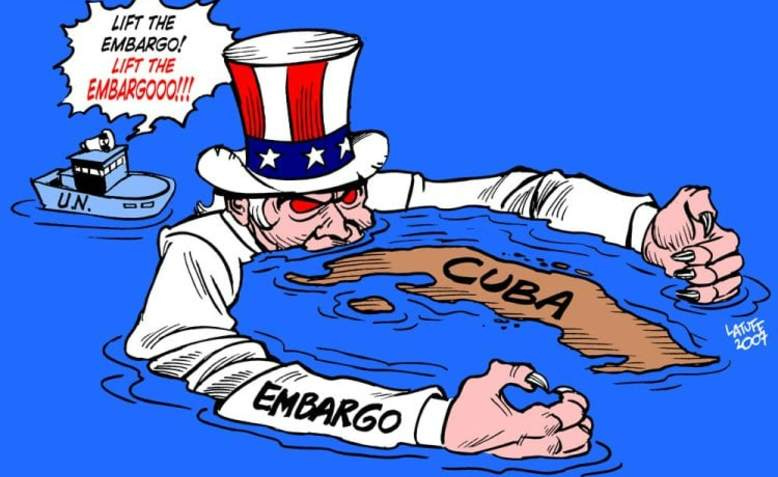
Siege by Sanctions
Washington Is Starving Cuba of Light
The oil blockade is not economic pressure. It is a civilian punishment infrastructure sixty-three years in the making.
In the oncology ward of the National Institute of Oncology and Radiology in Havana, Jorge Elias sits in a chair waiting for radiotherapy. The machine that will treat him requires electricity. Electricity requires fuel. Fuel requires a tanker. The tankers stopped coming in January.
This is where American foreign policy arrives, stripped of its language about freedom and democracy. It arrives in a cancer ward where the lights may not stay on long enough to complete a course of treatment.
Cuba’s Health Minister José Angel Portal Miranda told the Associated Press in late February that U.S. sanctions are no longer an economic abstraction. They are, in his precise formulation, threatening “basic human safety.” Five million Cubans living with chronic illnesses face disruption to medications or treatment. Sixteen thousand cancer patients require radiotherapy. Another 12,400 are undergoing chemotherapy. The minister did not hedge. “You cannot damage a state’s economy without affecting its inhabitants,” he said. “This situation could put lives at risk.”
That is not the Cuban government speaking in political slogans. That is a physician describing what happens when an oil blockade meets an oncology department.
January 3, and What Followed
The sequence of events that produced the current crisis in Cuba was not accidental. It was constructed, in documented steps, over the first weeks of 2026.
On January 3, U.S. forces removed Venezuelan President Nicolas Maduro from Caracas in an operation the Trump administration named “Operation Absolute Resolve.” Venezuela had been supplying roughly 26,500 barrels of oil per day to Cuba, covering approximately 33 percent of the island’s import needs. That supply stopped the same day Maduro was taken. No cargo has departed Venezuelan ports bound for Cuba since.
Trump announced the terms publicly on Truth Social: “THERE WILL BE NO MORE OIL OR MONEY GOING TO CUBA. ZERO. I strongly suggest they make a deal, BEFORE IT IS TOO LATE.”
The capital letters were the operative policy instrument.
Mexico had been Cuba’s largest single oil supplier, covering approximately 44 percent of the island’s imports. Mexican President Claudia Sheinbaum had publicly criticized the U.S. blockade as “very unjust” and “very unfair.” She sent two ships of humanitarian aid to Havana in early February. Then Trump threatened tariffs on Mexican exports to the United States, and Mexico suspended its oil shipments to Cuba. Sheinbaum called it a “sovereign decision.” A decision made under economic coercion carries that description in form only.
Russia supplies approximately 10 percent of Cuba’s oil. The Trump administration has indicated it will seize tankers carrying sanctioned cargo. U.S. Navy warships have repositioned from the Caribbean toward the Atlantic, closer to Cuba’s approaches. The message to Moscow is being delivered in nautical miles.
The Financial Times reported, citing Kpler shipping data, that by January 30 Cuba had enough oil to last fifteen to twenty days at current demand levels. That estimate was published nearly four weeks ago.
What the Satellite Imagery Shows
Bloomberg News analyzed satellite imagery of nighttime light emissions across Cuba and compared the data against a 2017 to 2022 baseline. Light levels across the island have dropped by as much as 50 percent. Eastern cities, Santiago de Cuba and Holguin among them, recorded the sharpest declines. Rural areas and provincial centers outside Havana have been hit hardest. Havana itself, which has a higher concentration of solar panels and battery storage systems, has fared comparatively better. The disparity maps directly onto wealth. Those who can afford backup systems survive the blackouts. Those who cannot do not.
Cuba’s state electricity authority, Union Electrica, publishes daily generation deficit reports. On February 23, the authority recorded a peak impact of 1,748 megawatts against total demand of 2,100 megawatts. Cuba was meeting 58 percent of its electricity needs at the worst point of that day. By six in the morning on February 24, availability stood at 1,230 megawatts against 2,100 megawatts of demand. The gap was 870 megawatts. That gap is measured in hospital corridors, in dark kitchens, in stalled buses, in garbage trucks that cannot move.
Garbage collection in Havana has broken down. Reuters reported trucks sitting idle as fuel shortages halt operations, waste accumulating in neighborhoods across the capital. Air Canada suspended its Cuba service after Cuban aviation authorities notified international carriers that jet fuel for refuelling was being suspended for a month. The U.S. Embassy in Havana advised American nationals to prepare for significant disruption from power outages and fuel shortages. Washington created the conditions it was warning its own citizens about.
The Institutional Gap Between Statement and Record
The Trump administration offered $6 million in humanitarian aid to Cuba while maintaining the blockade that made humanitarian aid necessary. The gap between that gesture and the scale of the crisis is not a policy inconsistency. It is the policy. The $6 million functions as a claim that Washington is not indifferent to Cuban suffering, while the blockade continues to produce that suffering at industrial scale.
Secretary of State Marco Rubio is directing the administration’s Cuba posture. He has called for regime change in Cuba throughout his political career. The current policy executes that position through energy infrastructure rather than military force, which allows Washington to describe what is happening as economic pressure rather than siege. The distinction is administrative, not humanitarian.
The United Nations does not accept that framing. On February 13, the UN Office of the High Commissioner for Human Rights issued a formal determination that the current U.S. sanctions against Cuba constitute a violation of international law. UN Secretary-General Antonio Guterres stated that he was “extremely concerned about the humanitarian situation in Cuba,” which will “worsen, if not collapse, if its oil needs go unmet.” His spokesman also noted that the UN General Assembly has called for an end to the U.S. trade embargo on Cuba every year for more than three decades. Washington has ignored that resolution every year for more than three decades.
The Grid Was Built to Fail Under These Conditions
Cuba’s electricity infrastructure was not in good condition before January 2026. The IEEE documented in mid-2025 that the national grid had collapsed four times in the previous six months. Average daily electricity deficits ran at approximately 1,600 megawatts throughout 2025. The Antonio Guiteras thermoelectric plant in Matanzas, the island’s largest, failed catastrophically in October 2024, causing a total nationwide blackout. The grid has almost no redundancy. Its protection systems are too old to detect faults and isolate them before cascading failures occur. The thermal plants that generate most of the island’s power run on crude oil and fuel oil. They date, most of them, to the Cold War.
The structural reason this infrastructure was never modernized is not administrative incompetence. Cuba has been barred from accessing international capital markets by U.S. sanctions since 1962. It cannot borrow to build. It cannot attract investment to upgrade. It cannot purchase spare parts from a wide range of suppliers without triggering secondary sanctions on the sellers. The grid is old because U.S. policy made it impossible to replace it. The blackout that satellite imagery now maps across the island is the accumulated product of sixty-three years of deliberate economic strangulation, accelerated in six weeks to a point of near total system failure.
Energy analysts have stated the operational logic without qualification. “The fuel situation in Cuba will get pretty dire pretty fast,” Skip York of Rice University’s Baker Institute told Fortune. “That’s going to put tremendous pressure on the government because energy, whether it’s oil or electricity, is the lifeblood of any country. And if the U.S. stays the course, they will board any sanctioned tankers heading toward Cuba.”
Take Venezuela. Cut Cuba off from Venezuela’s oil. Use tariff threats to prevent Mexico from stepping in. Use naval positioning to deter Russia. Wait for civilian misery to produce political collapse. Call the outcome liberation.
The People in the Dark
Vilma is a university employee in Havana. She asked reporters to identify her only by her first name. She and her colleagues have been suspended from work since January. Eight to ten hour blackouts are the norm. Without electricity, there is no internet. Without internet, there is no remote work, no communication, no news from outside the island. “If you don’t have electricity to power an internet connection,” she told Prism Reports, “what are we talking about?”
In Cuba’s eastern provinces, the situation is compounded by Hurricane Melissa, which struck in late October 2025 and displaced more than 735,000 people. Infrastructure destroyed by the storm has not been repaired. The blackouts rotate according to a schedule Union Electrica publishes daily, but actual electricity availability falls short of the plan, so the rotation is not carried out as published. Provincial authorities choose which communities lose power and for how long. The average is nineteen hours without electricity. Some circuits exceed twenty-four.
Food cannot be refrigerated. Cooking requires gas or wood when electricity fails. Transportation stops when buses have no fuel. Workers who cannot get to work cannot earn. Small businesses without generators close. The tourism industry, one of Cuba’s primary sources of hard currency, is losing bookings as international travel agencies remove Cuba from their catalogues because basic services cannot be guaranteed. Without tourism revenue, the government has less capacity to purchase fuel. Without fuel, the blackouts deepen. Washington designed the loop.
The Sixty-Three Year Context
The current crisis cannot be separated from its history. The U.S. trade embargo against Cuba was imposed in 1962. In the six decades since, it has survived the end of the Cold War, the dissolution of the Soviet Union, the normalization of U.S. relations with China and Vietnam, and twelve American presidencies. It has never been subjected to serious congressional reexamination on humanitarian grounds. It has been managed as a domestic political instrument calibrated for the electoral arithmetic of Florida.
Cuba survived the Special Period of the 1990s because it could still import fuel from somewhere. The analysts who draw comparisons between that period and the present identify a critical difference: in the 1990s, the embargo did not extend to threatening third-party suppliers with tariffs and naval interdiction. Now it does. The perimeter has been extended. The island has been sealed more completely than at any prior point in the embargo’s history.
Cuban President Miguel Diaz-Canel has stated his government remains open to dialogue with Washington on any issue. Foreign Minister Bruno Rodriguez has described the blockade as “cruel aggression” aimed at “breaking the political will of the Cuban people.” Cuba’s Ambassador to the United Nations, Ernesto Soberon Guzman, told Democracy Now in February that what the United States is doing constitutes a massive violation of human rights and a massive violation of international law.
Washington responded by repositioning warships.
What the Record Shows
The United States imposed an economic embargo on Cuba in 1962. That embargo prevented Cuba from modernizing its energy infrastructure for six decades. In January 2026, the United States militarily removed the leader of Cuba’s principal oil supplier, then cut off Cuban access to that supply. It threatened tariffs against any country attempting to provide an alternative. It repositioned naval assets to enforce compliance. It offered $6 million in humanitarian assistance to the population it was simultaneously blockading. The UN determined the policy violates international law. The UN has made the same determination about the broader embargo for thirty-three consecutive years.
Eleven million people are living under these conditions ninety miles from Florida. The satellite photographs of their darkness exist. The daily deficit reports from Union Electrica exist. The hospital cancellations exist. The grounded aircraft exist. The suspended garbage trucks exist. The cancer patients waiting in oncology wards for machines that require electricity to function exist.
The American public has access to this record. What it lacks is a media and political environment that treats the record as the story, rather than the regime change rationale as the story. Those are different stories. Only one of them is happening to people.