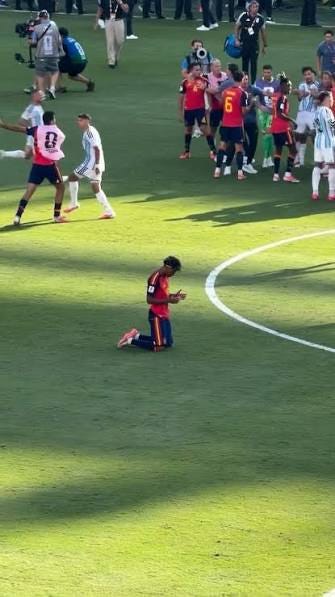
Spain defeated Argentina 1-0 in extra time on Sunday night in the 2026 FIFA World Cup final at the New York New Jersey venue, ending a tournament spread across the United States, Mexico, and Canada that expanded the competition to 48 teams, 104 matches, and 16 host cities. It was the biggest World Cup FIFA has ever built. That scale did not make it too sacred for politics. It made the silence around politics harder to defend.
By the time Ferran Torres scored in the 106th minute and Spain’s players disappeared beneath the usual storm of flags, camera cranes, sponsor backdrops, presidential optics, and official rhetoric about unity, the oldest lie in modern sport was already being repeated with full ceremonial confidence: that the grandest stage in football must remain protected from politics even as politics saturates every inch of it. The World Cup final is introduced to us as if it were a pristine human interval, a brief suspension of history in which talent, nerve, beauty, and national memory can exist apart from the structures that finance the spectacle, police its perimeter, script its ceremony, and decide which forms of collective feeling are welcome on screen. But the final has never belonged to that innocent universe. It belongs to this one, the real one, where nations perform themselves before global audiences, corporations wrap their logos around public emotion, governments seize prestige where they can find it, and institutions talk endlessly of humanity while treating actual human suffering as a contamination risk.
That contradiction was not incidental to the 2026 tournament. It was built into the architecture from the start. FIFA did not stage a compact championship tucked neatly into a single host country. It staged a continental production across three states and sixteen cities, from Mexico City to Vancouver to the northeastern corridor of the United States, and in doing so turned football into a month-long choreography of border management, commercial saturation, security planning, broadcast rights, municipal branding, and geopolitical theater. The expansion to 48 teams and 104 matches was sold as openness, access, and a larger embrace of the world. It was also a way of making the tournament more total, more profitable, more administratively sprawling, and more saturated with the institutional machinery that sport’s defenders suddenly pretend not to see the moment anyone asks for a gesture toward Palestine, Sudan, Iran, or any other place where civilians are being crushed while the cameras stay fixed on more profitable emotion.
The final itself sharpened the absurdity. Spain arrived chasing a second men’s World Cup after its title in 2010. Argentina arrived as defending champion, carrying the late-career gravity of Lionel Messi and the strange public tenderness that follows any team when the audience suspects it may be seeing the end of an era. The match remained scoreless deep into extra time, then turned on a single finish, a single lapse, a single moment around which every replay package and every morning-after national mythology will now be built. Donald Trump, the current president of the United States, appeared as part of the surrounding official spectacle. Yet even with all that national pageantry in plain sight, even with the language of statehood and prestige hanging over the night as plainly as the floodlights, many people would still insist that politics would only have entered the frame if someone had unfurled a banner for Gaza, worn a black armband for Sudan, or interrupted the final’s polished script long enough to name the civilians the world has chosen to watch die in installments.
That is what “keep politics out of sports” has always meant in practice. Not the exclusion of politics, which would be impossible, but the protection of the politics already embedded in the event from competition by moral speech that cannot be easily managed. The anthem is politics. The flag is politics. The presidential appearance is politics. The security theater outside the stadium is politics. The multinational host arrangement is politics. The entire claim that a World Cup jointly staged by the United States, Mexico, and Canada represents an uncomplicated festival of shared humanity is politics. What becomes intolerable, suddenly, is not politics itself but unsanctioned politics, politics from below, politics that names the dead without clearing the language through sponsors, federations, and government relations teams. Institutions do not fear politicization. They fear dissent that survives management.
The defenders of the old formula usually retreat to sentiment. People are tired, they say. Fans need one place untouched by the misery of the age. There is, at the level of private life, something intelligible in that desire. A person finishing a week of work, sitting on a couch, wanting ninety minutes of release from the rolling catastrophe of the news cycle, requires no indictment. But the emotional wishes of private spectators cannot settle the ethical obligations of the largest public ritual in world sport. The World Cup final is not a family picnic. It is a planetary ceremony, one of the last media events that still persuades governments, broadcasters, advertisers, and ordinary viewers to inhabit a common frame at the same time. An event that large does not get to borrow the language of humanity, unity, and universality when it wants grandeur, then plead fatigue when someone asks whether the world beyond the stadium should be allowed to intrude in the form of the bombed child, the displaced mother, the starved city, the camp, the grave, the siege, the family that will never see its dead returned intact.
And that is why the scale of the 2026 tournament matters so much to this argument. If FIFA wanted the biggest World Cup in history, then it accepted, whether it admits this or not, a larger moral frame. A tournament stretched across three countries and sixteen host cities cannot plausibly advertise itself as a gathering of the world while policing the world’s suffering out of view. The promise of this competition was not modest. It was maximalist. More teams than ever before. More matches than ever before. More host territory than ever before. Fine. Then let the conscience attached to it expand as well. A ceremony of that size can find time for fireworks, celebrity cutaways, branding exercises, heads of state, aerial beauty shots, heritage montages, and post-match tributes to togetherness. It can find ten seconds for the truth.
The usual institutional answer is procedural. If Palestine, why not every conflict. If Sudan, why not Congo. If Iran, why not Yemen, Kashmir, Myanmar, Ukraine, Haiti, or the next disaster already forming beyond the editorial horizon. The question is designed to convert urgency into paralysis. Because everything cannot be named, nothing should be named. Because justice cannot be perfect, indifference should be total. It is a bureaucrat’s morality, and it collapses under the slightest pressure. Institutions make selective choices constantly. They choose which anniversaries deserve remembrance graphics, which causes are market-safe enough for symbolic support, which deaths can be converted into tasteful solemnity, and which names are too politically expensive to speak aloud. Selectivity already governs the field. The real dispute is over who gets selected for silence.
This is where the athlete enters the argument, and where the reflexive contempt toward athlete speech becomes especially revealing. Players are allowed, even encouraged, to embody every approved symbol in public life. They may weep during the anthem, kiss the badge, wrap themselves in the flag, point to the sky, embrace military ritual, thank political leaders, thank sponsors, submit their bodies to endless commercial extraction, and stand in for the nation as a whole in moments of victory and grief. Their labor is nationalized. Their emotion is monetized. Their image is public property for the duration of the tournament. But the moment an athlete tries to use that body, that image, that extraordinary concentration of public attention to say that children should not be exterminated, starved, displaced, or erased under the cover of strategic language, the guardians of sporting purity suddenly rediscover restraint. Stay in your lane, they say. The lane, it turns out, includes everything except conscience.
What makes the World Cup final such a potent site for this struggle is not that symbolic politics can end a war. It cannot. A patch on a sleeve does not stop artillery. A minute of silence does not reopen a humanitarian corridor. A pre-match statement does not rebuild a hospital or force a ceasefire through the Security Council. But politics is not composed only of direct instruments. It is also composed of visibility, shame, legitimacy, memory, moral ranking, and the public contest over whose suffering counts enough to interrupt ceremony. On that level, the World Cup final matters immensely. A UN briefing reaches one audience. A sports spectacle reaches another, including millions who no longer meet the world except through entertainment. The institutions understand this perfectly well. That is why they police symbolic dissent with such nervous energy. They know a sentence spoken under those lights can travel where years of documentation did not.
Palestine belongs in that frame by name. Sudan belongs there by name. Iran belongs there in the plain sense that civilians caught beneath bombardment and regional power games do not vanish because state officials prefer strategic abstractions and broadcasters prefer cleaner copy. The same principle applies beyond the causes fashionable enough to survive a news cycle. The point is not to produce a complete catalogue of human suffering before kickoff. The point is to puncture the fiction that the largest gathering in sport can continue to speak of the world while quarantining the world’s wounds outside the turnstiles. Once you see the mechanism clearly, the moral arrangement becomes hard to tolerate. Some politics enter the stadium through the VIP gate and sit in the front row. The politics of the dead are told to wait outside.
There is also a harder truth beneath the softer rhetoric of neutrality. A final of this scale performs emotional governance. It reassures audiences that the world is still coherent enough for flags, ceremony, and beauty to mean what they once meant. It offers a carefully managed image of human collectivity, complete with rival nations accepting the same rules, the same referee, the same symbolic order, the same field. That image is powerful. States prize it. Corporations pay fortunes to stand near it. Broadcasters drape whole national narratives around it. To introduce Palestine or Sudan into that frame is not simply to make a statement. It is to refuse the emotional lie that history can be paused for entertainment while mass death proceeds elsewhere at an acceptable distance. That is why power resists the interruption so fiercely. Not because the interruption is irrelevant, but because it is exact.
The 2026 World Cup invited this question more than any recent tournament because its own design announced a larger claim about inclusion. FIFA enlarged the bracket, widened the map, multiplied the venues, and sold the whole undertaking as an expanded belonging. The event was bigger because more of the world had been invited in. Very well. Then let more of the world arrive in full, not in costume only, not as flags and songs and marketable folklore, but as history. Let the places under siege enter with the rest. Let the civilians buried under official language enter with the rest. Let the reminders of what this age is doing to human beings enter with the rest. Otherwise the rhetoric of inclusion was only a commercial style, one more glossy surface wrapped around a machine that knows exactly whose pain is bad for business.
By the time Spain lifted the trophy, by the time Argentina’s defeat was folded into the melancholy of an era ending, by the time the cameras settled into the reliable grammar of champions, dignitaries, confetti, and grief arranged into television, the final had already answered the question it never meant to answer. The 2026 World Cup proved again that football is one of the few surviving forms of truly planetary attention. It also proved how determined our institutions remain to use that attention for everything except moral honesty. There was room in this tournament for 48 teams, 104 matches, 16 host cities, presidential pageantry, and a month of corporate slogans about unity. There was still, apparently, no room for the dead.
That was the politics.
Cowardice.


