The Administered Faith
Russia, the IRGC, and the Colonization of Muslim Consciousness
Iran has between seven and ten million Sunni Muslims. Approximately one million of them live in Tehran, a city of 9.6 million people. There is not a single Sunni mosque in the capital. The Islamic Republic, which governs in the name of God and the oppressed, has prohibited the construction of Sunni houses of worship in its own capital while allocating forty billion tomans annually from the municipal budget to Shia mosques and nothing to Sunni places of worship. The Baloch of Sistan-Baluchestan, who are Sunni and have been poor for as long as anyone has recorded, were executed at a rate accounting for roughly 42 percent of all documented executions in Iran in 2025, despite comprising less than two percent of the population. In September 2022, during Friday prayers at the Jameh Mosque of Makki in Zahedan, IRGC and Basij forces opened fire on worshippers leaving the building and killed over ninety people. The imam who led the prayers, Molana Abdolhamid, called it a massacre and denounced what he named the absolute lies of a state that had described its own congregation as separatist terrorists.
Russia’s encounter with Muslim peoples runs longer and deeper than any alliance it has formed since. Of the 26,000 mosques functioning across the Russian empire in 1917, fewer than 1,000 remained open by 1941. The entire Chechen and Ingush population was deported to Central Asia in cattle cars in 1944. The bombardment rate over Grozny during the winter siege of 1994-95 exceeded 4,000 detonations per hour. Russian airstrikes over Syria between 2015 and 2017 killed over 7,700 civilians, the majority of them in Sunni Arab neighborhoods, in a campaign monitoring organizations established within its first two weeks was not directed at the Islamic State.
These are the two states the Muslim world has been persuaded to call its defenders.
The argument that follows is not about whether the United States has committed crimes against Muslim peoples. It has, repeatedly, and the record is not in dispute. The argument is about what happens when that documented record is used to exempt two other states from the same accounting, and what those two states have actually built in the territories and populations they govern. The ledger does not belong only to Washington. It never did.
The Long Machinery of Control
The Tsarist solution, formalized by Catherine the Great in 1788 through the Religious Council in Ufa, was institutional domestication. The Russian state appointed Muslim clerical authority, funded it, and made obedience to that authority a condition of its recognition. Islam practiced through state-licensed structures was permitted. Islam that organized independently of those structures was suppressed. This was not religious tolerance. It was the conversion of faith into administrative apparatus.
The Soviets inherited this architecture and applied industrial methods to it. Of the 26,000 mosques functioning in the Russian empire in 1917, fewer than 1,000 remained open by 1941. Thousands of Muslim clerics were arrested during the Great Purge and executed. The Jadidist reformers, Muslim intellectuals who had accepted Soviet partnership on the premise of coexistence, were among the first to be shot. Stalin deported the entire Chechen and Ingush populations to Central Asia in 1944, in winter, in cattle cars, killing thousands in transit and thousands more in the settlements of Kazakhstan and Siberia. They were punished collectively for alleged collaboration with the Wehrmacht. In practice, they were punished for being a Muslim people on Russia’s border who would not stop resisting.
In place of what it destroyed, the Soviet state built the four Spiritual Directorates: managed religious bodies that nominally represented Muslim communities while functionally serving as instruments of security service penetration. The clergy produced by these institutions reported to the state that licensed them. Soviet Muslims emerged from seventy years of this system without access to the scholarly tradition that had sustained their faith for a millennium. The madrasas were closed. The legal culture was gone. The Sufi networks had been driven underground or executed. When the Soviet Union collapsed and Gulf-funded missionaries arrived in Uzbekistan, Tajikistan and the Caucasus, they were filling a vacuum the Soviet state had spent sixty years deliberately carving out.
The Chechen wars of the 1990s and 2000s were the punctuation mark on this history. The first war killed more than 100,000 people. The second, beginning in 1999, destroyed Grozny so completely the United Nations called it the most destroyed city on earth. The bombardment rate in Grozny during the winter siege of 1994-95 exceeded 4,000 detonations per hour, fifty times the documented rate at the height of the Sarajevo siege, which the West correctly called a war crime. On February 5, 2000, OMON riot police from St. Petersburg went house to house in the Grozny suburb of Novye Aldi and killed at least sixty civilians, including a one-year-old boy and his twenty-nine-year-old mother, who was eight months pregnant. Russian authorities confirmed the operation was conducted by those units. One officer was eventually charged, went into hiding, and the case was suspended. No one has been held accountable. Putin’s approval ratings rose.
The Export Model: Syria
The Syrian campaign was not an improvisation. It was the first operational deployment of a purpose-built joint command architecture that Russia and Iran had been constructing for months before a single Russian aircraft reached Hmeimim, an airbase southeast of Latakia on the Syrian Mediterranean coast that Russia secured by treaty in August 2015 and which served as the nerve center of its entire Syria operation.
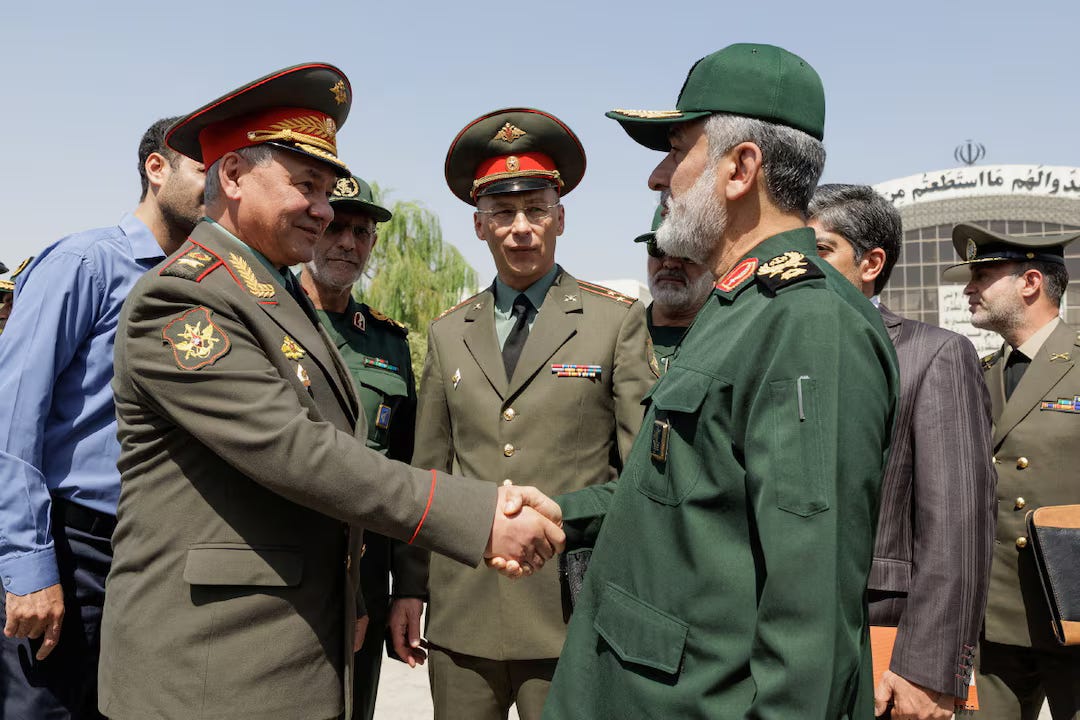
The planning began in earnest in January 2015, when Ali Akbar Velayati, Khamenei’s foreign policy adviser, traveled to Moscow carrying a letter from the Supreme Leader and met with Putin and Defense Minister Sergei Shoigu. Qassem Soleimani flew to Moscow in July 2015. By the time Russian jets flew their first sorties on September 30 of that year, the operational structure was already standing: IRGC combat detachments, Syrian intelligence, Hezbollah liaison elements, and officers of the Quds Force had been embedded at the Russian command post at Hmeimim Air Base. Iran appointed former Defense Minister Ali Shamkhani to a newly created position whose sole function was coordinating policy with Russia on the military campaign. Soleimani remained the main point of contact until his assassination in January 2020. The two states ran the war the way a joint venture runs a factory: Russia held the air, Iran held the ground, and the coordination center in Baghdad, staffed by Iran, Iraq, Syria, and Russia, managed the deconfliction.
What the deconfliction managed was not a counter-terrorism campaign. Monitoring data established within two weeks of operations that over 80 percent of Russian airstrikes targeted opposition militias rather than the Islamic State. The institutional claim of an anti-ISIS operation was the announcement; the Sunni Arab political community that had rejected Assad’s governance was the target. By April 2018, Russian airstrikes had killed over 7,700 Syrian civilians, approximately a quarter of them children, according to the Syrian Network for Human Rights. The pattern in Aleppo, where Russian Tu-22 long-range bombers and Su-25 fighters flew support for the Iranian ground assault in 2016 under what IRGC commanders called Operation Dawn of Victory, was the same pattern the Soviet Union had run in Afghanistan and the Russian Federation had run in Chechnya: use air power to make the population’s continued habitation of contested territory untenable, allow the ground force to consolidate, and call whatever remains a liberated city.
Up to 3,000 IRGC-Quds Force officers were involved in planning and executing the Aleppo campaign. Hezbollah deployed up to 8,000 fighters across Syria and arrived with considerably expanded rocket arsenals that it had no reason to leave behind when the campaign ended. The Fatemiyoun Brigade, composed of Afghan refugees recruited from inside Iran and paid by the IRGC, lost over 350 fighters in Syria. The Zainabiyoun Brigade, recruited from Pakistani Shia, lost at least 21. They were paid salaries by the Iranian military, wore IRGC uniforms, and received state funerals with uniformed Guards in attendance. Tehran sometimes denied their existence. The funerals were public.
Iran’s presence at T-4 Airbase in eastern Homs became a documented node of Russia-Iran logistics, with Iranian cargo aircraft linked to Mahan Air, a carrier sanctioned by the United States for transferring fighters and weapons for the IRGC-Quds Force, landing at Hmeimim itself as late as 2023. When Putin held his year-end press conference following Assad’s fall in December 2024, he disclosed that Tehran had asked Moscow to facilitate the evacuation of its forces from Syria using Hmeimim. Russia flew 4,000 pro-Iranian fighters out of the country, relocating some to Lebanon and Iraq. The partnership that had sustained the Assad regime for nine years ended in the same bureaucratic register in which it had been built: a request, a coordination, a flight manifest.
What Russia and Iran suppressed in Syria was not terrorism. It was an organized civilian population that had refused to accept governance it had not chosen. The two states named that refusal extremism and built the institutional apparatus to destroy it. The archive of their coordination is public: the Hmeimim command post, the Baghdad intelligence center, the Shamkhani appointment, the Soleimani flight to Moscow. None of this required a leak. The states involved announced enough of it themselves. What required concealment was the category of people being killed, and the information architecture they built was adequate to that task.
The Managed Provinces: Central Asia
The mechanism is consistent across Uzbekistan, Tajikistan, and Kazakhstan: a state-licensed clergy authorized to register mosques, appoint imams, and dictate the content of Friday sermons; and a legal category, “Wahhabi,” that functions not as a theological designation but as a criminal one. In Uzbekistan, Human Rights Watch documented the arrest, torture, and imprisonment of an estimated 7,000 people in the campaign against independent Islamic practice that the Karimov government ran through the late 1990s and 2000s. The majority of those arrested were Hanafi Sunnis, the dominant traditional school in Central Asia, who had committed no act of violence. Some were imprisoned for praying five times daily, which local authorities treated as evidence of suspicious piety. Others were jailed for wearing a beard. The criminal code prescribed up to five years for membership in an unregistered religious group and up to twenty years for participation in groups designated extremist, a designation applied to any theological current the state had not licensed. The people imprisoned were not Wahhabis; the label was a mechanism of exclusion, not a description.
Tajikistan ran the same system and extended it further. Thirteen thousand men were forcibly shaved by police as part of a state secularism campaign. One hundred and sixty Islamic clothing stores were shuttered. The parliament banned Arabic-language names. The Islamic Renaissance Party of Tajikistan, a moderate democratic Islamist organization that had participated in the 1990s peace process and held seats in parliament, was designated a terrorist organization in 2015. Every institutional expression of political Islam, however moderate, was erased from the legal landscape. What remained was the state mosque, the state imam, the state sermon. Authorities in Tajikistan and Uzbekistan, as a March 2026 analysis documented, now operate what amounts to a secularist militancy, dictating beard length, sermon content, and children’s names, deploying modern surveillance to enforce the compliance the Spiritual Directorates once enforced through informant networks.
The label applied to this system is secularism. The practice is state monopoly on religion: Islam is permitted in the form the government administers and prohibited in any form it does not. The vocabulary is inherited directly from Catherine’s 1788 Religious Council in Ufa; the technology is newer and the doctrine is unchanged.
Russia’s relationship to this architecture is not passive. The Central Asian states remain within Moscow’s security orbit through the Collective Security Treaty Organization and economic dependency through the Eurasian Economic Union. Russia is their model, their guarantor, and their precedent. When Moscow prosecutes Muslims in Tatarstan or Dagestan for “extremism,” a designation applied to nonviolent Hizb ut-Tahrir membership, it produces the case law and institutional logic the Central Asian states invoke. When RT Arabic publishes features on Russian Muslim soldiers’ loyalty to the state, the message to the seventy million Muslims within Russia’s Central Asian sphere is that licensed Islam is the path to recognition and unlicensed Islam is the path to prison. The Kremlin has moved to formalize Islamic economic integration through a Federal Law on Islamic Banking, now in pilot phase across four Muslim-majority Russian republics. The management model has been updated to include financial inclusion alongside surveillance. The monopoly is intact.
The imam Abduvali Mirzaev of Andijon was among the most respected independent religious figures in Uzbekistan when he disappeared in 1995. He has not been seen since. His disappearance did not produce Security Council resolutions. The Uzbek state offered no account. The question of where he is remains open: not as a rhetorical device, but because the fact that it is genuinely unanswered and treated as unremarkable tells the observer which disappearances get counted.
The Ideology That Wears Islam
Understanding why Russia and Iran fit together requires understanding what kind of state the Islamic Republic actually is, which is not the state its name describes.
The 1979 Iranian revolution was not a purely Islamic political event. It was the product of a broad coalition in which Marxist urban guerrillas, Third Worldist intellectuals, pro-Soviet Tudeh party cadres, and liberal nationalists all contributed to the overthrow of the Shah under the organizational and symbolic canopy Khomeini provided. Ali Shariati, whose ideas shaped a generation of Iranian leftists and were indistinguishable, in some formulations, from Frantz Fanon applied to Shia theology, had spent years at the Sorbonne absorbing French Marxism and existentialism before fusing them with his reading of Imam Hussein. His audience did not experience this as a departure from Islam. They experienced it as the most politically alive version of Islam they had encountered.
Khomeini understood that Shariati’s framework could be operationalized, and he borrowed the organizational logic without crediting the source. The velayat-e faqih, the doctrine that a supreme religious jurist should govern on behalf of the Hidden Imam, is an innovation with no solid precedent in classical Shia jurisprudence. Traditional Shia legal opinion held that offensive jihad was suspended until the Imam’s return and that the clerical role was one of guidance rather than governance. What Khomeini built was not a recovery of classical Islamic governance. It was a Leninist vanguard party structure given Islamic framing: a small ideological elite, claiming to understand the interests of the masses better than the masses themselves, governing in the name of a divine authority that could not be questioned because it could not be verified. One scholar of the Leiden documents described the model as “built largely upon the pre-existing model of the Bolshevist revolution,” sharing its fundamental distrust of popular self-governance. The leftist groups that had helped overthrow the Shah recognized the architecture too late. Khomeini then purged them.
The IRGC was the instrument of this consolidation. Established in May 1979, it was built from the networks of Khomeinist militiamen, many with pre-revolutionary training alongside Palestinian militants in Lebanon, and given a constitutional mandate that had no equivalent in any classical Islamic political theory: to protect not Iran’s territory but the Revolution itself. Its constitution mandates extending the sovereignty of God’s law throughout the world, which translates operationally into using Iranian state resources to suppress Sunni political movements across the region, arm Shia proxy militias whose operational loyalties run to Tehran rather than to the communities they nominally defend, and generate intelligence and propaganda assets, including the Fars and Tasnim news agencies, that export IRGC ideological framing to Muslim audiences worldwide.
The IRGC’s ideological training program explicitly incorporates the claim that Wahhabism and Salafism, the dominant theological frameworks of Sunni reformism, are inventions of British colonialism designed to destroy Islam from within. This is not a fringe position within the Guard. It is curriculum. It is taught at Imam Hossein University, the IRGC’s primary academic institution. The effect of this teaching, replicated across proxy networks from Hezbollah to the Houthi movement, is to frame Sunni theological identity itself as an enemy of authentic Islam. Moscow has run the same logic through a different institutional channel: in Russian-aligned Central Asian dictatorships, the term “Wahhabi” functions as a legal designation for any unsanctioned Sunni religious activity, allowing any practicing Muslim who operates outside state-licensed structures to be prosecuted as an extremist. The terminology is different. The governing logic is identical.
What the Republic Does to Its Own Muslims
Iran’s Sunni population, estimated between eight and ten million people, is drawn primarily from the Baloch of Sistan-Baluchestan, the Kurds of Kurdistan and Kermanshah, and the Turkmen of the northeast. They are Sunni and they are non-Persian, which means they occupy the intersection of two categories the Islamic Republic has treated throughout its existence as security threats. Iranian law requires allegiance to the Shia principle of velayat-e faqih as a condition of holding most government positions, a requirement that by definition excludes Sunnis from civic life as a matter of constitutional structure. The Baloch, who are neither Persian nor Shia, cannot hold most political office, cannot teach their language in public schools, and cannot build mosques without confronting a state that has razed the ones they have. When Hengaw, the Kurdish human rights organization, documented at least 142 Baloch executions in Iranian prisons in 2025, more than a third of those executed were below the age of 25. During the 2022 protests that followed Mahsa Amini’s death in state custody, 163 of the 378 people killed by security forces were in Sistan-Baluchestan and Kurdistan provinces. The mostly-Sunni city of Zahedan, already among the country’s poorest, saw at least 66 residents killed in a single day.
A Sunni Baluchi cleric named Molana Abdolaziz Mollazadeh rose in the 1979 Assembly of Experts that drafted the new constitution and objected to declaring Shia Islam the official state religion. A Sunni Baluchi lawyer named Hamidollah Mir Morad-Zehi, thirty years old, objected in the same assembly to enshrining velayat-e faqih in the constitutional text. Both were overruled. Both knew what was coming. What came was four decades of systemic exclusion, disproportionate execution, language suppression, mosque destruction, and the framing of any Sunni who objected as an agent of foreign infiltration.
Within Iran, the trajectory of the Republic’s own population toward its religion is the final piece of evidence the IRGC’s propaganda operation needs its external audience not to examine. Growing numbers of Iranians are rejecting not just the Islamic Republic as a government but the version of Islam it has imposed. Protesters in 2018 chanted “Death to velayat-e faqih” and “Our enemy is here, they lie when they say it is America.” Friday prayer offices, the regime’s ideological outposts, were set on fire across eighty cities. A theocracy that has governed in God’s name for four decades has produced a population that is leaving the state-sanctioned faith faster than any country in the Muslim world. This is not apostasy in the classical sense. It is the refusal of a people to continue performing a religion that has been used to justify their subjugation, execute their neighbors, and suppress their languages.
The Islamic Republic did not protect Islamic civilization. It weaponized one version of it against all others, including the majority Sunni tradition that constitutes most of the Muslim world, and then deployed that weapon in alliance with the state that has spent the longest historical time destroying Muslim institutional life anywhere on earth.
The Propaganda System and Its Mechanism
What allows this arrangement to function in Muslim public opinion is not fabrication. It is selective architecture: a structure that presents every verifiable Western crime and omits every Russian and Iranian one, building a ledger whose entries are accurate and whose omissions are the argument.
The infrastructure is substantial. Iran was estimated a decade ago to be spending $1.6 billion annually on propaganda directed primarily at Arab publics, distributed through the Islamic Republic of Iran Broadcasting network across eight international television channels and radio programming in 32 languages, alongside news agencies including IRNA, Fars, and Tasnim. Tehran tripled IRIB’s annual budget for 2025, reaching $480 million, the largest single-year increase in the organization’s history. Russia built RT Arabic in 2007, and by 2015 it had surpassed BBC Arabic, Sky News Arabia, and Al-Hurra in daily viewership across Egypt, Morocco, Saudi Arabia, Jordan, the UAE, and Iraq. Sputnik Arabic runs parallel. Several national news agencies in the Arab world have signed content-sharing agreements with these Russian outlets, which means RT’s framing enters domestic media without a Russian byline. The circuit runs from IRGC-affiliated Fars News to Press TV to RT Arabic to regional aggregators. A claim produced in Tehran appears in Cairo newspapers without a Tehran dateline.
The reason the system works is not technical sophistication. An Egyptian media expert cited in Deutsche Welle’s Arabic service described it plainly: the audience is “more susceptible and obedient to Russian counter-propaganda” because of pre-existing grievance against Western media bias, without this meaning the propaganda itself is good or effective. The infrastructure does not need to be persuasive. It needs to be available, and the grievance needs to be real. Both conditions are met.
The operation does not require its audience to believe Russia and Iran are virtuous. It requires only that they be held to a different standard of scrutiny than Washington, and that anti-imperialism be defined in a way that excludes Russian and Iranian conduct from the definition. The mechanism is the substitution: the real enemy is always the one these two states are also fighting. When the Russian state wanted to discredit the 2022 protests following Mahsa Amini’s death, RT ran the Iranian government’s “foreign-backed riots” line without qualification. When the UN Security Council convened on the protests, Russia’s Permanent Representative described them as a colour revolution engineered from outside. The claim was false. The point was that the framing placed Iranian state violence in the category of sovereignty defense, where it could not be evaluated on its own terms.
The Atlantic Council’s analysis of RT Arabic and Sputnik Arabic identified a coordinated operation targeting Muslim audiences through Islamic signifiers: Russian diplomatic missions sharing images of generals reading the Quran during visits to Algeria, six coordinated accounts publishing the same photo within two hours, embassies producing content keyed to Quran-burning incidents in Sweden. The signal being transmitted was not theological. It was civilizational: Russia stands with Muslims against the West, and the evidence is a general with a Quran. The Chechens deported in 1944 do not appear in this signal. The Grozny siege does not appear. The mosques closed from 26,000 to under a thousand between 1917 and 1941 do not appear. The Zahedan massacre does not appear. The 142 Baloch executions in 2025 do not appear.
The Aleppo bombing does not appear, and this requires noting: the populations whose displacement the operation manages are also its primary audience. Syrian refugees in Lebanon and Jordan, consuming Arabic-language media on phones, received an information environment in which their own displacement was framed as a counter-terrorism success and the forces that bombed their neighborhoods were presented as the only honest critics of Western imperialism. The system does not only obscure the crime; it recruits the victim into the framing that produced it. The Iranian left made this error in 1979, reading Khomeini’s anti-imperialism as their own, and discovered the difference when the arrests began. What was a domestic political miscalculation in Tehran is now an operation running at continental scale, and the correction, when it comes, will not arrive through a press conference.
The Architecture of the Arrangement
Russia manages the Muslim populations on its own territory and along its historical frontiers: the 15 to 20 million Muslims of Tatarstan, Bashkortostan, Chechnya, Dagestan and the other republics of the North Caucasus, and the 70 million Muslims of the five Central Asian states that remain within Moscow’s sphere of economic and military dependency. The management tools are the same ones Catherine built and the Soviets industrialized: licensed religious authority, surveillance of unlicensed practice, deployment of the “extremism” label against any theological position that has not been approved by state-affiliated clerics. Moscow now has four official mosques for four million Muslims in its capital. It has built a thousand mosques in Chechnya, not as religious provision but as political infrastructure sustaining Ramzan Kadyrov’s order, which is a securitized theocracy that serves the Kremlin.
Iran manages the sectarian fragmentation of the Sunni-majority Muslim world, the work Russia cannot do directly. The IRGC’s proxy network, built across four decades through Hezbollah, the Iraqi Popular Mobilization Forces, the Houthis, and the various Afghan and Pakistani Shia militias recruited for the Syrian campaign, has achieved one consistent political result in every theater it has entered: the destruction of Sunni Arab political capacity. In Iraq, the post-Saddam Sunni political community was systematically dismantled by Iranian-backed militias in the decade following 2003, producing the conditions of dispossession from which ISIS recruited. In Syria, the Quds Force and Hezbollah held the Assad regime together while it barrel-bombed Sunni civilian neighborhoods, long enough for Russia to arrive with the airpower that finished the campaign. In Lebanon, Hezbollah’s arms and institutional dominance have paralyzed the Lebanese state for a generation and stripped the Sunni political class of the capacity to govern. In Yemen, the Houthis have turned a political crisis into a catastrophic war whose costs fall overwhelmingly on communities outside the Houthi tribal coalition.
The January 2025 Comprehensive Strategic Partnership Treaty between Russia and Iran, twenty years and forty-seven provisions, institutionalized what this division of labor had already established. Russian Deputy Foreign Minister Andrei Rudenko’s clarification to the State Duma in April 2025 was the honest statement of what the treaty actually is: not a mutual defense pact, not a security guarantee. Iran receives diplomatic shielding, weapons technology and economic lifelines. Russia receives a functional proxy network managing the region that represents its most persistent strategic anxiety. When US and Israeli strikes began degrading Iranian military and nuclear capacity from June 2025, Russia did not invoke the partnership. It condemned. It vetoed. It watched.
Tehran understood. The assumption had been that the relationship had moved beyond transaction. Moscow’s clarification corrected this. The relationship has always been transactional, was built on transaction, and will endure precisely as long as Iran can perform its function.
The Flaw in the Lens
The Muslim world’s engagement with this arrangement requires a clarity it has not consistently applied. The grievance against Washington is legitimate and documented. It has backed Israel through the documented massacre of Palestinian civilians. It toppled Mossadegh in 1953 and reinstalled a dictator. It invaded Iraq on fabricated evidence and destroyed a state that has not recovered. Washington has armed Gulf monarchies that export Wahhabi ideology abroad while suppressing political dissent at home. Every element of this indictment is verifiable and has been verified.
What the argument requires from its Muslim audience is that only this indictment exists: that the ledger of crimes against Muslim peoples is a Western ledger, not a Russian one, and not an Iranian one. The Kokand massacre of 1918, in which Red Army forces killed up to 25,000 people while announcing the liberation of Muslim workers, does not appear in this ledger. The deportation of the Chechens in 1944 does not appear. The mosques closed from 26,000 to fewer than 1,000 between 1917 and 1941 do not appear. The cluster bombs over Aleppo’s civilian markets in October 2016 do not appear. The ninety worshippers killed in Zahedan during Friday prayers do not appear. The 142 Baloch executions in 2025 do not appear.
The operation does not require its audience to believe Russia and Iran are virtuous. It requires only that Russia and Iran be held to a different standard of scrutiny than Washington, and that anti-imperialism be defined in a way that excludes Russian and Iranian conduct from the definition. The Iranian left of the 1970s made this exact error. The Tudeh party, pro-Soviet and internally disciplined, supported Khomeini because they read his “Great Satan” rhetoric as anti-imperialism in Islamic dress. The leftists who carried his movement into power translated his language into their own political vocabulary and did not examine whether the state being built would serve Muslim liberation or suppress it. Khomeini then arrested them, executed many, and drove the rest into exile. The substitution is not a new phenomenon. It was the original error of the revolution that built the Islamic Republic.
In the Muslim world today, Russia’s multipolar narrative performs the same substitution. Moscow positions itself as the counter-pole against Western hegemony, the sponsor of sovereignty, the opponent of Zionist aggression, the reliable voice in the Security Council vetoing resolutions that would expose the consequences of its own operations. The Muslim audiences receiving this message are not being deceived about Washington. They are being asked not to notice that the state presenting itself as their advocate carries one of the highest documented tolls of Muslim civilian deaths of any power in the twenty-first century, and that its primary regional partner has built a constitutional system that treats Sunni religious identity as a security threat.
What the Record Requires
Molana Abdolhamid stood at the Jameh Mosque of Makki in Zahedan on September 30, 2022, and called what had happened outside its gates a massacre. He named it. He used the word. He said the Islamic Republic had told “absolute lies” about its own worshippers. His testimony has been on record for years and available to anyone who wished to examine it. The reason it has not been examined, in the circles where the Islamic Republic is discussed as a resistance power, is that examining it requires a consistency of moral accounting the resistance framework cannot survive.
The Russian record does not require excavation. It is continuous from Ivan IV’s destruction of the Kazan Khanate through the Chechen deportations of 1944 to the Grozny sieges and then Syria, where the targeting data established within the first two weeks of operations what the official mission statement denied. The security doctrine exported to Central Asian client states produced the conditions from which radicalization recruited, and Moscow’s benefit from their application of it has never been ambiguous.
Iran’s record with Sunni Muslims is not a secondary concern to be weighed against the achievement of confronting American hegemony. Sunnis banned from building mosques in the capital. Constitutional allegiance to Shia jurisprudence as the price of civic participation. Execution rates falling disproportionately on Baloch and Kurdish communities. An IRGC ideology curriculum designating Sunni reformism as a colonial fabrication designed to destroy Islam from within. This is the primary evidence for what kind of state is governing and what it is doing to the tradition it claims to embody.
The political theology that animates the IRGC is not classical Islam given new institutional form. It is a Leninist organizational structure dressed in Shia eschatology, governing exactly as that structure governs: through a vanguard claiming divine mandate, suppressing the autonomous religious life it cannot control, deploying the language of liberation to manage the populations whose subordination it requires. A state that had derived its legitimacy from genuine Islamic governance would not need to ban Sunni mosques in its capital or execute worshippers leaving Friday prayers.
The arrangement between Russia and Iran is not an axis of resistance. It is a division of labor for managing Muslim political life across two hemispheres, each partner covering the geography the other cannot directly reach, each providing the institutional and ideological cover the management requires. Together they have constructed, over decades and across a continuous geography from Chechnya to Zahedan to Aleppo to the Fergana Valley, the most sustained dual system for the suppression of autonomous Muslim political and religious life in the modern world. The grievance against Washington is legitimate and documented. Against Israel, against the long history of Western intervention in Muslim lands: documented. None of it changes what is in the archive of the two states presenting themselves as the alternative, and the political project that depends on that archive remaining unread is not a project of Muslim liberation. It is the administration of Muslim subordination through the language of resistance, which is the oldest technique in the imperial handbook, and the one that has always worked best.
The Baloch cleric Abdulghani Biyarjomandi described his community’s position inside the Islamic Republic in a sentence that applies with equal precision to the Chechen deported in 1944, the Uzbek Hanafi jailed for praying five times a day, the Tajik whose name was struck from the birth register, and the Syrian whose neighborhood was designated a counter-terrorism target: “We are the Muslims of the margins.” The margins are not an accident of geography. They are the administered destination for any Islamic life these two states have not licensed, and the people consigned to them have been consigned with consistency, across centuries, by the two powers now standing before the Muslim world as its defenders.


